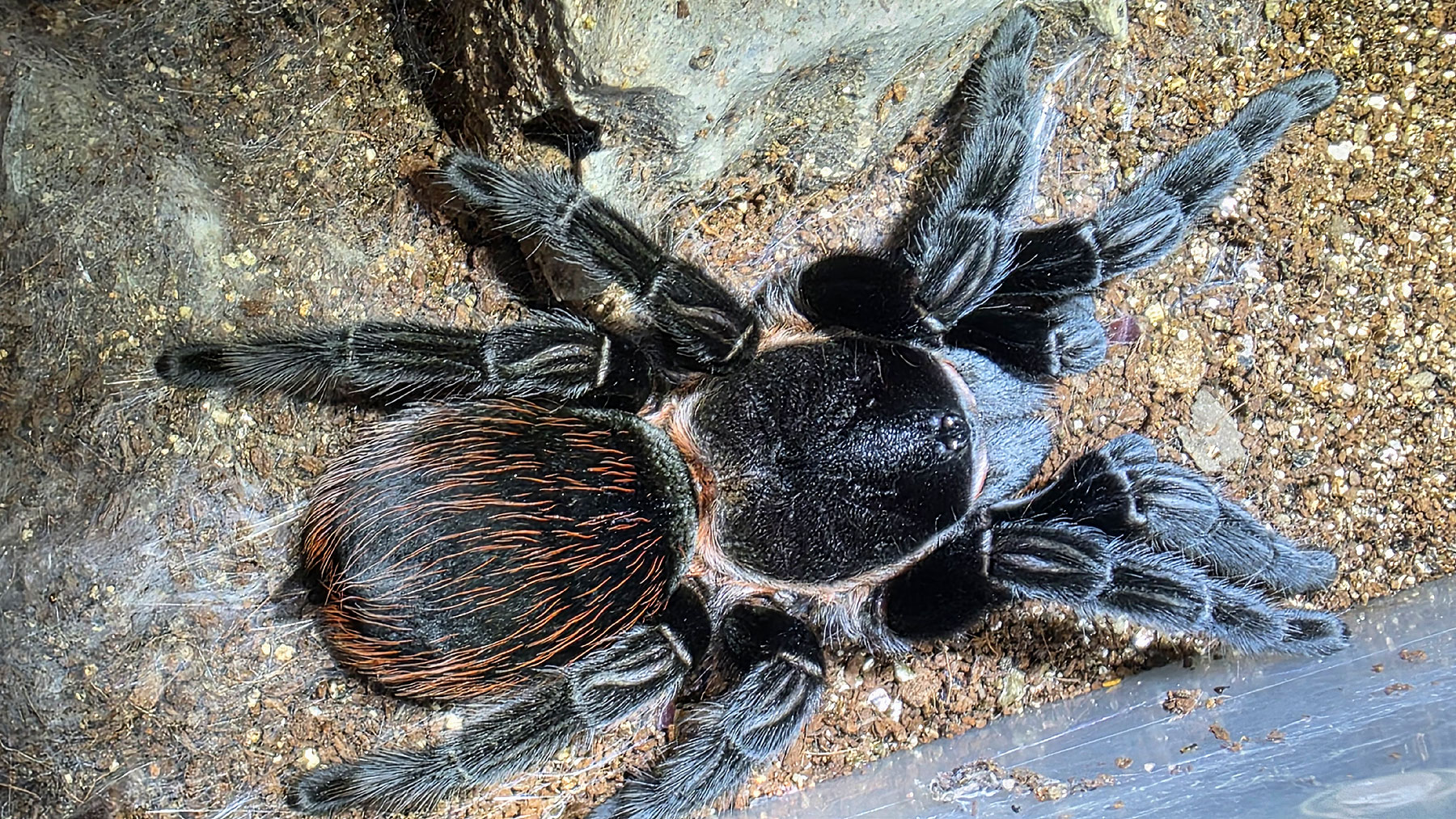
| Scientific Name | Tliltocatl vagans |
| Common Name | Mexican Redrump or Mexican Black Velvet |
| Countries of origin | Mexico, Guatemala, and Belize (and Florida, US) |
| Arboreal/Terrestrial/Fossorial | Fossorial |
| Max Size | 6.5″ or 16.5 cm |
INTRODUCTION
When I first got into tarantula keeping, the “Mexican Redrump” had the scientific name Brachypelma vagans and was quite popular and readily available, with wild-caught specimens being imported from Mexico for the pet trade for decades. However, as of March of 2023, CITES implemented stricter regulations on the exportation of Mexican tarantula species. Captive breeding projects in Mexico now produce slings specifically for the pet trade in order to eliminate the collection of wild-caught specimens. As a result, spiderlings are now offered more periodically and are often more expensive.
Although the T. vagans was once considered to be a good “beginner tarantula”, over the last several years, they’ve earned a reputation for being defensive and difficult. Some of the ridiculous words I’ve heard to describe them are aggressive, demonic, dangerous, and evil. Sadly, this species’ recent infamy is a byproduct of click-bait driven YouTube videos by unscrupulous content creators trying to capitalize on rampant arachnophobia to get a couple extra views. That said, this species has always been recognized as being a bit more skittish and lively than the average Mexican New World tarantula species.
A brief history of this species to help us understand its reputation. When most folks hear the name “Brachypelma” they think of slow-growing, docile species like the Brachypelma smithi, Brachypelma hamorii, and Brachypelma emila. These species have long enjoyed a reputation for being particularly good beginner tarantulas due to their ease of care and calm temperaments as adults.
The T. vagans was originally known as Brachypelma vagans, and that may be where their reputation as “aggressive” and unruly spiders originated. The genus Brachypelma had become synonymous with “beginner species.” Folks expecting a spider that was as calm and possibly tractable as its genus cousins were often surprised by a much more skittish, high-strung spider not afraid of kicking hairs or bolting when disturbed. This species also has an amazing feeding response, and it’s quite possible that folks prodding their spider for a possible handling session, or performing maintenance, were surprised by a sudden flash of fangs. Over the years, I’ve heard a handful of folks say that their Mexican redrumps will attack anything that enters their enclosure. It’s definitely feasible that a keeper expecting a calm, sedentary Brachypelma species might be intimidated by a spider quick to bolt, kick hairs, or threat posture. Suddenly, you have keepers sharing these experiences, and the T. vagans’ reputation as a “dangerous” and “aggressive” spider is born.
In my years of keeping, I’ve discovered for many species with bad reputations, their defensive behavior isn’t the result of a mean animal. Instead, it’s what happens when they are not kept correctly and become stressed. At the risk of anthropomorphizing, I like to point out that tarantulas that are constantly defensive are often insecure with their surroundings or “scared.” They are not lashing out, threat-posturing, or hair kicking because they want to hurt you; they are trying to defend themselves from what they perceive as a large predator.
In the case of the T. vagans, keepers set them up as terrestrials for years, giving them shallow enclosures that offered only a couple of inches of substrate and a hide. Although this type of enclosure might work for a more docile B. smithi, it is not appropriate for the T. vagans. In nature, this species is fossorial, adopting or excavating its own burrow and surfacing at night to hunt. When this spider is not given the space to burrow and create a secure hide for itself, leaving it exposed, it has the potential to become more reactive and defensive.
Now, in all of my videos, I usually put the disclaimer “temperament may vary from specimen to specimen.” Sure, mine may not give me threat postures or act particularly defensive, but that does not mean that others don’t have more feisty specimens. Are some folks still receiving threat displays despite giving them proper enclosures and set ups? I’m sure. However, after speaking with many folks over the years who keep the T. vagans, a couple points become quite clear:
First, this type of behavior is the exception and not the rule. Sure, most report that theirs are fairly quick and skittish, but they will usually run an hide before standing their ground. Others, myself included, report specimens that sit calmly out in the open without any defensive reactions at all.
Second, most who keep this species don’t find this type of behavior all that threatening or unmanageable. Sure, someone completely new to keeping tarantulas might find a large, skittish spider a bit intimidating, but anyone with a bit of experience should have no issue keeping one. Plus, as this is a hardy, faster-growing species, it would make it an excellent contender for a good first sling. Someone growing the T. vagans up from a spiderling would have time to “grow” with the spider.
FUN FACT:
This species is endemic to Mexico, Guatemala, and Belize. There are also established populations in the state of Florida in the US.This species was introduced in parts of Florida, and has thrived there due to similar environmental conditions. Although no one is quite sure how they were introduced, some have speculated that specimens from the pet trade were released into the wild. Also unknown is exactly when these spiders were first introduced, with the first wild specimens being discovered in St. Lucie County, Florida, by citrus grove workers. Considering their growth rate, it has been hypothesized that the first specimens had to have been introduced in the mid 80s.
SPIDERLING CARE
Although T. vagans slings start off quite tiny, they tend to be hardy and fairly fast-growing. For really tiny slings under 1/2 of an inch (1/27 cm), I find that dram vials work very well. Just be sure that there are ventilation holes in the top. Dram vials can be purchased in a number of convenient sizes, usually in packages of 10 or more, and they are quite inexpensive. People who have been ordering slings online for a while will also accumulate shipping vials that they can clean out and use for sling homes.
Other suitable enclosures are Amac Boxes, which can be altered to become excellent sling enclosures. When I first got started in the hobby, I raised dozens of slings in this type of enclosure. The model I recommend for slings measures 2 5/16×2 5/15×4 3/16” (6.4 x 6.4 x 11 cm).
For keepers looking to spend a bit more for a more aesthetically pleasing enclosure, another option is acrylic sling enclosures, like the Sling Cribs produced by Tarantula Cribs and other companies. These measure 2x2x3” (5x5x7.6 cm) and feature great cross and top ventilation and magnetic tops. Do keep in mind that with well-ventilated enclosures, you’ll need to be extra diligent to ensure that the substrate doesn’t dry out too quickly.
As this is a burrowing species, you’ll want to give your sling enough substrate to burrow while not providing so much that it gets lost in the enclosure. An inch (2.5 cm) is a great depth to begin with when raising super tiny slings. I usually start by packing in moist substrate on the bottom with a thin layer of dry on the top. For my fossorial species, I will use the back of a thin paintbrush to make a starter burrow between the dirt and the side of the enclosure. Many slings will be drawn to the moist substrate below and will use this area to begin their burrows. I also like to include a sprig of New Zealand sphagnum moss, which not only serves as cover for the spider, but it can be moistened to give the spider a place from which to drink.
Speaking of moisture, you’ll want to make sure that the spider has access to moist substrate at all times. It’s important to note that the substrate doesn’t need to be damp throughout. I like to keep the bottom layers moist and let the surface dry out. This not only helps prevent mold growth but also allows the tarantula to burrow down to the moisture level it needs. This is why do NOT recommend misting with slings. When you mist an enclosure, you are only soaking down the surface of the substrate. In a properly ventilated container, this moisture will evaporate rapidly, leaving the substrate dry.
For older slings that are 1” (2.5cm) or larger in legspan, I like to recommend 16-24 oz deli cups. After the 1” mark, this species tends to put on size fairly quickly, so you want to supply it with a container that isn’t so large that it’s swimming in it, but also one that gives it some room to grow. I furnish the enclosure with a couple inches of substrate, New Zealand sphagnum moss, and a cork bark hide with a starter burrow beneath it. As this type of enclosure would offer more room, I also like to add a water dish, usually in the form of a plastic water bottle cap.
To moisten the substrate in sling enclosures, there are a few options. Some folks like to use syringes to squirt the water down the side of the dirt and into the bottom layers. This makes it easier to keep the water from pooling on the top and not reaching the bottom layers. Pipettes will also work the same way; I used those for years, and they worked great for me. Today, I use a squeezable bottle with a nozzle tip, like the ones tattoo artists use. These are nice because they hold more liquid while still allowing you to direct the water where you want it to go.
Many folks will ask how often they should be adding water to their enclosures. Honestly, it all depends on many factors, including temperature and ambient humidity. In the wintertime, when the heat is on and the air is much drier, I tend to check my sling enclosures twice a week, adding a bit of moisture each time. In the summer, when it is warmer but often more humid, I usually get away with adding water once a week or so.
FEEDING:
First, let’s get this out of the way. There is no “perfect” or “correct” schedule when it comes to feeding tarantulas. I’ve changed my feeding schedules many times over the years, and no matter how often I fed, my spiders did just fine. Slings are much more fragile than their juvenile and adult counterparts, and more keepers report sudden and mysterious deaths in their babies than with their older specimens. Some of this can be attributed to the fact that they are more prone to dehydration, as they lack a fully formed, waxy coating on their exoskeleton that helps to prevent dehydration. As a result, many of us try to get our spiders out of the sling stage as quickly as possible.
These days, I feed my slings twice a week. There are a couple of reasons for this more aggressive feeding schedule. First, when I feed, I also check on the spiderling and ensure that it has the moisture level that it needs. Sling enclosures can dry out quickly, so diligence is necessary to ensure that they maintain some moisture. Second, I’m trying to get my spiderlings to grow more rapidly to get them out of the sling stage.
As for what to feed slings, there are a few options. For super tiny slings under 1/2 “ (1.3 cm), some folks use flightless fruit flies. The nice thing about these is that they reproduce readily and are small enough for the tiniest slings to eat. The bad news? They can be somewhat of a hassle to deal with. If you decide to use flightless fruit flies, a trick that I use is to tap a few out into a glass container, put a piece of foil over the top, then put them into the refrigerator until they stop moving. Then, you can simply shake a couple into the enclosure without having to worry about them escaping. Once they warm back up, they will begin moving again, which should stimulate the sling’s hunting response.
However, an easier option for tiny slings is to let them scavenge feed. All slings will feed off of previously killed prey, which is a heck of a lot easier than messing with fruit flies. If you choose this option, there are a few different ways to go about it. First, you can use “cricket drumsticks”, which means cricket legs. If you have larger specimens that are eating crickets, you can grab the insects by the thigh, which will cause them to detach the leg. Then, you simply drop the leg in with the sling so that it can feast on the thigh meat. For those using mealworms to feed their spiders, you can prekill the worm by crushing its head before cutting it into segments. Just drop a segment in with the sling before bed, and it can surface to feed off it. Using roaches? No problem! I will often pre-kill and even cut up small roaches and drop the pieces in.
Keep in mind that tiny slings can easily fill up after a larger pre-killed meal. If they feed a couple of times and then stop accepting food, they are likely in premolt. This is completely normal. Just understand that it can take several weeks for the sling to molt.
JUVENILES
“Juvenile” is a subjective term when it comes to tarantulas, as different species may be juveniles at different sizes. A juvenile Theraphosa is going to be MUCH larger than a juvenile H. formosus. And, as different species grow at different paces, you really can’t narrow it down to an age either.
I consider a spider to be in the juvenile stage when it begins showing its adult coloration. For the T. vagans, this is usually when the spider hits 1.5 to 2” (3.8-5cm). Once they reach this size, you may be looking to rehouse your spider into something with more room. In my experience, juveniles continue to burrow, so you want to provide something that allows for a few inches of substrate for digging. There are a couple options for this.
For my juveniles, I like to use plastic storage containers sold on Amazon. These containers measure 10.75 x 6.5 x 6.1” (27 x 16.5 x 16 cm) and offer a clear view and room for a few inches of substrate. Note that the hinged covers do not latch, so you’ll either have to attach an acrylic hasp or find another way to keep the lids down. A Repti/Barbarous Growth enclosure would also work. I would use the 12 x 7 x 9” (30.5 x 18 x 23 cm) model. They are crystal clear, relatively inexpensive, well ventilated, and offer plenty of room for dirt. These enclosures are also stackable, which can be very convenient.
Someone looking for something a bit nicer and more expensive might also consider a Tarantula Cribs enclosure, like the Large Slider Crip Pro. These enclosures measure 12 x 8 x 8” (32 x 20.3 x 20.3 cm), and feature sliding tops with magnetic latches. They are well ventilated and stackable.
For a setup, I recommend including 3-4” (7.6 – 10 cm) of substrate, mostly moist with a layer of dry on the top. I would also include a cork bark hide (or two!) with starter burrows beneath them. These days, I usually add some sphagnum moss around the cork and sprinkle in some leaf litter for aesthetic purposes. And, I always include a water dish. For smaller juveniles, I use the lids from Kombucha bottles. For larger ones, 2 oz mini deli cups work great.
FEEDING:
As mentioned earlier, the T. vagans has a reputation for being a great eater, and mine were no exception. Specimens that are 2” (5 cm) or larger will hunt and take down medium crickets or Red Runner roaches with no issues. Meal worms can also be used, but it advise crushing their heads first so that they don’t burrow before the spider can find them. Larger specimens can be fed a large cricket, adult B. lateralis roach, or medium B. dubia roach. Again, always crush the heads on B. dubia before dropping them in to prevent them from playing dead or burrowing.
The frequency of feedings is entirely up to the keeper. Back when I first got my two T. vagans, I would feed my juveniles small meals once or twice a week. Nowadays, I feed mine a larger meal every two weeks or so.
ADULTS
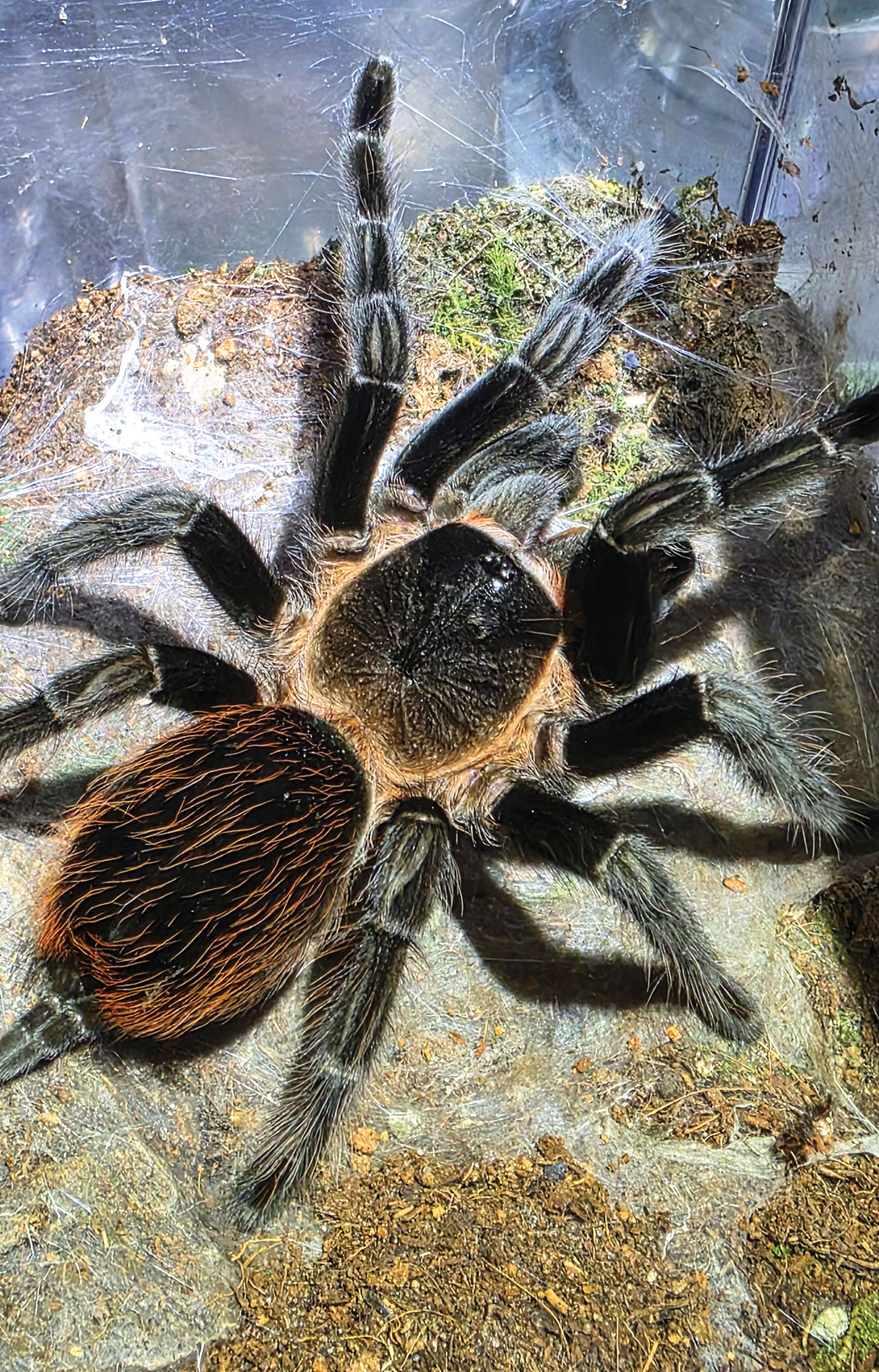
Once your tarantula reaches around 4” (10 cm) or so, it is a young adult. At this point, it’s time to think about what you will put it in for its final enclosure. Once again, you are going to want something that not only offers a 6”+ (15.25 cm) spider some floor space, but one that will also allow for it to continue to burrow.
There are many appropriate options for an adult T. vagans, and once again, these are just some of the possibilities one might consider. For an ultra inexpensive option, a large Sterilite plastic bin could work great. They are easy to ventilate using a soldering iron or drill, hold a lot of substrate, and are stackable. The big knock on them? The plastic is milky, and they don’t look great.
For something a little nicer that won’t break the bank, I would recommend a 10-gallon Repti/Barbarous Growth enclosure. They measure 18 x 9.5 x 11” (46 x 24 x 28 cm), are crystal clear, well ventilated, stackable, and offer plenty of room for dirt.
I’ve seen many folks keeping their adult T. vagans in Exo Terra mini 12” (32 cm) cubes. If you angle the dirt so that it’s deeper in the back, it would allow room for the spider to burrow. I would also recommend replacing the wire mesh on the lid, as tarantulas can get their toe claws stuck on them, leading to limb loss or even death. This can be done on the cheap by ripping out the screen and replacing it with drilled plexiglass. You could also replace the entire lid with one of the more appropriate aftermarket ones. Both Tarantula Cribs and Tinkerframes make suitable replacements.
If you’re looking for a high end enclosure and are willing to spend some money, a magnetic lidded acrylic cage from Tarantula cribs would work nicely. Both the 12” Cube (32 cm) and the Terrestrial XL (18 x 12 x 12 or 46 x 32 x 32 cm) would work well.
Once again, you want to give your spider several inches of substrate so that it can dig itself a proper burrow. I would also include cork bark hides with starter burrows beneath them, fake foliage, sphagnum most, leaf litter, and a water dish.
FEEDING:
Mine adults are both ravenous eaters, taking down a few large crickets or red runner roaches at a time. They will both accept large adult B. dubia roaches, although I crush the heads first so that the insects won’t play dead or burrow and hide. Although I don’t use them myself, meal worms or super worms would also be fine. For those overseas, locusts would also work wonderfully.
GROWTH RATE
This is considered by most to be a medium to fast-growing species. Slings are great hunters and good eaters, and can reach 2” (5 cm) in a couple of years. The one I raised up from a sling reached 4” (10cm) in about 4 years or so. Although I have not raised up a male, I’ve heard from folks who had males mature in 4 years time. Depending on temperatures and feeding schedules, I would guess that males could live from 4-8 years or so. Females, on the other hand, are obviously longer lived, with some reaching 20 years or older.
TEMPERATURES
For years, hobbyists lived by the old adage “If you’re comfortable, they’re comfortable.” Basically, after years of keepers attempting to heat their spider using devices like heat lamps, heat mats, and heat rocks as they tried to hit arbitrary temperature requirements, people figured out that, unlike reptiles and snakes, most species of tarantulas do just fine at room temperature. Unfortunately, what constitutes “room temperature” differs from home to home. For example, my parents keep their house at around 75 degrees F (24C), which would be plenty warm enough for any spider. Our home, on the other hand, is kept at 64F (18C) during the day, with my bedroom dipping to 55F (13C) at night. Our home temps would be too cool for most species, hence why all of my spiders are kept in a separate room with its own heating system.
Back when I got my first sling, my tarantula room was kept on the cooler side during the winter, with temps usually between 68 and 72 degrees (20-22C). In the summer, it was normally high 70s to 80 (25-27C). During this time time, both of my specimens grew well, with my sling reaching 2” or 5cm in a couple years.
Now, my tarantula room is kept at 74 (23C) in the winter and is usually about 80-84 (27-29) in the summer.
Considering that this species experiences temps in the wild that range between 70-85F (25-29C), and they use burrows to hide from the heat during the day, I usually tell folks that winter temps around 70 degrees (21C) should be just fine for this species and would mirror the types of temps they are exposed to in the wild.
A TALE OF TWO MEXICAN REDRUMPS
I currently keep two T. vagans, and their personalities have been markedly different.
The first I purchased as a sexed female from Fear Not Tarantulas back in April of 2016. At the time, I was interested in keeping this species, and I noticed that they had 2” (5 cm) unsexed juveniles on the site. Well, the juveniles had apparently sold out, but I was offered a 2.5” (6.4 cm) sexed female instead. I originally kept her in a small critter keeper with several inches of substrate. She burrowed all the way down to the button and spent most of her time out of sight. If disturbed, she wasn’t defensive; she would run to her burrow to hide.
In December of 2016, I moved her into a large Critter Keeper with several inches of substrate and a hide. In retrospect, this enclosure didn’t really offer her much room for burrowing. She did excavate a bit under her cork bark hide, and again she would retreat to this area if disturbed. However, as she put on more size and hit around 5” (13 cm) or so, she abandoned her burrow and spent more time out in the open. To my surprise, she remained quite calm, rarely bolting or throwing any hairs. A few years later, I moved her into a Sterilite ClearView Latch container, which measures 17 x 11 x 6.5” (43 x 28 x 16.5 cm). She remains a very calm and visible spider that barely moves when I open her enclosure for feedings and maintenance. In fact, when I recently brought some spiders in to show the students in my Arachnid Appreciation Club, she was one of the ones that I brought.
Although she seems comfortable in her enclosure, I do want to get her into something nice that will allow for her to burrow again, if she so chooses. I will most likely move her into a 10 gallon Reptile/Barbarous Growth enclosure.
I purchased my other T. vagans in mid-2014 as a .5” (.125 cm) sling, and it was sold to me as a Brachypelma albiceps. I originally put it into a 24 ounce deli cup, and it burrowed to the bottom and stayed mostly out of sight. In August of 2016, I rehoused her into a an Exo Terra Breeding box, which didn’t really offer her a lot of space to burrow. At this time, she was around 2.5-3” (6.3-7.6 cm) Although she did managed to dig and maintain a small burrow, she spent a lot of time on the surface. Any time I opened the enclosure for feeding or maintenance, she would bolt around, pausing only to kick hairs.
Finally, when she reached around 4.5” (11.4 cm), I moved her into a Gary Plastic clear box that measured 8.5 x 8.5 x 12.5” (22 x 22 x 32 cm). This time, I gave her several inches of substrate to burrow in, as well as two different cork bark hides and starter burrows. Once inside, she immediately created a deep burrow, and that’s where she stays during the day. She appears to be much more secure in this enclosure, and if disturbed, she quickly retreats to the safety of her burrow.
Although I wouldn’t describe either of my girls as particularly defensive now, one is much more calm and bold while the other is more skittish and secretive. To date, I have never received a threat posture from either of them. With their velvety black bodies and red abdomens, they are truly striking spiders, and have been an absolute pleasure to raise up.
HUSBANDRY VIDEOS FEATURING T. VAGANS
PODCAST FEATURING T. VAGANS

 Tom's Big Spiders
This made my day, bud!
LikeLike
Thanks so much, Luis! It feels GREAT to get back to this! 🙂
LikeLike
Hopefully I’m not leaving the same comment three times, wordpress is making me log in and it lost the last one 🙂
I really appreciate having the written site updates back in the mix. Don’t get me wrong, I love the podcast and videos, but when I want to make sure I really absorb the information nothing is better than reading (for me).
Last time I raised up a T vagans was when we thought they were B vagans. Between this post and the recent podcast I’m really considering getting another to do it again. Thanks again for taking the time to do the writeup of this misunderstood species.
LikeLiked by 1 person
Thanks so much for chiming in, Steve! I was hoping that some folks would appreciate having these in print. I’m really enjoying writing these again, too. And you really should try this species again!
LikeLike
You fully convinced me. Two 0.5″ slings are coming as soon as the weather is good for shipping.
LikeLiked by 1 person