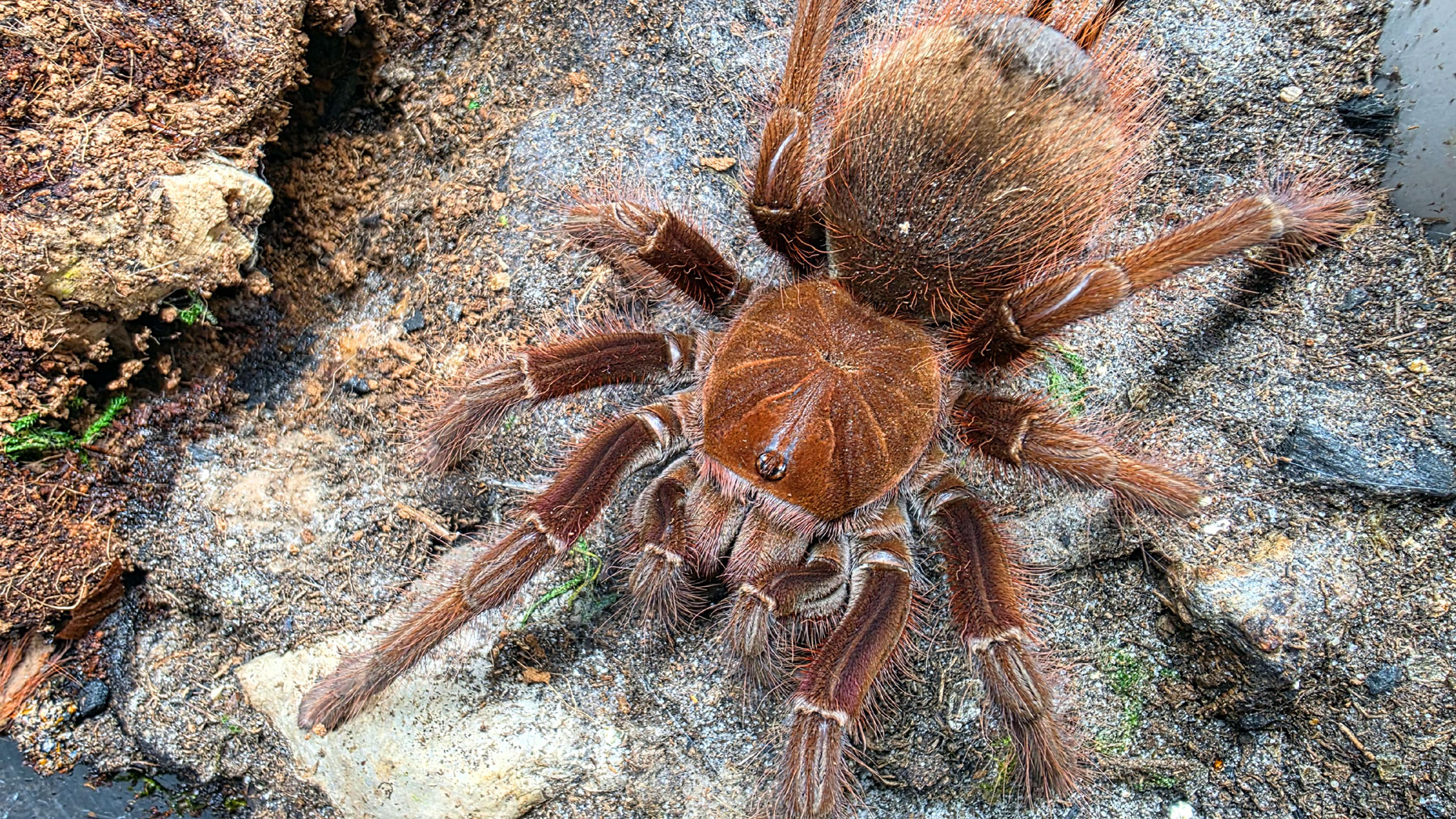
| Scientific Name | Theraphosa apophysis |
| Common Name | “Pinkfoot Goliath Birdeater” |
| Countries of Origin | Colombia, Venezuela, and Brazil |
| Arboreal/Terrestrial/Fossorial | Opportunistic burrower |
| Max Size | 10″ or more (25.5 cm) |
INTRODUCTION
When I first got into the hobby, I lived by the adage “bigger is better.” At that time, I figured that if you were going to keep large, hairy spiders, then you might as well keep the largest species available. Therefore, it wasn’t long before I discovered Theraphosa species and immediately became enamored with these true giants. Obviously, the legendary T. blondi or “Goliath Birdeater” was the first species that caught my eye. Unfortunately, not only was this species ridiculously difficult to come by, commanding exorbitant prices, but I also discovered that this species was supposedly difficult to keep due to its moisture requirements. I therefore settled on its cousin, the T. stirmi or Burgundy Goliath Birdeater, raising a young adult and two slings to adulthood. When, a few years later, T. blondi slings became available at an affordable price, I grabbed up two (now two 10” or 25.5 cm adults!). With two of the Theraphosa species under my belt, I kept a lookout for the third and lesser-known of these giants…the Theraphosa apophysis or “Pinkfoot Goliath Birdeater.”
After years of this species being on the top of my wishlist, I finally picked up two slings from Fear Not Tarantulas in June of 2020. At that time, they were each a leggy 1.25” or 6 cm. They are now both pushing a leggy 9” (23 cm) and have bloomed into stunning adult females. The T. apophysis still doesn’t command the same attention and popularity as its more heavy-bodied cousins, and I think that’s an absolute shame. For those looking for a giant, fast-growing, handsome spider, the T. apophysis might fit your tastes. Read on for a detailed description of how I kept these stunning giants!
SLINGS
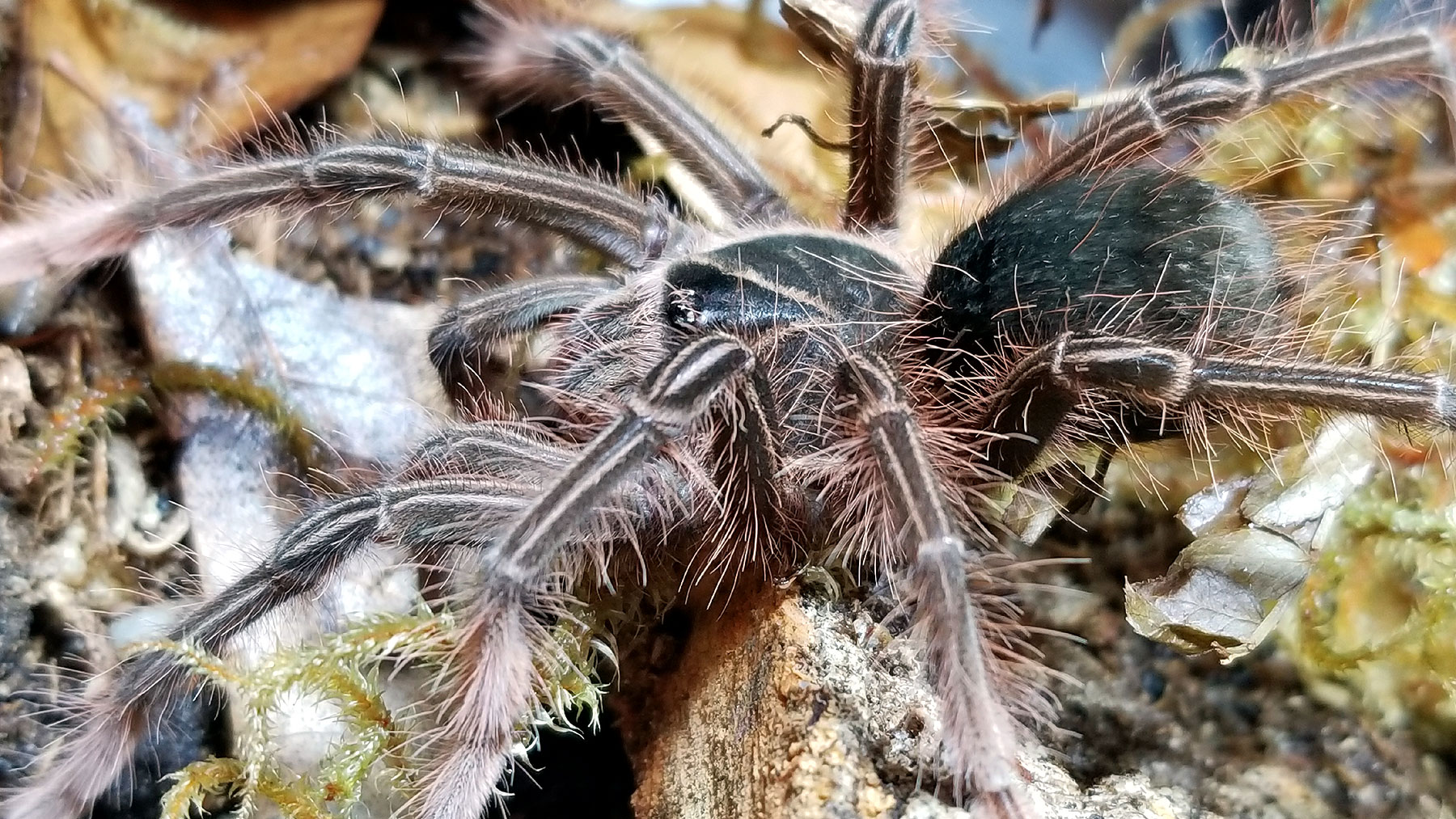
Slings start quite large, usually a leggy 1.25-1.5” (3-4 cm) and sport dark brown, almost black, carapaces and abdomens with lighter brown legs with beige striping running down their entire legs terminating in the pink feet that give them their common names. Unlike T. stirmi slings that only have pink feet on the first four legs, or the T. blondi that don’t have any pink at all, T. apophysis slings have pink feet on all eight legs. They are really quite striking as spiderlings.
Because the babies start quite large, you’ll want to forgo using a dram vial or deli cup, as these won’t offer any room for growth. I started mine in one of the mDesign Kitchen Pantry Storage containers that measure about 6.5 x 5 x 4” deep (16.5 x 13 x 10 cm). These offer some room for substrate and burrowing, as well as space for the spider to grow. Unfortunately, this model appears to be discontinued. Today, I would likely use the Sterilite Latch ID 2.5 qt. Containers. These measure 7 ⅝ x 5 ⅝ x 6” (19 x 14 x 15.25 cm) and offer extra room for substrate and burrowing, and are very easy to ventilate using a soldering iron or drill bit. I usually put two or three rows of tiny ventilation holes on all four sides (none on the lid). Whatever you choose to house your slings, you want to make sure that it offers room for substrate and growth.
If you have a larger sling over 2” (5 cm), you could easily start it in a larger enclosure, like an 8 x 8 x 12” (20.3 x 20.3 x 30.5) Acrylic or even a Barbarous/Reptile Growth 12 x 7 x 9” (30.5 x 18 x 23 cm). Either of these, or something around the same dimensions, would allow for some extra room for burrowing and growth. A plastic storage container by mDesign or Isaac Jacob would also work. The new models measure 6.5 x 10.75 x 6″ (16.5 x 23 x 15.25h cm) and can be purchased on Amazon. They have hinged lids that don’t latch, so be prepared to add an acrylic hasp or to find some other means to hold them closed. I have a couple of dozen of these, and I have them stacked in two rows on shelves so they fit snugly with the shelf above them. This holds the lids down.
Speaking of substrate, the Theraphosa apophysis is not quite as moisture-dependent as its cousin, the T. blondi, but it still requires moist substrate. For my slings, I kept the lower levels of substrate moist at all times and made sure that they had a water dish. At this size, I use a larger bottle cap, like the ones that come on Vitamin Water or Kombucha.
Sling Behavior: Keepers should be aware that, with their gangly legs, comes impressive speed. Although you don’t often hear about New World spiders being described as fast, Theraphosa slings are particularly quick and skittish. If disturbed, they have no problem turning on jets and bolting around the enclosure. This is why it’s important to give this species room to burrow. My two specimens were quite shy when smaller, spending the majority of the time hiding in their burrows. If not given the proper space to construct and an adequate hide, you can expect a reactive spider that will bolt or kick hairs when disturbed.
FEEDING
I usually try to get my spiders out of the slings stage as quickly as possible, as slings aren’t as hardy as their juvenile and adult counterparts and are more prone to mysterious deaths. Therefore, I tend to feed my slings more often, usually every three days or so. This also affords me the opportunity to check moisture levels and perform maintenance. At this size, my T. apophysis slings would take down small crickets, roaches, or mealworms. Although my other Theraphosa species were ravenous hunters, my T. aphophysis were a bit more shy, hiding in their dens before snatching their prey and dragging it down inside their burrows.
After a couple of molts, this species will have put on quite a bit of size. At this point, I started giving mine medium crickets or roaches. They had no problem at this point taking down larger prey.
JUVENILES
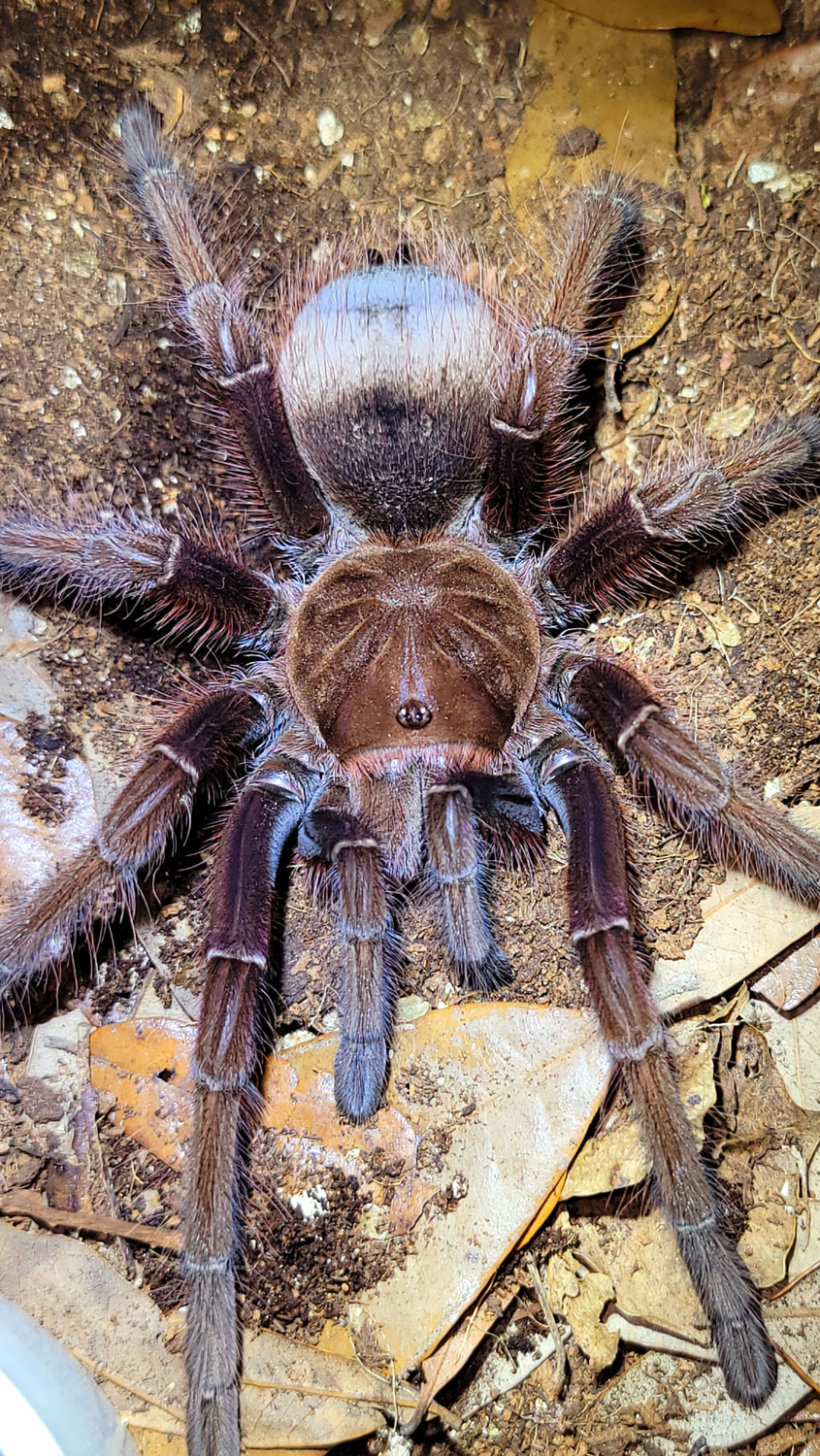
Juvenile is a very subjective term when it comes to tarantulas. Although for the average-sized species, this is usually around 1.5-2” (3.8-5”), the T. apophysis is a jumbo spider. Therefore, I would consider this species to be a juvenile when it reaches 3-4” (8-10 cm). At this point, they will still be showing off some of their sling patterning and colors, but their overall base color will turn to more of a reddish brown with hints of pink or even purple.
When mine hit around 4” (10 cm), I moved them into mDesign Plastic Storage boxes, which measure about 10.75 x 7.25 x 6.5” (27 x 18.5 x 16.5 cm h). Once again, I supplied each with several inches of moist substrate, a cork bark hide, sphagnum moss, leaf litter, and a water dish. Both constructed hides under the cork bark and would bolt to their dens when disturbed. If caught out in the open, they would sometimes freeze before finally kicking up a cloud of hair before running to their hides.
I kept the lower levels of substrate moist, allowing the top to dry out a bit. This allowed the spiders to choose the moisture level that they needed. When I would come up to check on my spiders in the early morning, I would usually find both sitting right out in the open. As they put on more size, I caught them out more and more.
It should be noted that a keeper could place a 4″ juvenile directly into an adult enclosure and skip a smaller juvenile enclosure. This species hunts well and grows quickly; therefore, putting it into a large enclosure at this point would be fine.
By May of 2021, they were both around 4” or 10 cm. Although mine certainly grew quickly, it was not as fast as my T. stirmis and T. blondies, which both hit around 5.5” (14 cm) in this same amount of time. Despite this species having a reputation for being just a “big brown spider”, my juveniles not only had some pink remaining on their toes, but also striping and an overall pinkish hue to their coloration. This is a species of spider that sports beautiful colors and patterning throughout its lifecycle.
FEEDING
As T. apophysis juveniles are larger than full-grown adults of other species, you can feed them larger prey. Mine were easily taking down several large crickets, adult B. lateralis roaches, or even medium to large B. dubia roaches in a sitting. I usually feed my juveniles every other week or so. If feeding smaller prey, I will often drop in 3-4 insects at a time. Mealworms, superworms, and locusts would also be suitable prey.
ADULTS
In September of 2022, one of my girls had reached about 7” or 18 cm and had outgrown her juvenile container. At this time, I decided to rehouse her into one of the Sterilite ClearView Latch containers that I use for many of my large terrestrials. These containers measure 17 x 11 x 6.5”h (43 x 28 x 16.5 cm), are easy to ventilate and stackable. I included about 4” of substrate (a mixture of coco fiber, peat, and vermiculite), leaf little, sphagnum moss, a cork bark hide, and a large water dish.
Now, could I have skipped this enclosure and put her into a final adult enclosure at this size? Absolutely. Although she did well in this enclosure, she could have used something with more depth to construct a better burrow. Also, although she used her hide initially, as she grew, she abandoned it. This led to more hair-kicking when I opened up her enclosure, as she felt exposed and threatened.
Having learned this lesson, in February of 2023, I moved my other specimen directly from her mDesign juvenile enclosure into the10 gallon Barbarous/Reptile Growth Tank. These enclosures are 20 x 10 x 11” (51 x 25 x 28 cm) and offer much more room for substrate and floor space. They are crystal clear, well-ventilated, and stackable. I gave her deep, moist substrate, a cork bark hide, leaf litter, and a large water dish. She immediately started digging and created a spacious burrow for herself. Although I catch her out in the open quite a bit, she will retreat to her burrow when disturbed. She is no longer particularly defensive, and I’ve experienced no more bolting or hair kicking.
I later moved my other girl into the same enclosure, and she too dug out her burrow and has more shy and reclusive than defensive. Both of my girls remain very leggy, much more so than their beefier cousins, the T. blondi and T. stirmi. One of them just molted, and her molt was around 8.75” (22 cm). This means that she is like 9” (23 cm) in legspan.
With these girls still growing and this species reaching 10+ inches (25.5 cm), I’m considering what I could move them into next. Ideally, I’ll be looking for something around the size of a 20-gallon long aquarium that offers plenty of depth for several inches of substrate and much more floor space. When I set up these new homes, I will likely include cork hides at both ends of the tank so that the spider can choose the one that works for it. I will also include a couple of fake plants for cover, as I think that this would allow the spiders to feel more secure, encouraging exploration.
FEEDING
These are obviously huge spiders, and they have appetites to match that size. Back when I used crickets, I would feed mine 5-6 large crickets every few weeks or so. Today, I use larger prey items like B. dubia adults, as these two-inch feeder insects make great meals for the giants. I usually drop in one at a time. That said, you can get away with feeding only one at a time. However, smaller prey can definitely work. If feeding crickets, B. lateralis roaches, or mealworms, you will want to give the spider multiple bugs at a time. I used to give mine 5-6 full-grown crickets when I used those as feeders. G. portensa, or adult Giant Madagascar Hissing Cockroach also make great meals for giant spiders.
I know that there are videos out there showing keepers feeding their Theraphosa species live adult mice. Sure, a full-grown mouse would make a great meal for a massive spider, but there are a few things that you should consider. First, it’s a cruel way to go for the mouse. Second, the mice can actually bite the spiders, injuring or even killing them. I would encourage using thawed or humanely killed mice instead of live ones. Finally, it can take more than a day for a large spider to consume a meal that large. If temperatures are warm, this can lead to decomposing organic material dripping onto and being absorbed into the substrate. Mice don’t have exoskeletons to hold the meat together, so the bolus will turn into a sloppy, dripping mess as the spider feeds. If this happens, you’ll want to scoop out any exposed substrate to avoid bacteria.
After a recent molt, I will switch to feeding larger prey twice a week until the spider’s abdomen puts on some size. I have a B. dubia roach colony, and I find that feeding an adult roach every couple of weeks until the spider fattens up works great. Once they’ve put some size back on, I go back to feeding my adults about once a month.
MALES
It should be noted that this species is sexually dimorphic, with males being much more gangly…and purple! That’s right, I’ve personally seen photographs of an almost 12” (30.5 cm) mature male sporting glorious metallic purple tones. Talk about one beautiful spider. Although mature male tarantulas will not molt again and have reached the end of their life cycles, males of this species can live for quite a while after maturing as long as they are given proper care. Because males wander around looking for ladies and are generally more active, they burn off more energy and become dehydrated more quickly. To keep your male going strong, make sure he has access to a water dish at all times, and feed him more often to keep his energy stores up.
TEMPERATURES
You might have read that if you’re comfortable, your tarantulas are comfortable. Unfortunately, there is a bit more nuance involved. Basically, after years of keepers attempting to heat their spider using devices like heat lamps, heat mats, and heat rocks as they tried to hit arbitrary temperature requirements, people figured out that, unlike reptiles and snakes, most species of tarantulas do just fine without supplemental heat. Unfortunately, what constitutes “room temperature” differs from home to home. For example, my parents keep their house at around 75 degrees F (24 °C), which would be plenty warm enough for any spider. Our home, on the other hand, is kept at 64F (18 °C) during the day, with my bedroom dipping to 55F (13 °C) at night. Our home temps would be too cool for most species. This is why I keep all of my spiders in a room that is independently heated from the rest of my home.
These days, my tarantula room is kept at 74 (23 °C) in the winter and is usually about 80-84 (27-29) in the summer. I’ve heard folks say that the T. apophysis requires extra warmth to flourish. It’s important to remember that although this species comes from warm, humid climates, they construct deep burrows in the wild, which not only provide them with a moist environment but also offer a reprieve from the heat. Although the temperatures may hit the mid 80s (29 C) outside, this species spends a lot of time in its burrow, where temperatures would be in the 60s (18 C).
MOISTURE
It’s important to note that, although this species is a bit less moisture-dependent than other Theraphosa species, I never let my enclosures dry out completely, and they always have access to clean water in a dish. To keep the substrate moist, don’t bother misting. Spraying water on the surface only raises the moisture level temporarily, as the water evaporates in hours. For my moisture-dependent species, I have a water bottle with holes in the top that I use to “make it rain” around the sides of the enclosure. I try to direct the water where the substrate meets the sides of the enclosures, which allows most of the water to percolate down to the bottom layers, keeping them nice and moist. I then let the top dry out a bit, which helps prevent mold and swampy conditions.
For a detailed explanation, check out my video on Keeping Moisture Dependent Tarantulas:
I often get asked if I use “false bottoms” in my Theraphosa enclosures. This is when a keeper lays down a drainage layer, usually clay balls, at the bottom of the enclosure, as well as a layer of screen, before packing the substrate over it. As the water drains down to this layer, it creates a reservoir for the extra water that is slowly released into the substrate. Although I’ve used this technique in a few enclosures over the years, I don’t find it necessary. That said, is the practice wrong? Absolutely not. Plenty of keepers use and swear by this type of setup.
Although the sheer size of this spider, coupled with its need for moisture, may seem daunting to those new to the hobby, I honestly believe that someone with some experience would have little trouble with this species. I’ve found mine to be very fast-growing, hardy, and easy to keep overall.
CHECK OUT THE LINKS BELOW FOR HUSBANDRY VIDEOS FOR THE T. APOPHYSIS!
 Tom's Big Spiders