
NE Herp – A Review

NE Herp

Although my T. stirmi enclosure has been holding at proper humidity with no pest or mold issues, I’ve been planning on adding isopods or springtails to help clean up any waste and to keep the tank mold free. While searching the net for dealers who carry these amazing insects, I stumbled upon NE Herp. Although I visited the site with the sole intention of procuring maintenance insects, I discovered that they carried so much more.

An amazing one-stop shop for all of your vivarium needs.

I first thought that NE Herp only carried invertebrates like D. Hydei fruit fly cultures, Springtails, and Dwarf Isopods, and it was quite by accident that I navigated to a page that presented the store’s ridiculously diverse selection of vivarium products. Water dishes, cork bark, bamboo, moss, hides, lights, enclosures, substrates…I could go on for pages. Keepers of frogs, lizards, snakes, tarantulas, or other invertebrates would be wise to check out the site.

I was elated to discover that they carry bamboo and cork bark at ridiculously low prices. Since entering the hobby, I’ve always been floored by the high cost of cork bark, and I’m constantly on the lookout for someone who sells this material for a reasonable price. NE Herp not only offers larger pieces for great prices, but they also sell a gallon-sized grab bag filled with medium to small pieces. At $7.99 (on sale for $5.99), this is an absolute STEAL.

Great packing and fast shipping!

My order was packed and shipped very quickly via Fed Ex, and it arrived on my doorstep a day later (NE Herp is just across the state from me, so the shipping time was extra fast). My order was very well packed, and NE Herp even included a cold pack to keep my springtails from baking in the hot temps. All of my items were heavily padded with packing paper and arrived in pristine condition.

The bag of cork bark proved an amazing value. I was elated to find that I contained curved and flat pieces ranging from 3 to 7″. As I like to include corkbark hides in most of my enclosures, the accumulated cost of buying this material can become costly. However, for about $6, I now have enough for at least a dozen cages.

My box from NE Herp.

My box from NE Herp.

The well-packed contents of my package.

The well-packed contents of my package.

My new cork bark, bamboo, plastic plants, and springtails from NE Herp.

My new cork bark, bamboo, plastic plants, and springtails from NE Herp.

I highly recommend NE Herp to any hobbyist.

I have already spent several hours on this site window shopping and putting together my wishlist for my next order. The amount of products they carry is staggering, and I’m still finding new things to add to my list. I will definitely be placing a second order soon. NE Herp carries an amazing selection of vivarium supplies, and their quick and reasonable shipping make ordering from them a very satisfying experience. I highly recommend them to any tarantula, snake, reptile, or frog keepers who are looking for reasonably-priced supplies for their enclosures.

 

Arachnoboards… THE Place for Tarantula Information

Arachnoboards

Anyone who has done a search for tarantula information or care sheets has likely stumbled upon links to the Arachnoboards forum. When I first started researching the hobby, I found that many of my Google searches inevitably brought me to this wonderful forum, and it wasn’t long before I decided to sign up.

If there is a place online with more useful information about tarantula keeping, I’ve yet to find it. The forum is populated by seasoned hobbyists and novices alike, and the amount of information shared and exchanged on any given day is impressive.  It’s a wonderful community where posters can discuss the hobby and mingle with others who enjoy keeping tarantulas. There are discussion boards, picture threads and galleries, dealer reviews, classifieds, as well as many other useful boards and topics.

A few tips for getting the most out of the boards.

1. Sign up! This may seem obvious, but it is very easy to just lurk on the site without every signing up. Unfortunately, if you don’t sign up, you are not able to see some of the boards, including the classifieds or dealer sections. You definitely don’t want to miss out on the many deals to be found on these boards. Also, if you’re not signed up, you can’t post or look up member profiles (two thing that you might find useful later on).

2. Do your homework! Although there are a number of knowledgeable and helpful members on the boards who will happily respond to your questions, that doesn’t mean the free advice should be abused. Before posting what could be an obvious or oft-repeated question on the boards, take the time to do a quick Google search. Many care sheets and basic info can be found in less time than it would take to make a post. Or, you could always…

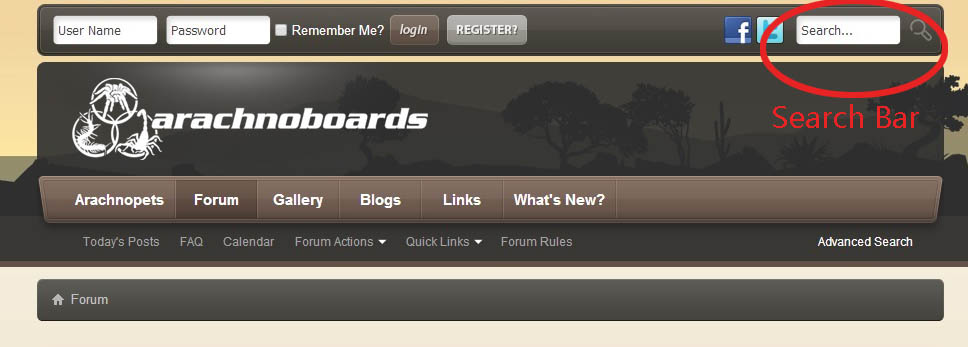
3. Use the forum’s SEARCH function! The amount of information on Arachnoboards it staggering. Chances are, if you have a question, it’s been answered somewhere before. Always use the search function first to see if you can quickly answer your own question. It’s easy, it’s quick, and it keeps the boards from being cluttered with questions that have been asked dozens of times before.

Use the search function in the upper right corner before posting.

Use the search function in the upper right corner before posting.

4. Beware of the “hot” topics! There are a few topics that can soon turn the boards into a battleground of dissenting arguments. Should you hold your tarantula, or does it endanger the animal? Should you supply water bowls, or is that a waste of time?  Should you use expensive cages, or make your own cheaper ones? Do you have the experience to safely own an old world T? These are some of the topics that divide hobbyists and send tempers flying. You’ve been warned…

5. Identify those with experience and pay attention! It doesn’t take long to figure out which members have years of experience and valuable information to share. Pay attention to what these guys and gals say, as you will likely glean plenty of useful information from their posts and responses.

6. Use the  scientific names! There are just too many species of tarantulas with way too many overlapping “common” names for hobbyists to keep straight. Just look up “white knee” and see how many species this name may apply to. Scientific names provide a convenient, accurate, and common language for hobbyist to use so that species aren’t confused.

Arachnoboards is a wonderful community for anyone interested in the tarantula keeping hobby, and should be a frequent stop for the serious enthusiast. Hope to see you on the boards!