Tarantula Care Sheets – An (Un)necessary Evil

No-care-sheets


We’ve all done it.

While perusing a tarantula site, you come across a new species that totally catches your eye, but whose care and husbandry you are unfamiliar with. Eager to learn about this specimen, you hop onto Google (or bing, if you’re an iconoclast) and frantically type in the scientific name of species as well as the following words…

CARE SHEET

As you start clicking on the results, one-by-one, your excitement inevitably turns into confusion … and later frustration.

You see, each of the care sheets you read seems to contradict the one you read before it. One says the species enjoys low humidity while a second says they’ll die if not kept moist. One lists an ideal temperature range of 68-80° while another explains that temps below 80° can be deadly. A fourth sheet says the species can reach a maximum size of 9″ while a fifth states the size taps out at around 5″.

Now what?

Most of us learned years ago that the internet can be a literal sewer of misinformation and lies spoken as irrefutable truth. It takes a bit of patience, internet savvy, and general common sense to wade through the knee-high piles of internet detritus to find those useful and accurate nuggets of information.

Never is this principle more clear than when searching for information on tarantulas.. The amount of misinformation online is staggering, and it often feels like the bad information far outnumbers the good.

Care-sheet-nightmares-final

The fact is, many of tarantula care sheets are just plain WRONG.

For the sake of this argument, let’s define “care sheets” as those brief, usually single-page basic care instructions for specific pets or animals. These sheets usually offer the basics like what and when to feed, ideal temperatures, humidity, and set-up. They are basically distilled, stripped-down instruction manuals for your exotic pet.

There’s a reason experienced keepers abhor care sheets, and that’s because most offer incomplete or incorrect information. Many present outdated information that, if used, could lead to the death of your beloved spider. Others are written by folks who have little to no experience in the hobby who, in their misguided attempts to share their love for the arachnoculture, simply regurgitate earlier information they read on another inaccurate site or blog (or, even better, cut and paste from a Wikipedia page). Although I can appreciate wanting to write about an activity you love, doing so with no valid experience is a bit irresponsible.

Look at some care sheets for common species and you’ll soon see it; several different pages offering the EXACT same information, word for incorrect word. In some of the more comical examples, they even share the same typos and grammatical mistakes.

GBB-DEATH-FINAL

Personally, when I look for information, I’m looking to hear from folks who have successfully kept the species I’m researching. I don’t want some generic and random temperature ranges and bogus humidity requirements from some self-professed tarantula expert whose only experience comes from incorrectly keeping a G. rosea for ten years. In the very least, I want notes from someone who has proven they have kept this species alive and thriving for a reasonable amount of time.

The problem for many is that to correctly research a specimen, it takes time and patience, and those are two things that many of us lack. Care sheets offer a quick and easy read; something we can glance over in less than five minutes and feel that we’ve been adequately informed. However, as many in the hobby will point out, tarantula keeping is NOT something you want to take a haphazard approach to.

If you really want to learn about that new species, here’s how to go about it.

Tips for finding accurate information

1. Check the message boards for information and to speak to other keepers.

Arachnoboards and The British Tarantula Society forums are both amazing places to get current and relevant information about tarantulas. Start by using the forums’ search functions to find archived info about these animals. Look specifically for posts made by those who actually keep the species you’re looking for. If you still have questions, make a post and ask folks for their opinions on how they keep these species.

2. Speak to reputable dealers and breeders and ask for advice.

Many of the tarantula vendors online are very experienced and willing to help with your questions. In my personal experience, Jamie from Jamie’s Tarantulas and Paul from Pet Center USA are both incredibly approachable and eager to help. If you have a question about a species and are having no luck finding information, don’t forget to use the dealer as a resource.

3. Check the dates of the information you find.

The hobby is constantly evolving, with new species being introduced often. When searching for specific care notes, whether it be on a website or, even better, a dedicated forum, check to make sure that the information was posted recently. That’s not to say that older information can’t be correct; however, you’ll want to cross-reference it with a more current source to be certain.

4. Check the credentials of those offering advice.

If you’re on a reputable forum like Arachnoboards, or getting advice directly from a breeder, you’re likely in good shape. However, if you stumble on a tarantula site purporting to proffer expert advice, be sure to research the credentials and experience of the folks running it. Anyone can set up an intuitive and professional site these days, and a slickly-designed web presence does not necessarily equal quality information. When in doubt, don’t hesitate to toss the person an email inquiring about what species they currently keep. If they don’t or haven’t kept the species you are researching, move on.

5. Compare, compare, compare…

If you stumble across what you think is a good source, don’t stop there. Take the time to look at what some other keepers say. Then, when you’ve got a few sources, take a moment to compare and contrast them. What are the commonalities? Where do they differ? Are there questions that aren’t yet answered? If not, continue to research (or see numbers 1 and 2 of this list).

Take your time and do it right…your Ts will appreciate it.

In the early days of tarantula keeping, before Google became the go-to research tool, the only way T keepers could find information was to read often outdated books or speak with other dealers and keepers. Back then, photocopied care sheets detailing rudimentary animal care were commonly handed out at pet expos or in pet stores so that the customer had an idea of how to care for his/her new pet.

Back then, this was a necessary evil.

However, the hobby has grown immensely in the past twenty years, and advent of this little thing called “the internet” has made it simple to locate accurate and appropriate information for just about any species. Static, archaic, and often just plain inaccurate care sheets should be allowed to go the way of aquarium gravel for substrate.

It might take a little extra effort, but the next time you want to learn about a new species, take some time to do some research and to reach out to those who have experience. You’ll not only receive richer, more useful information than any care sheet could provide, you might just also make a new friend in the hobby.
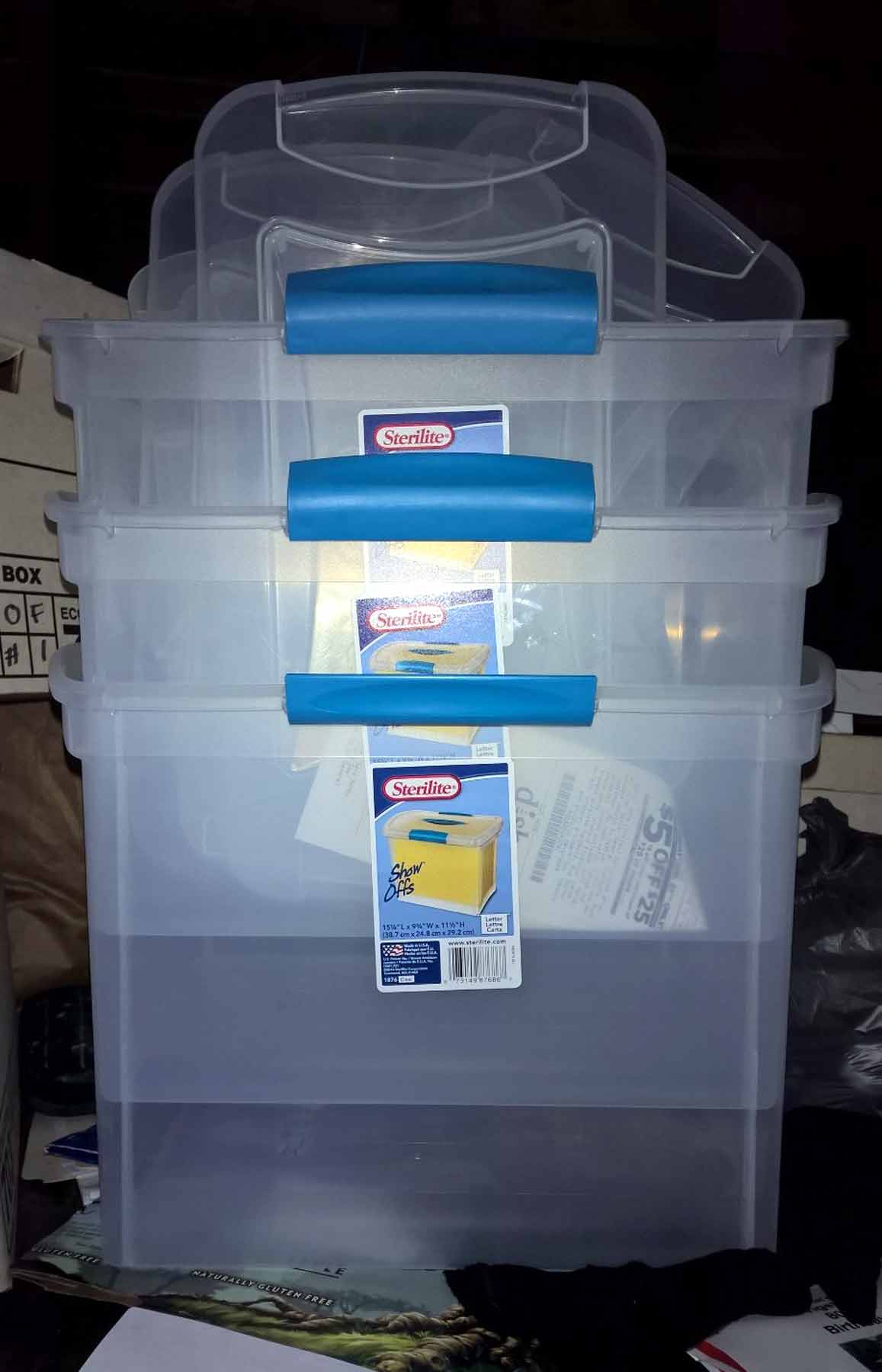
Quick and Easy DIY Tarantula Enclosure – Arboreal

A simple, attractive, and stackable arboreal enclosure.

Having spent the last year burying and repurposing just about every conceivable container for use as tarantula cages, I’ve finally settled on a few sizes and styles that I plan to use from this point on.

Enclosure-sterilite

I’ve found the large Sterilite Show Off containers, which are designed to hold hanging files, are very versatile and perfect for both fossorial (burrowing) and arboreal enclosures. Measuring 15.25″L x 9.75″ W x 11.5H, they leave plenty of depth for deep substrate or height needed when housing an arboreal.

If I’d planned ahead, I might have ordered some 3″ plastic vents from roundvents.com, However, this would have been a more aesthetic choice; holes work just as well.

To put together one of these enclosures, all you’ll need is:

  • Sterilite container
  • Soldering iron (for burning holes)
  • Glue gun
  • Substrate (I’m using a mixture of top soil, coco fiber, peat, and a bit of vermiculite).
  • Sphagnum moss
  • Cork bark flat
  • Water dish
  • Fake plants (optional)

1. Ventilating the enclosure

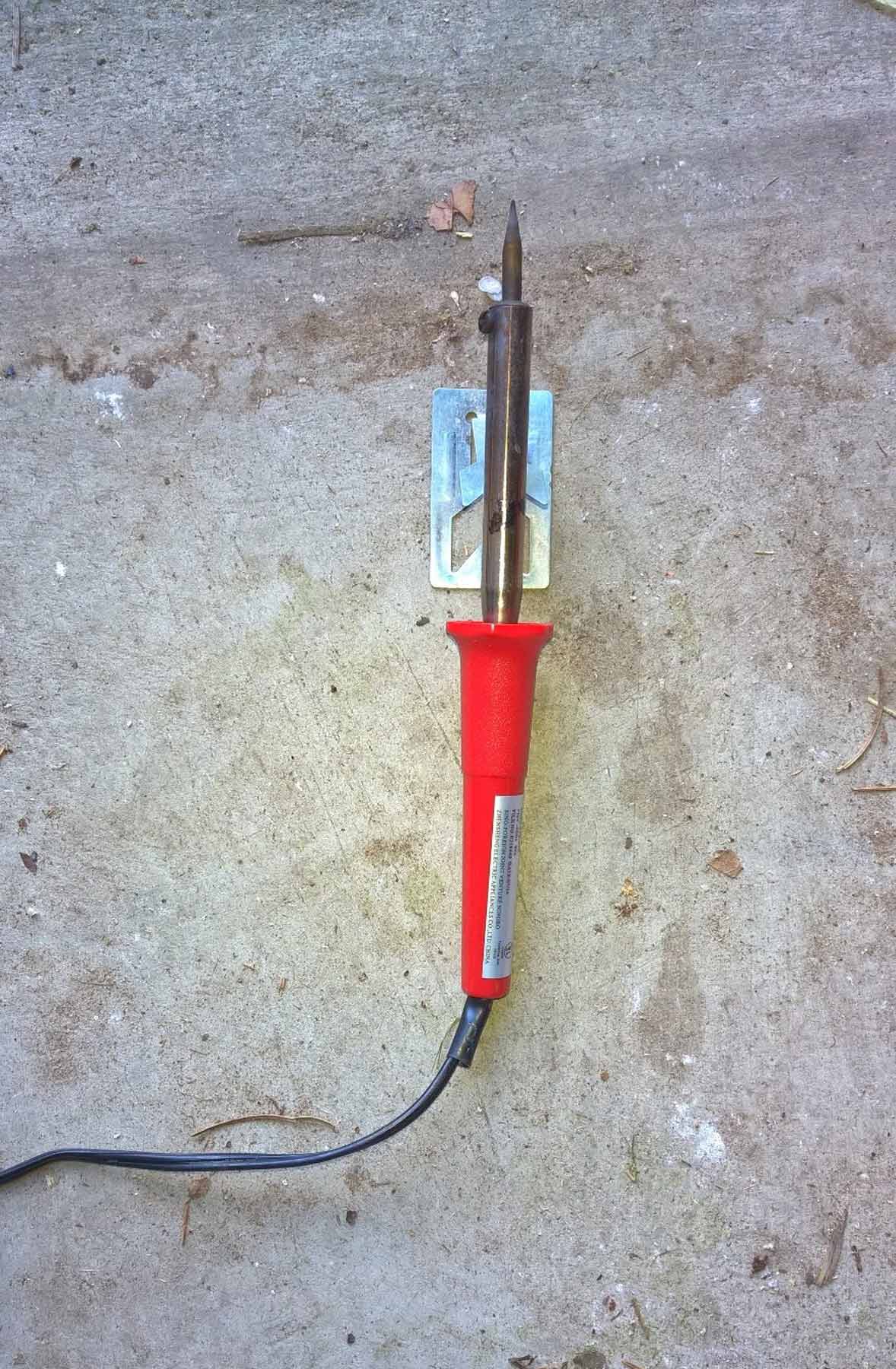
First off, if you find yourself making a lot of DIY tarantula cages, then immediately head over to Amazon and invest in a soldering iron. The one I use is manufactured by J&L, and it costs just over $10 (money VERY well spent).

Enclosure-iron

Using the soldering iron, I make a series of holes horizontally starting about an inch below the lip of the container. As you’ll be housing large juveniles to adults in this setup, you can use a bit more pressure on the iron to make larger holes. I will do about five to six rows of these on each side, spacing the holes about 1/4″ apart or so. For the arboreal enclosure, you are going to have more vertical space, so it’s okay to put holes lower on the side of the enclosure. However, for a fossorial species, you’ll want to keep the holes toward the top to allow for adequate substrate depth.

You can add holes to the other sides as well if you prefer, but keep in mind that if you’re trying to create a micro-climate, too much ventilation will make it very difficult for you to maintain optimum conditions. I do not add holes on the lid, as this just allows moisture to evaporate faster.

2. Add the substrate.

This one is pretty self-explanatory. For an arboreal enclosure, you want to add 2-3″ of packed-down substrate. Appropriate substrate can be coco fiber (Eco-earth), peat, organic (no animal products added) top soil, or any mixture of the those. For more on substrates, feel free to check out this link.

3. Arrange the water bowl and cork bark

Because we’re setting up an arboreal enclosure, we’re going to be using a cork bark flat set at an angle. Now, cork bark can be quite pricey when purchased at a pet store, so I’ve been buying mine from New England Herpetoculture (NE Herp). Not only do they carry an amazing supply of everything you would need to decorate an enclosure (fake plants, bamboo, cork bark, etc.), but their prices are fantastic. A 13-16″ long slab costs about $10 and yields you enough bark for about three enclosures if you section it.

You want to lay your piece of cork bark at an angle, wedging the bottom of it into the substrate so that it doesn’t slip down. When positioning it, try to ensure that it doesn’t cover up your air holes as well.

Enclosure-top-down

I will usually put the water dish at the base of the cork bark, just off to the side. You don’t have to get fancy with what you use for your dish, either. Some folks use souffle cups or other “found” items. I like to use these small, white ceramic water dishes that I found at Petco. I know Petco has a rep for being over-priced, and the items sold in their brick and mortar stores usually are. However, if you sign up for their online newsletter, you’ll discover that they are constantly having 25-40% sales, often with free shipping after a certain amount. I usually end up paying only about $1 per water bowl, which I think is pretty darned good. I’ve also managed to score some gorgeous fake plants there for 50% off.

4. Add some sphagnum moss.

I generally buy long fiber sphagnum moss from my local Home Depot. It’s about $5 a bag, and it is enough to set up several enclosures. I add the moss behind the cork bark (my poecilotheria species like to use it to build “curtains”) and around the water bowl. For species that require a little more humidity, you can moisten down the moss to help keep the moisture levels up.

5. Decorate!

Now, if I’m being honest, the majority of my enclosure setups are rather spartan. However, for some of my big arboreals, I like to go the extra mile. Not only does it make for a beautiful display enclosure, but by adding some faux foliage, I give my spider more places to hide.

For this enclosure, I used my glue gun to glue some plastic leaves to my piece of cork bark. I also added an artificial plant next to the cork bark to give the animal more security (and, it looks darn pretty). I purchased both of these on sale at Petco during a 40% off sale. For the leaves, I buy the plastic vines then just pop the leaves off to use as needed.

6. Finally … add your spider!

It takes me about an hour to set up three or four of these enclosures, and most of that time is spent melting the ventilation holes in the plastic. As for cost, the Sterilite container retails for $5.99, the water dish was $0.99, the cork bark was about $3, and the plant (which is optional) was $5.99. So, this enclosure cost me about $16. Considering that it will housing my gorgeous, and pricey, female P. metallica, I think it’s well worth it.

Enclosure-stacked

Grammostola iheringi (Entre Rios)

A gorgeous “grammy” with plenty of spunk.

G.-iheringi

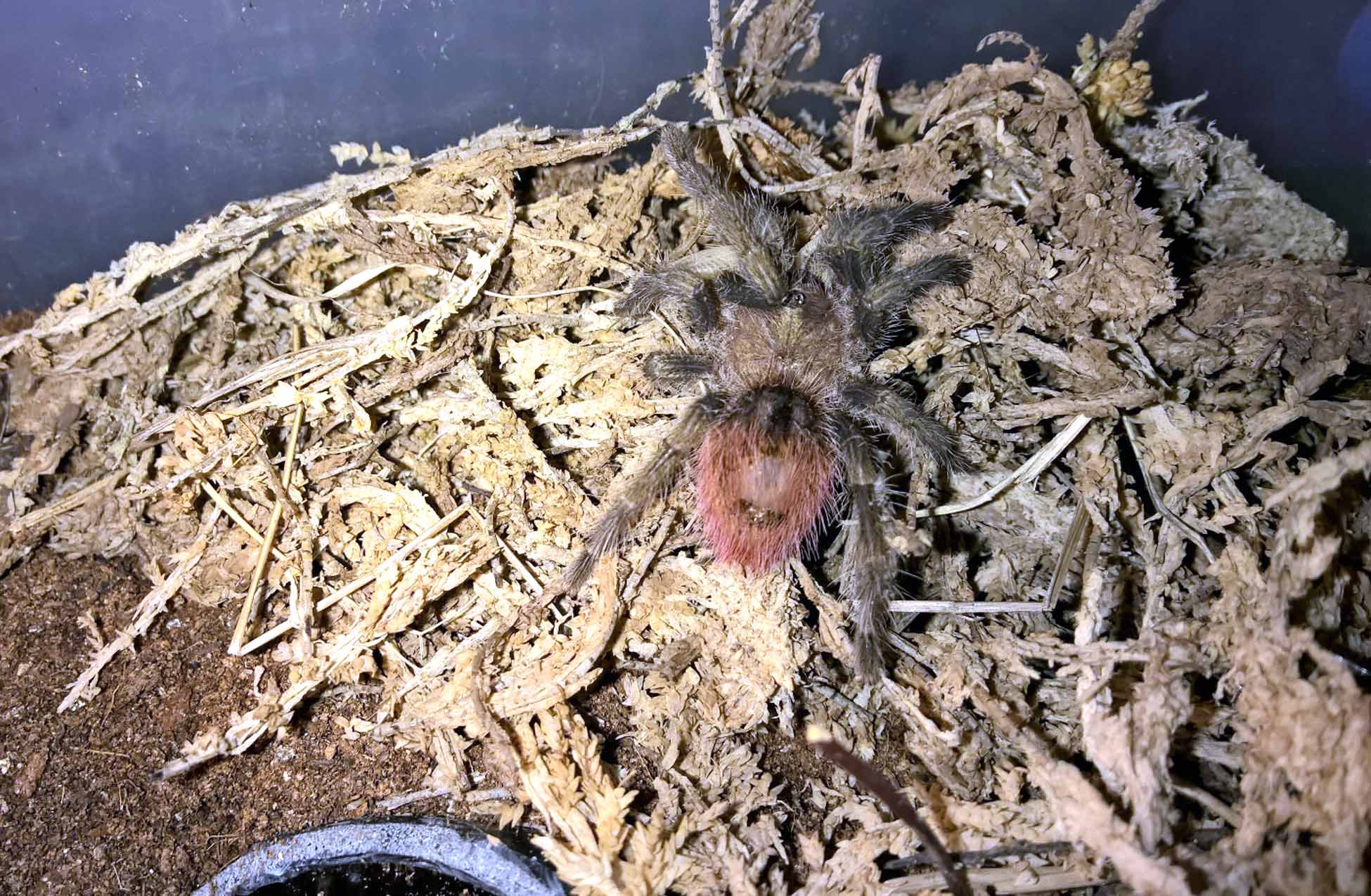
About a year ago, I was perusing various topics on a tarantula message board when I came across a spider I had never seen or heard of before. The lucky keeper was posting photos of his newest acquisition, a 4″ female “Entre Rios.” With its bluish-gray body and bright red rump, it was a truly amazing-looking spider. I would later learn that the scientific name of this beautiful specimen was Grammostola iheringi, and it was a much sought after tarantula for many enthusiasts. After reading up on the species, including many accounts from those who actually kept this marvelous spider, I decided that I had to have one.

Fast-forward to just a couple of months ago. I place an order with my favorite vendor, Jamie’s Tarantulas, and due to unfortunate circumstances, one of the animals I ordered couldn’t be shipped. Being the amazing dealer that she is, she offered me a replacement that easily trumped my original purchase…a 2.75″ female G. iheringi. Since receiving her in early May, she has become one of my favorite specimens.

GWA … Grammostola with Attitude!

The first thing that impressed me about this species was its temperament. Those used to other slow-n-steady Grammostola species (porteri, pulchripes, pulchra, etc.) might be taken off guard with the much more high-strung iheringi. This species is quite leggy and seemingly much faster than its cousins, and many keepers have commented on its speed. Upon opening her shipping container to rehouse her, she bolted from deli cup and took two laps around her container before I could blink. This is definitely not a slow, calm spider.

Also, those used to other Grammostola species with more tractable natures should be aware that iheringis are quite skittish and can be defensive. While cleaning out a bolus in my spider’s enclosure, I was startled when she burst from her den, slapped at my tongs, then bolted back to her hole. Although I’m pretty sure that she was rushing what she hoped to be a food item, the experience was still quite eye-opening. This is definitely not a species I would risk holding, and care should be taken for feeding and maintenance.

The G. iheringi has a voracious appetite and will charge at prey with impressive speed and ferocity. Unlike my other Grammostolas, who will generally wait and ambush prey when it gets close, my iheringi will stalk and charge the crickets. I feed my 3+” female two large crickets a week, and she has no trouble taking down the larger prey. The only time she has refused food was shortly before a molt.

Although most Grammostola species are painfully slow growers, the iheringi grows at a medium pace. Mine has already molted once in my care, and because of her amazing appetite, she is quickly packing on the weight. During her last molt, she grew from about 2.75″ to just over 3″. Some consider this species to be one of the largest Grammostolas with a max leg span reaching up to 8″. However, most keepers report their reaching about 7″ in size. Still, that’s a fairly good-sized specimen.

A gorgeous spider with simple husbandry.

Care for this species is quite simple. I keep my female in a repurposed Sterilite plastic shoe box that has been well ventilated to allow for a cross current of air. For substrate, she has about 3″ of coco fiber and peat, and I provided a piece of black PVC pipe for a hide. I keep the substrate dry, but I do provide her with a large water dish for drinking and for keeping the humidity up a bit.

Like most of my tarantulas, she is kept between 70 and about 78° during the winter and 74-84° during the summer months. As with most species, higher temps will usually allow for a faster metabolism and growth rate. This is a long-living species, with females expected to live 20+ years.

My juvenile G. iheringi enclosure made from a re-purposed Sterilite container.

My juvenile G. iheringi enclosure made from a re-purposed Sterilite container.

G. iheringi enclosure set up. I used a piece of black pvc pipe with cork bark for the hide.

G. iheringi enclosure set up. I used a piece of black pvc pipe with cork bark for the hide.

A must for any New World aficionado

The most common complaint I hear about Grammostola species is that their sedentary lifestyles render them “boring” species to keep. This is definitely not an issue with the iheringi; this tarantula has plenty of spunk and personality. For a keeper accustomed to keeping more lively tarantulas, the G. iheringi is fantastic specimen and a must for the collection.

My female G. iheringi after a recent molt. Notice her tiny abdomen.

My female G. iheringi after a recent molt. Notice her tiny abdomen.


H. incei gold Rehousing

Well, this turned out to be a bit of an adventure!

Last year, I purchased three H. incei gold juveniles from Michael Jacobi’s Spider Shoppe. Since then, one ended up a mature male, hooking out and passing away two months later. Last week, I got a good look at the second one, and he, too, has hooked out. The third? Well, I was never able to get a good look at it.

While doing several rehousings this weekend, I decided that it was time to get this little one a new home. I hoped to also get the opportunity to possibly sex it, as this would be the first time I would be seeing it out of its den in a long time.

Once again, my daughter, Sid, handled the camera duties as I took care of the actual rehousing. As these guys can be very skittish and fast, I anticipated that this might not go as smoothly as I hoped.

I was right!

Still, I try to be prepared and to stay calm during all rehousings, and I don’t panic if the spider doesn’t go exactly where I want it to right away (as often, they don’t). I also do all rehousings inside a larger plastic container to put an extra barrier between a fleeing spider and my dinner table. In this instance, this practice served me quite well.

With four kids and three dogs in my household, things can be quite loud and lively. You’ll notice in this video that my concentration was tested, not only by the potential escape, but by barking dogs and a thirsty four-year-old. 🙂

As for my little spider, it looks to be another male. Oh, well…

Aphonopelma chalcodes – The Desert Blonde

A-chaldodes-NEW

An Underrated North American Beauty

When I first began expanding my collection, I was so enamored with the hundreds of exotic species available from far away locales that I all but ignored some of wonderful tarantulas that could be found in my own county. As much as I hate to admit it, I paid little attention to the Aphonopelma genus, subconsciously designating  the species it contained as a bit mundane. After all, why keep a tarantula that I could essentially find in my back yard (well, give or take several thousand miles!) when I could have something found across the world?

Now that I’ve established a pretty good-sized and diverse collection, I’ve turned my attention to some of the species I might have previously overlooked. Although I’ve kept an Aphonopelma schmidti for over a year, it was only recently that I had a change of heart about this genus. While looking at a fellow collector’s photos, I was taken by the gorgeous earthy grays, browns, and blonds of these spiders, something I had long admired in my schmidti. Having already added an A. anax sling to my collection, I was keeping my eyes open for a A. chalcodes. When I found a young adult for sale, I jumped at it.

Temperatures and set up

The A. chalcodes’ natural range is in the Sonoran deserts of southern Arizona and northern Mexico, which experience two major rainy seasons in the summer and winter. Although this animal flourishes in dry conditions, it can definitely tolerate more humid climes. In the wild, this animal experiences high temps in the mid 80s in the summer, and lows of 52º F in the winters. A burrowing species in the wild, the A. chalcodes would avoid both of these extremes by retreating to its den.

With this in mind, I set my chalcodes up on four inches of dry substrate made up of a 50/50 mixture of coco fiber and peat. To stimulate its natural burrowing tendencies, I included a short section of black PVC pipe as a starter burrow. I also supplied a water dish and some sphagnum moss. I do not overflow the water dish. Currently, it does not use its burrow, but instead chooses to sit out in the open. This is perfectly fine by me, as this little blonde ball of fluff is quite the looker.

This is a species that does very well at room temperature. Mine is currently kept between 70 and 75º F; in the summer, this range will be between 75 and 85º F. For folks who have colder temps in their homes during the winter, this would be a good spider to consider keeping.

Species in the Aphonopelma genus are notoriously slow-growing, and the chalcodes is not an exception. Although keeping this animal at higher temps will stimulate its metabolism, leading to faster growth rates, you can still expect this spider to take many years before it reaches maturity. Males of this species are expected to live 5-8 years, dying a year or two after reaching sexual maturity. It is estimated that a female could live 25+ years.

Size, feeding, and temperament

The A. chalcodes is a medium-sized tarantula reaching a max size of about 6″. So far, mine has proven to be an excellent eater, and I’m currently feeding her 2 large crickets a week. However, I have noticed that my other Aphonopelmas seem to pick up on environmental factors during the late fall months, and they will forgo eating for most of the winter. In the wild, this species will spend the winter fasting in its burrow, so I wouldn’t be surprised if mine did the same once the temps drop again.

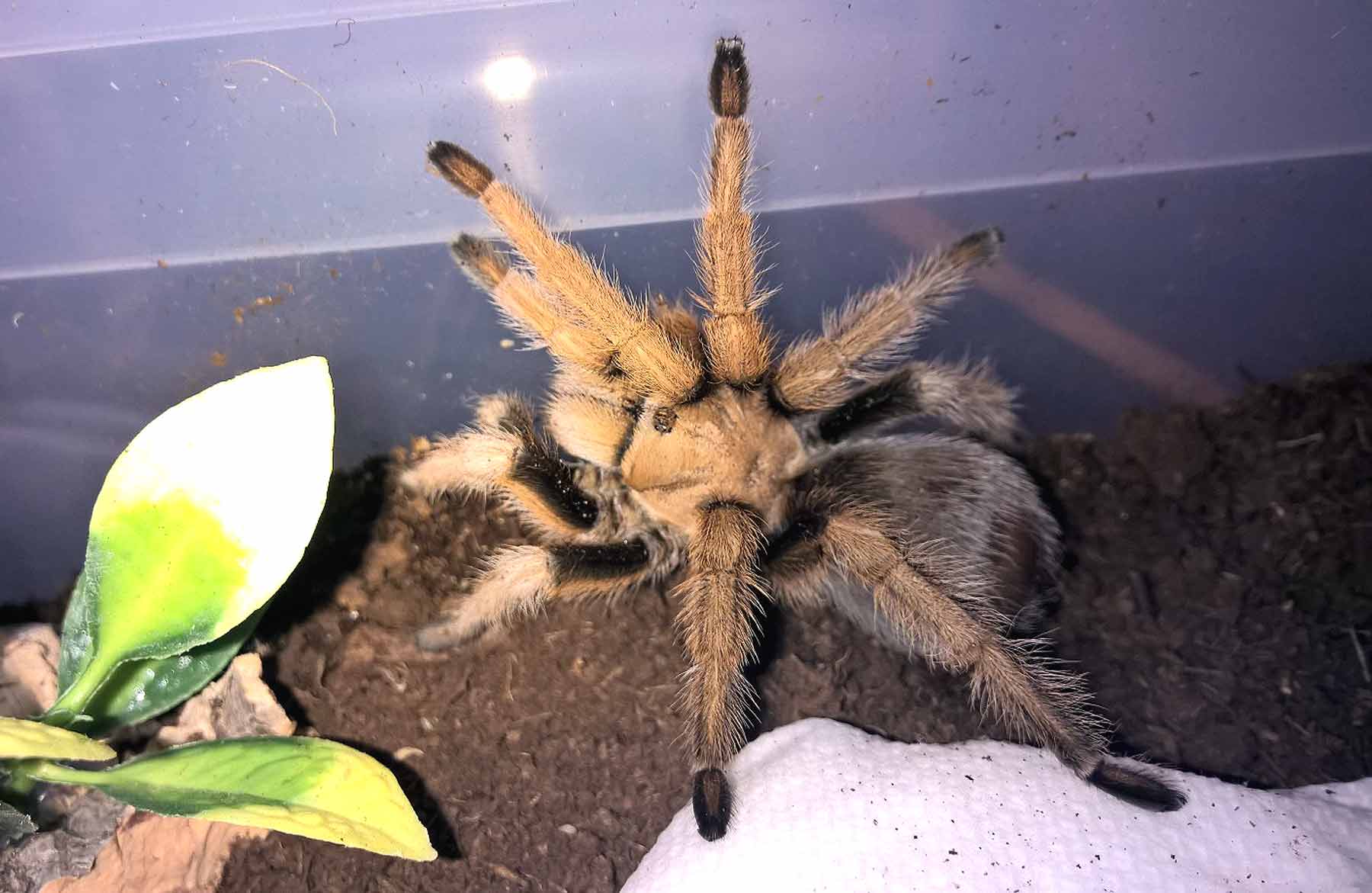
This spider is often recommended as a great beginners species due to ease of husbandry and a tractable disposition, and for the most part, this is a good tarantula for novices. However, behavior varies wildly between individual specimens. Many folks report their chalcodes being a bit more feisty and prone to biting; others keep specimens that are quick to kick hairs. This information is important to keep in mind when performing maintenance or interacting with your animal. My A. chalcodes can be a bit skittish, but she has yet to show me a threat pose or any defensive behaviors. Still, her bald abdomen is an indication that she may kick.

A-chalcodes-WEB

The A. chalcodes is a beautiful, relatively calm spider with easy husbandry requirements that make it a wonderful addition to any collection. If you’re a collector in the States, don’t make the mistake I did and pass up this little gem.

New England Reptile Distributors (NERD) – A Review!

NERD

NERD is not just for reptiles.

There’s a belief among many serious tarantula enthusiasts that if you’re going to buy tarantulas online, you should only purchase through a reputable tarantula breeder or vendor. Although many reptile dealers also peddle spiders (after all, the two hobbies are quite similar), many times it’s almost as an afterthought. Unfortunately, an expert in snakes does not an expert in tarantulas make, and although these folks usually mean well, they can sell overpriced stock that has not been kept optimal conditions. I’ve heard many horror stories about poorly packed spiders perishing in the mail, or of customers receiving animals of the wrong size, sex, or even species.

This is absolutely NOT the case with New England Reptile Distributors; it’s obvious that owner Kevin McCurley knows his tarantulas.

I’m usually weary of purchasing from businesses whose main focus is reptiles. However, while recently studying up on various species of the Phormictopus genus, I stumbled upon some P. atrichomatus slings for sale at New England Reptile Distributors (NERD for short). I immediately recognized the name from my days collecting snakes, and I remembered them having a stellar reputation. With that info in mind, I decided to place my first order.

Stock

I was immediately impressed by the selection that NERD offered. I expected to find a smaller listing of some of the more common species. Instead, I found a very large and diverse selection that included some hobby regulars as well as some rarer species, like the coveted H. pulchripes. Their prices, overall, were also quite good, and they seem to add new stock fairly often. I do hope they eventually put together a newsletter that announces new stock, but I’ve been on the site enough times now to recognize the new additions.

Communication and Customer Service

I reached out via email first to find out if they could hold my order until the weather warmed up, and if I could add to the order when it came time to ship. Kevin responded immediately, and was very friendly and helpful. He had no problem with holding my spiders until it was safe to ship, and had no issue with me adding to my order while I waited. As it turned out, it was over a month before the weather permitted shipping. During this time, we stayed in communication, and he always responded to emails immediately. I did end up adding a couple Ts to my order, a T. ockerti and an A. chalcodes, and both orders were combined with no issue. When I was ready to ship, the package went out that week.

Shipping and Packing

My tarantulas were shipped FedEx overnight for a very reasonable $35. My order shipped quickly, and I was emailed a tracking number. Kevin was even good enough to have my order held at my local FedEx facility for pick up.

Nerd-Box

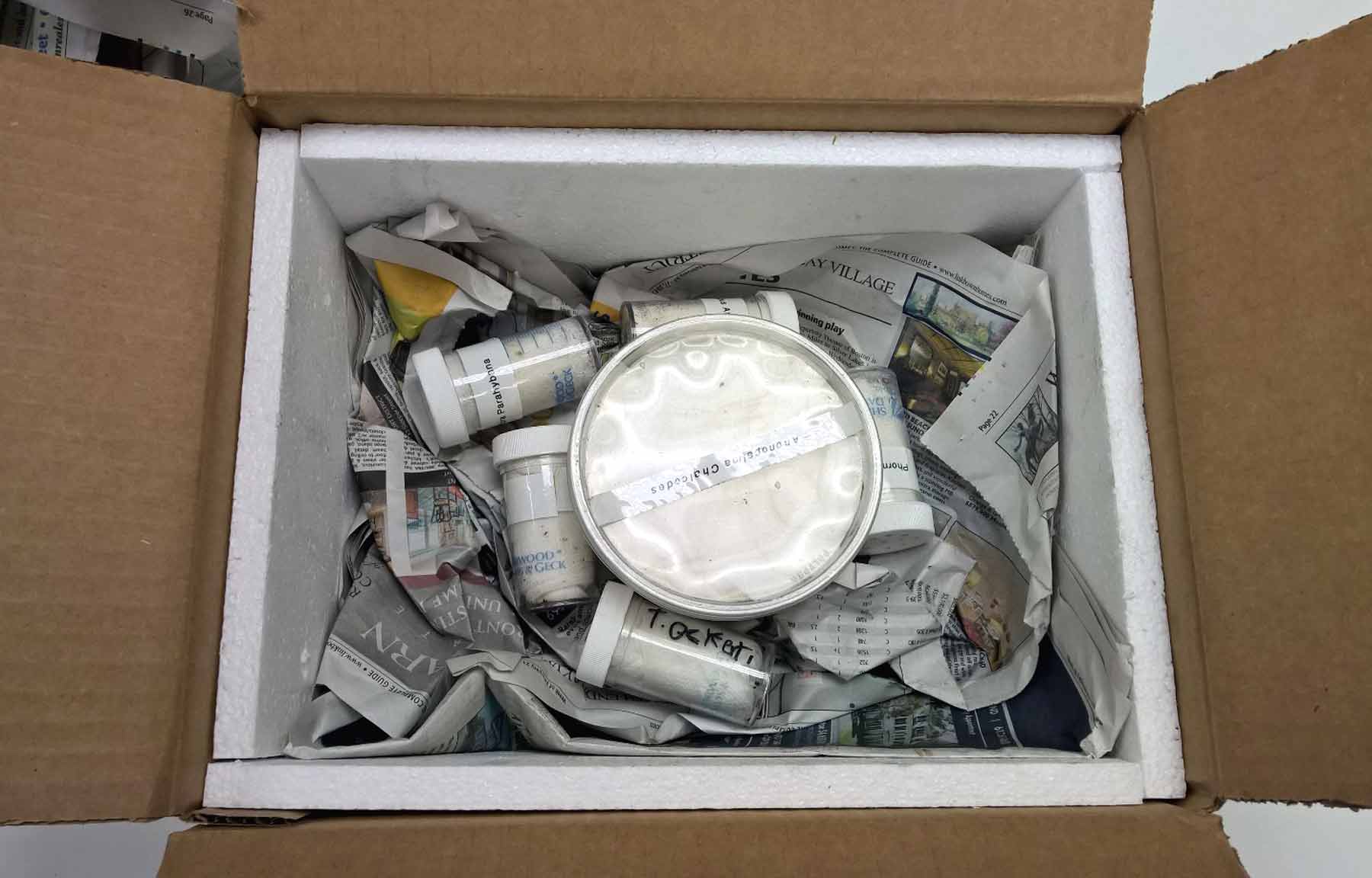
My spiders were expertly packed in a foam lined box with a heat pack included. I loved that the heat pack was securely taped to the top panel of foam, keeping it from shifting during transit and cooking the spiders. The five vials and one deli cup that contained my tarantulas were safely nestled in crushed newspaper; they would have been quite safe if the package had been jostled or dropped.
Nerd heat packI’ve mentioned it other reviews, but how the spiders are packed into the deli cups or vials can make the difference between and easy or nightmarish transfer. My new acquisitions were perfectly packed in their travel containers, and they were very easy to rehouse as a result.

Nerd-Vials-in-box

Nerd-Vials

When I opened my box, I was delighted to discover that Kevin had included a freebie with my order. I now have a new 1.5″ Lasiodora parahybana sling to add to my collection. I love free spiders, so this was definitely a plus.

Condition of the animals

All of my new acquisitions were in great shape and had obviously been well cared for. All six of them we plump and well-fed, and they took to their new homes quickly. Five of them have already taken their first meal; the sixth, the LP, is in premolt. It is apparent that these animals received excellent care by the guys at NERD.

A. chalcodes from NERD.

A. chalcodes from NERD.

P. atrichomatus sling from NERD

P. atrichomatus sling from NERD

T. ockerti juvenile from NERD.

T. ockerti juvenile from NERD.

The guys at NERD know their tarantulas!

My transaction with New England Reptile Distributors could not have gone any better. Kevin was  a true pleasure to do business with, and it’s obvious that the guys at NERD know their tarantula husbandry. Their shipping costs were very reasonable, and their packing was excellent. This was an all-around excellent experience; I would recommend NERD to other tarantula hobbyists without reservation!

Sexing a Tarantula from a Molt – L. itabunae

It’s a girl!

A recent L. itabunea molt. The Epigastric furrow is circled in read, and the spermatheca (female sex organ) is outlined in blue.

A recent L. itabunae molt. The Epigastric furrow is circled in red, and the spermatheca (female sex organ) is outlined in blue.

At least, it’s looking that way.

After many ill-fated attempts in which I clumsily destroyed molts in an effort to sex a tarantula, I finally got one that I didn’t accidentally shred. When I noticed my Lasiodora itabunae laying down a molting mat the other night, I hoped that I might be able to get some good snapshots of its molting process. Well, not only did I get a few cool photos, but I was actually able to remove the molt within minutes of it molting (and before it dried out or was destroyed).

After removing the exuvia, I laid it out on a plate and sprayed down the the twist of abdominal skin to make it more pliable. Using a couple tooth picks, I carefully untwisted the thin tissue and spread it out so that I could clearly see the two sets of book lungs and, what I hoped, would be the female sex organs.

After I identified what I though what I thought was the spermatheca, or the female sex organ that serves as a receptacle for sperm, I posted the photo on arachnoboards to have others chime in. So far, the consensus is that it is a lovely young lady.

This is a particularly nice surprise as my itabunae has become one of my favorite Ts, and they are not particularly common in the hobby. This is definitely one of the species I would eventually love to breed, so having a female is a HUGE win for me.

I’ve got a couple more unsexed Ts getting ready to molt, and I hope to sex a few more soon. With any luck, I’ll have a few more females.

My L. itabunae laying down a molting mat.

My L. itabunae laying down a molting mat.

My L. itabunae on its back in the process of molting.

My L. itabunae on its back in the process of molting.

My L. itabunae just moments after fully casting off its old exoskeleton.

My L. itabunae just moments after fully casting off its old exoskeleton.

My L. itabunae stretching out a day after its molt.

My L. itabunae stretching out a day after its molt.


Rehousing a Burrowing Tarantula – Video

My Hysterocrates gigas gets a new home

Back in late August, I purchased two 1″ H. gigas slings  from Jamie’s Tarantulas . I placed these adorable little guys in tall Ziploc Twist “n Lock containers, and they quickly burrowed all the way to the bottom where they spent most of the next seven months. Every once in a while, I’d catch a glimpse of a leg, or a flash of movement as one of my pets bolted up a tunnel and snatch a prey item. However, for the most part, I rarely saw them out.

Just the other day, I opened the enclosure to find one of the H. gigas juveniles sitting boldly on top of the substrate. Not only was I surprised to see one out and about, but I was also shocked by the size of it. My little slings were now pushing 3″ in length. They were long overdue for a rehousing.

It was time to do some digging!

I currently keep several fossorial (burrowing) species of tarantulas, and many of these spiders are feisty old worlds. Therefore, I’ve had to get accustomed to digging out fast, sometimes aggressive Ts. I’ve had pretty good luck so far, as I’ve found that the majority of them will try to hide as long as possible before making a mad dash from their old enclosure.

Armed with my rehousing tools (spoon, paintbrush, catch cup, etc.), I set to getting these guys into their new homes. With my daughter, Sid, wielding the camera, we decided to catch one of the transfers on video. It’s a bit of a long one, and I’m afraid it’s not the most action-packed video I’ve posted, but I think that it illustrates well that, when digging out an aggressive T, patience and care are both a must.

Enjoy!


Chilobrachys guangxiensis – “The Chinese Faun”

Not just another big brown tarantula

C.-guangxiensis-new

I generally put a lot of thought into the each species of tarantula I buy. Like many hobbyists, I have a long wish list of animals that I have thoroughly researched with the anticipation that I will one day acquire them. There are never impulse buys, and when I pull the trigger, it’s usually on something I’ve been eyeing for months. Every so often, however, I take a chance on a species that I’m not as familiar with and that might not have been in Tom’s Top Ten to Be Acquired list.

My C. guangxiensis was one of these species.

My first exposure to this tarantula came when I found a small juvenile female listed for sale at Jamie’s Tarantulas. Although I was familiar with this tarantula’s cousins, Chilobrachys fimbriatus and dyscolus, I had never heard of this Asian terrestrial with the seemingly unpronounceable scientific name.

I quickly Googled this spider and found that, although it didn’t sport the beautiful blues of a C. dyscolus blue, or the amazing tones and patterning of the fimbriatus, there was still something undeniably beautiful about this T.  When I discovered that the care of this species was the same as others from the genus, I decided to grab her up.

A gorgeous, sleek, velvety-brown species from southern China.

Like other species from this genus, the C. guangxiensis is a fast, slightly defensive obligate burrower that requires a bit of extra humidity and deep moist substrate to thrive. As this faster growing species, I afforded her a bit of extra room to grow and gave her a larger enclosure than I normally would for a spider that size. This also allow me more room for maintenance.

Her first home was repurposed 7.2 quart Sterilite plastic storage container that measured about 11″L x 7.5″W x 8″H. Both ends of the container are vented to allow for good cross-ventilation and adequate air flow. Although this species appreciates a bit of extra humidity, I’m always careful to avoid creating the stuffy, stagnant conditions that could harm or kill a T. I provide a water dish at all times for drinking and for added humidity.

When I received my female, she was about 2″, so I gave her an enclosure with about 5″ of substrate depth in which to construct a burrow. For substrate, I use a mixture of 40% coco fiber, 40% peat, and 20% vermiculite. I find that this blend not only holds moisture well, but it also absorbs water more readily when it comes time to moisten it back up. The sub is damp, but not wet; if you squeeze it in your hand, it will hold its form, but no water will drip out. Once a month or so, I will use a bottle modified to be a watering can to make it “rain” and moisten down half of the substrate.

A hide really isn’t necessary for this species, as if it is given enough substrate, it will quickly dig its own burrow. Before I added it to it’s enclosure, I just created a small hole/starter burrow in the corner. It quickly adapted this hole and used it to create its home. It now has two entrance holes and a large open den at the bottom of the enclosure.

I’ve observed no specific temperature requirements for this species. Mine is kept at 70-77° F during the winter and 75-84° F during the warmer summer months. She has eaten well in both ranges, although higher temps usually lead to higher metabolisms and faster growth.

Just add crickets and watch it grow!

The C. guangxiensis is a medium /fast growing species that can reach 7″ in size. My female has molted three times in the eight months that I’ve kept her, and she has gone from 2″ to about 3.5″. She is a voracious eater, taking down prey with lightning speed before quickly dragging it down into her den for consumption. As a juvenile, she was eating 3 medium crickets a week. Now that she is a bit larger, I’ve been feeding her two large crickets a week.

If there will be any knock on this species, it might be that it can be a bit of a pet hole. Of all of my obligate burrowers, this one might be my most secretive. I sometimes catch it out after the lights go out for the night, or early in the morning, but she will bolt back into her den at the slightest disturbance. This has made it very tricky to photograph. Still, when I see her out an about, it is a true thrill.

This one can throw down the silk.

It should be noted that some keepers have been successful keeping their Chilobrachys species on more shallow substrate with a hide. These species can be prolific webbers, festooning their enclosures with copious amounts of thick webbing. Specimens denied the opportunity to dig will build elaborate homes out of their webbing.

Personally, I like to let them burrow as the deeper depths of the substrate can provide them with a secure and more humid place to retreat to when frightened or when they need more moisture.

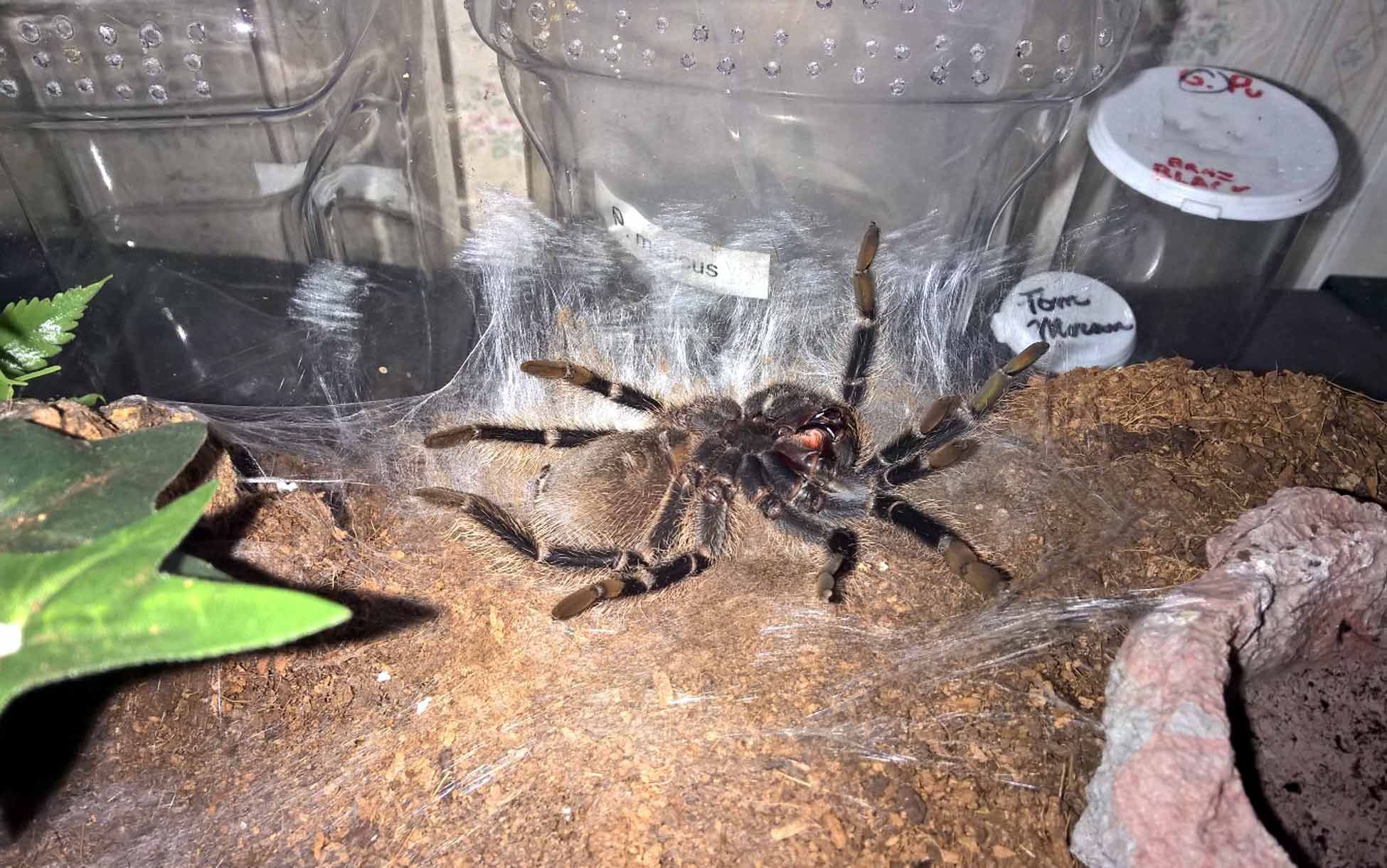
My C. guangxiensis has webbed up her entire enclosure with thick web. Even though she has a den, she will come out at night to lay down more silk, and she will often web the top of her enclosure shut. As a result, I open her cage several times a week to remove the webbing on the lid.

My C. guangxiensis' enclosure. I have to open this one quite often, even when not performing maintenance, as she will often web the top shut.

My C. guangxiensis’ enclosure. I have to open this one quite often, even when not performing maintenance, as she will often web the top shut.

A beautiful addition to an intermediate collection.

Unfortunately, with so many more colorful and easier to keep tarantulas available, including other members of the Chilobrachys genus, I worry that the C. guangxiensis sometimes gets overlooked. Pictures just don’t do this specimen justice, as its slick, shimmering coat and lithe, athletic build make it a stunning specimen in its own right.

And although I’ve seen many photographs that make it appear to be a simple, plain shade of brown, its true tones are difficult to describe and must be seen to be appreciated. For those used to Asian terrestrials, including their attitudes, speed, and care requirements, the C. guangxiensis would make a great addition to the collection.


Tarantula Rehousing Tips … With Videos!

Nothing gets the old heart pumping quite like a rehousing!

With many of my tarantulas outgrowing their current enclosures, I’ve been doing a lot of rehousing as of late. In the last two weeks, I’ve moved about a dozen of my spiders into new homes, and I still have several more to go. When I first got heavily into the hobby, rehousing were something that I used to stress about. After all, the thought of one of these large, fast, sometimes defensive spiders possibly escaping during a botched transfer is enough to the get your adrenaline flowing.

Now that I’ve rehoused dozens of Ts, I actually look forward to this activity. Don’t get me wrong, I still remain cautious and very focused whenever moving spiders, but with experience has come some degree of comfort. I used to fear the tarantula getting out of its enclosure; now I recognize that if the spider doesn’t make it directly into its new home, it’s not the end of the world. I’ve also found that I’m able to stay much more calm, which leads to slower, more deliberate movements (and more relaxed animals).

When rehousing Ts, there are a few different methods to consider. I have tried all the techniques listed below, and I find that they are all quite good depending on the situation. Experience and experimentation will help you to determine which ones work for you and in which circumstances.

The cup method entails simply placing a clear plastic cup over the tarantula, sliding a piece of cardboard beneath the opening, then moving the animal to its new home. You can also tip the cup on its side and use a long instrument like a paintbrush to guide the T into it. Some folks will use deli cups for this procedure, then put the cap on for a safe, secure transfer. This method is particularly useful for larger Ts.

The plastic bottle method is also a fantastic and easy way to transfer slings and juvies. Creating your transfer tool is simple; just take a small plastic bottle (I use a 1 liter seltzer bottle) and cut the bottom off. Like the cup method, place the open end of the bottle over your T. Once the spider is inside, either cover the bottom with cardboard or coax it up the side with a paintbrush. With the spider contained, put the bottle in the new enclosure, unscrew the cap, tilt the neck toward where you want the spider to go, and use a paint brush to guide it out the hole. In most cases, the spider will freely move toward the tapered end of the bottle. This is great for directing a spider directly into a pre-dug den or hide.

The bag method is a wonderful way to transfer fast or defensive slings and juveniles. It entails placing a clear plastic back over the mouth of your original enclosure and affixing it with a rubber band. After poking a small hole in the bag, you use a paintbrush to coax the critter out of the enclosure and into the bag. Once it’s safely inside, you remove the rubber band and carefully pinch closed the bag, being careful to keep your hand away from the spider (they can bite through the plastic). Finally, just put the end of the bag in the new enclosure and carefully maneuver the spider out of the back and into its new home.

Tips for safe transfers

Like most aspects of this hobby, reading about transfers and rehousings only gets you so far. To get comfortable with them, it really takes experience. Keeping that in mind, here are some tips to think about before rehousing.

  • When rehousing, make sure that you have a clear, clutter-free area in which to work. I use my dinner table and try to clean as much off of it as possible.
  • Make sure that pets or small children are safely out of the way. I have three dogs and a younger child, and I always make sure that they are all out of the room when I work.
  • Many keepers also recommend attempting transfers on colder mornings, as the spiders will be a bit less lively and likely to bolt.
  • If you try a transfer, and the T demonstrates its agitation by running around or displaying aggressive behavior, STOP and try again later. There is no need to make the experience more difficult for yourself (and more stressful for the T).
  • You should assume the spider will get out, and prepare accordingly. Negotiating your hands and tools into small enclosures can put you more at risk for a bite. Sometimes it’s simpler to gently coax the spider out onto a table so that you can easily and safely cup it. I’ve found that assuming the spider will get out makes the transfer much less stressful.
  • When possible, you can always leave an older enclosure in the new one if it will fit inside. This way, the tarantula can come out when it is ready. Be warned, though, that some never want to leave!
  • And, above all, stay calm and move slowly. Yes, I know that it’s difficult to stay cool when a large T is attacking your paintbrush, but you don’t want to lose your composure. If something doesn’t go as plan, take a deep breath, try to relax, and keep your eye on the tarantula at all times.

Tools of the trade

It’s very important to be totally prepared when performing a transfer. I like to keep the following tools and materials on hand.

  • Several clear plastic cups, various sizes – I always have multiple “catch cups” on hand, ready to go if a T should try to bolt.
  • A plastic bottle with the bottom cut off – These are GREAT for smaller Ts.
  • Long tongs and paintbrushes – I always have a pair of 8″ and 12″ tongs on hand to help in the process. They can be used to move hides, dishes, and substrates. Paintbrushes are also excellent tools to use to coax Ts out.
  • Small dish towels – These work wonderfully as hiding spots for a bolting T. I like to spread them around my work area so that if a spider bolts, it will likely take refuge under one of these “spider traps”.
  • Pieces of cardboard – Cut some cardboard to size so that you can use the pieces to cover up the bottom of the cup or bottle to hold the T inside.
  • Spoons – These can be handy when you have to dig a species out. Just be careful not to injure the T, and be prepared for an agitated tarantula to burst from its den.
  • Large, shallow Sterilite container – This one is optional, but I like to put the enclosures I’ll be using inside a large plastic storage bin. The bin I use is shallow, allowing for me to easily work. This gives me an added barrier if a T should happen to get out. You can see the one I used in the videos below.

Four transfers, four very different experiences.

Today, I planned to move four different tarantulas: my juvenile A. brocklehursti and my three juvenile Phormictopus sp. purple juveniles. My brock has traditionally been a bit skittish, but has never been defensive. My purples, on the other hand, can be little terrors. I’ve seen more threat postures from this trio than any of my other species. They are quite feisty, and it doesn’t take too much to rile them up.

With the potential for some exciting and unpredictable action, I decided that it would be a good time to break out the camera. My 1o-year-old daughter, Sidney was kind enough to man the camera for me so that we could catch all of the action. Although I’ve done many “easy” transfers, where the spider is quickly moved without incident, I wanted to possibly capture a rehousing that didn’t quite go so smoothly. After all, switching enclosures can be quite tricky, and spiders can act unpredictably. You need to be prepared for anything. 

My A. brocklehursti transfer went about as smoothly as a transfer can go. I mean, this little guy didn’t even need to be prodded out of the bottle; he just plopped down on his own!

As my Phormictopus sp. purple juveniles are quite feisty, I expected that rehousing these guys could be a bit of an adventure. Well, the first transfer went quite smoothly, and the little guy cooperated for the most part.

How do you set off a defensive species? Well, just drop a little dirt on it. This rehousing doesn’t quite go as planned as a bit of stray dirt riles up my second purple juvenile. Despite the inauspicious beginning (and some spider on paintbrush violence), he makes it into his new home.

This stubborn little guy does NOT want to cooperate at first, and it takes a bit of patience and finagling to finally get him into his new home. Of course, he first has to get a piece of that paintbrush. If you watch closely when he attacks, you’ll see why I NEVER hold my tarantulas. Had that been my hand, I would have flicked him into the air.

For those looking to rehouse a fast and feisty arboreal, here is a video featuring my P. hanumavilasumica.

Transferring Fossorial (Burrowing) Species

As I’ve received several questions about how I go about rehousing fast-and-feisty fossorial species, I’m adding a couple movies to this tutorial. What follows are rehousing videos for my H. Gigas and O. philippinus, both species that built dens deep in the substrate.