Communal Project Part 3: First Week’s Observations

The Communal Project series will document my setup of a Moncentropus balfouri communal, starting with the planning and acquisition of both the enclosure and tarantulas and continuing through as they mature. This is the third installment in the series; the first part is “Communal Project Part 1: An Enclosure by Brooklyn Bugs.” and the second part is “Communal Project Part 2: Nine M. Balfouri Slings” .


How will they adapt to the communal setup?

Now that the nine M. balfouri slings were housed in their new enclosure, it was time to let them settle in and to observe their behaviors. Although I had read plenty of accounts that should have assured me the risk for casualties was minimal, I still worried that that the tiny little slings would somehow turn on each other as they staked out territory and fed. After hearing for years how cannibalistic tarantulas were, it was very difficult for me to subdue the nagging feeling that this wasn’t going to work out.

However, I would soon learn that my fears were completely unfounded.

Within 24 hours, I started to see signs that my new wards would indeed be able to live peaceably. The following details my observations over the first week, including any details I thought were important or interesting.

DAY ONE: The evening they arrived, I decided to offer food right away. For the first meal, I dropped in 10 tiny B. lateralis pinhead roaches. I won’t lie; when I woke up the next morning, I rushed down to check on the communal partially expecting to find signs of spiderling cannibalization. Instead, I discovered that the little ones had been busy the night before, and fine curtains of webbing now covered some of the den entrances and cork bark.

Even cooler, four of the slings were bustling in and out of one burrow opening. Despite having shot off in several directions upon being housed, it seemed that the slings really had started to gravitate to the same den.

I also watched nervously as two slings encountered each other in another corner of the enclosure. At first, I was convinced that the larger of the slings was going to attack and kill the smaller. As they met, he froze, then reached out carefully with his first set of walking legs, almost as spiders do when they sense a prey item nearby. However, the other sling quickly reciprocated by putting out his fist sets of the legs. The two entwined for a bit, much in the same way males and females do when mating, as they continued to feel each other out. Then, about a minute later, they both walked off in different directions.

No attacks.

No bites.

No devoured sling.

I was amazed by the encounter; it appeared that they could differentiate between one of their own species and a prey item. There was no friction whatsoever. After watching many spiders reflexively pounce on anything that moved in their enclosures, I couldn’t help but to feel a bit mind-blown by this development.

As for feeding, I wasn’t sure if any of the roaches were devoured, and there still appeared to be several of them running around the enclosure. The slings either didn’t notice or didn’t care as they continued working on their den. I decided to give it another day to see if I could catch one or more feeding.

DAY TWO: Having seen a few of the roaches I dropped in still roaming around without a care in the world. I worried that some of the slings might not be eating. Remembering that the M. balfouri mothers often kill prey for their young, I killed a large cricket, mashed it up a bit, and dropped it in front of the den entrances. My hope was that I could catch some of this group feeding I had read about.

I popped in to check on the little guys before bed, and was floored by what I saw. Several of the slings were feeding on the cricket at the same time. Even more interesting, there was no fighting or friction between the feasting tarantulas. They very calmly approached the cricket, tore off a chunk of meat, and simply ate their meals.

I also observed that at least FIVE of the slings now occupied the same burrow. They really were purposely gravitating to the same burrow despite having enough space to stake out their own homes. This was true communal behavior I was witnessing, not just a bunch of spiders sharing space because they were forced to.

DAY THREE:  I crept down late at night to see what my communal was up to (darned insomnia), and I discovered that all nine slings were apparently sharing the same den. For a full five minutes, I watched as they moved in, out, and around the single den entrance with at least four of the slings laying down webbing. They weren’t just living together; it appeared that they were cooperating with each other to build their home. AMAZING.

DAY FOUR: Failing to capture the group feeding on film the first time, I dropped another cricket in on the third night hoping that I might be able to get the next meal on video. I awoke early the next morning to discover several of them eating off of the same cricket. Like a buffoon, I sat their ogling this for bit before remembering to record it. By the time I grabbed my phone, a couple of the spiderlings had toddled off. Still, I managed to catch a few of them eating in the video below. Again, there were no spats or fighting to speak of, and the slings obviously recognized the difference between the prey and the other spiders.

DAY SEVEN: It’s official: all of the slings have adopted the center den as their home, and all are living communally in a single den. The amount of webbing in this area has increased with all lending a hand (or their webbing) to the construction. There are now several entrances including the main one, and the slings spend much of their day going in and out of them.

So, I can cross one of my questions off my list.

  • Will the slings all gravitate to one burrow?

Yes, they sure will…and cooperate to build it apparently.

Having raised three M. balfouri slings to adulthood that were kept alone, I do have a couple observations:

  1. I’ve noticed that these slings are out in the open MUCH more than my specimens kept separately ever were. Although I’d catch mine out and about every so often, they were very skittish and would spend the majority of their time hidden in their burrows. Perhaps my communal subjects will display more of that secretive behavior as they become more mature, but so far they seem to be much bolder than my last specimens. Could this be because they feel more secure when kept communally? I’m not sure.
  2. My first batch of slings were very finicky eaters, often going weeks without eating and often refusing prey one week only to indulge the next. They would also be intimidated by normal sized prey items, and I’d have to feed them crickets that were smaller than what I would usually feed slings that size. As a result, they grew slowly often taking several months between molts. These new slings, however, have been eating like machines. I drop a cricket in and they are on it in minutes. Now I’m wondering if these slings will eat more and grow faster in the communal setting.

With these latest developments, I would have to revise my list of question I wanted to answer.

  • Will the slings all gravitate to one burrow? An enthusiastic YES for this.
  • Do they really eat together and without friction? (I want to catch more feedings)
  • Is their any difference in behavior in M. balfouri slings kept communally as apposed to kept individually (I raised three from slings previously)
  • Will their ability to get along change as they mature?
  • Do M. balfouri slings kept communally eat more and grow fast than those kept alone?

As I move ahead, I’ll look to answer these questions and will post updates whenever I observe, photograph, or film something of interest!

Next up…M. Balfouri Communal Project Part 4: How Many M. Balfouri Slings Does It Take to Eat a Large Roach?


Communal Project Part 2: Nine M. balfouri Slings

The Communal Project series will document my setup of a Moncentropus balfouri communal, starting with the planning and acquisition of both the enclosure and tarantulas and continuing through as they mature. This is the second installment in the series; the first part is “Communal Project Part 1: An Enclosure by Brooklyn Bugs.”


After a couple of years of research and daydreaming, I will finally be setting up my first communal.

I’ve been fascinated by communals since I first saw photos of H. incei setup on a forum several years ago. I had always known tarantulas to be cannibalistic, so I was intrigued by the idea that a group could live together harmoniously without it turning into a survival of the fattest bloodbath. Since then, I’ve read articles and blogs, watched YouTube videos, and even spoken to a couple keepers who have tried it. I’ve researched the many species said to tolerate a communal living situation, including Poecilotheria species, Heterothele villosella, Neoholothele incei, Pterinochilus murinus, and of course, the Monocentropus balfouri.

Although all of these species have demonstrated the ability to co-habitate with other members of their species without immediately resorting to cannibalism, the level of true “communalism” can vary greatly. Every keeper would love to witness a true tarantula community where members actually benefit from living in close proximity to each other, possibly hunting and even eating together. But the fact is, many of these species are forced to live closely together in the wild due habitat constraints; they don’t naturally prefer it. Therefore, when they are forced to live together in an enclosure, the relationship between the inhabitants more closely resembles a fragile tolerance than a strong communal bond.

As a result, many keepers who have tried to keep communals have found the need to abort the projects upon discovering that their ten lithe specimens had suddenly become five portly ones. With many of the communal setups,  cannibalism is a constant threat, and the thought of needlessly loosing often expensive Ts is enough of a deterrent for many keepers. Personally speaking, I love my spiders and pride myself on not having many deaths in my collection. The possibility that by creating a communal I might putting a group at risk of unnecessary death was a tough concept for me to get by.

One species has always stood out for me in the communal list…

One of the species that seemed to demonstrate some legitimate communal tendencies was the Monocentropus balfouri. I had discovered early on that this beautiful tarantula had some of the strongest motherly instincts of any species, and a quick Google search of “M. balfouri mother with slings” brings up some amazing photos of this maternal spider seemingly nurturing its young. This is an animal that keepers have witnessed killing prey to feed its spiderlings, as well as standing guard over them like a protective parent. Hobbyists that have kept this species communally report slings huddling together in the same burrow, even when given space, and feeding on the same prey…together. I have read several accounts by folks who have set up more than one balfouri in an enclosure, and it seems that it doesn’t matter the size of the specimens that are introduced together, they all live quite harmoniously.

After reading several accounts by keepers who had tried communal setups, it seemed that the chance of casualties was low…ridiculously low. I only found one instance where one of a group of about a dozen disappeared, but there was nothing to indicate it didn’t just die a natural death (and not at the fangs of one of its cage mates). Even more promising were the many photos of juveniles and adults living and even feeding together peaceably.

It seemed like if I was going to attempt a communal setup, M. balfouri would be the species to do it with. However, although the prices on these gorgeous Ts have continued to drop over the years, they still run about $60 or so for slings. It would be quite an investment to get one of these going, especially if I wanted to start with more than just a handful. For a little while, it seemed like it would remain a bit of a pipe dream.

Enter Tanya from Fear Not Tarantulas

After my last fantastic experience buying from Fear Not Tarantulas, I got to chatting with Tanya about spiders, the blog, and her breeding projects. It’s been fantastic conversing with someone who is not only knowledgeable, but also thoroughly entrenched in this amazing hobby. During one of our conversations she made an amazing offer; she would hook me up with enough M. balfouri slings to finally start that communal I had been pondering for years. To say I was ecstatic would be an understatement.

The original plan was to start with five or six specimens, so I had to go ahead and set up an enclosure that wouldn’t be too large for the .75-1″ slings, but that would also allow for plenty of room for growth (for more on the enclosure, click here!). Once the enclosure was ready, I gave Tanya the go ahead to ship my tarantulas. I had shared my photos and ideas for the design of the enclosure with Tanya, and when it arrived I explained that it was a little larger than my first idea, but I thought that it would work out well. After texting me with updates on the packing (as well as a photo of the A. amazonica I was was also getting), Tanya informed me that she was actually sending nine M. balfouri. NINE. I was absolutely floored. The extra space would definitely go to good use.

She shipped them promptly and they arrived expertly packed, labelled, and in fantastic shape. As a picture is worth 1000 words, I’m guessing that a video is worth even more. Below is the video of the unpacking along with the rehousing of the nine M. balfouri slings into their new homes (the rehousings start at about 3:32). I will admit to feeling just a bit of apprehension as I started loosing the slings into their new enclosure together. A part of me really worried that they might turn on each other or I might capture friction on camera.

It soon became apparent that my fears were unwarranted as the rehousing went off without a hitch and the nine little slings scuttled to the pre-formed burrows without a single incident of aggression. Even better, when I checked on them later in the day, a few of the slings had actually taken residence in the same burrow.

I’m finding the communal setup utterly fascinating, and I’ve been checking on them constantly to see how they are getting along. So far, so good. As these little guys continue to make this new enclosure their home, I will continue with updates including my observations and video/notes on any behaviors of interest. A few questions I hope to answer are:

  • Will the slings all gravitate to one burrow?
  • Do they really eat together and without friction?
  • Is their any difference in behavior in M. balfouri slings kept communally as apposed to kept individually (I raised three from slings previously)
  • Will their ability to get along change as they mature.

Next up…M. Balfouri Communal Project Part 3: First Week’s Observations (and Video of Group Feeding!).

* A very special THANKS to Tanya at Fear Not Tarantulas who made this whole project possible! 


Hysterocrates gigas – “Cameroon Red Baboon”

A gorgeous, if a bit reclusive, baboon species.

H.-gigas-full

Back in August of 2014, I ordered a couple .75-1″ Hysterocrates gigas slings from Jamie’s tarantulas. At this time, I had been acquiring several baboon species, and I had become fascinated with the gigas since discovering YouTube footage of one seemingly diving into water and swimming. I had never heard of this behavior from  a tarantula before, so I decided that I definitely needed one in my ever-expanding collection.

Upon receiving the two timid slings, I housed them in 32 oz Ziploc deli containers. The T. gigas is a fossorial species that loves to build intricate and extensive burrows, so the taller cups allowed for several inches of moist substrate for tunneling. Within a day of being introduced to their new homes, both of my slings burrowed straight to the bottom.

The first several months I kept my gigas slings, I rarely saw them. I keep a number of fossorial speices, and I usually have good luck catching them out and about in the morning when I come down for work and first turn on the lights. These guys, however, were much more reclusive and difficult to spot. Occasionally, I’d catch a glimpse of a back leg as one quickly slunk down into its burrow, but that was about it.

I did know that they were eating well. Twice a week or so, I would drop in a cricket, and it was almost always gone by morning. On the rare instance that the prey item was still there the next day, I would just assume the spider was in premolt and wait a week to try again. Due to the amount they were eating, I guessed that they had to have put on quite a bit of size during this period. However, the fleeting glimpses I was able to catch of them made it difficult to assess their size.

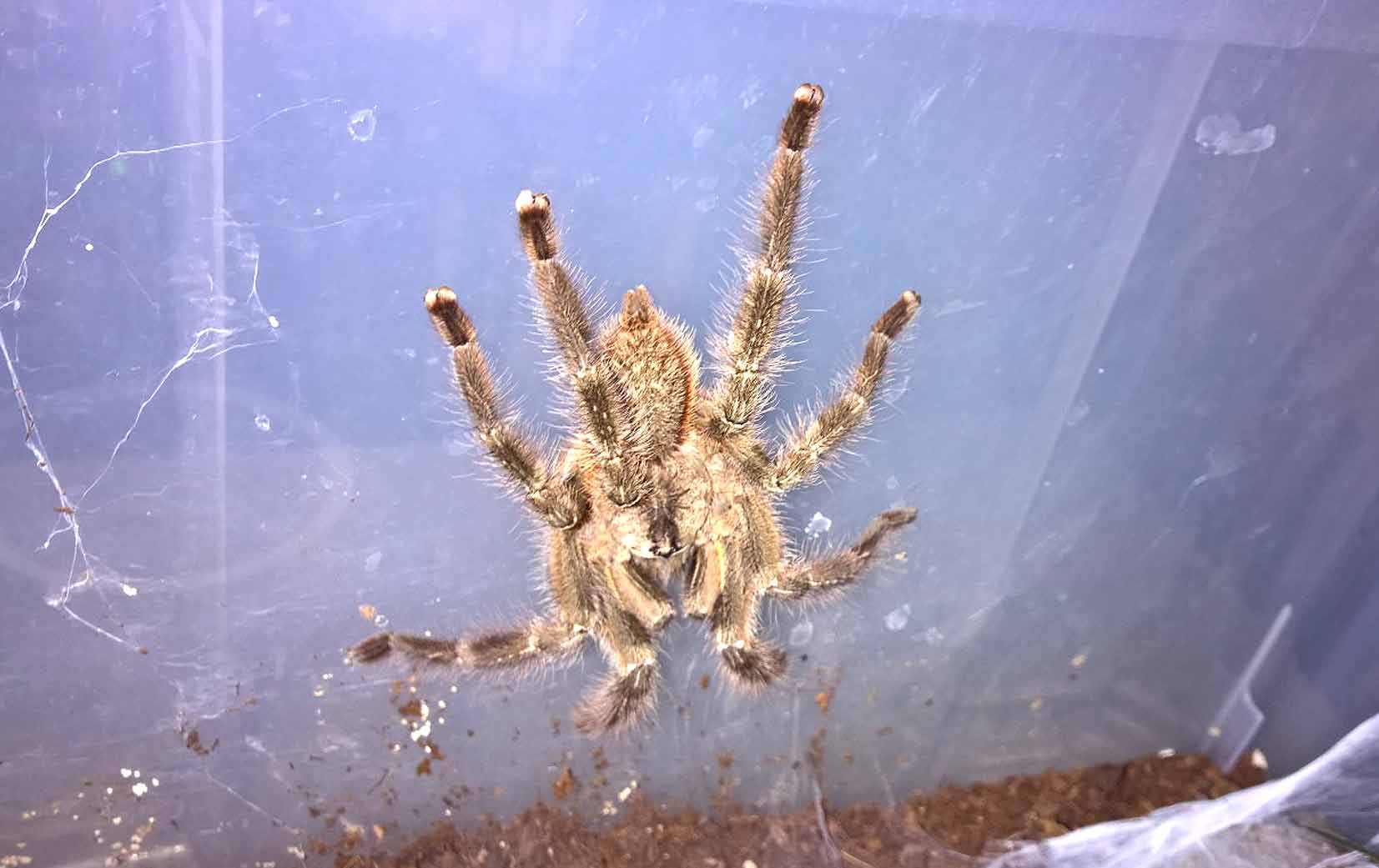
My H. gigas young adult retreating to her den.

My H. gigas young adult retreating to her den. Check out those thick back legs…

For temperatures, they were kept 72-75° in the winter and 75-80° in the summer months. I didn’t notice any difference in how much they ate due to seasonal temperature changes. This is a species that does not tolerate dry conditions, so I made sure to keep the substrate moist by periodically pouring water in and letting it percolate down the sides of the enclosure. This helped to keep the lower levels of its den damp even as the top of the substrate dried out a bit. I also provided each with a small water dish (both were unceremoniously buried several times).

Definitely a fast-growing tarantula.

Finally, in March of 2015, about 7 months after I first acquired them, I opened one of the enclosures to find a gigas perched right on the surface. I was floored. My little sling was now easily a 3″ tarantula. I had heard that this species had a fast growth rate, but I wasn’t prepared to discover a spider this large. It was time for a rehousing.

The H. gigas is an Old World species recognized as having a nasty disposition and a potent bite, so I was particularly cautious when rehousing these two. They both proved to be a bit skittish, but I saw no defensive behavior from either. That said, tarantulas are known to experience temperament changes as they mature, so they could easily develop a bit more attitude in the future. Many keepers have reported that their specimens are quite defensive and willing to bite. Currently, both of my specimens are spending more time on the surface, and I usually catch them out in the mornings. If disturbed, they will immediately bolt back to their burrows (which made getting these photos a joy!).

My, H. gigas enclosure

My, H. gigas enclosure

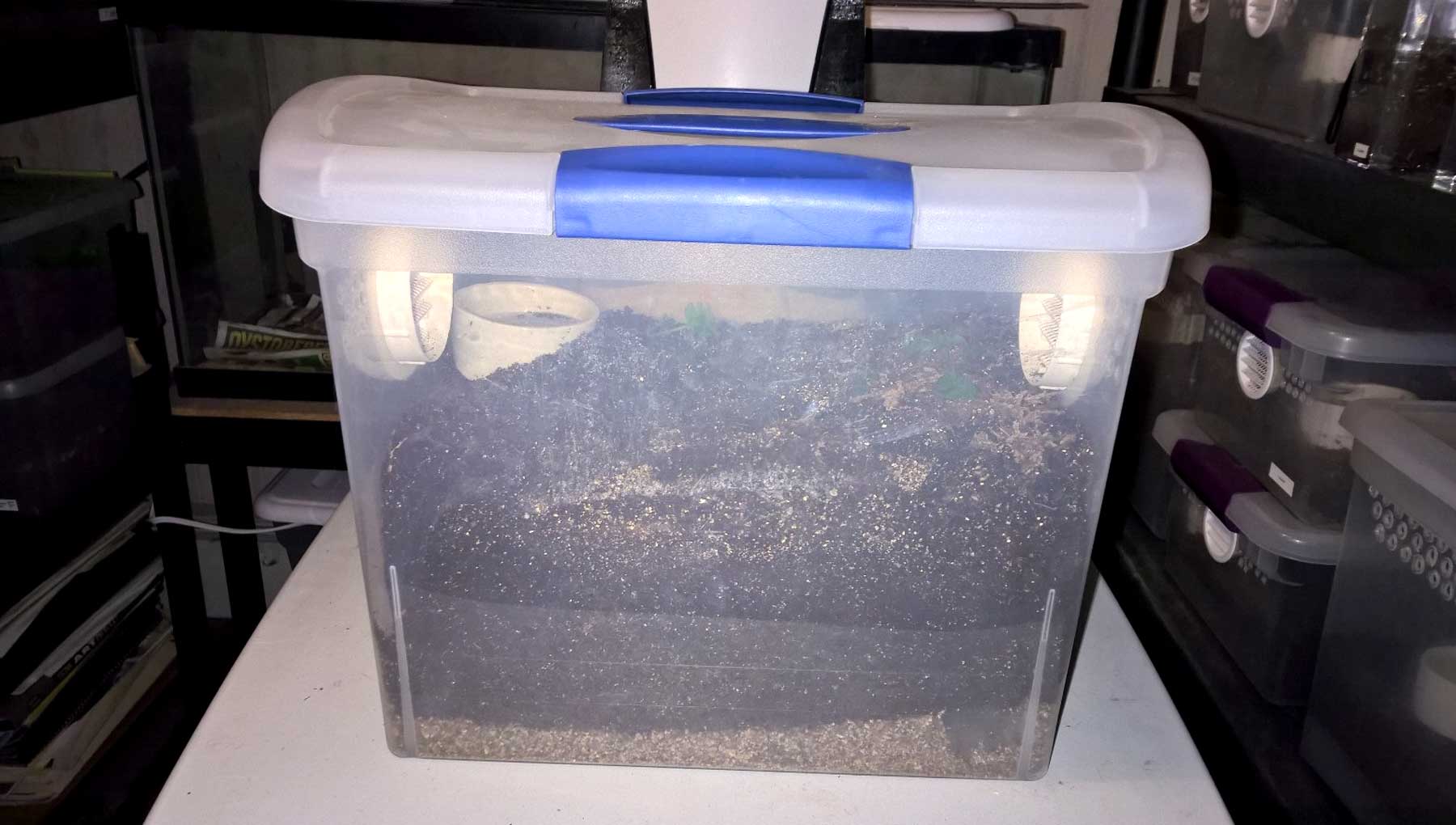
Now that they are about 5″ each, they are housed in large Sterilite plastic containers with about 7″ of moist substrate and water bowls. Both  dug to the bottom and have excavated huge burrows beneath the surface.  I currently feed them each one large dubia roach once a week. After their next molts, I will likely rehouse them into their final enclosures, which will offer a bit more space and about 10″ of moist soil to dig in. I’m also still giving some thought to creating a custom enclosure for one that would allow for a deep water area in one end. It sure would be cool to observes some of that swimming behavior in  person…

The H. gigas is readily available in the hobby with slings usually fetching about $15-20. For those interested in fast-growing Old World fossorial species, that price is an absolute steal. This is a beautiful and interesting species, if a bit shy, and a wonderful to addition to any baboon tarantulas enthusiast’s collection.

If I Knew Then What I Know Now -Tarantulas FAQ

Or, the very basic information every new tarantula keeper needs to know.

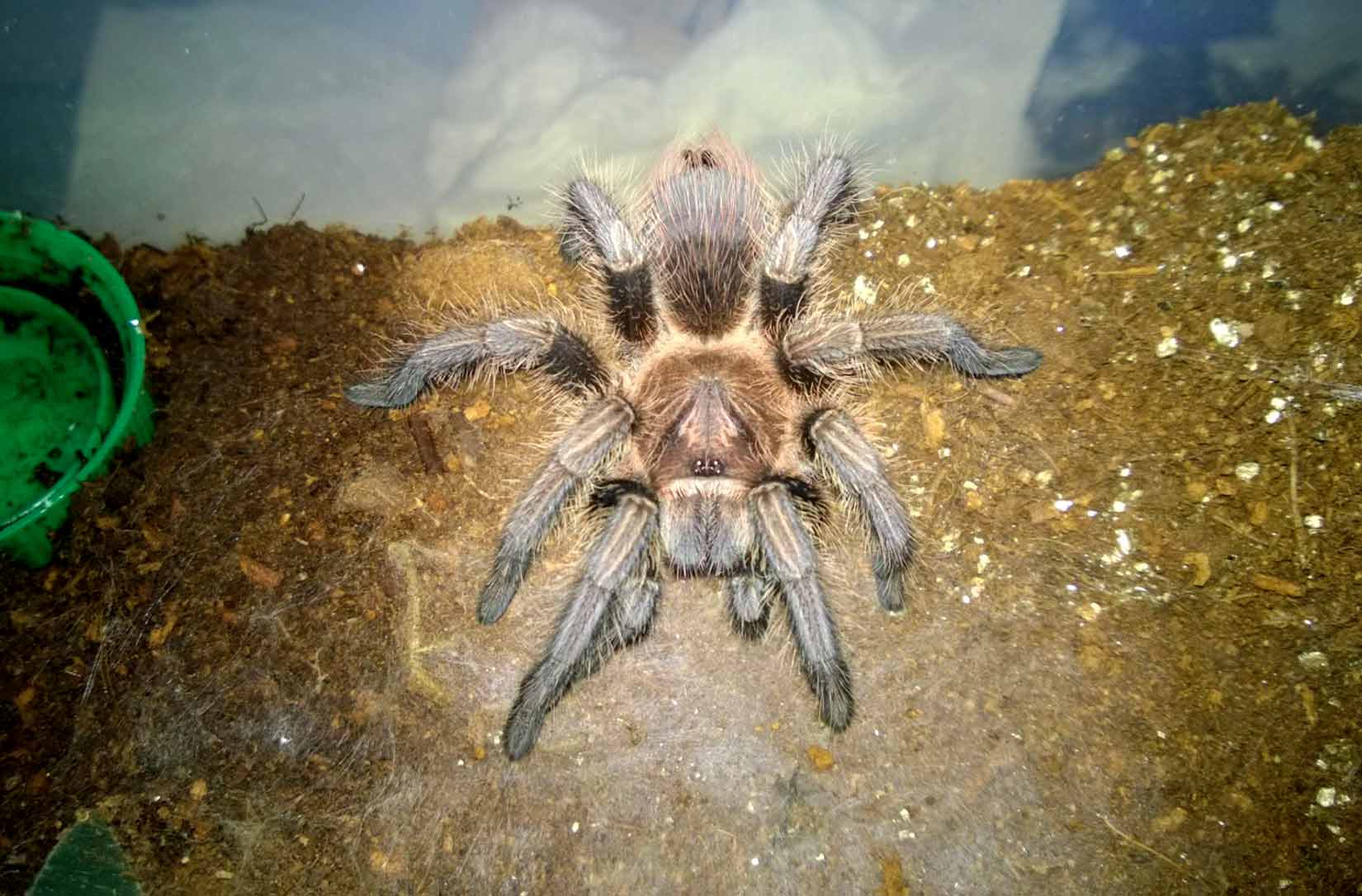
Anyone who has followed my blog or YouTube page has likely heard me talk about the first tarantula I ever acquired. About 20 years ago, after being an arachnophobe for my entire life, I decided that I would get a tarantula to help me get over my irrational fear. This was an animal that fascinated me as much as it terrified me, and I was hoping that handling a big, hairy spider would be an eventual cure. Finding one for sale in the Bargain News, I drove to a fellow exotic pet keeper’s home to procure my new pet. $20 later, I was the proud owner of Grammostola porteri (which I knew only as a “Rose Hair” tarantula). Although I had several dozen snakes at the time, this fluffy little spider was the biggest “oddity” in my collection, and folks often asked to see her when they visited

The fact that this tarantula survived all of my husbandry missteps and general arachno-ignorance those first few years (there wasn’t a lot of great information back in the mid-’90s!) is a testament to just how hardy this species is. Every mistake that could be made, I likely made it, and I truly feel terrible for my poor girl … hence why she has a fancy cage kept right in the center of my vast collection now!

I spend a lot of time talking to new keepers, and when I get asked questions that they think might be foolish or obvious, I try to point out that it really doesn’t feel like that long ago that I had the very same questions. We all start somewhere and, for some of us, many mistakes were made along the way. After doing some reminiscing about my beginnings in the hobby, I thought it might be fun to put together a list of some of the information I wish I knew back then along with some anecdotes about by own missteps and misinformation. With any luck, this will be a fun and informative way for those new to the hobby to learn some basic information about these fascinating creatures while I share some personal (and sometimes embarrassing) anecdotes. For those who are more established, perhaps you will have some stories of your own to add…

And now, things I wish I knew when I first started keeping Ts!

A tarantula on its back is not dead; it’s simply molting. I worry that this misconception has lead to much misery and more than a few dead spiders. During my first year keeping my G. porteri, I discovered her on her back one morning. I called my wife over, and we were both very upset that I had apparently lost my spider. As luck would have it, I had to go to work, so I left her in her enclosure with the full intent of burying her later. When I returned home that night, I opened her cage and stared in total confusion. Not only was my girl still alive, there were now TWO tarantulas in the enclosure!

Itabunae-post-molt

My L. itabunae just moments after fully casting off its old exoskeleton.

It took me a few minutes to realize that my T hadn’t miraculously spawned a duplicate a-la Gremlins; she had molted her exoskeleton. I had come dangerously close to burying my new pet alive. Sadly, I’m not the first keeper to experience this, and I’ve heard many horror stories about owners who mistakenly tossed their pets thinking them dead. When tarantulas molt, they turn onto their backs for the process. If you see your tarantula on its back, there is no need to panic. Sit back, relax, and enjoy one of nature’s most fascinating events.

Mature males live far shorter lives than females. The second tarantula I ever bought was an adult Aphonopelma seemanni that I acquired at a reptile convention. I took my new pet home, built him what I thought was an awesome enclosure with deep substrate, a pre-made burrow in florist’s foam, and a water dish. I put it in its new home and waited for it to acclimate and eat.

Well, it never did. Instead, it spent all of it’s time climbing the enclosure walls in a seemingly endless effort to escape. I couldn’t figure out what I had done wrong, and I worried that my husbandry was leading to his restlessness. My fears were seemingly realized when, several months later, my new pet curled up and died.

It was years before I stumbled onto an article about spiders that helped me to understand what really happened. My A. seemanni had been a mature male at the end of its life cycle. Many mature male spiders don’t eat ever again and spend all of their time wandering and looking for a female. At this point, they are on borrowed time; they will either be devoured by the female during copulation, or die of old age. A dealer had likely unloaded this specimen on me as it had either already bred or he didn’t have use for it.

Over the past several years, I’ve talked to many folks who were either sold a mature male, or had a sling mature into one and had no idea why it was restless and wouldn’t eat. This can be very upsetting to folks who blame their husbandry for nature taking its course.

There are major differences between Old World and New World tarantulas. For years, I thought that a tarantula bite was like a bee sting. Luckily, this wive’s tale didn’t end up biting me (no pun intended) in the can. At the same show I bought my A. seemanni at, a dealer was selling a magnificent and terrifying spider labeled “Thailand Black Tarantula.” This large ebony beauty was in a five gallon tank, and it was baring its fangs and spastically slapping at anything that moved (which, in this crowded show, was a lot). I was totally enamored with this animal, and came very close to buying it. Although my wife worried about it’s temperament, I assured her that if it did bite me, it would only be about as bad as a bee sting.

WRONG!

The fact is, HAD I bought that T, and HAD it bitten me, I would have been in for a very nasty surprise. As an Old World species, this tarantula’s bite was medically significant. Although the bite wouldn’t have killed me, I would have been in excruciating pain and suffered other complications like cramping, nausea, and vomiting.

New World species, or tarantulas from North America, South America, and the Caribbean islands, kick urticating hairs from their abdomens as a means of defense. These barbed, irritating hairs get caught in skin, eyes, and nasal passages causing extreme discomfort. New World species have weaker venom, and in many instances, their bites are about the same as a bad bee sting. However, the hairs can be just as nasty and effective.

NEW-WORLD-COMPARISON

Old World species of tarantulas (Ts from Asia, Africa, Australia, etc) on the other hand, lack the urticating hairs of their New World counterparts and will therefore use their fangs and more potent venom for defense. Although a bite from an Old World species won’t kill you, it can cause excruciating pain, dizziness, full body cramping, and nausea. Simply put, the can put a real hurtin’ on you. These fast ‘n feisty spiders demand a bit more caution and experience to care for.

I still talk to many folks who are new to the hobby that don’t realize that the “bee sting” comparison is a myth and don’t know the difference between New and Old World tarantulas. Even more disconcerting, I have many try to tell me that they’re not worried about being bitten by a T because it can’t kill them. Yikes. For those interested in learning more about tarantula bites, you can check out the article “A Word About Tarantula Bites”.

You don’t have to handle your tarantulas to be a “real” keeper. When folks find out that I have tarantulas, one of first questions they usually ask is, “do you hold them?” Back when I first got my G. porteri, my friends and family were constantly asking when I would handle her, and I’ll admit to feeling like a bit of a chicken for having never attempted it. After all, that was the point I got her, right?

Finally, the day came. Mustering up all of my courage, I sat her enclosure on my floor, opened it up, and set my hand inside. Using my other hand and a paintbrush, I carefully poked her back legs. With a speed I had never seen from her before, she wheeled around and latched onto the brush with her legs and fangs.

And this sudden violence, a feeding response most likely, shocked me so badly, that I actually passed out. Yup, like out cold.

I woke up a bit later, confused,light-headed, and slumped against the wall, to find my girl perched right at the lip of her enclosure almost as if she was laughing at me. I regained my composure, shooed her back into her cage, and decided that was the last time I would ever attempt to hold a tarantula.

Since that embarrassing experience, I’ve completely overcome my fear of spiders, and I’ve actually held a few of them without incident. However, I choose not to handle them anymore as they get nothing out of it and I know that if I get bit, I’m likely to toss the T, hurting or killing it.

Euathlus sp. red

Euathlus sp. red after she crawled out of her enclosure and into my hand. Note: I normally do not handle my Ts

Now, can you hold your pet? If you’ve done the research and have a tractable specimen, of course. However, handling is certainly not mandatory, and many serious keepers have a hands-off policy with their arachnids. I’ve spoken to many new keepers who seem to think that all “expert” tarantula keepers hold their animals, which is definitely not the case. It’s personal decision best left up to the responsible keeper to decide.

Care sheets and their “ideal” temperatures are total nonsense.  When I first acquired my G. porteri, I got a tri-folded care sheet from a convention that supposedly detailed the correct husbandry for this species. This document mentioned “ideal” temperatures in the 8os and (wait for it) humidity levels around 80%. Even worse, it suggested using heat lamps or heat rocks for added warmth and recommended spraying the T and its enclosure once a week.

Of course, this is a species that does well in temps in the mid 60s, so this ideal of 80 is nonsense. At the time, I didn’t realize that, so I used to keep the enclosure dangerously close to one of my snake’s heat lamps to keep it nice and warm. It was a minor miracle that I didn’t fry my poor spider doing this, as the heat could have very well have dehydrated my G. porteri.

Even worse, this guide made me think that I had to keep my spider moist, when in fact, this species abhors moisture. For a while, I kept half of the substrate in the enclosure moist, as I thought that this species needed high humidity. It was only after I noticed that she seemed to avoid the wet areas like the plague that I stopped the needless spraying and just started using a water dish.

As it stands, this bogus care sheet led to me accidentally torturing my poor spider with inhospitable conditions (although it could have been much worse). The fact is, generic care sheets usually do more harm than good, and anything mentioning “ideal” temperatures or humidity requirements should immediately tossed in the garbage. I would be willing to bet that many tarantulas are lost due to folks obsessing over false temperature and humidity requirements. Pet stores will often try to sell folks supplementary heat items, like lamps, heat rocks, and mats, and the fact is, these can prove deadly to tarantulas. In most cases, no supplementary heat is needed; they do fine at room temperature.

For more on temperature and humidity, check out “Humidity, Temperature, and Tarantulas“. Or discover more about why care sheets are to be avoided in “Tarantula Care Sheets – an Unnecessary Evil”.

When a tarantula buries itself, there’s no need for panic. Although I never had a problem with my G. porteri burrowing, this became a issue for me when I got my first slings. After about a month of watching my Lasiodora parahybana sling take down every prey item I dropped into its enclosure, I awoke one morning to discover that it had completely closed off the entrance to its den.

Was this purposeful? Had the den caved in? Was it dead? How would it eat?

As the days passed with no sign of my LP, my anxiety grew. I was convinced that the little guy was dead, and I even made the terrible mistake of trying to push a roach into the area I thought to be its webbed up its den entrance (something one should never do). I continued to keep a corner of the substrate moist, and just assumed that I had lost my first sling. Luckily, after a bit of research, I learned that this was normal behavior, and I decided to leave the poor thing along. Sure enough, about a month later, it reopened the mouth of its burrow and sat at the top, hungry and a bit larger.

The fact is, when a tarantula buries itself, it’s the T’s way of putting up the “Do Not Disturb” sign. This is a very natural occurrence, and the keeper just has to trust that their spider knows what it’s doing. It’s not buried alive, it’s not starving, it’s not dead … it just wants to be left alone for a bit. Still don’t believe me? Check out “Help…My Tarantula Buried Itself!”.

Tarantulas can be terrestrial, arboreal, or fossorial. Back when I first got into the hobby, I was heavily into snakes and attended many reptile conventions. At these events, there were always a few dealers who were peddling tarantulas with most displaying them in large terrariums to garner a bit of extra attention. I keenly remember that a few of the species seemed particular ornery as they sat in the center of barren enclosures on a couple inches of vermiculite, angrily slapping at everything.

I now realize that part of the problem was that many of these species were being kept incorrectly, either due to display purposes or just bad husbandry. Back then, I could remember dealers telling folks that all species do well in a 10 gallon aquarium with a couple inches of substrate. This one size fits all approach to tarantulas was of course quite wrong.

I now know that there are three basic types of tarantulas.

Terrestrial tarantulas live on the ground and do well with a few inches of substrate and a hide (often a piece of cork bark). It should be noted that many terrestrial species will burrow as slings, but will outgrow this behavior and stay out in the open as they mature.

Fossorial tarantulas live in burrows under ground. These species need deep substrate to construct their homes, and do not need to be offered hides as they will dig their own. Many fossorial species will spend the majority of their time underground, proffering their keepers only glimpses of their front legs as they wait for prey.

Arboreal tarantulas live off the ground in trees in their natural habitat. These species need more height for their enclosures and branches or cork bark to climb on. For most, substrate depth isn’t important as they will spend the majority of their time on the decorations or walls.

In the same vein, there are also arid species that require dry substrate and moisture-dependent species that need moist substrate to thrive. A keeper who does his or her research will be careful to consider all of these factors when setting up a proper home for a new spider.

Tarantulas are amazing escape artists. This one almost bit me in the butt with my A. seemanni. The first tank I put her in was meant for fish, so the acrylic top had a smallish hole in it for a filter. Considering that this tarantula was about 5″ long, I figured there was no way he could fit through the hole.

Boy was I wrong.

While at work, I got a frantic call from my mother who was babysitting my son at my apartment. Mom was terribly arachnophobic, and it took a lot of convincing to get her to come to my home because of the spiders. Well, while she was there, my A. seemanni squeezed out of the hold and was sitting right on top of the enclosure when she entered the room. She grabbed her keys and my son and refused to come back.

Although the story is quite funny now, this oversight on my part could have led to the death of my spider. The fact is, these animals can squeeze through any gap that will allow their carapaces to fit through. They are also quite strong and able to lift up the corners of unsecured tank tops. Do you have a fancy enclosure with wire mesh vents? Well, you might want to replace them as tarantulas can chew right through them with little effort.

When choosing a home for your new acquisition, it’s always important to make sure that it is secure enough to adequately contain your new ward.

chewed-vent

A wire mesh vent that my L. itabunae nearly chewed completely through.

Tarantula common names, although sometimes cool, are often quite useless. For years, I referred to my G. porteri as my “Rose Hair” or simply my “rosie”. I was used to referring to my pets by breed names, like labrador retrievers, pit bulls, etc for my dogs, or common names for snakes, like boa, corn, or king. It never occurred to me that I should ever have to learn the scientific name of anything.

Unfortunately, the hobby is rife with overlapping, inaccurate, or just plane bogus common names for the various species of tarantulas available. There are so many “bird eaters” and “striped legged” spiders currently available that it’s enough to make a person’s head spin. In some instances, species don’t have common names at all. The fact is, those truly into the hobby only use the scientific names when describing their animals. Most tarantulas dealers also list their stock alphabetically by scientific name, with many not including the common name at all.

Now, that’s not to say that there is anything wrong with using common names. It’s just with the amount of overlap and the fact that some are literally made up by dealers, the best way to accurately identify a tarantula (or theraphosidae) is by their scientific names. Those interested in learning a bit more about scientific names can check out “Tarantulas – The Importance of Learning (and Using!) Scientific Names”.

Tarantula can drink just fine out of water dishes. For the first several months I kept my G. porteri, I had a chunk of natural sponge in its water dish. After all, I was told that tarantulas couldn’t drink from just a normal dish, and that they needed a sponge to “suck the water out with their fangs.”

I can’t even begin to explain how embarrassingly wrong this is.

First off, tarantulas have mouths to drink and eat. Their fangs are meant to inject venom, not to suck up water like two pointy straws. Trust me, I’ve seen mine drink directly from their water dishes many times. Secondly, sponges are incredibly unsanitary and will soon turn a water bowl into a veritable petri dish of bacteria. They serve no purpose in a tarantula’s home.

This hobby is ridiculously addictive. If you’ve been keeping tarantulas for a while, this needs no further explanation. If you’re brand new to this amazing hobby, consider yourself warned…

Did I miss anything? What do you wish you knew before getting into the hobby? Please, chime in using the comments section!

Tarantula Controversies #1: The OBT as a Beginner T

Recently, I sat down to write an article about some of the divisive, hot-button topics that dog the tarantula hobby and often ensnare uninitiated keepers in heated debates. These are subjects that new hobbyists are often interested in learning about, but an internet search or an innocent forum query produces two equally heated and opposing answers. My hope was to present both sides of these gray-area arguments so that keepers could develop their own informed opinions.

Please take a moment to participate in the poll above. Thanks!

As this feature took shape, it was apparent that there were enough of these topics that to try to cover them in one blog post would prove daunting (not to mention provide for a particularly long-winded blog post). The logical decision was to instead cover these topics as a series, focusing on one issue at a time. And, I could think of no better way to kick off this feature than by starting with one of the most incendiary topics in the hobby today…

Should OBTs be kept by beginners?

AOBT

Background

Like politics, climate change, taxes, gun control, or any other hot button issues sure to spawn heated debates, the subject of OBTs in the hands of beginners is perhaps one of the most divisive and incendiary topics in the hobby today. At least once a week, some unsuspecting newcomer will start an OBT thread on Arachnoboards that quickly de-evolves from a constructive discussion to ruthless one-sided admonishment replete with petty name calling. Things heat up so quickly when this infamous animal is mentioned, that threads have been known to hit several pages in an hour.

Talk about a popcorn thread.

When I first got seriously into the hobby and was spending the majority of my free time researching which tarantula I might want to get next, I stumbled upon a blog post titled “Top Ten Beginner’s Tarantulas”. As it was currently the top site to come up with my search, I assumed that the blog must be a fairly reputable source. Although the majority of this article listed spiders I had already read were good beginners, #10 on the list was one I hadn’t encountered before…an OBT.

The Pterinochilus murinus was a stunning orange tarantula, and I was immediately fascinated by this gorgeous animal. Although the author of this list mentioned that this species was an Old World with a “bad attitude and dangerous venom”, the majority of the post detailed the ease of husbandry and hardiness. This spider immediately shot to the top of my wish list, and I set off to do some more research on it. Had I not spent the next several days scouring the boards for more info about this species, I might have immediately hopped over to Jamie’s tarantulas and snatched up a couple of the slings she had for sale.

However, a quick search revealed that this was a bit more than a spider with a “bad attitude”; in fact, this animal was literally infamous for its vicious temperament, blinding speed, potent venom, and propensity for biting. A quick review of Arachnoboard’s Bite Report section convinced me that this was a spider not to be trifled with. It didn’t take me long to determine that I wasn’t ready for the feisty beauty affectionately referred to as the “Orange Bitey Thing”.

Not all newer keepers wait to acquire this fascinating and notorious T, and this can prove quite problematic to hobbyists that consider this  species to be an “expert-level” spider. They believe that the P. murinus is potentially dangerous tarantula that is best kept in the hands and collections of seasoned keepers. However, not all agree with this assessment. On the other side of the fence, hobbyists argue that this species is okay for beginners. Although this used to be an argument favored more by folks newer to the hobby, I’ve seen at least one reputable breeder and several experienced hobbyists come out in support of this idea. Below are the arguments and counter arguments and how they usually break down. For clarity, stances supporting OBTs for beginners will be in GREEN; stances against will be in RED.

The Arguments

Ease of care is what defines a good “beginner” tarantula, and there is none easier than the OBT  The P. murinus is widely recognized as one of the hardiest Ts on the market. They do well set up as terrestrials or semi-arboreals, meaning they can adapt to just about any enclosure type. They have no moisture or temperature requirements and thrive on bone dry substrate; many folks don’t even give them water dishes due to their propensity to web them over. OBTs eat well and grow fast, meaning your precious spider will be out of its fragile sling stage quickly. Finally, they are readily available in the hobby and quite inexpensive, which makes them a great, low-risk introductory spider.

As for the OBT’s legendary and unpredictable temperament, some argue that the notoriety it receives for being hyper aggressive and fast actually renders them predictable. Informed newbies who acquire this animal will have already heard scores of stories about its nasty nature and will likely be overly cautious when working with it. Although this spider is more of a handful than other beginner tarantulas, a bit of caution and common sense would go along way. For those just getting into the hobby, this would be a great hands-off introduction to tarantula keeping.

Temperament MUST be considered when choosing a beginner tarantula, and the OBT’s attitude renders it inappropriate for a beginner. Folks in this camp tend agree that there’s more to a good “beginner level” tarantula  than ease of husbandry. Although the OBT is an undeniably hardy tarantula, with many joking that they can thrive if kept on shattered glass for a substrate, their temperaments, speed, and venom potency render them potentially dangerous in the hands of people who don’t have a lot of experience keeping tarantulas.

Although ease of husbandry is definitely a priority, temperament should also be a consideration, especially for species packing medically significant bites. A mistake with a docile tarantula, like a Grammostola or Brachypelma, could lead to a bite that is little more annoying than a bee sting; a mistake with an OBT could lead to a hospital visit. Bites from this species can lead to excruciating pain, nausea, cramping, and other unpleasant symptoms in a full-grown adult.

Transfers are also a major part of husbandry, and this is an area where OBTs can be their most troublesome. Escapes are a major concern for those working with tarantulas, and a keeper not used to these spiders’ sudden speed bursts often experience the panic of suddenly having a large spider on the loose in his or her home. For slower New World terrestrial species, this isn’t as much of an issue as they are usually easily cupped and returned to their enclosures. As for the OBT, these speedy little devils can be a nightmare to wrangle.

http://www.youtube.com/watch?v=XOT55H4W7ZI

With proper research, and new keeper can prepare to correctly care for an OBT.  Any responsible hobbyist is sure to do adequate research for any species he or she is looking to acquire, and it’s no different with the P. murinus. Keepers new to the hobby can prepare to receive an OBT by spending some time researching this species. This research should include speaking to experienced folks, watching the YouTube videos illustrating their speed and attitude, and reading accounts from those who keep them. 

These folks also argue that NO ONE is ever really ready for a defensive and unpredictable species like the OBT, and even an experienced keeper isn’t necessary going to be any more prepared for an escape or a bolting spider than someone new to the hobby. After all, isn’t an experienced keeper who’s getting an OBT for the first time in the same boat as a newbie as neither has kept this species before? Experience is gained by doing, so the best thing to do before procuring this species is to read up and prepare.

Research isn’t enough; experience is necessary. On the other side of this debate are generally more experienced keepers and those newer to the hobby who feel that reading about a species is in no way the same as the experience garnered from actually keeping them. Many of these folks have been around long enough to see inexperienced keepers acquire this species only to later become afraid of it, and some have even acquired OBTs from folks who became terrified of them. Respect for any tarantula is necessary, but fear can can be dangerous to the keeper and the spider. This intimidation can lead to poor husbandry, as the keeper is unable to clean or rehouse their pet.

Keepers who have already worked with calmer species for a while will have honed basic skills like cleanings, feedings, and rehousings, which will make dealing with a spider that can be this defensive, fast, and unpredictable much safer. They argue that an experienced keeper getting a P. murinus for the first time might not have experience with that particular spider, but their hands-on experience with other species and an understanding of T keeping fundamentals will leave them much better prepared for mishaps.

Many keepers believe in the “Ladder System”, or the idea that people new to the hobby should work their way up to more advanced Old World species only after gaining experience by working with more docile New World beginner species. In this scenario, a keeper might start by keeping a “calm” species like a B. smithi or B. albopilosum before “graduating” to something a bit larger and more feisty, like an A. geniculata. After spending a couple years with these species, this keeper might then move to getting a beginner Old World, like E. pachypus or C. darlingi.

In this system, the keeper spends time working with tarantulas for at least a couple years as he or she develops the skills and instincts needed to successfully and safely deal with advanced species like the OBT. Proponents of this system argue that reading about spiders only gets you so far; the best knowledge comes from actually keeping them. They believe that inexperienced keepers that skip this step are setting themselves up for problems. For example, you wouldn’t give someone with only a few months of experience driving a moped a Ninja to ride; they would have to work up to the more advanced bike.

Obviously, many folks new to the hobby have kept OBTs over the years without incident, so it’s no big deal. Head to any online tarantula vendor to check out their stock, and you’re likely to find that they have plenty of P. murinus slings available for purchase (and at really low prices). The OBT has been a hobby staple for quite some time, and there’s a good chance that the majority of the hundreds, if not thousands, of slings sold each year are going to folks who are not tarantula keeping experts.

The fact is, for all of the alarm and condemnation when a newbie to the hobby procures this species, there really aren’t a lot of reports out there about a newbie losing, getting bit by, or being overwhelmed by his/her new pet. After all, if hundreds or thousands of these spiders are out there, there should in the very least be dozens of bite reports, right? In several instances, those who have been in the hobby for a while will eventually admit to acquiring an OBT early on and raising it without incident, seemingly debunking the theory that they are an “expert species”.

It puts the hobby at risk. For folks on this side of the fence, the issue also goes beyond the welfare of the individual keeper and spider; they feel that a well-publicized bite report could lead a species ban or a ban on tarantula keeping in general. In all likelihood, the majority of bites aren’t reported on public forums, meaning there is no way to tell how folks are handling this animal. However, many feel that all it would take is for one bite report to make the news in a sensationalized manner for the hobby to be put in jeopardy.

If we’re being honest, tarantula keeping is a bit of an eccentric, niche hobby. Anyone who has been in the hobby a while has gotten used to the strange, often judgmental looks when you tell folks that you like to collect giant spiders. And, as many people are very ill-informed about these animals, fallacious stories abound about deadly spiders capable of horrendous violence against their keepers and their unsuspecting families. One publicized trip to the emergency room could lead to a campaign to ban these animals by an over-zealous politician.

On a personal note, I live in Connecticut where it is already illegal to sell venomous animals (including tarantulas) in pet stores and at public conventions. Even worse, after the highly-publicized chimp attack in 2009, legislators proposed a bill that would have banned ALL exotic pets. Folks who worry about a partial or full ban on the hobby are not being alarmists; it could happen.

My $0.02.

Again, like many debatable topics, this topic really isn’t a black and white issue. If you’re a keeper who is still panicking because your spider has buried itself for a molt or who has never had to transfer a spider from one enclosure to another, you really should avoid the OBT until you have some more experience. I do feel that base experience is necessary before one attempts to keep an OBT, but I also feel the amount of experience needed is going to vary greatly from keeper to keeper. Are the majority of new keepers ready for an OBT? I’ve spoken to many over the years, and my experience tells me “no.” There are just so many basic skills necessary for this hobby that are much more easily mastered and perfected with slower New World species. However, there are those I have encountered who are more than ready, and do a great job transitioning well into keeping this feisty T.

Again, it’s not black and white.

I’ve seen many instances of new keepers announcing that they’re ready for an OBT only weeks after posting a  panicked cry for help because their T has flipped to molt. Or, they post that the transfer of their B. smithi was a total debacle, then later explain that the same thing won’t happen if they get a P. murinus. These are the types of alarming statements that raise the ire of more experienced keepers and get those OBT threads heating up…

Furthermore, I truly believe that if you’re taking to a public forum to ask if you are ready, the answer is most assuredly NO. As much as many folks would like to pretend that there are some set ground rules for who can get an OBT and when, that’s really not the case. Asking folks on a forum only evidences that the keeper is probably not ready for this animal and is looking for confirmation from other keepers (and believe me, that keeper will get it!). Ultimately, it’s up to the individual to make the responsible and informed decision as to if he or she is ready for this animal.

I do feel strongly that this is an species that should only be purchased by someone who, in the very least, has the basics of husbandry under control. This means, cleaning, recognizing common issues, feeding, transferring, and other common housekeeping aspects. As many accidents and escapes happen during rehousings, I believe that it’s particularly important that keepers have a practiced and safe system for transfers. Once you have the basics of tarantula keeping down and you’ve worked with a few species of spiders, then it might be time to consider some more advanced species.

Again, fear is dangerous in this hobby, and this species is one of the “scarier” spiders available. If you’re thinking of getting an OBT, but the idea of having one of these speedy orange devils scares you a bit, wait. Respect and caution is paramount when dealing with fast-moving defensive spiders; fear can lead to mistakes which then lead to a bite or a dead spider.

I do believe that some individuals are just more inherently capable of correctly caring for an OBT and dealing with its attitude without as much experience as others. That’s a fact. However, it’s not up to me or other keepers to determine who those folks are. I have noticed that many of the folks that post about getting one on the forums seem to be the ones I would rather not have them.

I also think that this species should be for adults only. There is also the very real issue of younger keepers who are still living at home acquiring this species. Although OBTs will not kill you with their venom, a bite from this species will definitely make an adult individual miserable. Now, imagine for a moment that one of these spiders escapes and ends up biting the family dog, cat, or a child in the house. By their nature, teenagers, can be a bit reckless. Heck, I used to be one, and I still marvel at some of the less-than-informed decisions I’ve made. Hop on YouTube and you can find a plethora of videos featuring younger keepers proudly displaying reckless behavior with their Ts, and more than a few featuring the OBT.

Obviously, there are likely some fine young keepers out there who innately possess the maturity and skills needed to safely care for this animal. However, I do think that parents need to be informed and a big part of the decision process for a teen who is looking to acquire a P. murinus, as a mistake could affect the whole household. In the very least, a younger keeper still living at home needs to do his or her best to inform parents or anyone else in the household about these animals so that a decision can be made as a family as to whether or not to keep one.

Final thoughts

The P. murinus is a gorgeous and amazing species of tarantula that I personally believe is a great addition to any collection. That being said, it’s notoriety as a vicious, unpredictable speed demon is well deserved, meaning that this is a species not to be trifled with. A quick glance at bite reports for this species illustrate that it is quick to bite, will bite repeatedly, and its strong venom can produced intense pain and lingering full-body cramping.

In other words, the OBT has all the makings for a really bad day.

That said, responsible keepers with a modicum of common sense and a basic understanding of tarantulas and their husbandry might be tempted to keep this unique an notorious spider. However, before any hobbyist, new or experienced,  brings one of these Ts into the home, she should ask herself, “am I ready?”

Bumba cabocla “Brazilian Redhead” Husbandry

A gorgeous beginner-friendly species.

B.-cabocla

When I first encountered this unique tarantula, it was known as the Maraca cabocla or “Brazilian Redhead”, and I was immediately enamored with its build (and, if I’m being honest, with its funny name). With its deep red carapace and long, lithe, tapered legs, it bore more than a passing resemblance to a true spider, and I wondered why this species wasn’t more prevalent in the hobby. While doing research on its husbandry, I discovered that information was rather sparse and often conflicting. Some kept it dry while others kept it moist. Some reported fast growth rate while other reported less frequent molts with modest size gains. I was fortunate enough to find tips from a keeper who had successfully bred this species to get me started. Having kept these guys for a while, and with several folks asking me about their care, I figured it was time to share some of my observations.

A hardy species offering some husbandry wiggle room.

I acquired my two slings about a year ago at about .3” or so. Both were housed in dram bottles with about 2.5” of moist substrate, and both quickly dug a system of complex tunnels straight down to the bottom. It seems if given the substrate depth, this species will dig. Over time, I allowed the substrate to dry out a bit and just periodically moistened part of it by carefully pouring some water down the sides of the bottles. Although I’ve heard some keepers report that their B. caboclas gravitated toward moisture, mine haven’t shown any preference for it. In their natural habitat, this species experiences a several months long dry period followed by a rainy period, so it seems to be physiologically equipped to deal with the two extremes.

My B. cabocla specimens have proven to be slower growers.  Both are currently kept at temperatures that range 72-76 in the winter and about 75-80 in the summer. Since I acquired them, they have both molted about three times each and are both just over 1” in size now. Both are now showing some of their adult colorations as well, which is quite cool. As tiny slings, I would feed them pre-killed baby crickets or pieces of mealworm. When still very small, my two specimens were not particularly voracious eaters; they would occasionally refuse meals when not in premolt and seemed intimidated by live prey. Once they put on a bit of size, they seemed to develop better prey responses. Mine now have no trouble chasing down small crickets.

I have spoken to a keeper who has experienced slightly faster growth rates with hers as she keeps it in warmer temperatures year round. As always, warmer temps will lead to faster metabolisms and growth rates, so it’s very possible that caboclas kept at higher temps will grow much faster than mine have.

A note about burrowing…

During the first winter that I kept my cabocla slings, both buried themselves, covering up the entrances to their burrows completely. In one instance, I was able to see the sling at the bottom of his burrow through the pill bottle. The other sling, however, covered up all openings, and it almost appeared that the tunnels had possibly collapsed. Now, I warn keepers all of the time not to disturb their spiders if they should bury themselves. After all, tarantulas know what they are doing, and if they suddenly disappear into their dens, you can bet that there’s a good reason for it. However, after three months of seeing no signs of life, I succumbed to my impatience and carefully dug through the sub to find the little guy. What I first mistook to be a shriveled corpse proved to be a molt; the actually spider, a bit larger now and obviously upset, popped out a moment later.

That’s the last time I don’t follow my own advice.

Now that the slings have put on a bit of size, I have moved them both to16-oz deli cups with a couple inches of substrate, cork bark for hides, and bottle cap water dishes. Both have taken to the hides and have done a bit of digging.

Temperament-wise, they have proven to be a bit skittish, often bolting directly to their burrows when disturbed. Once the largest of the slings hit the 1” mark, it began hanging out on the surface much more and seems a bit less likely to run when disturbed. It also has no problems chasing down and subduing small crickets, seemingly having outgrown its fear of moving prey. As far as the experience level needed for this species, I would think that it could easily be kept by someone new to the hobby as long as they were cognizant of it’s flighty behavior.

Check out one of my B. cabocla slings in the video below!

For those looking for a unique, beautiful, medium-sized T that’s tough as nails, the B. cabocla should definitely be a consideration. I’ve been seeing more an more of these guys on the market, and I’m hoping that they start getting the attention that they deserve.

Breeding Project: Poecilotheria Regalis

What better way to start the new year than with some breeding projects?

With many of my females maturing, it’s time for me to get going on some of the breeding projects I’ve been anticipating. First up is a pairing between my mature male and female Poecilotheria regalis. I was very fortunate that this male and female, purchased separately as a sling and a juvenile respectively, matured at about the same time. Although I was cutting it a bit close (the male had his final molt a couple months ago), everything eventually fell into place nicely.

Background

7" mature female P. regalis

7″ mature female P. regalis

The female was purchased as a 2.25″ unsexed juvenile about 22 months ago. Her last molt was on December 2, and since then I’ve fattened her up a bit with three large dubia roaches and a hissing cockroach.  She is currently about 7″ in length.

6.5" male P. regalis

6.5″ male P. regalis

The male was purchased about 14 months ago as a 1.5″ sling and had its final molt in early November. He’s been observed tearing down sperm webs a couple times over the past several weeks, so he’s been ready to go.  Although I would have ideally used this male earlier to breed, I wanted to wait until my female molted out one more time and gained a bit more size. He is currently about 6.5″.

Introducing the male and female.

I’d considered a few ways to introduce the two potential mates to each other. Courtships can last quite a while for Pokies, and I reasoned that I might not be able to sit by with a camera and hope to catch the process. I was also hoping to leave them overnight as to offer a dark, noise-free breeding environment. As Poecilotheria species are rather tolerant of each other (as evidenced by the many successful communal set-ups out there), most keepers reported that they allowed the two specimens to remain in the same enclosure unsupervised anywhere from overnight to a week. I planned to keep them together for an evening.

I had read about “shark tanking/shark caging”, which is when the male is added to the female’s enclosure for a few days while inside a smaller enclosure to protect him. The idea is to allow the pair to get accustomed to each other while still keeping the male our of harm’s way. Eventually, the male is released so that he can mate, hopefully with less risk of getting eaten by the female.

I know that several keepers have used this technique with some success, but the breeders who I have spoken to had not used shark tanking with the successful pairings of their Poecilotheria species. Also, the size of my female’s enclosure wouldn’t have allowed the space needed for this practice, so it became a moot point.

I also considered capturing the male and carefully introducing him directly into the female’s enclosure. Again, however, I worried that the size of the enclosure might not be conducive, as a spooked male might run directly into the female, getting munched before he could do his thing. Also, if the male was able to successfully insert, my female’s enclosure would offer minimal space for escape should she then decide she was hungry.

After measuring the two containers that housed my specimens, I decided that I would buy a much larger enclosure that would accommodate both the cages. With this setup, I would be able to put both enclosures in, open the tops, and let the spiders find each other on their own. This would avoid spooking the tarantulas during the introduction and allow them to encounter each other as they might in the wild. This breeding tank also offered plenty of free space should the male need to beat a hasty retreat.

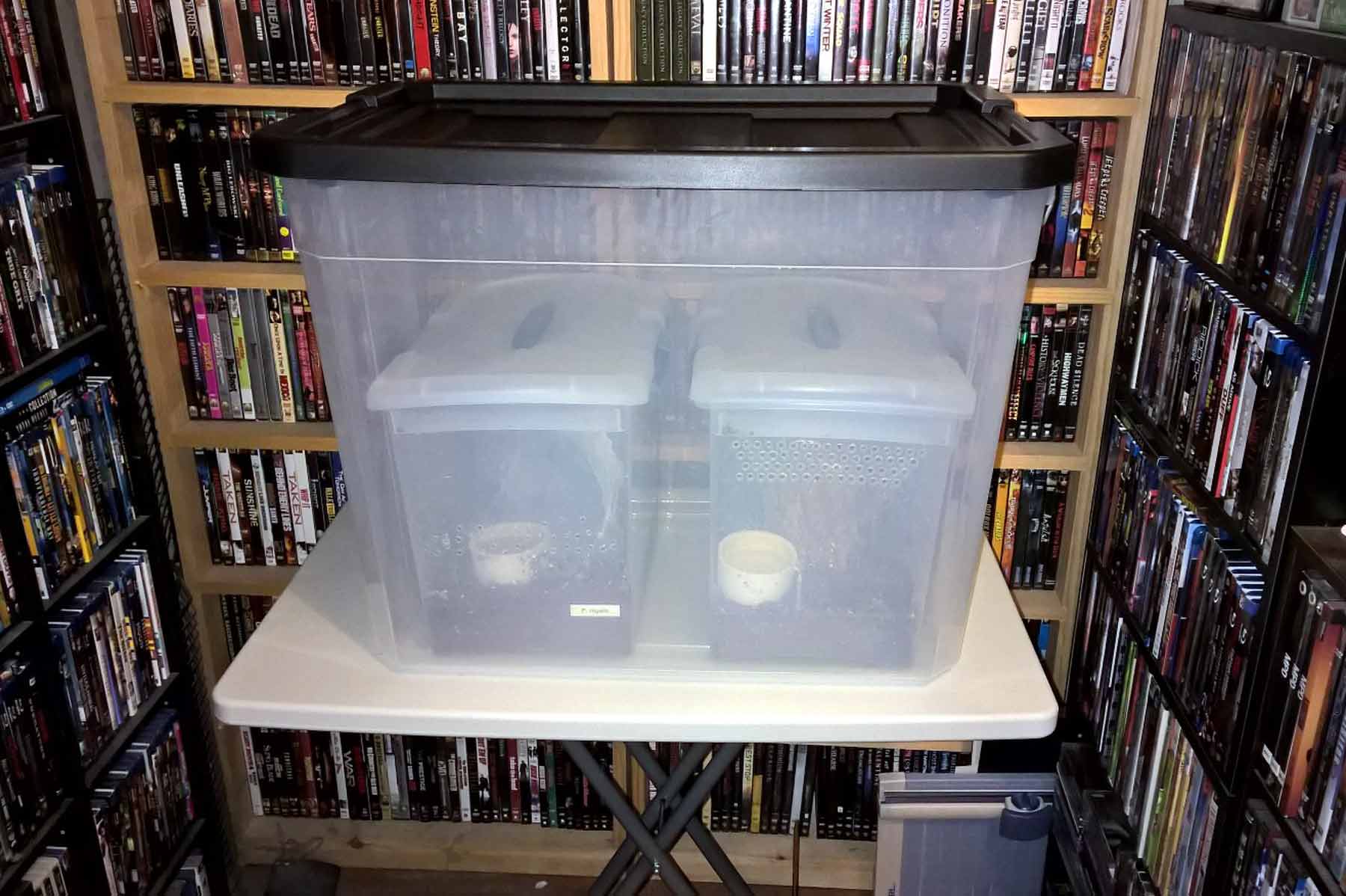
A "breeding chamber" for my P. regalis pair. Both pokie enclosures were place inside this larger enclosure and their lids removed.

A “breeding chamber” for my P. regalis pair. Both pokie enclosures were place inside this larger enclosure and their lids removed.

The tank I chose was a 27-gallon latch-able Sterilite container that offered enough floor space and height to allow the spiders to mingle on neutral territory. I used my soldering iron to put ventilation holes in both sides to allow for air flow, and I placed it on a small table in a corner of my tarantula room that doesn’t get much traffic.

The pairing

I placed both enclosures in the breeding chamber earlier in the day, but I waited until the evening to take the tops off. Within an hour, both had started to crawl out of their cages to explore. Just before bed, I observed both the female and the male drumming their legs as they courted. I’m taking this as a good sign that their may have been an insertion after I went to bed. When I turned the lights out, they were still at opposite ends of the enclosures continuing their courtship ritual.

I left them in unsupervised overnight, and when I checked on them in the morning, both were fine and perched in opposite ends of the larger enclosure. All told, they spent about 14 hours together, with about 10 of that being in darkness. I left them a bit while I had my morning coffee so I was awake enough to wrangle them both back into their cages. As it turns out, I didn’t need the coffee; each had returned to his and her respective enclosures while I was gone. I couldn’t have asked for an easier pairing.

The next step

Although I’m pretty optimistic that the two mated last night, I’m going to go ahead and try again next weekend while I still have the male. After that, it will be a watch-and-wait game as I hope to discover the female is gravid. With any luck, I’ll have a sac in a few months. I will not only post a blog update if I have any news, but I will also update this post.

Next up … it’s time to find a date for my female P. vittata.

Wish me luck!

Phormictopus Species Husbandry

Awesome intermediate species tarantulas with plenty of character.

Anyone that follows me on Tom’s Big Spiders, Tumblr, or YouTube has probably picked up on my Phormictopus obsession. I currently keep seven different Phormictopus species, and I am attempting to acquire all the species and color variations available. These spiders have quickly risen to the top of my list of favorite terrestrials. and I’m looking very forward to some future breeding projects with them.

But why the fascination?

I first encountered this genus while perusing the Jamie’s Tarantulas website for something new and interesting. She had just listed some Phormictopus cancerides or “Hatian Brown” slings for sale, and something about them caught my eye. At this point, I had a much smaller collection, and the majority of the specimens I was keeping were the more docile beginner terrestrials. I decided to do some research, and I discoved that most described the P. cancerides as a large brown, ornery tarantula with a bad attitude.

Phormictopus sp. purple

Phormictopus sp. purple

Large and brown? Having just acquired an A. versicolor and two C. cyaneopubescens, I was on the market for more colorful tarantulas. The idea of a “blah” brown spider didn’t quite appeal to me. Of course, after some investigating, I learned that males from this species were a gorgeous purple, and females were more a metallic bronze. This was far from just a big “brown” spider.

P. cancerides female

P. cancerides female

Ornery with a bad attitude? THAT, on the other hand, caught my attention. Most of the Ts I kept were quite calm and well-behaved, and I felt that it was time for me to graduate to something a bit more spirited and “advanced”. The idea of a larger, more feisty spider appealed to me.  It wasn’t that I necessarily wanted to add a giant eight-legged terror to the collection, but I felt I was ready for the challenge if this species turned out to be less than friendly.

In my research, I also learned that this species apparently “required” moist substrate, which was a husbandry requirement that I hadn’t yet contended with. As I had my eye on some Asian terrestrials down the road, this would be a good stepping stone to keeping spiders with more complicated husbandry.

Beautiful blue slings with vicious appetites

After a week or so of research, I decided to pull the trigger and order two P. cancerides slings. When I unpacked them, I was immediately amazed by the color. These two little 1.25″ slings sported a gorgeous a metallic blue sheen that looked nothing like the supposed “brown” tones sported by their adult counterparts. I rehoused each and, as is usually my habit, I offered each its first meal.

And I instantly fell in love.

I watched in awe as one of these gorgeous blue slings bolted across the enclosure and LEAPED on a cricket with so much force that it actually rolled over onto its back for a few seconds while it wrestled with the bug on top of it. I had never seen anything like it. I quickly fed the other and was delighted to discover a similar response.

P. atrichomatus sling

P. atrichomatus sling

Since then, I’ve discovered that all of my Phormictopus species attack their prey with the same fervor, and it honestly never gets old to see one of these guys launch itself at a roach or cricket.

As slings, Phormictopus species do appreciate deep, moist substrate, and the majority will burrow if given the opportunity. For substrate, I use a mix of topsoil, peat, and some vermiculite, and I keep it moist enough that it will hold its shape when squeezed but no water will drip out. As the spiders become established I let the top layers of the sub dry out a bit. This allows the T to burrow to the more moist depths to find the correct humidity level. If I need to add water, I’ll use the end of a paintbrush to carefully put some holes down the side of the enclosure and allow the water to filter down to the lower levels.

Phormictopus sp. purple sling

Phormictopus sp. purple sling

As slings, these guys are voracious eaters. During this period I will feed them 2-3 times a week, depending on the size of the prey. Unlike other species, I’ve found that Phormictopus have no trouble taking down larger prey, so I will often give my little ones crickets that aren’t much smaller than they are. They have only ever refused a meal when in heavy premolt, and even then I had one eat just a couple days before molting.

Get ready for an amazing growth rate

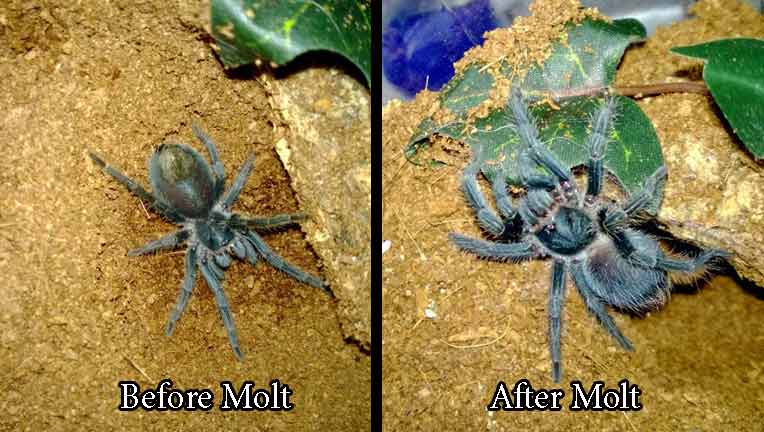
As I’ve stated in my other husbandry articles, my spiders are kept between 70-76° in the winter and about 75-80° in the summer. Although higher temps would obviously lead to faster metabolisms and growth, my Phormictopus species do very well in these ranges. Not only is this a species that will molt very regularly (at one point, mine were molting about every 5-6 weeks as slings), but the amount of size they gain between molts is amazing. After keeping slow-growing Brachypelmas and Grammostolas for a while, I was floored when my P. cancerides slings first molted, putting on about .5″ of size as well as impressive girth.

Phormictopus-before-after-m

Although I started off with small slings, it didn’t take too many months or molts before I had large, hairy bronze spiders. In their first year, my 1.25″ P. cancerides slings reached about 3.5″ in size. Imagine the growth rate if they were kept at higher temps. On the other hand, my 1″ Phormictopus sp. purple slings grew from about 1″ to a leggy 3.75″ (I’m sure the fact that I bought them closer to the summer had something to do with the slightly faster growth rate). So far, my atrichomatus specimens, which I purchased in April as 1.25″ slings, are about 2.75″ or so.

Once mine hit about 2.5″ or so, I slow down the feeding schedule. I currently feed my juveniles a large cricket every five days. For my sub-adult specimens, they get a couple large (1-1.5″) dubia roaches once a week or so. If I have extra large crickets, I’ll sometimes toss a couple in as well for variety.

Housing for Phormictopus species

Due to the fast growth rate, I tend to house my Phormictopus species in larger enclosures than I would for other species. As slings, I usually use 2-quart clear plastic jars or the small Sterilite stackables containers (I believe it’s about 1.75 quarts or so). After filling them up with moist substrate, I supply them with a bottle cap water dish, a cork bark hide with a plant, and a starter burrow.

PhormiCAGE-Canister

2-quart plastic canister (purchased at WalMart for about $2)

Although enclosures this size might seem a little large at first for a 1″ sling, they grow fast and need a bit of extra space to eliminate the need for frequent rehousings. Trust me, they will quickly grow into their new homes.

Small Sterilite stackable container.

Small Sterilite stackable container.

Once my guys reach about 2.5-3″ or so, I will move them to their juvenile enclosures. For these, I use Sterilite clear plastic shoeboxes and set them up more like a terrestrial. They’ll get about 3″ of moist substrate, a cork bark hide, and a water dish. I find that at this size, my Phormictopus have become more bold and will mostly hang out in the open. They no longer burrow, but will retreat to a hide if disturbed.

My Phormictopus sp. blue female's enclosure (a clear Sterilite shoe box)

My Phormictopus sp. blue female’s enclosure (a clear Sterilite shoe box)

My largest specimens (5″ or over) are currently housed in Sterilite 15-quart “ClearView” containers (purchased at the local Target). Once again, they are set up terrestrially with cork bark hide, water dish, and 3-4″ of damp substrate.

Although a lot of the early care information I read about Phormictopus indicated that they needed to be kept moist, I’ve discovered that they do fine if the sub dries out a bit in between as long as they are provided water dishes. Although I start all of mine on moist sub, I let it dry out a bit and periodically moisten down part of the dirt when they are near a molt. I’ve noticed that they don’t seem to gravitate to this moist area, and are quite content to sit on the dry end.

I will note that other keepers still make sure to keep their Phormictopus species moist at all times, and those interested in breeding are often much more careful in keeping the moisture levels up.  However, unlike my Pamphobeteus and Theraphosa, I don’t obsess about it with these guys. If you buy one of these species and the enclosure dries up a bit, they will be fine as long as they have water.

A note about temperament

Phormictopus species have developed a bit of a reputation for being a bit ornery and defensive. I’ve found slings of this genus to be quite fast and skittish, often bolting around their enclosures or to their burrows if disturbed. As they gain some size, they become a bit more bold, often sitting out in the open when their enclosures are opened. Still, they can move quite quickly when motivated, and I’ve heard of instances where they are not reluctant to use their fangs.

Phormictopus sp. Purple

Phormictopus sp. Purple

Out of the seven species I currently keep, I’ve only ever received a threat posture from my sp. purples; they seem to be a bit more high strung than my other species. Personally, I’ve found that if I’m careful not to disturb them when I perform maintenance or feed them, they are relatively calm when they get older. They also seem quite reluctant to kick hairs, which is a huge plus in my book. To date, only one has ever kicked hairs that I’ve witnessed.

Still, these guys get pretty large, with some reaching 8″, and their amazing feeding responses often have them charging anything that enters their enclosure (including a keeper’s tongs or paint brush). Caution should be exercised whenever feeding or performing routine maintenance.

A wonderful stepping stone to faster and feistier species.

For those who have successfully kept some of the beginner species and are looking to graduate to faster, more defensive intermediate species would do well to check out some of the  spiders the Phormictopus genus has to offer.  These are large, hardy,  fast-growing tarantulas with relatively simple husbandry that are very similar to the super-popular Pamphobeteus species in terms of build and temperament.

It’s also worth mentioning that males of these species are often quite colorful, with some sporting beautiful purples and blues after their ultimate molts. This makes discovering that your spider is a male quite a rewarding experience…after all, who doesn’t like purple spiders?

Phormictopus species I currently keep:
  • Phormictopus cancerides
  • Phormictopus sp. purple
  • Phormictopus sp. green
  • Phormictopus sp. blue
  • Phormictopus atrichomatus
  • Phormictopus cautus violet
  • Phormictopus sp. south hispaniola

Sexing Tarantulas Using Molts

Title-pic
For most tarantula keepers, females are where it’s at.

It’s not that we don’t have love for their male counterparts. In fact, some male species like Phormictopus and Pamphobeteus are more colorful and stunning than the females. No, in most instances, the reason comes down to longevity and their ability to produce young. Female tarantulas are much more long-lived than their male counterparts, often thriving decades after the males have matured and expired. Females can also be bred to produce slings, an integral and fascinating part of the hobby for many.

The story is a bit different for male tarantulas. Some species of male tarantulas can mature in just over a year, leaving you with a leggy, antsy boy who wanders around his enclosure in a desperate attempt to fulfill his life’s goal to mate with a willing female. At this point, the best thing you can do for this tarantula that you have lovingly raised and cared for is to ship him off to someone with a female for breeding, leaving you with an empty cage. Sure, you can do do a breeding trade for half of the slings a successful pairing produces, but not all attempts end in viable sacks, and some end with the male being unceremoniously munched.

Those who enjoy raising tarantulas (and who don’t feel like paying the higher prices for sexed females) will often pick up spiderlings. As small slings are often difficult, if not impossible, to sex accurately, you never know exactly what you’re getting when you pick up a tiny spiderling. Many keepers (myself included) will pick up three or more slings of the same species at a time to increase their chances of getting a female. You then feed them, love them, and watch for signs that you might have hit the spider jackpot with a female.

Female C. cyaneopubescens molt (GBB)

Female C. cyaneopubescens molt (GBB)

Sometimes you notice one growing faster than the others, and immediately suspect a male. After all, males in many species will grow and mature faster. Other times, you see the spider’s underside pressed up against the side of its enclosure and you swear you see female parts. And still others, you’ll latch on to some physically dimorphic feature, like color or patterning, in hopes that it indicates a female.

Any keeper who has patiently waited to sex a spider they have raised from the sling stage has undoubtedly experienced the thrill of discovering they have raised a young lady … or the letdown that their beloved pet is a more short-lived male.

How do you sex a tarantula?

There are several methods keepers to use to determine the sex of their tarantulas, but many are not very accurate or require the keeper to have plenty of experience as well as a keen understanding of the anatomy of many species.

One method used to sex tarantulas is ventral sexing, which entails examining the tarantula’s ventral area (the bottom of the tarantula) around the epigastric furrow to try to determine its gender. The epigastric furrow is an opening between the set of book lungs closest to the cephalothorax (body) of the spider. Folks using this method will compare the curve of the furrow, the distance between the anterior book lungs, and the angle of the lungs to determine gender.

In females of some species, the epigastric furrow is more pronounced with what can be described as “lips”. In others, it is not nearly as pronounced. This method takes plenty of practice and knowledge of what both the female and male characteristics of each species are. Keepers attempting this technique will want to do some research and get some photos of both males and females for comparison.

A ventral shot of an A. insubtilis. This specimen was likely male.

A ventral shot of an A. insubtilis. This specimen was likely male.

Personally, I don’t even try to sex via ventral shots anymore, as I don’t feel that I’m particularly good at it, and it’s often not very accurate. Sure, some species like some of the Poecilotheria sport some fairly obvious lady parts early on, but others can be quite misleading and difficult to determine. Arachnoboards has a wonderful area where keepers can post ventral shots of their Ts so that others can determine the sex, but due to the trickiness of using this technique, many of the responses are just guesses (as evidenced by the same spiders being proven to be a different sex later on). Still, if you attempt this method, try posting a good ventral photo up on this board to get some other opinions.

There is also the epiandrous fusillae method.  With this technique, the keeper looks for epiandrous fusillae, or a second set of micro spinnerets used by mature male tarantulas to create sperm webs.  This is a technique that requires a keen eye and a lot of practice, so it might not be the most appropriate for some keepers, especially those new to the hobby.

Sexing your spider using the molt

The best way to your tarantula is to examine its exuvia or molted exoskeleton. An intact molt from a larger specimen (smaller specimens may require use of a microscope) can be examined for evidence of the female’s spermathecae, or the receptacle the female that stores the male’s sperm in. This organ is often described as a little “flap” or “pouch” above the epigastic furrow.

Although this method can be tricky at first, especially with smaller specimens, it’s the most accurate and easy to practice. All you need is an intact molt, some good lighting, and you can give it a shot. Here’s how to go about it:

A comparison of molts from a 3.5" male and a 3.5" female T. stirmi. The piece of paper on the female molt is showing the "flap".

A comparison of molts from a 3.5″ male and a 3.5″ female T. stirmi. The piece of paper on the female molt is showing the “flap”.

1. First off, you’ll want to do some research and find reference photos for both a male and female of the species you want to sex. I would encourage folks to hop on Arachnoboards’ Tarantula Sexing board and check out some of the shots there, or do a Google or Bing image search and study some of those. Every species is different, so looking at a molt from a L. parahybana might not be useful for determining the sex of a GBB. 

2. Next, you need a molt that has the abdomen flesh containing the book lungs intact. If the abdomen has been completely shredded in this area, you will find it difficult or impossible to sex the molt. I try to grab the molts from spiders I want to sex right after they molt (as long as I can do it without disturbing the tarantula). 

3. You need to soften up the exuvia, or molt, to make it less fragile and more pliable. I use a very small spray bottle and give it a few squirts. I then wait a few minutes for the molt to soften up. Other folks will drop the molt into a dish of warm water for a minute or so. Either of these methods work, just use care when handling the molt not to tear it or get urticating hairs on you. You may also want to put it on a piece of paper towel to wick up some of the excess water.

4. Position the molt so that the fangs are facing up and the molt is on its “back” on your well-lit working area. I like to use white plates myself, but a piece of foam board would be great if you want to pin the molt down. Now, carefully spread out the legs and unfurl the abdominal skin if it has become twisted. Work slowly and carefully, as the area that you need to sex the molt is VERY fragile and will tear. I will usually use toothpicks and cotton swaps to unfurl mine. You want to open up this abdominal skin so that you can see the underside of the area where the two sets of book lungs are.

G-PORTERI-LABELED-NEW

5. Now, some folks will immediately spot a slit between the set of book lungs closest to the body and think that they have a girl. Not so. This slit is found on both males and females. What you are looking for is a pronounced “flap” or the spermathecae, which will be above the epigastic furrow if present. The smaller the specimen, the more difficult this area can be to see. I often use a magnifying glass or take a close-up photo with my phone to get a better look. On well-developed females, you can even take a small piece of paper and slide it behind the flap to be sure.

UPDATE-FURROW

If you find the spermathecae, congratulations … it’s a girl! If not, and you are sexing a largerer specimen, you are likely looking at a male. You can always try again on a future molt to double-check.

Now this all sounds quite simple, but it’s not always that cut and dry. Some species don’t develop enough for the casual keeper to sex until later in their life cycles. Also, males from some species will have organs that can be mistaken for spermathecae, meaning that sexing those species can be a bit more challenging. If you are trying to sex your pet, you should spend some time researching and examining molt photos from both the males and females of the species. For some wonderful reference diagrams of the spermathecae of females from different species, check out this site. A Google search will also bring up several useful photos, and you can also check the sexing topic on Arachnoboards and compare the photos.

L. itabunae female molt with the spermathecae highlighted.

L. itabunae female molt with the spermathecae highlighted.

Recognizing mature males

It should be mentioned that mature males can be quite easy to sex, and you will often hear keepers refer to their males as “hooking out.” This expression comes from the fact that males from some species develop tibial “hooks” behind the knees of their first set of walking legs upon maturing. The key word here is “some”, as many species will not present this feature while others, like some in the Avicularia genus, will have hooks too small to see.

An illustration of a male tarantula. Some species don't have tibial hooks, so it is better and more accurate to look for the emboli.

An illustration of a male tarantula. Some species don’t have tibial hooks, so it is better and more accurate to look for the emboli.

Honestly, the phrase should be changed to “bulbing out” or something similar, as keepers should be keeping an eye out for another telltale feature; namely the bulb-like emboli at the end of the male pedipalps. The pedipalps are the shorter set of appendages inside the first set of walking legs that look like shorter legs. When a male spider has his ultimate molt, he develops emboli, or essentially the male’s sexual organ used to deliver the sperm to the female, on the end of his pedipalps. Instead of the ends of these appendages looking like the rest of the tarantula’s “feet”, they will instead be round and bulbous (some keepers refer to them as “boxing” gloves).

A comparison of a mature male's pedipalps (with emboli) and a mature female's.

A comparison of a mature male’s pedipalps (with emboli) and a mature female’s.

Because all male tarantulas will develop this feature, it makes more sense to look for emboli when trying to determine if your spider is a mature male or not.

Not only do males mature much faster than their female counterparts, but there are often many physical differences between a male and female of the same species. First off, males tend to be thinner and “leggier” than the girls, who are much more heavy-bodies. Many male tarantulas have different colorations than females, with some being very pronounced. Female L. violceopes, for example, sport gorgeous iridescent blues and purples upon reaching maturity. Males, on the other hand, are brownish to olive in color. Some males also mature at a much smaller size than the females of the same species; this can lead to some confusion for keepers who discover that their gangly male is done growing at 5″ and will never reach the 7″ max size of the females they’ve read about.

Unfortunately, many of these features won’t appear until the specimen’s ultimate molt, so those using this “method” would literally be discovering their pet’s sex at the latest possible opportunity.

Lots of practice is required!

No matter what method you choose to try to sex your specimen, research and practice are key. I have literally examined over a hundred molts now and spent countless hours staring at sexed molts on my computer screen. And although I feel like I’ve definitely got the hang of it, I still have difficulties at times. I’m certainly not yet an expert yet. When you’re first starting out, be sure to try and sex every molt you can. Do you have specimens that are already sexed male or female? If so, examine and photograph their molts as practice and to use as references.

With all of the variations between species, it can be very difficult to know what to look for. I would encourage anyone attempting to sex their T to look up the species first and find out all you can about it’s anatomy or any sexual dimorphism. Some questions you should be researching are:

Are their differences in colorations, marking, or bandings between the sexes?

Is this a species that can be sexed ventrally with accuracy?

What is the shape of the female’s spermathecae?

At what size to the genders become apparent enough to accurately sex by molt?

Does the male of this species have an organ that could be mistaken for a spermathecae?

Does the male of this species have tibal hooks?

Sexing may seem daunting and confusing at first, but with enough practice, most keepers will be successfully identifying the genders of larger specimens in no time. And honestly, the first time you examine a molt and discovering that the sling you have raised for a year is a little lady makes all of the effort and frustration worth it.

* Note: I will continue to update this blog with photos of sexed molts. It’s my hope that this can be a resource for some looking for reference photos.

M. balfouri Husbandry Video

So, earlier this week I was a bit disappointed when one of my Monocentropus balfouri young adults molted into a mature male. Although the little guy is gorgeous with his metallic blue carapace and legs, it means he won’t be with me all that much longer.

Well, yesterday I was delighted to discover that one of my others molted, and it’s a girl! The little beauty was stretching out on the surface, so I took the opportunity to get some photos and this quick husbandry video.

If I were to make a list of best entry-level Old World tarantulas, the M. balfouri would likely be right at the top. This fossorial species is very simple to keep, needing only deep, dry substrate and a water dish to thrive. Mine do well in temperatures in the 70s, although higher temps would lead to faster metabolisms and growth.

Temperament-wise, they are quite calm compared to some of my other baboon species. I’ve found these guys to be more skittish than defensive, and to date I’ve only received one threat posture from any of them. When startled, they will usually just bolt to their dens and hide. That said, temperament can vary from specimen to specimen, and this species is quite fast and can pack a wallop of a bite, so caution is always advised.

Even better, of all of my fossorial species, my balfouris are usually quite visible, venturing out at night to hunt and sometimes just hanging out on the surface. This isn’t your standard “pet hole”, which is great as they’re just too darned pretty to spend all of their time hidden.

Although I feel like I tend to ramble a bit in all of my videos, this one might be even worse do the impromptu nature of it. I was basically snapping photos of this little girl when it dawned on me that I should get a video before she retreated to her den again. So, with little preparation, I set to it. You’ve been warned!