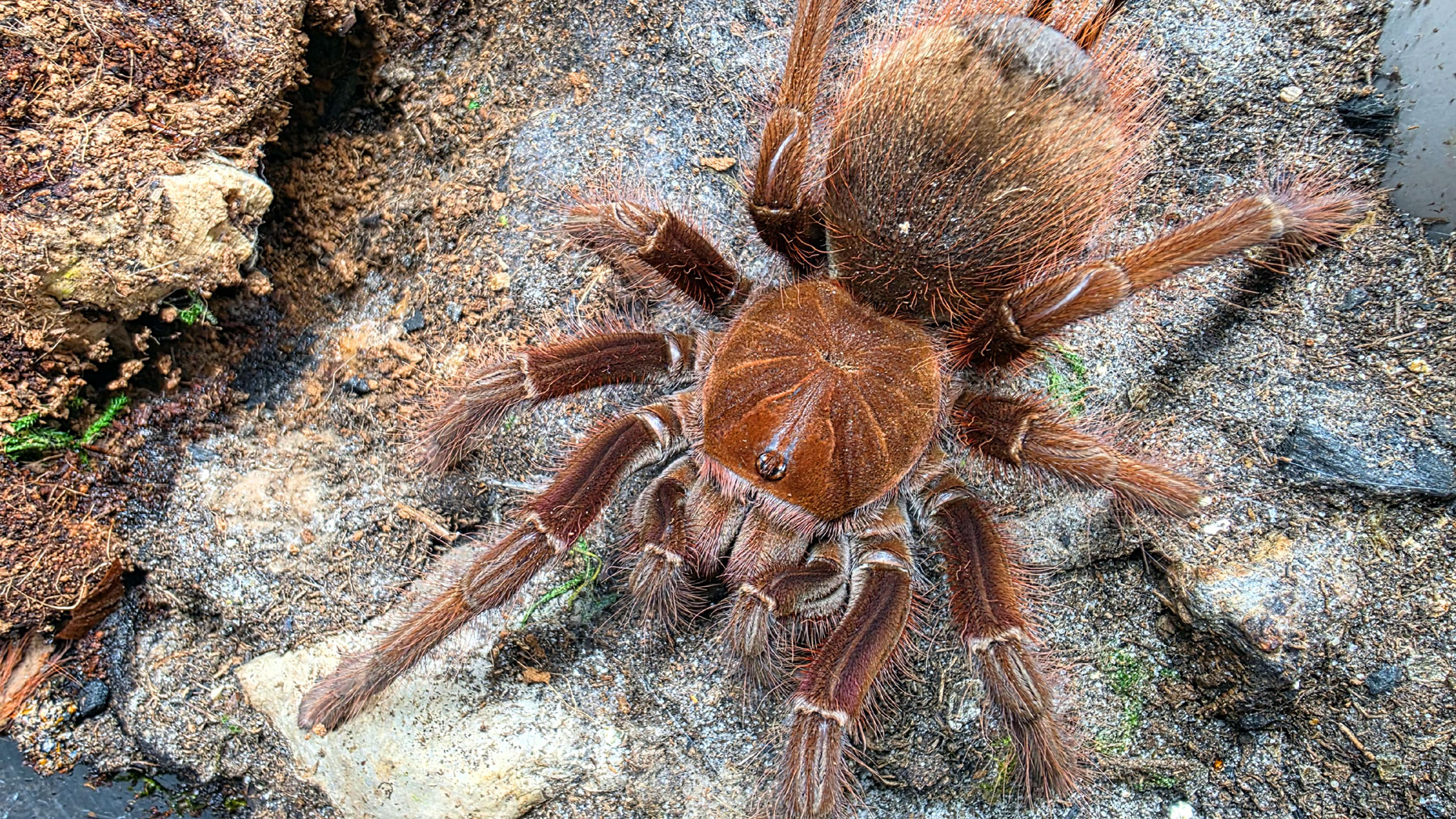
When I first got into the hobby, I lived by the adage “bigger is better.” At that time, I figured that if you were going to keep large, hairy spiders, then you might as well keep the largest species available. Therefore, it wasn’t long before I discovered Theraphosa species and immediately became enamored with these true giants. Obviously, the legendary T. blondi or “Goliath Birdeater” was the first species that caught my eye. Unfortunately, not only was this species ridiculously difficult to come by, commanding exorbitant prices, but I also discovered that this species was supposedly difficult to keep due to its moisture requirements. I therefore settled on its cousin, the T. stirmi or Burgundy Goliath Birdeater, raising a young adult and two slings to adulthood. When, a few years later, T. blondi slings became available at an affordable price, I grabbed up two (now two 10” or 25.5 cm adults!). With two of the Theraphosa species under my belt, I kept a lookout for the third and lesser-known of these giants…the Theraphosa apophysis or “Pinkfoot Goliath Birdeater.”
After years of this species being on the top of my wishlist, I finally picked up two slings from Fear Not Tarantulas in June of 2020. At that time, they were each a leggy 1.25” or 6 cm. They are now both pushing a leggy 9” (23 cm) and have bloomed into stunning adult females. The T. apophysis still doesn’t command the same attention and popularity as its more heavy-bodied cousins, and I think that’s an absolute shame. For those looking for a giant, fast-growing, handsome spider, the T. apophysis might fit your tastes. Read on for a detailed description of how I kept these stunning giants!
It’s a question that I’ve been asked dozens of times over the years, and one that I’ve strategically avoided answering. First off, although I’ve managed to keep over 130 different species, that’s only a fraction of the 900+ species of described tarantulas in the world. It would literally be impossible for me to comment on the fastest-growing species, having no experience with the majority of tarantulas out there.
Also, there are several factors that can impact tarantula growth, and while one keeper might experience super-fast growth with a species, another keeper may find that their specimen is taking forever to put on size. In my years of experience, I’ve had many folks come to me with differing opinions on a particular species’ growth rates.
The fact is, a specimen’s growth can be impacted by several variables, including temperature, feeding schedule, and genetics. Someone maintaining their collection at 80 F (27 C) will likely experience faster growth rates than another person keeping hers at 70 F (21 C). A keeper may feed his slings once a month, while another keeper feeds his spider twice weekly, again leading to faster growth. Then, some specimens just seem to put on size more quickly than others due to genetics. How could I possibly assemble an accurate list when there was just so much to take into consideration?
However, after years of dodging the question, I finally decided that the best way to approach the topic wasn’t to make a list of the fastest-growing tarantulas in the hobby, but to talk about the species I have personally raised that have exhibited faster-than-average growth rates. And, as the temperatures in my tarantula room tend to run lower than some of the year, with winter temps often in the lower 70s F, it would mean that these species grew quickly despite not having high temperatures. Therefore, someone keeping theirs at higher temperatures should still experience even faster growth. So, how could one go about determining which species are “fast growing”? Kyle Shane Horner summed up the issues best with his comment:
When assembling this list, I took a couple of factors into account. First, I looked at species in which males mature quickly, as mature males are adults nearing the end of their life cycle. In these instances, their female counterparts were not sexually mature but still qualified as “young adults.” I also looked at annual growth, as I found that my fastest-growing tarantulas usually gained several inches in the first 12 months of their lives. With the spiders on this list, one can expect their little sling to resemble a big hairy adult within a year while also reaching a large percentage of their max size.
So, at long last, here is my list of the 14 fastest-growing tarantulas I have had the pleasure of keeping!
Many folks who are just getting interested in the tarantula hobby start by consulting the numerous “beginner tarantula” lists to select their first spiders. And those who do will often discover that the genera most recommended on these lists are the GAB species (Grammastola, Aphonopelma, Brachypelma). These species are recognized as being very hardy, long-lived spiders that are super easy to care for and that generally grow up to be docile adults. And, as these are New World species, one doesn’t have to worry about the potent venom.
However, after years of speaking with new keepers, I realized that most folks want to start with a larger specimen, like an adult. Although most of these species were readily available and inexpensively available in the pet trade as wild-caught adults several years ago, new restrictions have rightfully choked off the supply. This means that well-established juvenile or adult GAB species are very difficult to find and usually incredibly expensive when they are available.
When hobbyists realize this, they often turn their attention to captive-bred slings. However, this poses another problem.
As great as the GAB species are as first tarantulas, most are very slow growing, taking years to grow out of the sling stage. When you factor in that they start as super small (often ⅓” or .8 cm) and can be fairly expensive, these species become less attractive options for one looking to keep their first sling. Many folks purchase slings of these species, not realizing that it could be years before they have anything that resembles the gorgeous photos of adults they have fawned over.
And, let’s be honest: many keepers are freaked out by the idea of growing up a tarantula from a tiny spiderling.
New hobbyists are often told that, by starting with a sling of a certain species, they can “grow” in the hobby as the sling grows. This means that as the sling marches on through adulthood, the hobbyist can hone their skills at a measured pace before they are dealing with an adult spider.
This sounds great on paper, but for someone beginning with a tiny GAB sling, it doesn’t really work. These species take SO long to grow that many folks eventually find themselves keeping Old World spiders long before their sling reaches adulthood. Although they make great pets as adults, they aren’t always the best species for a keeper to raise as his/her first sling.
So, with hundreds of species, which ones are good first spiderlings for the first-time sling keeper? Well, read on for a list of tarantula species that would make excellent first attempts by keepers used to keeping babies. Not only have I raised multiples of each of the following species, but I’ve also heard from many keepers over the last several years that mirror my opinion of them as good first slings. If a keeper does their research (I’m including links to care videos for each of these species), they should have no trouble growing their first tiny spider up to a giant, hairy tarantula.
To create this list, I considered the following factors:
Availability and cost – It drives me nuts sometimes when folks are asking for recommendations for a starter sling, and someone chimes in with a spider that is new to the hobby, not readily available, and super expensive. The spiders on this list are quite prevalent in the hobby (at least in the US) and are usually under $50 as slings.
Hardiness – The spiders on this list are usually pretty forgiving when it comes to care and are quite hardy, even as slings. This means, no moisture dependency, good appetite and feeding response,
Growth Rate – The species on this list are all known to have fast growth rates overall, meaning that your sling will molt more often and often add a good amount of size with each molt. With these species, you will actually be able to “grow with the spider,” gaining more valuable experience with each molt.
Size of Sling – Most of the species on this list start as fairly large slings, which means it will be easier to spot them and to procure live prey for them
IMPORTANT NOTE: Although I’ve created a “Top 10” list with these species, feel free to begin with whichever species you feel comfortable with. I encourage you to read through the Pros and Cons and select the spider that works best for you. Now…onto the list!
Here are some of the species that I recommend, with Pros and Cons, to those looking to raise as their first slings.
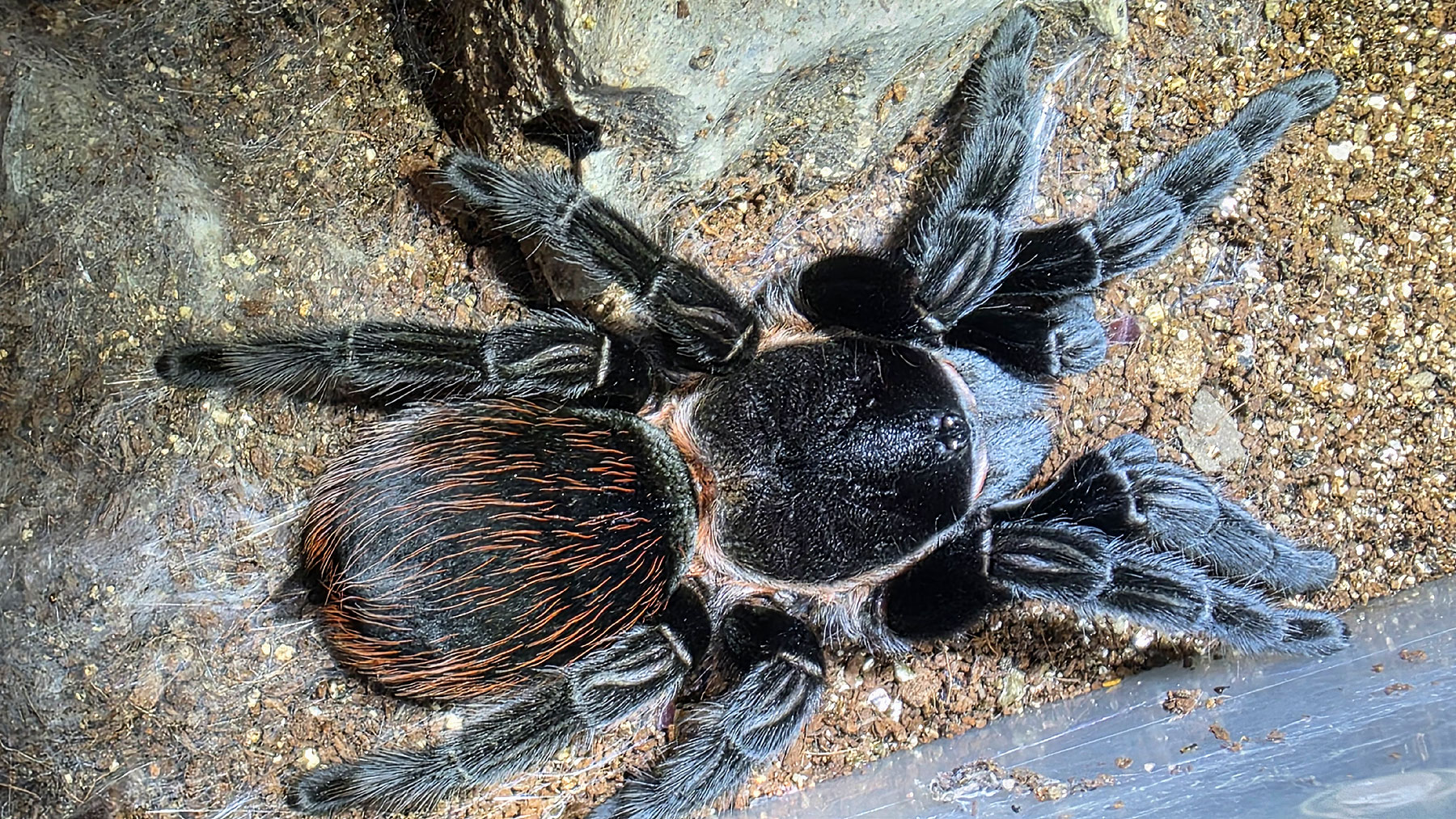
When I first got into tarantula keeping, the “Mexican Redrump” had the scientific name Brachypelma vagans and was quite popular and readily available, with wild-caught specimens being imported from Mexico for the pet trade for decades. However, as of March of 2023, CITES implemented stricter regulations on the exportation of Mexican tarantula species. Captive breeding projects in Mexico now produce slings specifically for the pet trade in order to eliminate the collection of wild-caught specimens. As a result, spiderlings are now offered more periodically and are often more expensive.
Although the T. vagans was once considered to be a good “beginner tarantula”, over the last several years, they’ve earned a reputation for being defensive and difficult. Some of the ridiculous words I’ve heard to describe them are aggressive, demonic, dangerous, and evil. Sadly, this species’ recent infamy is a byproduct of click-bait driven YouTube videos by unscrupulous content creators trying to capitalize on rampant arachnophobia to get a couple extra views. That said, this species has always been recognized as being a bit more skittish and lively than the average Mexican New World tarantula species.
A brief history of this species to help us understand its reputation. When most folks hear the name “Brachypelma” they think of slow-growing, docile species like the Brachypelma smithi, Brachypelma hamorii, and Brachypelma emila. These species have long enjoyed a reputation for being particularly good beginner tarantulas due to their ease of care and calm temperaments as adults.
The T. vagans was originally known as Brachypelma vagans, and that may be where their reputation as “aggressive” and unruly spiders originated. The genus Brachypelma had become synonymous with “beginner species.” Folks expecting a spider that was as calm and possibly tractable as its genus cousins were often surprised by a much more skittish, high-strung spider not afraid of kicking hairs or bolting when disturbed. This species also has an amazing feeding response, and it’s quite possible that folks prodding their spider for a possible handling session, or performing maintenance, were surprised by a sudden flash of fangs. Over the years, I’ve heard a handful of folks say that their Mexican redrumps will attack anything that enters their enclosure. It’s definitely feasible that a keeper expecting a calm, sedentary Brachypelma species might be intimidated by a spider quick to bolt, kick hairs, or threat posture. Suddenly, you have keepers sharing these experiences, and the T. vagans’ reputation as a “dangerous” and “aggressive” spider is born.
In my years of keeping, I’ve discovered for many species with bad reputations, their defensive behavior isn’t the result of a mean animal. Instead, it’s what happens when they are not kept correctly and become stressed. At the risk of anthropomorphizing, I like to point out that tarantulas that are constantly defensive are often insecure with their surroundings or “scared.” They are not lashing out, threat-posturing, or hair kicking because they want to hurt you; they are trying to defend themselves from what they perceive as a large predator.
In the case of the T. vagans, keepers set them up as terrestrials for years, giving them shallow enclosures that offered only a couple of inches of substrate and a hide. Although this type of enclosure might work for a more docile B. smithi, it is not appropriate for the T. vagans. In nature, this species is fossorial, adopting or excavating its own burrow and surfacing at night to hunt. When this spider is not given the space to burrow and create a secure hide for itself, leaving it exposed, it has the potential to become more reactive and defensive.
Now, in all of my videos, I usually put the disclaimer “temperament may vary from specimen to specimen.” Sure, mine may not give me threat postures or act particularly defensive, but that does not mean that others don’t have more feisty specimens. Are some folks still receiving threat displays despite giving them proper enclosures and set ups? I’m sure. However, after speaking with many folks over the years who keep the T. vagans, a couple points become quite clear:
First, this type of behavior is the exception and not the rule. Sure, most report that theirs are fairly quick and skittish, but they will usually run an hide before standing their ground. Others, myself included, report specimens that sit calmly out in the open without any defensive reactions at all.
Second, most who keep this species don’t find this type of behavior all that threatening or unmanageable. Sure, someone completely new to keeping tarantulas might find a large, skittish spider a bit intimidating, but anyone with a bit of experience should have no issue keeping one. Plus, as this is a hardy, faster-growing species, it would make it an excellent contender for a good first sling. Someone growing the T. vagans up from a spiderling would have time to “grow” with the spider.
Back in the 90s when I was more into keeping snakes than tarantulas, my wife, Billie, and I attended a reptile expo in Massachusetts. While perusing the animals at the various tables, we saw a 10-gallon aquarium with about two inches of colorful aquarium gravel and a large black tarantula stood dead in the middle of it. It was easy to surmise that this spider was NOT happy, as it had its front legs raised high into the air and it would slap the ground every time a curious individual got too close to the tank. Although I did have two tarantulas at this time, I was still quite intimidated by them, and I found this threat display to be equally fascinating and terrifying. The cage was labeled simply, “Thailand Black Tarantula”, and I gave serious thought to purchasing the poor girl as she looked so stressed. I remember telling Billie, “their bites are no worse than a bee sting” so it wouldn’t really be dangerous to keep it.
What I didn’t know at the time was that this species was an Old World tarantula, and a bite from one would be a heck of a lot worse than a bee sting. I also had no idea that this was a shy, burrowing species, and the threat display was not due to the spider being “aggressive”, but because the setup was woefully inappropriate for it.
My experience was definitely not a unique one, as people first discovering the hobby are often confused to hear hobbyists discussing two different groups of tarantulas; New World and Old World. Luckily, a little research will reveal the main reason for the delineation between the two.
The simple explanation is that New World tarantulas are found in the western hemisphere and include Theraphosidae from North and South America and the surrounding islands. This includes species from the US, Mexico, all of South America, and the Caribbean islands.
Old World tarantulas, on the other hand, are found in the Eastern continents including Asia, Africa, Australia, and Europe.
Simple, right?
Now, being separated by an ocean isn’t the only difference in these two types of tarantulas. Anyone doing proper research will quickly hear New World spiders being described as calm, visible, and reluctant to bite. Even better, if they do happen to nip, their bites have been described as little more than “bee stings.”
Conversely, they will also discover that Old World spiders have been stigmatized for being potentially dangerous to the point where new hobbyists showing interest in these more “advanced” species are admonished by experienced keepers for even considering keeping them. For some, these more defensive spiders serve as a way to show off how brave one is for keeping such a fearsome creature. For others, stories about painful bites and aggressive behavior have completely turned them off to the idea of ever keeping one of these spiders.
Although there are absolutely key differences between New World and Old World species that all keepers need to be aware of, much that is made about these differences can be over exaggerated. With that in mind, let’s examine the major variances in these two types of spiders in terms of behavior and means of defense.


 Tom's Big Spiders