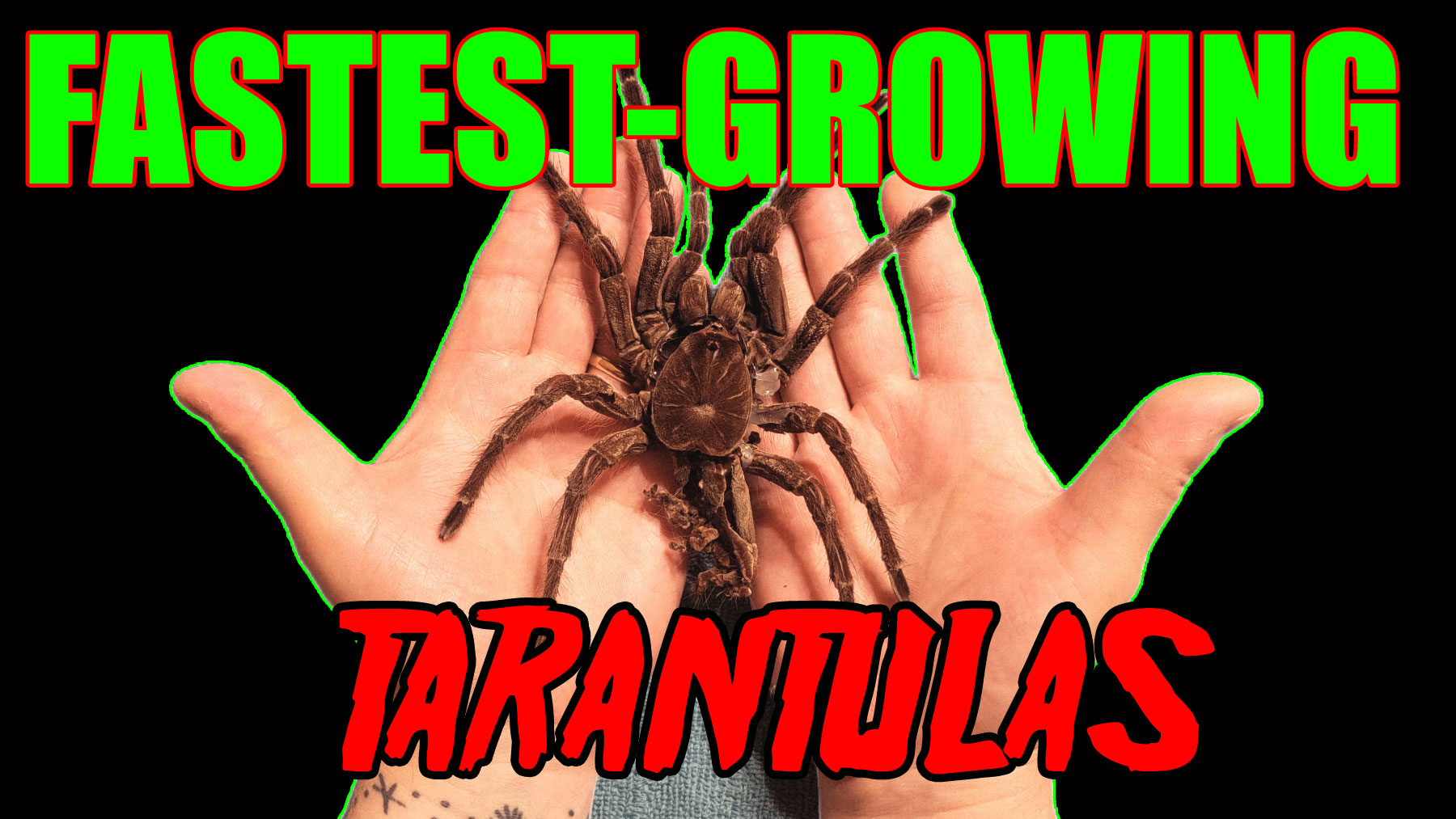
It’s a question that I’ve been asked dozens of times over the years, and one that I’ve strategically avoided answering. First off, although I’ve managed to keep over 130 different species, that’s only a fraction of the 900+ species of described tarantulas in the world. It would literally be impossible for me to comment on the fastest-growing species, having no experience with the majority of tarantulas out there.
Also, there are several factors that can impact tarantula growth, and while one keeper might experience super-fast growth with a species, another keeper may find that their specimen is taking forever to put on size. In my years of experience, I’ve had many folks come to me with differing opinions on a particular species’ growth rates.
The fact is, a specimen’s growth can be impacted by several variables, including temperature, feeding schedule, and genetics. Someone maintaining their collection at 80 F (27 C) will likely experience faster growth rates than another person keeping hers at 70 F (21 C). A keeper may feed his slings once a month, while another keeper feeds his spider twice weekly, again leading to faster growth. Then, some specimens just seem to put on size more quickly than others due to genetics. How could I possibly assemble an accurate list when there was just so much to take into consideration?
However, after years of dodging the question, I finally decided that the best way to approach the topic wasn’t to make a list of the fastest-growing tarantulas in the hobby, but to talk about the species I have personally raised that have exhibited faster-than-average growth rates. And, as the temperatures in my tarantula room tend to run lower than some of the year, with winter temps often in the lower 70s F, it would mean that these species grew quickly despite not having high temperatures. Therefore, someone keeping theirs at higher temperatures should still experience even faster growth. So, how could one go about determining which species are “fast growing”? Kyle Shane Horner summed up the issues best with his comment:
When assembling this list, I took a couple of factors into account. First, I looked at species in which males mature quickly, as mature males are adults nearing the end of their life cycle. In these instances, their female counterparts were not sexually mature but still qualified as “young adults.” I also looked at annual growth, as I found that my fastest-growing tarantulas usually gained several inches in the first 12 months of their lives. With the spiders on this list, one can expect their little sling to resemble a big hairy adult within a year while also reaching a large percentage of their max size.
So, at long last, here is my list of the 14 fastest-growing tarantulas I have had the pleasure of keeping!
Back in the 90s when I was more into keeping snakes than tarantulas, my wife, Billie, and I attended a reptile expo in Massachusetts. While perusing the animals at the various tables, we saw a 10-gallon aquarium with about two inches of colorful aquarium gravel and a large black tarantula stood dead in the middle of it. It was easy to surmise that this spider was NOT happy, as it had its front legs raised high into the air and it would slap the ground every time a curious individual got too close to the tank. Although I did have two tarantulas at this time, I was still quite intimidated by them, and I found this threat display to be equally fascinating and terrifying. The cage was labeled simply, “Thailand Black Tarantula”, and I gave serious thought to purchasing the poor girl as she looked so stressed. I remember telling Billie, “their bites are no worse than a bee sting” so it wouldn’t really be dangerous to keep it.
What I didn’t know at the time was that this species was an Old World tarantula, and a bite from one would be a heck of a lot worse than a bee sting. I also had no idea that this was a shy, burrowing species, and the threat display was not due to the spider being “aggressive”, but because the setup was woefully inappropriate for it.
My experience was definitely not a unique one, as people first discovering the hobby are often confused to hear hobbyists discussing two different groups of tarantulas; New World and Old World. Luckily, a little research will reveal the main reason for the delineation between the two.
The simple explanation is that New World tarantulas are found in the western hemisphere and include Theraphosidae from North and South America and the surrounding islands. This includes species from the US, Mexico, all of South America, and the Caribbean islands.
Old World tarantulas, on the other hand, are found in the Eastern continents including Asia, Africa, Australia, and Europe.
Simple, right?
Now, being separated by an ocean isn’t the only difference in these two types of tarantulas. Anyone doing proper research will quickly hear New World spiders being described as calm, visible, and reluctant to bite. Even better, if they do happen to nip, their bites have been described as little more than “bee stings.”
Conversely, they will also discover that Old World spiders have been stigmatized for being potentially dangerous to the point where new hobbyists showing interest in these more “advanced” species are admonished by experienced keepers for even considering keeping them. For some, these more defensive spiders serve as a way to show off how brave one is for keeping such a fearsome creature. For others, stories about painful bites and aggressive behavior have completely turned them off to the idea of ever keeping one of these spiders.
Although there are absolutely key differences between New World and Old World species that all keepers need to be aware of, much that is made about these differences can be over exaggerated. With that in mind, let’s examine the major variances in these two types of spiders in terms of behavior and means of defense.
A feisty new world “dwarf” terrestrial tarantula from Colombia
At a Glance
Old World or New World
New World
Terrestrial/Arboreal/Fossorial
Terrestrial
Moisture Dependent
Yes (although adaptable)
Temperatures
Room temps
Max Size
3.5″ for females
Temperament
Skittish
Growth Rate
Fast
Beginner Appropriate?
Possibly
For several years after getting serious into the hobby, the mantra “bigger is better” informed all of my purchases. During these formative years, I ignored any species that was saddled with the unfortunate moniker of “dwarf” as I amassed a collection of the largest species the hobby had to offer. While perusing vendor lists for my next purchase, I repeatedly turned my nose up to any species that didn’t reach at least 5” DLS. At the time, I thought the idea of keeping a tarantula that wasn’t much larger than spiders I could find in my basement was kind of ridiculous.
Luckily, my ignorance didn’t last too long, as another keeper finally convinced me that I needed to add the small, feisty little species amicably referred to as the “Pumpkin Patch” to my collection. He explained that what this unique little spider lacked in mass, it more than made up for with a lively personality, gorgeous coloration, and a brutal feeding response. I received my first trio of tiny slings in August of 2014, and I was immediately enamored with this “pygmy” species. Since then, it has become one of my favorites, and in March of 2017, it became the first species that I successfully paired.
As the common name implies, the Pumpkin patch hails from the country of Colombia. Although this country has four seasons, they remain relatively consistent due to its proximity to the equator. Temperatures here tend to be warmer closer to the coast and cooler at the higher elevations inland. Columbia experiences a minimum temperature of 66.7℉ (19.2℃) with high temps reaching 87℉ (29℃). It experiences a drier season from December to March and a rainy season from April to May.
As a result, the Hapalopus sp. Colombia does well at normal room temperatures, which for most of us is upper 60s to mid-80 Fahrenheit (or around 20 – 29 Celsius). My first three specimens were kept between 68 and 72° F during the winter and between 72 and 80° F during the summer for the first few years I had them. Now, they are kept in the mid to upper 70s throughout the year. Even when kept at temps in the 60s, mine ate and grew quite well.
Many care sheets have this species listed as a “dwarf” tarantula, which is a bit misleading. There are actually two very similar Hapalopus species sold in the hobby; the Hapalopus species Colombian “large” and the Hapalopus species Colombian “Klein” or “Small.” Females of the “large” variant actually reach a max size of around 3.5-4” (8.9-10 cm), which would make it a bit too big to be a true dwarf. The “Klein” (German for “small”) on the other hand, reaches a max size of 2-2.5” (5-6.35 cm), which would make it a dwarf. At this time, the sp. “Klein” appears to be much less prevalent in the hobby.
Furthermore, there has been some confusion over the years surrounding the name of this spider. In the United States, this species is sold as Hapalopus sp. Colombia “Large.” However, overseas a seemingly identical species is sold under the name Hapalopus formosus. Although there is speculation that these two spiders are the same species, it has never been scientifically proven that the hobby form is indeed H. formosus. Until this theory is explored and settled through taxonomic study, it’s important to keep the two species separated to avoid potentially mixing two different species.
For a video version of this article, click the link above!
(Note: The following article is an update on my original C. versicolor husbandry article from October 19, 2014. )
Despite being very common and established in the hobby, there is perhaps no tarantula available right now, save maybe the T. blondi, that causes owners more stress over the husbandry than the C. versicolor. When I first got into the hobby, I was immediately amazed by this gorgeous arboreal, which starts as a stunningly-blue sling and morphs into a fuzzy, multi-colored adult. The C. versicolor has been one of my favorite spiders to grow up, as it is beautiful and colorful in every stage of its life.
The Caribena versicolor hails from the island of Martinique, one of the Caribbean islands. With a tropical climate all year round, Martinique is generally hot and humid 12 months of the year, with plenty of rain and sunshine during both its dry and wet seasons. This spider lives the lush forests and banana plantations, creating its heavily webbed home in the crooks and hollows of trees. For some amazing video of this spider in the wild, I encourage you to check out the channel World of Spiders.
Anyone researching this amazing species will likely find information that is frustratingly confusing and contradictory. On one side are the keepers who still say this species is difficult to keep due to strict humidity requirements. However, keepers who have had success with this spider argue that humidity and moisture are not as important as good cross ventilation, and that a stuffy, humid cage will prove to be a death sentence for this animal. Unfortunately, while focusing on the high heat and humidity of their natural habitat, some folks tended to ignore that the island usually enjoys air-circulating winds for most of the year.
These dank enclosures resulted constant mention of SADS, or “Sudden Avic Death Syndrome”, the name of the phenomena where a seemingly healthy Avicularia (the versicolor’s old genus) suddenly dies for no apparent reason. The message boards and chat groups were rife with stories of these little blue spiders curling and dying suddenly and without an obvious cause. Many now believe that these deaths can be attributed to the misguided husbandry of keepers struggling to maintain bogus high humidity requirements.Continue reading →
The species originally referred to as Eauthlus sp. “Red” or “Fire” is now Homoeomma sp.chilensis.
The species originally referred to as Euathlus sp. “Yellow” is now Homoeomma orellanai.
For those who have been in the hobby for a while, this news isn’t exactly shocking. Euathlus has long served as a bit of a “place holder” genus for spiders who have not been adequately described. The hobby staple, Brachypelma hamorii, for example, was once Euathlus smithi. It has long been thought that this species would be moved into the genus Homoeomma once it was properly studied and examined, and many vendors had already begun labeling them as Homoeomma sp. fire.
Now, for changes like this to become truly “official”, the paper has to be published, peer reviewed, and accepted by the scientific community. With the paper having just been published this month, I’m not sure if this has happened yet. However, as with all name changes, word will spread quickly and many will have questions as to why this species is suddenly listed under another name. Vendors may also change the names on their websites, which can lead to some confusion.
Personally, I’m excited about this new development. Anytime species get properly described, it’s a good thing for science AND the hobby. As always, there will be some folks who are reluctant to adopt the new name due mostly to sentimentality and a misunderstanding of how scientific names and species identifications work. I know of a couple folks who refuse to call the species formerly known in the hobby as “B. smithi” the correct name of “B. hamorii.” Still, it’s important for folks to understand and appreciate that a name change, although jarring and confusing at first, is a sign that these creatures are getting much needed attention from taxonomists and the scientific community.
I would encourage anyone interested in this change to read the accompanying paper. Along with the reclassification of these two species were a couple other very interesting informational nuggets.
Interesting Tidbits:
These will be the first two Homoeomma species to be found in the country of Chile. Previously, this genus was known to be found in Brazil, Uruguay, Colombia, Argentina and Peru.
In the wild, H. chilensis was found in shallow burrows beneath rocks and under tree trunks. Burrows were generally no deeper than around 5 cm.
They were observed eating ground beetles, wasps, and other spiders.
Possibly the most interesting revelation is that H. chilensis adults were found to occupy burrows in close proximity to other adults, sometimes mere centimeters apart. One particularly fascinating photo included in the papers shows three burrows in about a 1 square foot area.
Generally, once a paper is widely accepted, the changes will be reflected in the World Spider Catalog . Those who want to follow the progress of this new development will want to check in there.
A heads up to “Pokie” lovers…this one is going to sting a bit…
Note: The following information impacts ONLY hobbyists in the United States.
In July of this year, the United States Fish and Wildlife Service released its final report and ruling on Poecilotheria species. Per this ruling, five species of Poecilotheria from Sri Lanka were deemed endangered species under the Endangered Species Act of 1973 and added to the List of Endangered and Threatened Wildlife. The five species impacted by this decision are:
Poecilotheria fasciata
Poecilotheria ornata
Poecilotheria smithi
Poecilotheria subfusca
Poecilotheria vittata
This rule becomes effective on August 30, 2018. As a result of this new law, there are some major changes in how these five species can be imported and sold in the United States. Here is how it breaks down and how keepers may be impacted.
Does this mean that it is now illegal to keep these species?
No, it is NOT illegal to keep these species. Those who currently have any of these five species in their collections may continue to keep them without fear of seizure or penalty.
Can I still buy these species after the deadline?
This is where things get a little more tricky. YES, you can still purchase species on this list as long as you are buying from a person, breeder, or dealer in your own state. For example, if I live in North Dakota, then I may legally buy from another person, dealer, or breeder in North Dakota. I may NOT, however, buy from someone in another state through mail order or by personally picking them up and transporting them over the border. Interstate sales and commerce with these five species is now illegal and prohibited. Online vendors will soon be listing these species as only for sale to folks that live in the same state.
Is there any way to legally import or sell these across state lines?
Technically, yes. Folks who wish to legally import or sell across state lines would have to apply for and receive a Captive Bred Wildlife (CBW) permit. HOWEVER, there are some major caveats for those looking to procure one. For starters, the cost to apply for the permit is $200 per incident, and both the seller and buyer need to get one. Unfortunately, those in the know say that it is nearly impossible for a standard hobbyist or breeder to get approved for the CBW. Worse still, your $200 fee is non refundable should you apply and be rejected, and it can take months for the decision. For most folks, obtaining one of these permits is very unrealistic.
The impact on the hobby
The good news is, we are still legally able to keep these species in our collections. Also, many other species of Poecilotheria, like the hobby favorite P. metallica, were NOT included in this ban. For the time being, the Indian species are safe and can still be imported and sold across state lines. Many in the hobby are trying to view this as a “could have been worse” scenario.
However, the consequences of this ruling are damaging and could have a far-reaching impact on the hobby. Folks living in states with smaller tarantula markets will likely have a very difficult time finding these species. The prices of these species will also vary widely from state-to-state, with some paying exorbitant costs for these animals. As transport across state lines is illegal without the CBW permit, gene pools in some states will begin to stagnate without the introduction of new blood lines.
Finally, I recently did an article about the practice of “brown boxing”, an illegal activity that involves circumventing costly and complicated legal importing procedures by shipping spiders using the U.S. postal service. Unfortunately, rulings such as this, especially with the interstate ban, will encourage more folks to break the rules in order to get their spiders. The hobby has been very transparent for years, possibly to our detriment, with species openly sold and traded in public forums. Rulings such as this one will unfortunately encourage more folks to “bend” the rules and conduct more commerce “underground.” Although this type of activity should never be condoned, it will be an unfortunate consequence.
What about breeding loans or the gifting of a spider?
Under this ruling, breeding loans are legal as long as no money is changing hands and no one is making a profit. Also, it is legal to gift a spider to another person across state lines in legitimate instances (NOT in an attempt to circumvent the law). In both cases, the shipments should contain the correct documentation explaining the activity).
(A huge thanks to Steve Doud for supplying this information and the link!)
What should we do?
With the deadline looming, many looking to procure some of these species from out-of-state retailers will need to act quickly. Tarantula dealers are already reporting increased Poecilotheria species sales as hobbyists look to “stockpile” some before the ban takes effect. Many folks who have been interested in keeping Poecilotheria are making the move to obtain the Sri Lankan species before their options narrow.
It is vital for hobbyists to start to identify the breeders and dealers in their state who will likely be responsible for keeping these five species from phasing out of the hobby. Those looking for one of these spiders will have severely limited options once this ban goes into effect. It’s important that hobbyist coalesce state-by-state to ensure that a system is in place to ensure the survival of these Poecilotheria species in local collections.
An important step
In an upcoming post, I will be soliciting the names of reputable breeders /dealers/vendors from state to state in order to compile a comprehensive and accurate list for hobbyists looking to legally procure these species. Between this current FWS ruling and the recently surfaced legal issues surrounding the importation and interstate sales of Brazilian species (more on this to come), it is CRUCIAL that hobbyists know who they can buy these species from in their states. Please, keep a lookout for this post and respond if you have information to offer.
Quick Summary of the new rule.
LEGAL
Hobbyists may still legally keep these species
Hobbyists may buy and sell these species in their own states
Hobbyists may send breeding loans across state lines (no money can be involved)
Hobbyists may send a tarantula as a gift.
ILLEGAL
Foreign importation or exportation of these species*
Inter-state commerce involving these species*
Possession of illegally taken spiders
*without a CBW permit
Those interested in reading the full report from the FWS can follow this link:
Author’s note: The following topic pertains to the United States tarantula market and doesn’t necessarily reflect the import/export laws of other countries. That said, if you are importing tarantulas into your country, you should be aware of your own national import and export laws.
By now, you’re hopelessly addicted to the hobby and have a wish list so long, it reads like an abbreviated edition of the World Spider Catalog. While shopping online for your next acquisitions, you stumble upon a Facebook post by a vendor you have been following.
NEW IMPORT PREORDER!
Reading the announcement, you feel your excitement build as you learn that said vendor is expecting a huge import from overseas containing a myriad of species. As you feverishly peruse the species list, you notice many of the species that are on your wish list, as well as exotic species you’ve never seen before. Pen in hand, you start jotting down a preliminary list of animals you’ll be pre-ordering and start to formulate a convincing argument for your spouse to justify the several hundred dollars you are about to plop down pre-ordering bugs.
But not so fast.
Although import pre-orders are certainly exciting, and many of us take advantage of these wonderful opportunities, there are some things that keepers really need to be aware of before buying imported stock. Many folks are under the assumption that all publicly announced import is done legally, but this is far from true. Sadly, many folks resort to cheaper and illegal measures to get their livestock into the country, a fact that many hobbyists are unaware of.
Recently, I covered the topic of shipping tarantulas using the USPS, and how the practice is illegal on a federal level. Many folks are ignorant of this fact and assume that if vendors are advertising the service publicly, it must okay. Unfortunately, that is not the case. Those choosing this method to ship their spiders within the states are breaking the law.
Keeping that in mind, it’s also important to recognize that some of the folks offering “import” are also breaking the law, and on a much larger scale. Anyone buying animals from these disreputable folks are contributing to this issue. Not only does illegal import put customers at legal risk, it undermines legitimate dealers and poses a threat to the import that is currently the lifeblood of the United States hobby.
What is BROWN BOXING?
Legally importing animals from other countries can be a very time-consuming and costly process. Importing livestock from another country requires permits, expensive shipping and inspection costs, and quite a few logistical preparations. Contrary to popular belief, this holds true for both wild-caught and captive bred specimens. Importing legally can make ordering and receiving animals from other countries a very cost-prohibitive option for those looking to import. I often hear folks complain about paying $40-$50 to ship a package of spiders through FedEx. Well, when shipping air freight (the only legal shipping option for this type of transaction), you can expect to pay several hundred to well over $1000 for your animals.
Unfortunately, some folks find this type of investment unpalatable and decide to cut corners and break the law by “brown boxing” their animals into the country. Continue reading →
For those interested in possibly breeding the Caribena versicolor in the future, here is an account of my pairing. All in all, it was a rather simple endeavor from start to finish, and I would encourage others to try it. And for those looking to acquire some of these little blue beauties, be sure to read to the bottom of the article…
The Pairing – November 26, 2017
In November of 2018, I paired my mature female Caribena versicolor with a mature male lent to me by Tanya atFear Not Tarantulas. I had raised this female from a sling, and she is currently about 5 years old. She was fed very well leading up to the pairing and was quite plump before the breeding attempt. I have never attempted to breed her before this pairing.
Upon opening both enclosures, the male, who was incredibly active, came right out and approached the female within 30 seconds. The female appeared startled at first, and a quick “scuffle” ensued which caused the male to back off for a few moments. However, he quickly regrouped and approached her again, and she was very receptive. After a very brief courtship in which they entangled legs and the male tapped on her a bit, they coupled. I observed two insertions before the two disentangled and the male calmly walked away. I did not try to pair them a second time, as I was pretty sure the first pairing was successful.
The entire event took only about 5 minutes total from beginning to end. The female showed no aggression toward the male and did not try to consume or pursue him when they had finished.
The Female Makes a Sac – December 27, 2017
About two days after the pairing, the female webbed herself up completely in a funnel web down the side of the enclosure. Although she had webbed up a bit of a “chamber” for her last molt, she thickened the sides, especially on the Plexiglas, and closed off the ends. I tried offering her crickets the day after she was bred, but she showed no interest in eating.
Caribena versicolor
On December 28th, I noticed that she had finally created an egg sac. This sac was about 1″ in diameter. During the incubation period, I kept her enclosure on a high shelf that ranged in temperature from about 78° F to 80°F. I kept her water dish full, and once a week I would open the enclosure and use a large bottle with holes in the top to simulate a rain shower. I would use this technique to moisten part of the substrate so that enclosure wouldn’t become too dry.
For this breeding, I chose not to pull the sac and instead left it with the mother. She continued to care for it perfectly during the incubation period, constantly rolling and moving it to keep the eggs from sticking or getting crushed. She was an excellent mother throughout the entire process.
2nd Instar Spiderlings Emerge – February 18, 2018
Finally, I came down on the morning of February 18th to find that several little blue 2nd instar slings had emerged. Over the next three days, the rest of the brood freed itself of the sac, and little blue spiderlings lined the entire inside of their mother’s web den. Instead of immediately spreading out and leaving the web, the slings huddled together while the mother stood over them.
As the mother’s enclosure offered several means of escape for the tiny slings, including gaps and vent holes, I had to sling-proof it before any of the little ones could get away. I used some cheesecloth and clear cellophane tape to cover up the vents and gaps. The cheesecloth kept the slings inside without restricting ventilation.
Despite my best efforts, I apparently missed a corner, and I woke up one morning to find a sling’s toe poking from the breach. With the slings now starting to spread out and wander a bit, it was time to separate and house them.
Separated and Rehoused the Slings – February 21, 2018
We started by carefully opening the cage and removing the mother. Using a paintbrush, I coaxed her away from the slings and into a deli cup. Although she was reluctant to move, she did not become defensive or nasty. With mom out of the way, Billie and I spent the next hour getting the slings out of the web and into their enclosures (dram bottles and small deli cups). Fortunately, the slings didn’t attempt to scatter, but instead congregated in groups as they tried to hide. This made things MUCH easier. We had placed the mother’s enclosure inside a large Sterilite container in case the babies tried to bolt, but it never became an issue.
When all was said and done, we had 148 lively slings! Being 2nd instar, the slings were very active and ready to eat. I gave the ones I kept a couple days to settle in and to start webbing before offering the first meal. For the first feeding, I used pinhead red runner roaches, which I prekilled and dropped in each sling’s webbing. So far, all have eaten twice.
Versi Babies for Sale!
Unfortunately, with all I have going on with the blog, YouTube channel, and now my podcast, I don’t have the extra time I would need to raise and sell my own slings. Although several folks have inquired about buying directly from me, that’s just not practical for me at this time. However, for those who want to get their hands on a couple of these gorgeous blue slings, you’re not out of luck.
A few days after the slings were rehoused, we got a visit from Tanya Stewart and Rachael Pan from Fear Not Tarantulas. They picked up all but a few of the baby C. versicolors (I held onto five for myself), and they will selling them online from their store and at expos. Tanya is a very well-respected and trusted dealer in the hobby, and folks will have the option of getting more for their shipping money by possibly ordering other species from her diverse selection. Even better, Fear Not is offering 15% off the price of a C. versicolor sling if you use the code “tom” at checkout. C. versicolor are always in demand, and the slings are going fast, so be sure not to wait too long if you want to grab one.
Moving ahead, I will continue to pursue breeding projects that interest me and with species there is a demand for. At the moment, I’m hoping to have my M. balfouri and H. pulchripes both bred after what appeared to be successful pairings. I will obviously keep folks updated if and when anything develops!
A brand new group hoping to fill a much needed hole in the hobby.
Several years back, I got an email from a frantic hobbyist who was preparing to start his freshman year in college. With only a few weeks to go before he was to move into his dorm, he made an unfortunate discovery; this particular school didn’t allow any pets in the freshman dorm rooms. This young man had amassed a modest collection of a half-dozen or so tarantulas, and his mother, an arachnophobe, had already made it quite clear that the animals couldn’t be left behind. Instead of enjoying his last remaining days before starting school, this poor guy was desperately trying to find a new home for his beloved pets. He was even willing to part with them for free if they went to a good home, and he was hoping I might know of some place that would be willing to take his collection and ensure his animals got the proper care.
Over the years, I’ve received several similar emails from hobbyists looking for someone to adopt their pets, and I’ve usually directed them to the classifieds section of Arachnoboards or FaunaClassifieds. The truth is, although there are obviously a plethora of options for folks keeping warm-blooded vertebrates like cats, dogs, ferrets, etcetera, the options for invertebrate keepers are quite limited. Although a few shelters will take in the oddball invert, most know little about their care or are particularly interested in dealing with the “creepy crawlies.” I’ve heard of cases of people with one or two spiders donating them to a school science teacher or a friend or family member, but what does one do when she has several spiders? Or, perhaps someone has outgrown the hobby and recognizes that he no longer has the passion to keep these animals. Where should he go to get them new homes? Sure, Craigslist and the classifieds can work, but selling off larger collections can take time…and emergency situations can lead to strict deadlines.
Then there are hoarding cases or instances in which a keeper dies leaving behind dozens of pets that no one wants or knows how to care for. What happens to these animals after being confiscated by the authorities?
Well, now there may be a new option.
While chatting with hobbyist Samantha Miller, I learned about her idea to create an adoption and rescue service specifically for inverts. Within weeks, she had set up the ‘T’ Time Adoption/Rescue group on Facebook in an effort to see her idea come to fruition. With the membership numbers swelling and the group off to quite the auspicious beginning, I caught up with Samantha to learn more about this fantastic and much-needed new group.
After much debate, I’ve decided to start a weekly podcast about tarantulas and other arachnids. I had been asked about starting a podcast a few times over the years, and as I really didn’t know too much about them, I scoffed at the idea. I just couldn’t imagine I would have enough to say to make one interesting, or that folks would be even remotely interested in hearing it. I know it may sound in my videos like I love hearing myself talk, but I can’t stand the sound of my own voice (really, who does?).
But after a recent discussion with my brother, an admitted podcast junkie, and another chat with a keeper, I decided to do a bit of research to see if it was a realistic outlet for me. For the past several months, I’ve been making a list of possible topics as well as folks I would like to either work with or interview. As luck would have it, I’ve been doing much more voiceover work in my YouTube videos as of late, so I have also gotten some good experience with talking and staying on subject.
Last month, I asked some of my friends on Facebook if this was something I should pursue, and the reaction was very positive. It seems that there are a lot of hobbyists out there that like podcasts, and not a whole lot of people doing them. Excited by the possibility of branching out into new media, I signed up for a plan, downloaded some programs, and sat down to test it out.
So far, I’m loving it.
Many times when putting the videos together, I have to shorten my explanations because I don’t have enough footage to accommodate for all of the dialog. I’ve found that recording the podcasts allows me to go into much more detail with the discussion. There are also topics that might not make for the most interesting videos or articles that might be better delivered in a more conversational format. Even better, this format would make interviews much more natural and easier for the interviewees.
It won’t replace my articles or videos, but I do believe the format will allow for another excellent outlet for tarantula information.
To start, I will be releasing one 30-minute episode every week on Sunday. As I know folks that follow podcasts like them to be released consistently, I’m recording several ahead of time to start so that I will always have one ready to go even if life intervenes. As I get more comfortable with the format and schedule, I’ll look to start mixing in interviews and even live episodes. If all goes well, they will be available on both iTunes and Google Play as well.
Below is my first “pilot” episode in which I field a question about feeding dead prey to tarantulas and discuss shipping in the winter, as well as a bonus episode featuring a Q & A. I’m also including a link to my podcast page. Hopefully you all find it enjoyable and continue to check out future installments. I’ve got some cool ideas going forward, and I think that I’ll continue to improve with each outing.
EPISODE 1: Tom’s Big Spiders … The Podcast! (Pilot)




 Tom's Big Spiders