Aphonopelma schmidti Molt

Back in October of last year, I was perusing the Jamie’s Tarantulas website when I noticed a species listed that I hadn’t seen before. The Aphonopelma schmidti (Superstition Mountain Tarantula, among other more colorful common names) being offered was a 1.75-2″ female. I was immediately struck by the beautiful earthy tones of the adults—stunning blonds and rich reddish-browns—so I did some research on the personality and husbandry requirements. Described as a shy, somewhat skittish T, the A. schmidti required dry substrate deep enough for burrowing, low humidity, and room temperatures. Perfect. As the females posted on Jamie’s site generally don’t last long, I quickly purchased her.

A. schmidti

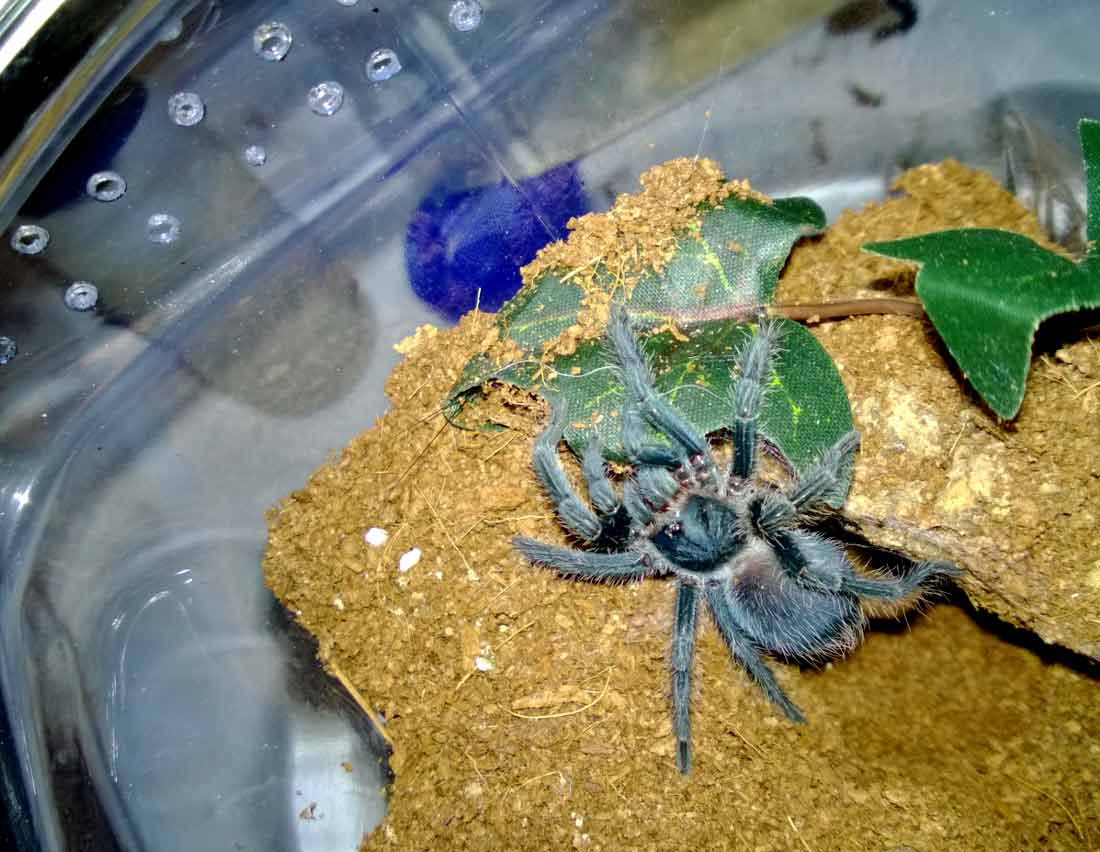
A photo of my A. schmidti shortly after I acquired her in October of 2013.

When she arrived, I was immediately captivated by her giant abdomen, which seemed ridiculously out of proportion when compared to the rest of her body. After setting up her enclosure, being sure to add enough dry coco fiber to allow her to dig, I allowed her to sit and acclimate to her new surroundings. As stated in the accounts I had read, she immediately started digging and bulldozing her enclosure. However, unlike other burrowing species I keep, she never seemed quite satisfied with her work. Several times, she would completely bury herself for a few weeks, only to pop up again later through a brand new den entrance. Over the course of a month, she buried her cork bark hide, a plant, and two water dishes.

Despite her mammoth rump, she did not appear to be in premolt and still ate. She did prove to be a bit of a finicky and shy eater, as she would often run from crickets or roaches that were put in alive and kicking but would readily take a pre-killed one placed at the mouth of her burrow. In late December, she refused a meal, signifying that she had eaten enough and, possibly, had begun her premolt period. I couldn’t wait to see what she would look like with a fresh exoskeleton. So, I waited…

…and waited…

…and waited…

…and waited.

January passed, then February, then March. Let’s just say, Aphonopelma’s distinction as slow growers is well deserved. Over this time, I made over a dozen more acquisitions. And as some of my other Ts molted three times, warranting rehousings, my little A. schmidti sat in the corner of her little burrow, only emerging periodically to drink or to endlessly rearrange her substrate.

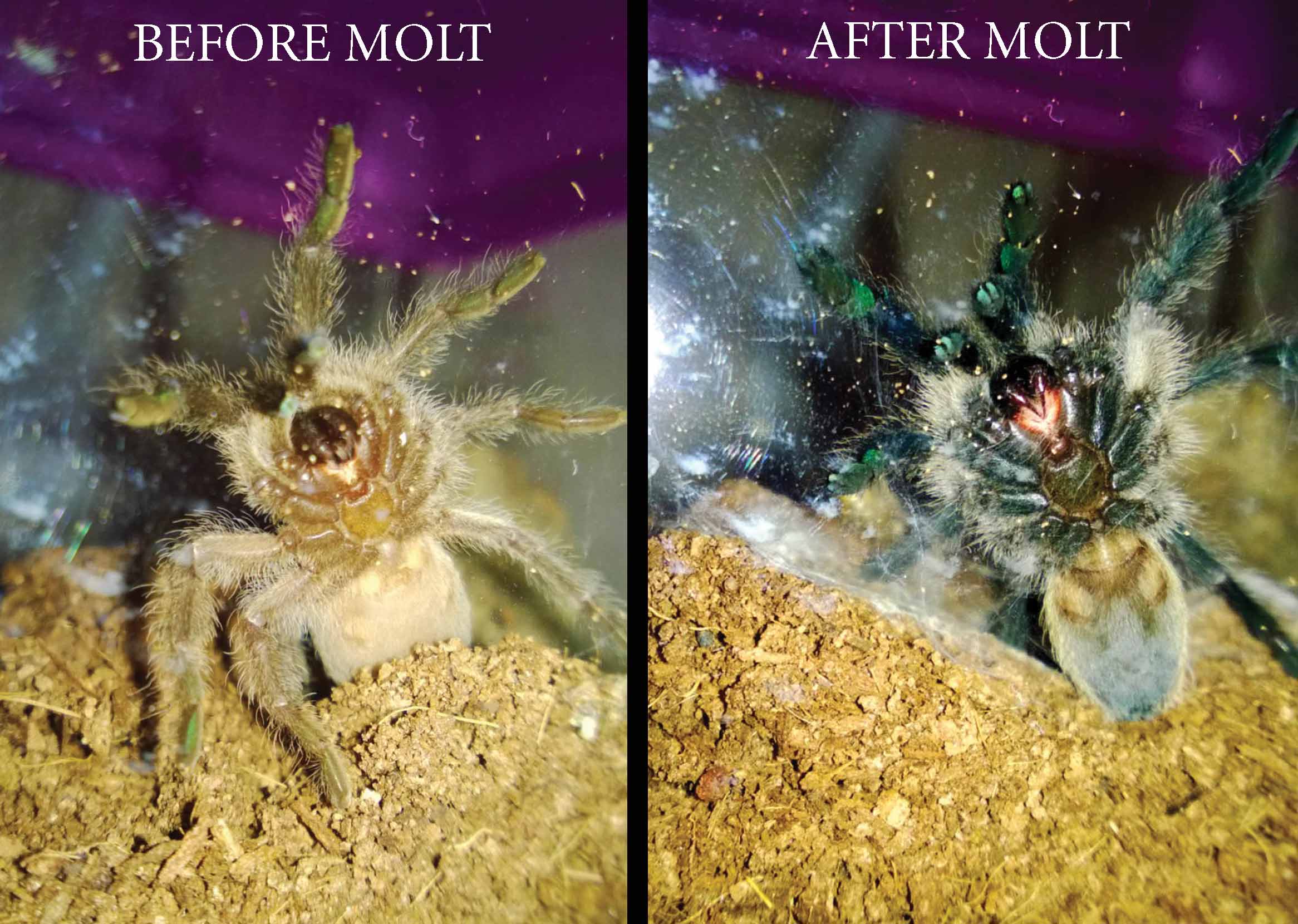
Then, finally, it happened. Last Friday, as I was getting ready for work, I noticed that she was upside-down. When I returned home that evening, it was to a freshly-molted T(FINALLY!).

A. schmidti post molt

My A. schmidti three days after a long-overdue molt.

With her tones becoming closer to adult coloration, I was reminded of what attracted me to this species in the first place. She now sports a strikingly blond carapace, redish-brown hairs on the abdomen, and a lightening of the color on her legs below the femurs. Although I haven’t been able to get a good measurement yet, she looks to be about 2.25-2.5″. Again, a slow grower, but well worth the wait.

For those looking for an active, fast-growing species, an A. schmidti might not be for you. Although the non-stop digging and tunneling can be amusing, this is a T that can be quite secretive and will spend a lot of its time hiding in its den. Still, their husbandry is quite simple, and they are pretty little Ts who will likely outlive some of the faster-growing species, and when they do molt, it really is cause to celebrate. Personally, I think that the A. schmidti would make a wonderful first T for the patient keeper.

P. cancerides Fresh After Molt

P. cancerides Juvenile

Newly-Molted P. cancerides Juvenile (3″)

After just writing that I was excited to see how my two P. cancerides juveniles would look after their latest molts, I discovered that one had actually molted yesterday. In this photo, you can see the freshly-molted specimen standing next to its discarded exoskeleton. Not only did this particular T go from about 2.5″ to 3+” with this latest molt, but it is also now sporting more of an adult coloration. Gone are those beautiful blues replaced by a more muted blue-gray with striping and reddish hairs on the abdomen. Still, I’m loving this new look, and once again, I’m floored by not only the new length, but also the girth attained through this latest molt.

As its current enclosure is only about 4″ square, he/she will be getting  rehouse as soon as the new exoskeleton has hardened.

Phormictopus cancerides

Late last year, while looking for interesting new species of Ts to possibly add to my collection, I encountered P. cancerides (Hispaniola Giant or Haitian Brown) slings on several sites. A couple of the descriptions I read didn’t make them sound particularly interesting, with cancerides being described as good eaters, but fast and skittish tarantulas that mature into large 7+ inch brown females or purplish male adults. Still, the slings were gorgeous, sporting a gorgeous blue sheen, and the fast growth rate was a plus. After weeks of reading personal accounts from those who kept this species, and finding them all to be enthusiastically positive about these animals, I decided to pick a couple slings up from Jamie’s Tarantulas.

I’m so glad that I did.


P. cancerides sling 1.75"

P. cancerides sling when first procured in November, 13. 1.5″

P. cancerides has quickly become one of my favorites. My juveniles have a vicious feeding response, stalking their prey with a fast, no-nonsense approach that I’ve only seen in my female L. parahybana. My large P. cancerides will literally leap at prey at an awesome speed. However, as described, they are more skittish than aggressive, choosing to flee into their dens rather than stand their grown or hair kick when their enclosures are opened. I’ll be interested to see how their temperaments change as they mature.

Speaking of dens, both of my juveniles are ambitious burrowers, constructing huge underground caves for their dens. However, unlike some of my other burrowing species, they spend much of their time standing boldly out on the surface for easy viewing. No matter time of day, they are usually right out in the open, ready for another meal.


P. cancerides

Same P. cancerides a week after molting, now 2.25″

As for the rate of growth, my two larger specimens have only molted once in my care. However, the amount of size gained between molts was nothing sort of amazing. My slings started off at a thin 1.5 inches, but grew to an impressive and robust 2.25″ after molting (see photos). More than just the length was the thickness of the spiders; they went from looking like little bluish garden spiders to hairy mini Ts. Both of my cancerides are in pre-molt again, and I can’t wait to see how much they grow this time around.

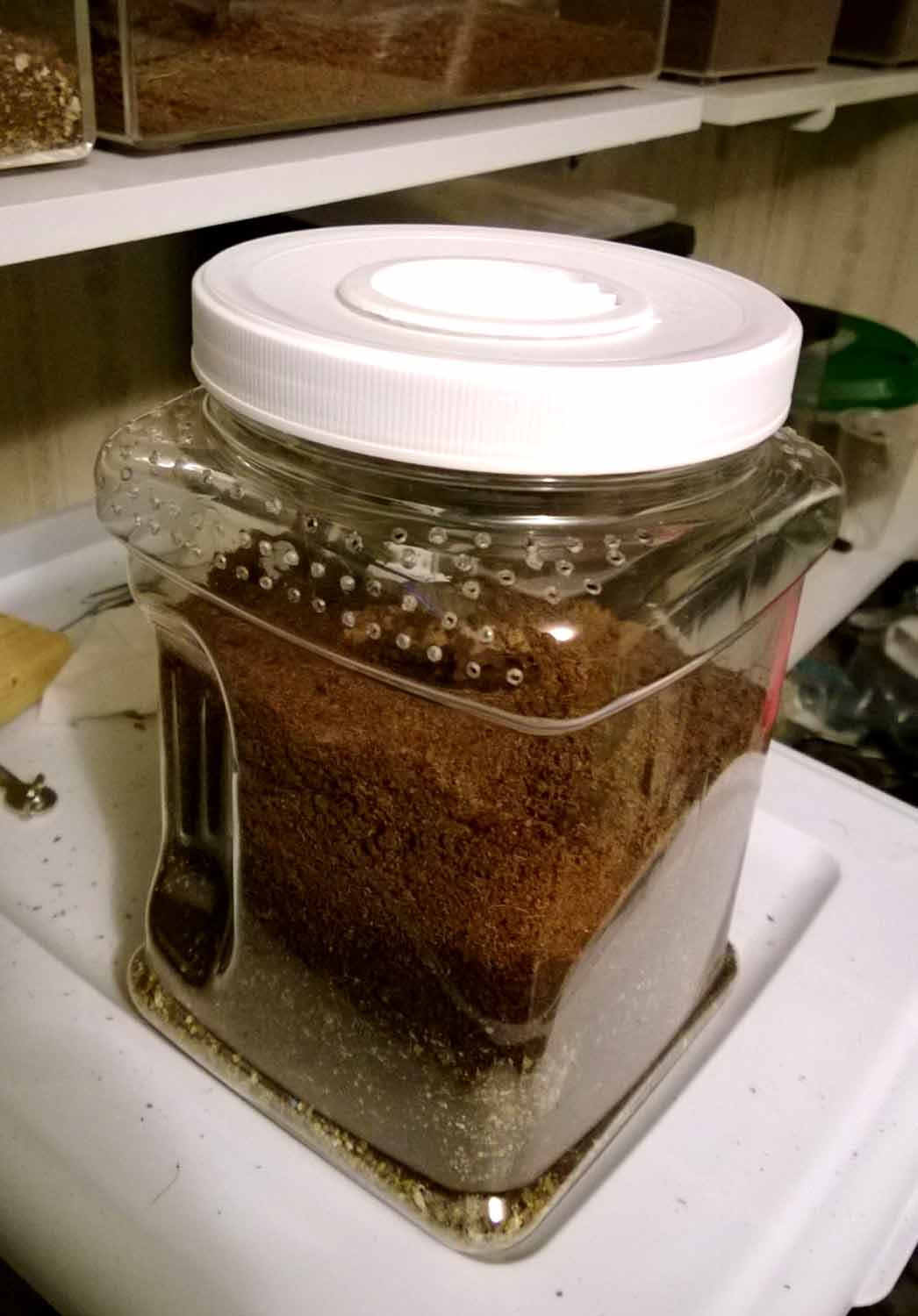
Their care has proven to be quite simple: I keep both of mine in plastic jars measuring 4.5 L x 4.5 W x 7″ H filled to a couple inches from the top with a mixture of coco fiber and sphagnum peat moss (with a layer of vermiculite at the bottom to retain moisture). This gives them plenty of space for burrowing, and the layer of vermiculite at the bottom allows for better moisture retention and a humidity gradient. The top of the substrate is mostly dry, although I overflow the water bowl on one side; the bottom of the substrate is damp. I do not mist, and instead pour water in a corner and allow it to percolate down to the lower levels.

The enclosure is well-ventilated with a round 2″ vent in the top and strategically place air holes in the sides to supply cross ventilation. The temperature is around 70 degrees at night with a high of about 78 degrees in the day. These two are fed medium crickets or roaches twice a week.

P. cancerides enclosure

Custom P. cancerides enclosure made from plastic cereal canister.

I recently picked up a third P. cancerides, a 1″ sling from Net-Bug, in hopes of increasing my chances of procuring a female. If my current trio turn out to be all males, I will look forward to buying more slings and growing some more. This is definitely a species I’m interested in breeding in the future. For someone with some T keeping experience, P. cancerides is a beautiful, fast growing, hardy tarantula that would make a perfect addition to any collection.

M. balfouri juvenile freshly molted

M. balfouri juvenile molt

M. balfouri Juvenile Molt

One of my M. balfouri juveniles molted, and I’m delighted to see some of the striking adult coloration (check out those blue legs!). The original photo was taken in late February; the second yesterday. This un-sexed juvi is about 2.25″. I’m looking forward to fattening the little him/her up when the new exoskeleton hardens and he is all ready to eat.