“What is the fastest-growing tarantula species?”

It’s a question that I’ve been asked dozens of times over the years, and one that I’ve strategically avoided answering. First off, although I’ve managed to keep over 130 different species, that’s only a fraction of the 900+ species of described tarantulas in the world. It would literally be impossible for me to comment on the fastest-growing species, having no experience with the majority of tarantulas out there.
Also, there are several factors that can impact tarantula growth, and while one keeper might experience super-fast growth with a species, another keeper may find that their specimen is taking forever to put on size. In my years of experience, I’ve had many folks come to me with differing opinions on a particular species’ growth rates.
The fact is, a specimen’s growth can be impacted by several variables, including temperature, feeding schedule, and genetics. Someone maintaining their collection at 80 F (27 C) will likely experience faster growth rates than another person keeping hers at 70 F (21 C). A keeper may feed his slings once a month, while another keeper feeds his spider twice weekly, again leading to faster growth. Then, some specimens just seem to put on size more quickly than others due to genetics. How could I possibly assemble an accurate list when there was just so much to take into consideration?
However, after years of dodging the question, I finally decided that the best way to approach the topic wasn’t to make a list of the fastest-growing tarantulas in the hobby, but to talk about the species I have personally raised that have exhibited faster-than-average growth rates. And, as the temperatures in my tarantula room tend to run lower than some of the year, with winter temps often in the lower 70s F, it would mean that these species grew quickly despite not having high temperatures. Therefore, someone keeping theirs at higher temperatures should still experience even faster growth. So, how could one go about determining which species are “fast growing”? Kyle Shane Horner summed up the issues best with his comment:

When assembling this list, I took a couple of factors into account. First, I looked at species in which males mature quickly, as mature males are adults nearing the end of their life cycle. In these instances, their female counterparts were not sexually mature but still qualified as “young adults.” I also looked at annual growth, as I found that my fastest-growing tarantulas usually gained several inches in the first 12 months of their lives. With the spiders on this list, one can expect their little sling to resemble a big hairy adult within a year while also reaching a large percentage of their max size.
So, at long last, here is my list of the 14 fastest-growing tarantulas I have had the pleasure of keeping!
Hapalopus formosus (or sp. Colombia Large) “Pumpkin Patch”
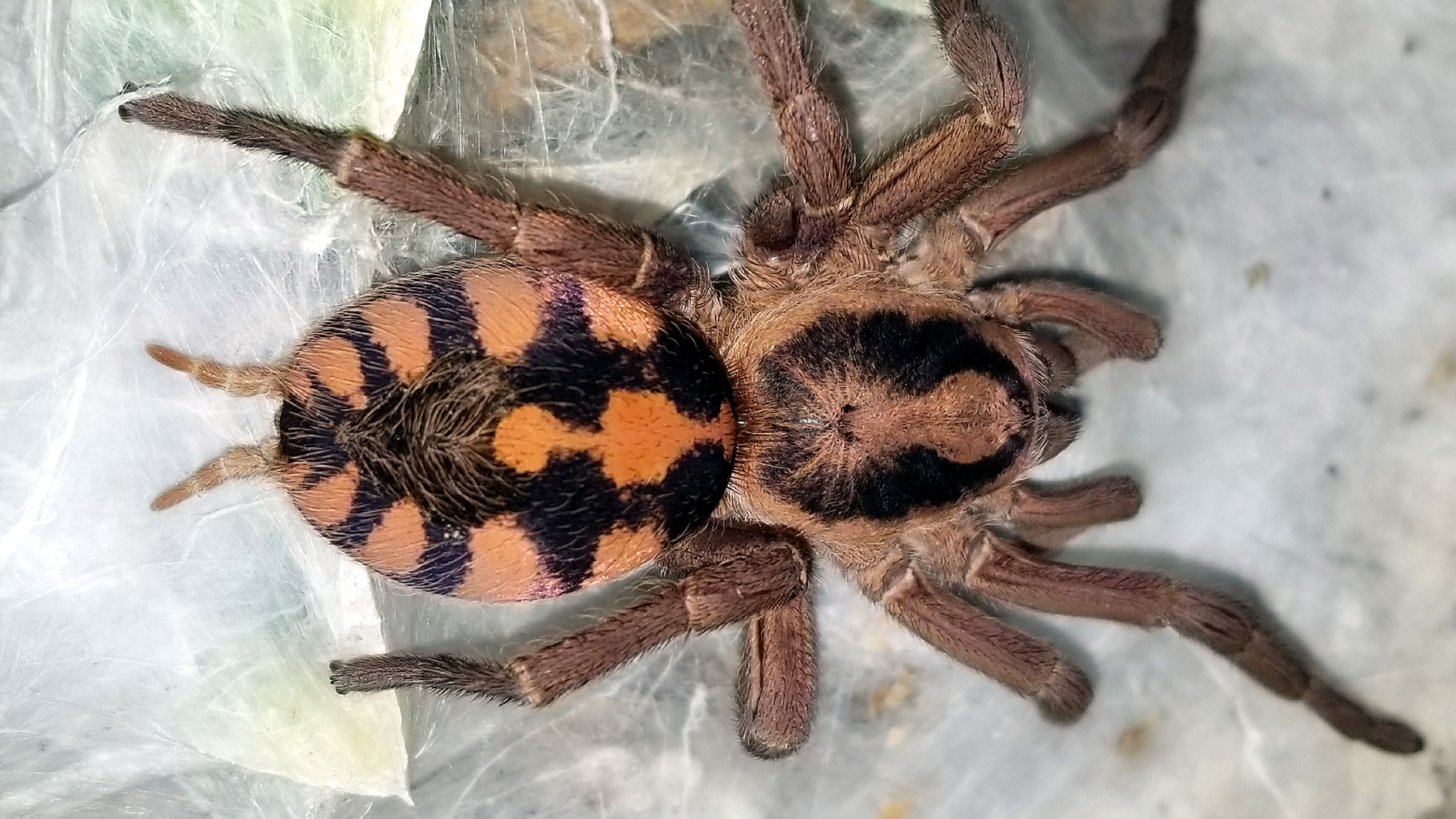
Not only does this awesome little species have the distinction of being one of the only slings that sports its adult colors from day one, but it’s also one of the fastest-growing tarantulas in the hobby. I’ve raised two sets of Pumpkin Patch slings over the years, and both grew like weeds. I received my first trio of .25” (.6 cm) Hapalopus formosus back when the temperatures in my tarantula room often dipped into the high 60s (20 C). Despite the cooler temps, they still ate great, molted frequently, and put on size quickly. My first male matured at around the 13-month mark, and his two sisters were a beefy 2” (5 cm) at the same time. Considering that an adult female only reaches about 3.5” (9 cm) in max size, this is excellent development. A friend of mine who kept her Pumpkin Patches around 80 degrees had a male mature out after only 10 months; now THAT is fast growth.
Although slings start off as quite tiny, keepers interested in trying this species out can at least take solace in the fact that they won’t remain minuscule for long. They are excellent hunters, often tackling and subduing prey items not much smaller than themselves before pulling them into their heavily webbed dens. One of the more unique-looking tarantulas in the hobby, the Hapalopus formosus is an awesome choice for someone looking for a hardy, fast-growing tarantula.
Ceratogyrus Darlingi “Rear Horned Baboon”
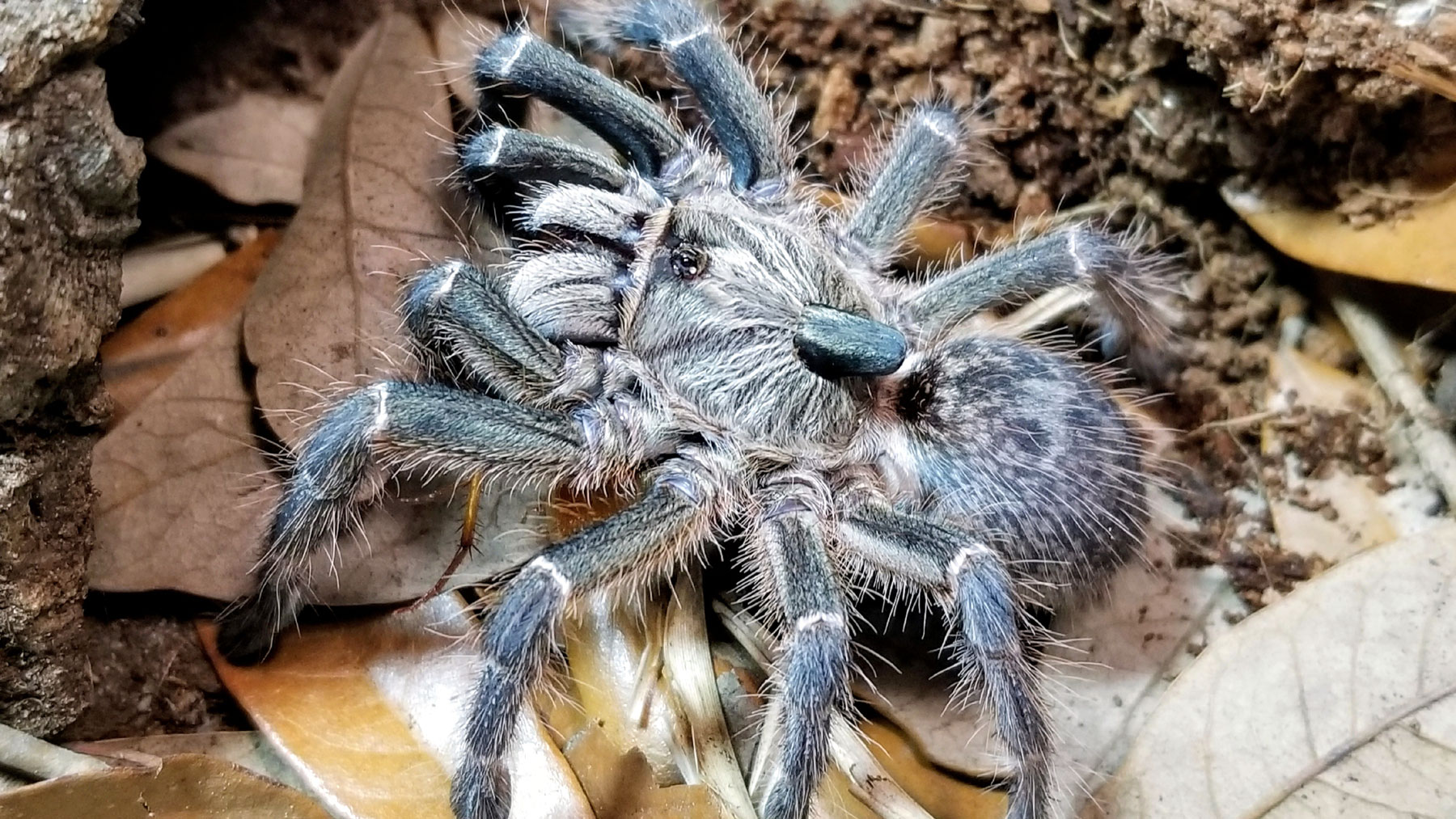
Several years ago, I got a couple .5” (1.25 cm) C. darlingi slings with the hopes of possibly getting a female. After watching my little ones grow for 10 months, waiting for them to develop the “horns” that give this species its common name, I was absolutely shocked to discover that one had matured out male. Not only did this little guy mature out in under a year, but he was one of the tiniest mature males I had ever seen, measuring a diminutive 1.75” (4.4 cm). A second male matured a bit later at around 12 months at a more impressive 3” (7.6 cm), showing that this wasn’t a fluke.
This fast growth wasn’t limited to just the boys, either. My two females were around 3” (7.62cm) at the 1-year mark, and both sported their horns and looked like mini adults at this time. The C. darlingi are great eaters, often bursting from their webbed burrows to snatch up prey items as large as they are. They molt frequently and put on a decent amount of size with each passing molt. For folks looking to keep Old World tarantulas for the first time, their shy, often calm demeanors make them an ideal candidate for the best beginner Old Worlds list.
Nhandu tripepii “Brazilian Giant Blonde”
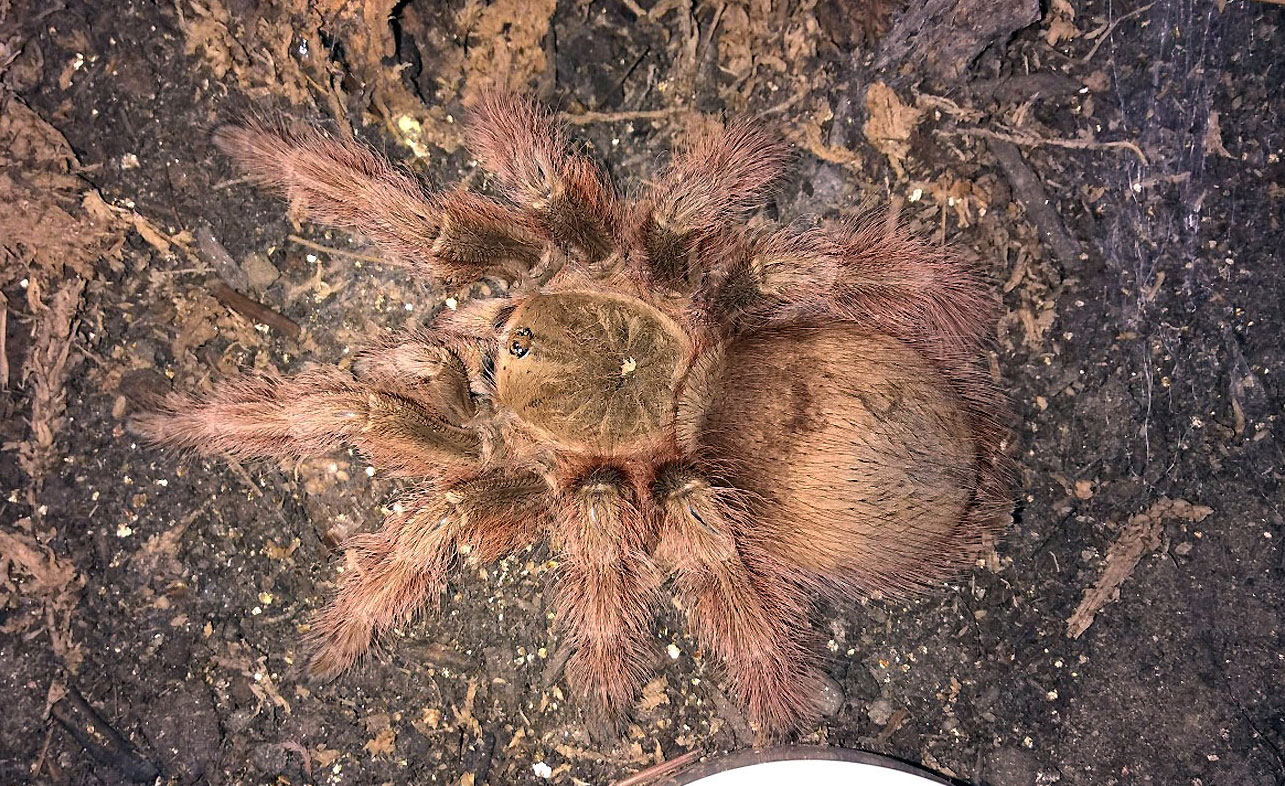
This species is actually the last I added to this list, as when I first had the idea for it, I only had my adult female and several tiny .5″ (1.27 cm) slings. Now, I had heard that this species grew quickly, and my female had been a frequent molter even though she was a young adult when I got her, but I hadn’t yet personally experienced this species’ supposed fast growth.
However, in the 10 months it’s taken me to put this video together, the largest of my slings is now pushing 4” (10 cm) in leg span and looks to be in premolt again. If that doesn’t qualify as fast growth, I don’t know what does! Even as teeny tiny slings, my N. tripepii were voracious eaters and frequent molters, putting on a great deal of size with each molt. At the rate these guys are all growing, I’m guessing that I’ll have several fluffy young adults before a year is up. Those looking for an adorable and spunky blonde ball of fluff should look no further than the Brazilian Blonde.
Hysterocrates gigas “Cameroon Red Baboon”
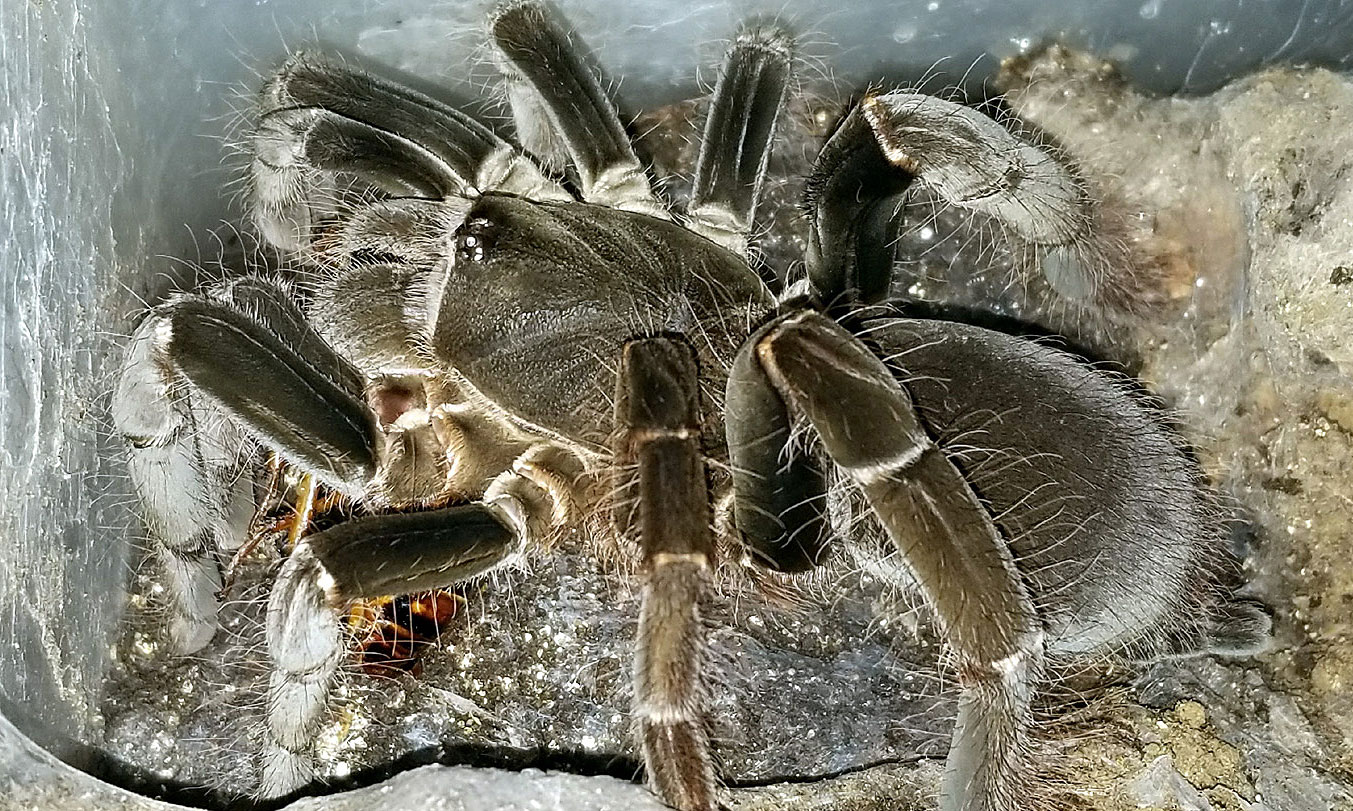
In 2014, I picked up two small H. gigas slings, which I housed in 32-oz Ziploc deli containers. Both immediately buried themselves in the moist substrate, and although I never saw them out in the open, the crickets I dropped in twice a week disappeared, and occasionally they would seal off the entrance while presumably in premolt. A year passed, and while doing routine feeding one night, I unscrewed the top of the container and was shocked to discover that not only was one of the spiders out in the open, but it was pushing 4” (10 cm). Those elusive little slings had put on massive size during the 12 months I had them, and I had no idea because I never caught them out.
Luckily, both were quite well behaved during the ensuing emergency rehousings, and they are now two bulky 7” (18 cm) females. Although my two girls remained quite shy, spending the vast majority of their time in the moist confines of their burrows, I do catch them out every so often. They have remained excellent eaters throughout their lives, with mine taking down several large crickets every feeding. I’ve heard similar stories of super-fast growth from other keepers over the years, so I know that my experience wasn’t an anomaly. Folks looking for a large, fast-growing Old World spider need look no further than the H. gigas.
Omothymus violaceopes “Singapore Blue”
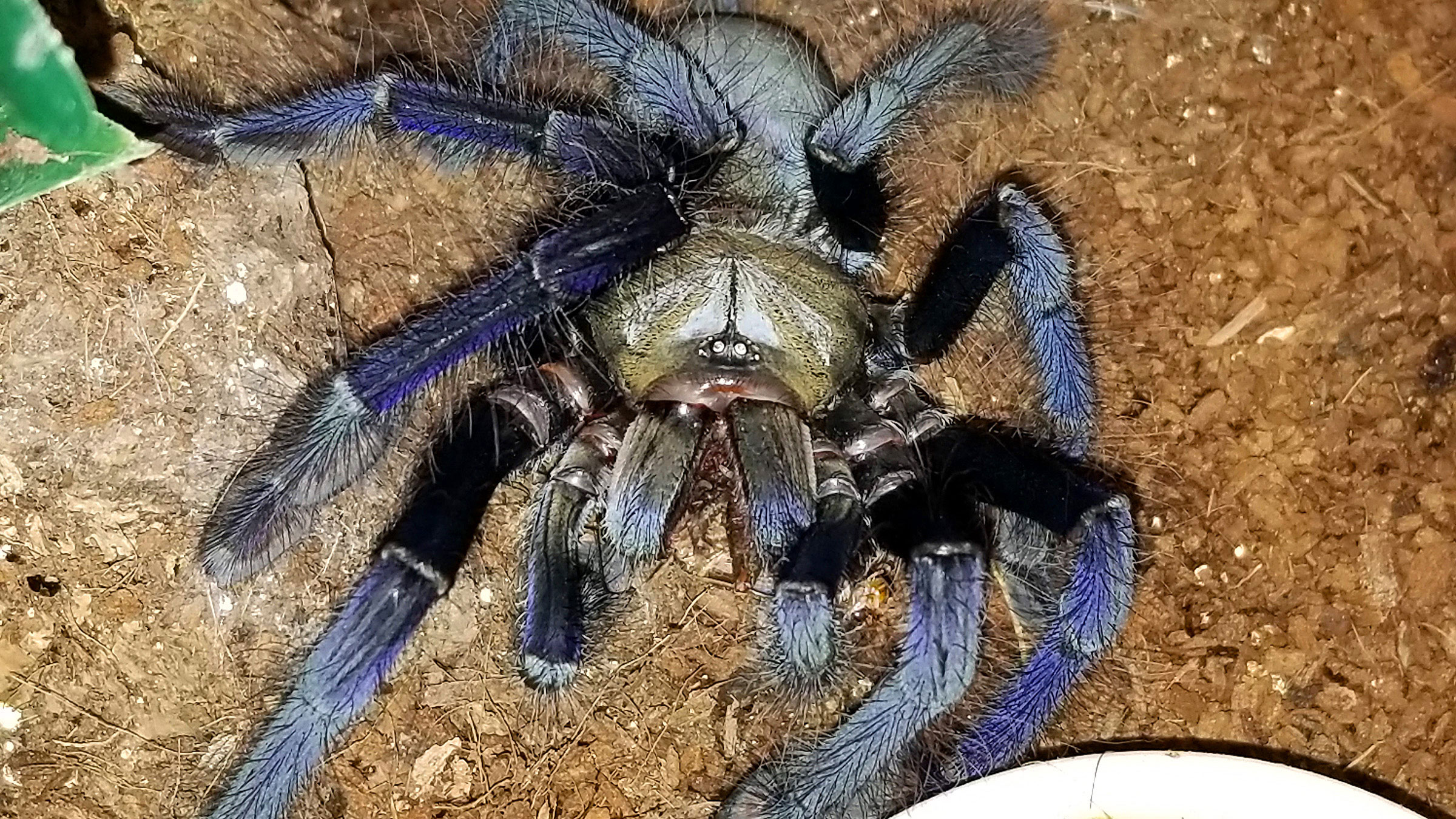
Back in 2014, I picked up three O. violaceopes slings in hopes of getting one of the big, beautiful blue females that I’d been admiring in photos online. I’d heard that this species was a fast grower, but I was still shocked when two of my specimens matured out into gangly green males just 14 months later. My sole female was a solid 5” (12.7 cm) at the time, and her next molt just a couple of months later brought some of the gorgeous blue and purple tones that this species is known for.
When slings and juveniles, my O. violaceopes were incredibly shy, spending all of their time beneath the surface in burrows. Although I rarely saw them hunt, they were great eaters, and any crickets that I dropped into their enclosures quickly disappeared. Like the aforementioned H. gigas, it was difficult to see how big they were getting, as I never saw them out. Even now that my female is an adult, I’ve only caught her out of her den twice in three years. That said, even just an annual glimpse of this stunning spider makes keeping her all worthwhile.
Megaphobema robustum “Colombian Giant Redleg”
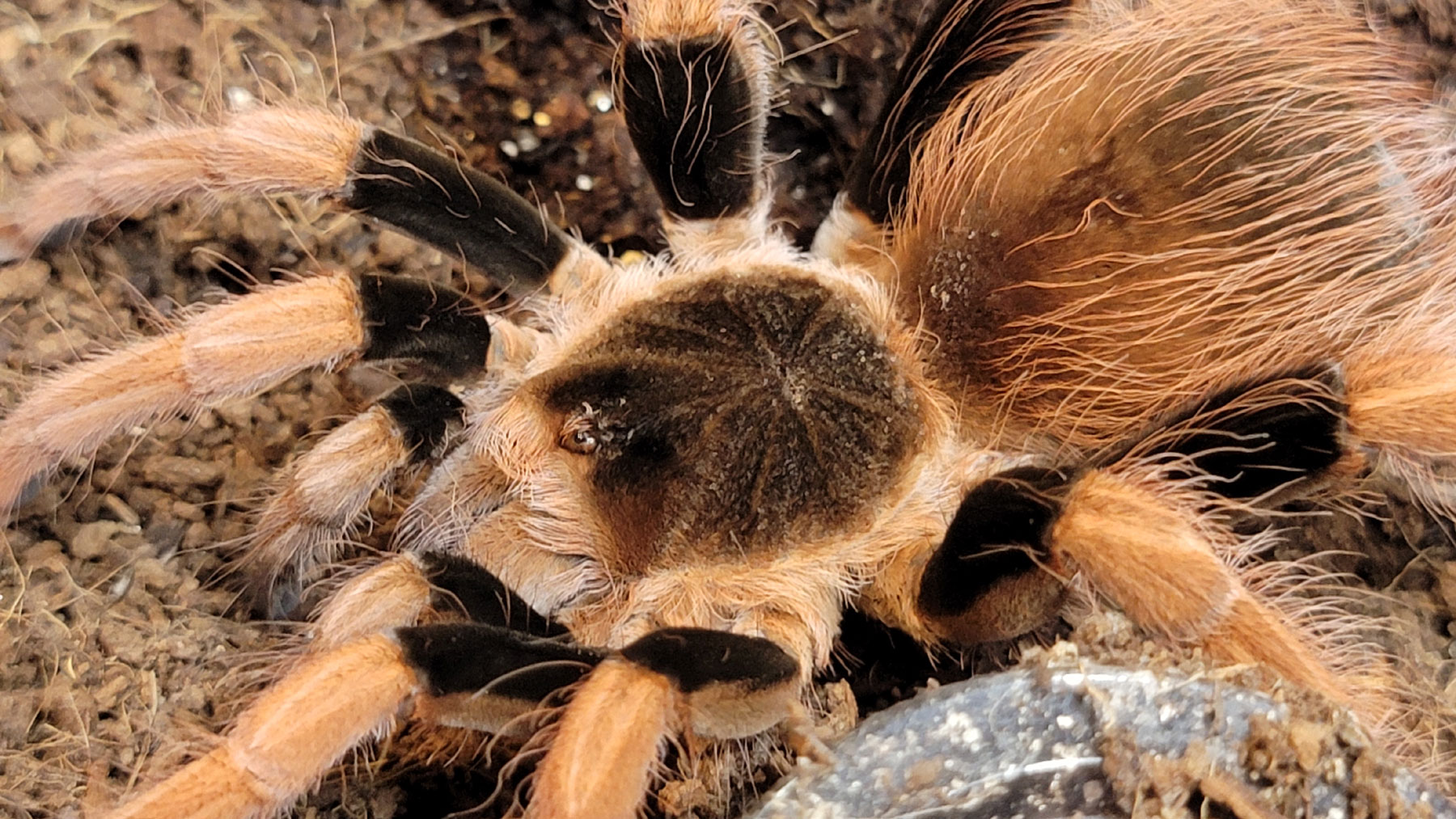
After missing out on a sexed female in 2014, it took me several years to finally get an M. robustum. My first specimen was actually a gift from a subscriber and M. robustum enthusiast, Samantha Miller who was appalled that I didn’t yet have one. The gorgeous 1.25” (3 cm) sling she sent immediately became a favorite with its voracious appetite and fast growth rate. This specimen hit the 3.5” mark within a year before maturing out male a year later. A second sling that I purchased a few months after receiving him again hit 3.5” at the year mark and is now a beefy 5.5” or so.
This large, leggy spider can hit a maximum leg span of over 7” (18 cm) and has one of the most unique defense tactics of all tarantulas. When threatened, the M. robustum will raise its abdomen in the air and kick out its back legs, often spinning in circles as it moves. The purpose of this maneuver is to try to strike any threat with sharp hairs on its legs. I’ve only seen mine do this once, and it was quite the display. Besides being a great eater and fast grower, the M. robustum is also a stunning spider with its dark chocolate carapace and femurs and striking orange/red legs. Although this species has fossorial tendencies right through to adulthood, they definitely venture out of their dens and venture out enough to be admired.
Birupes simoroxigorum “Sarawak Blue”
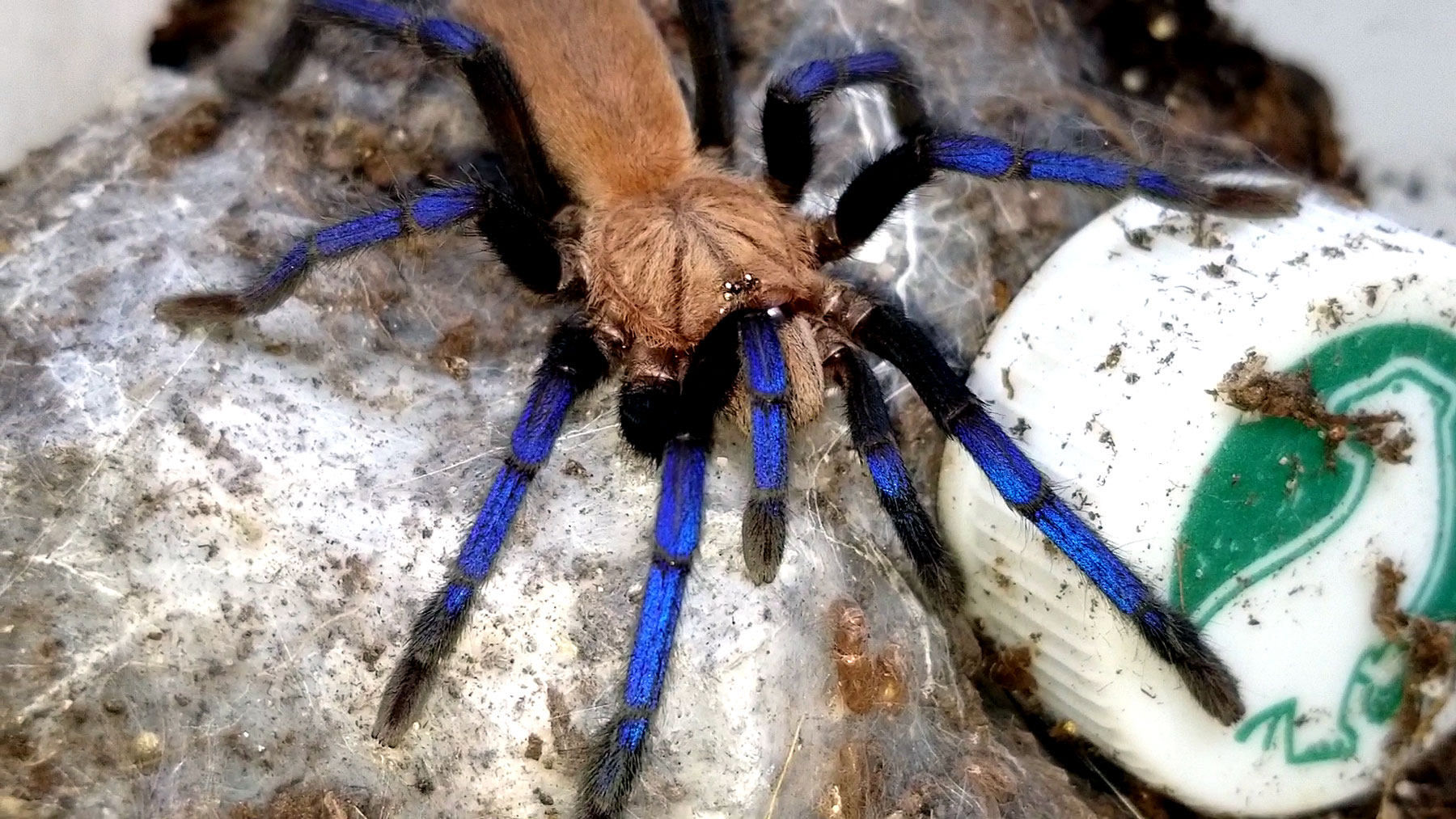
Recently introduced into the hobby, the Birupes simoroxigorum captured the attention of keepers due to its relative rarity and eye-catching electric blue legs. I picked up a pair of.5” (1.27 cm) slings from Fear Not in late February of 2020 in hopes of raising them up to document the care for them. I was delighted to discover that they weren’t just great eaters, but also fast growers. This burrowing species is quite shy and secretive, and I rarely catch them hunting. However, for the first several months that I had them, they molted frequently and put on a decent amount of size with each molt. My tiny, fragile 1 cm slings were soon over an inch and sporting some of those brilliant blues that keepers go nuts for.
It’s been nearly a year since I first received these beauties, and one is already around 3” (7.6 cm) with the other about to molt. I’ve been told that males can mature after only a year or so with females becoming sexually mature in two or three years. That’s impressive growth. Considering that this species currently carries a hefty price tag, at least keepers can take solace in the fact that their delicate little slings will be robust adults before too long.
Poecilotheria regalis “Indian Ornamental”
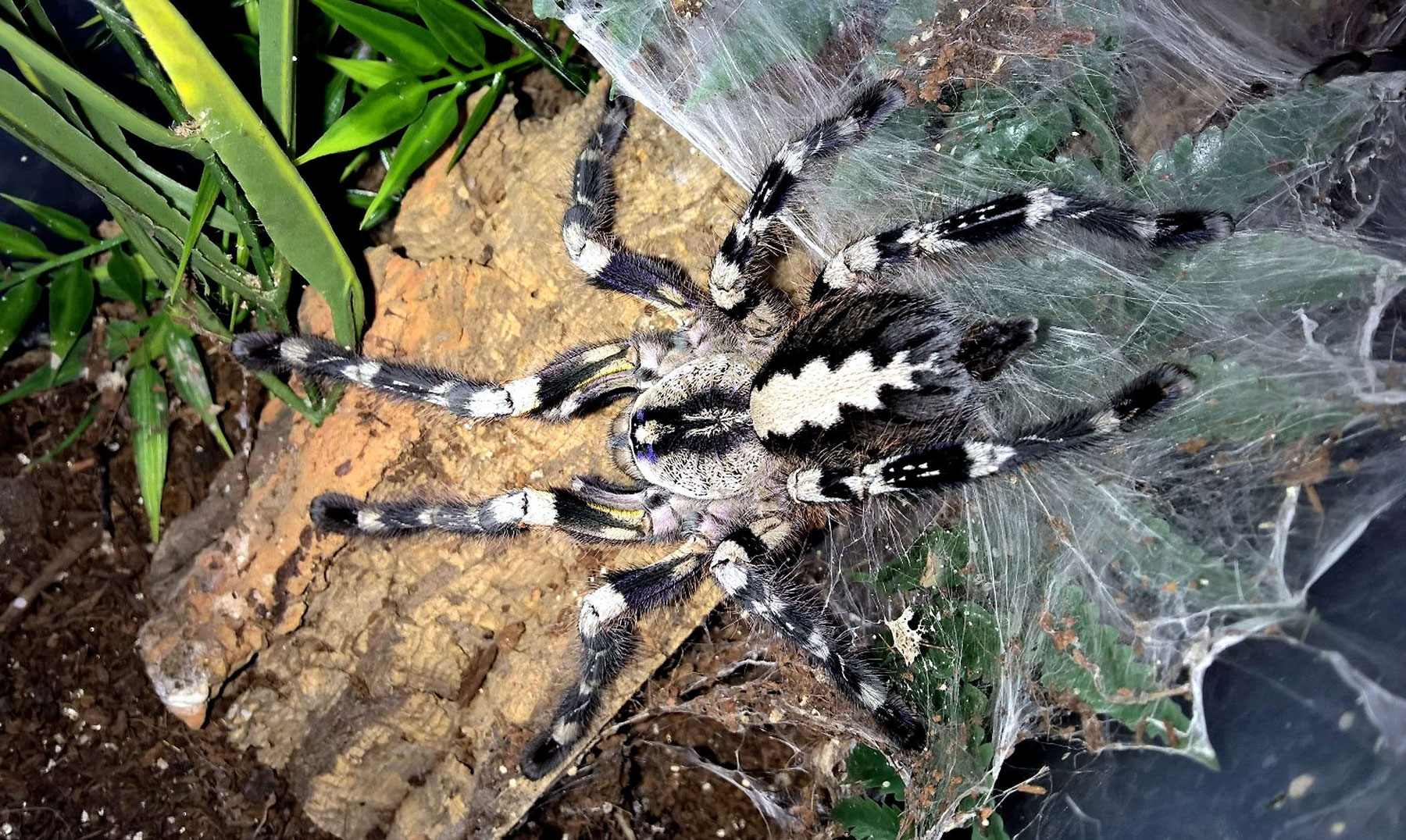
Now, to be honest, I could probably have picked any of the species from this genus of arboreal spiders, but for the sake of streamlining the list, I narrowed it down to one. I picked up two Poecilotheria regalis slings back in 2015. The first, a 1.75” (4.5 cm) specimen molted out male in 14 months. The smaller one, a female, reached a diagonal leg span of just over 4” (10 cm) in the first year and was already sporting its striking adult coloration. This is a spider that can easily go from a tiny tan sling to a vibrant young adult in 12 month’s time. It should be mentioned that my tarantula room would sometimes drop into the high 60s back then, so this species still achieved impressive growth despite not having higher temperatures through much of the year.
Five years later, my female is about 7.5” (19 cm) in diagonal legspan, having just molted again a few months ago. As with all Poecilotheria species, the P. regalis are excellent hunters and eaters that are known to attack larger prey items even as slings. Although slings can start off fairly tiny, I always give mine a bit more room than I normally would due to how quickly they can outgrow their enclosures. In many instances, keepers can move this species from its sling enclosure directly into its adult enclosure.
Psalmopoeus cambridgei “Trinidad Chevron”
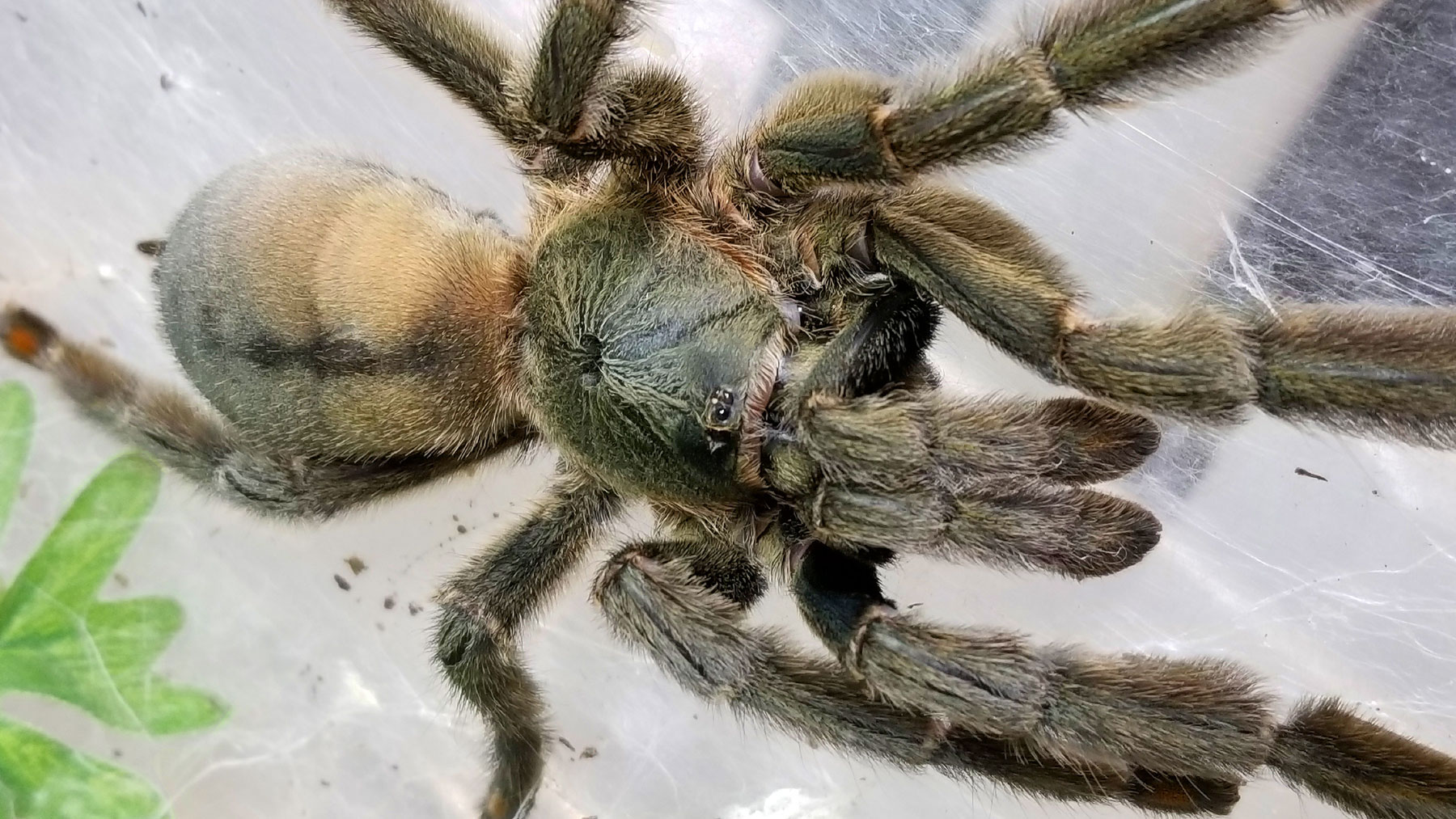
It’s amazing for me to think that there was a time when I wasn’t at all interested in Psalmopoeus species. All of that changed when I got my first, a P. cambridgei sling in late 2015. The first thing that impressed me was its awesome feeding response. Any little crickets dropped in were immediately and ruthlessly hunted down and consumed. And, as is the case with all the species on this list, with great eating came excellent growth. My P. cambridgei molted frequently, putting on good size with each shed, and quickly outgrew its sling enclosure in about 8 month’s time, going from .75” (1.9 cm) to over 3” (7.6 cm) in that time. By the time a full year rolled around, my little gal was a leggy 4” (10 cm), and her next molt saw a massive jump in size to a whopping 5” (12.7 cm).
Now a full-grown 7” (18 cm), this green-hued darling is one of my favorite spiders in my collection. She’s continued to be a great eater for me, and she’ll gobble up 3-4 large crickets each feeding. She is also quite visible, and more often than not, she can be found sitting on the side of her enclosure in full view. I actually love this species so much that I just got three slings from my buddy, Charles, who just bred them. I can’t help but giggle watching these tiny slings stalk and tackle prey items almost as large as they are.
Pamphobeteus sp. “Duran“
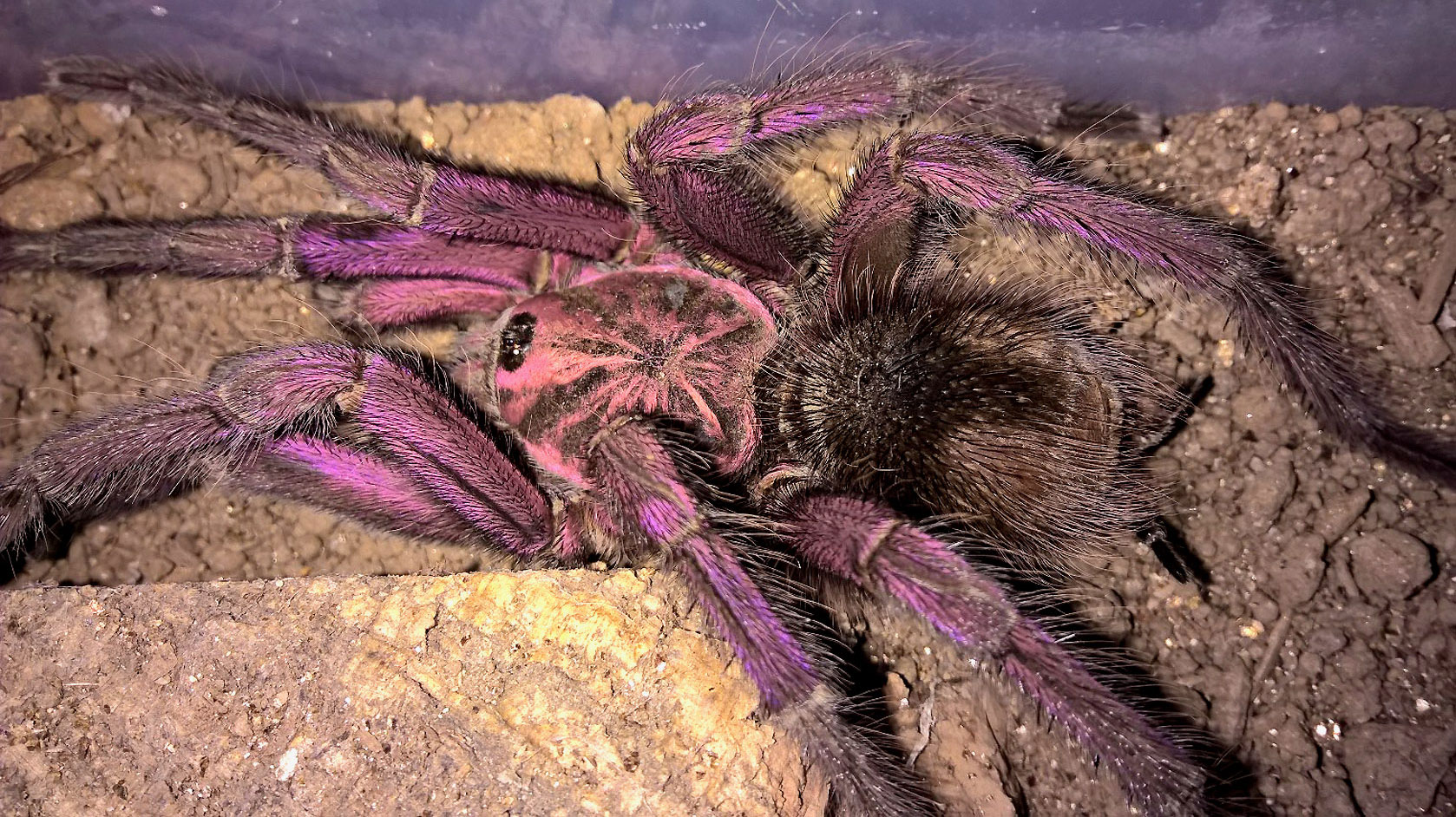
Again, any species from this genus could be on the list, but I’m choosing the one that I raised from a sling. I picked up two leggy 1.25” (3.2 cm) sp. Duran slings in the summer of 2014, and I was immediately enamored with their awesome feeding responses. My little guys were shy at first, immediately burrowing, but they showed no fear at all when it came time to eat. Both would burst from their retreats to ruthlessly hunt and subdue crickets, often taking down prey almost the same size that they were. Within less than a year, both were over 4” (10 cm) and sporting gorgeous pinks and purples. Just before the two-year mark, my male matured to a gangly 7-inch fuchsia beauty.
My female is now fully-grown at around 9″ (23 cm) and is still a voracious eater, taking down several crickets in a sitting. Unlike my adult P. antinous, who is quite calm, my species Duran is quite skittish and still uses a burrow to hide. She also lost her wonderful pinks and purples as she matured, but she is still a handsome and impressive spider nonetheless. Now, as sp. Durans can be difficult to find, those interested in the Pamphobeteus will be happy to know that they can expect the same fast growth from any species in the genus.
Phormictopus cancerides “Haitian Brown”
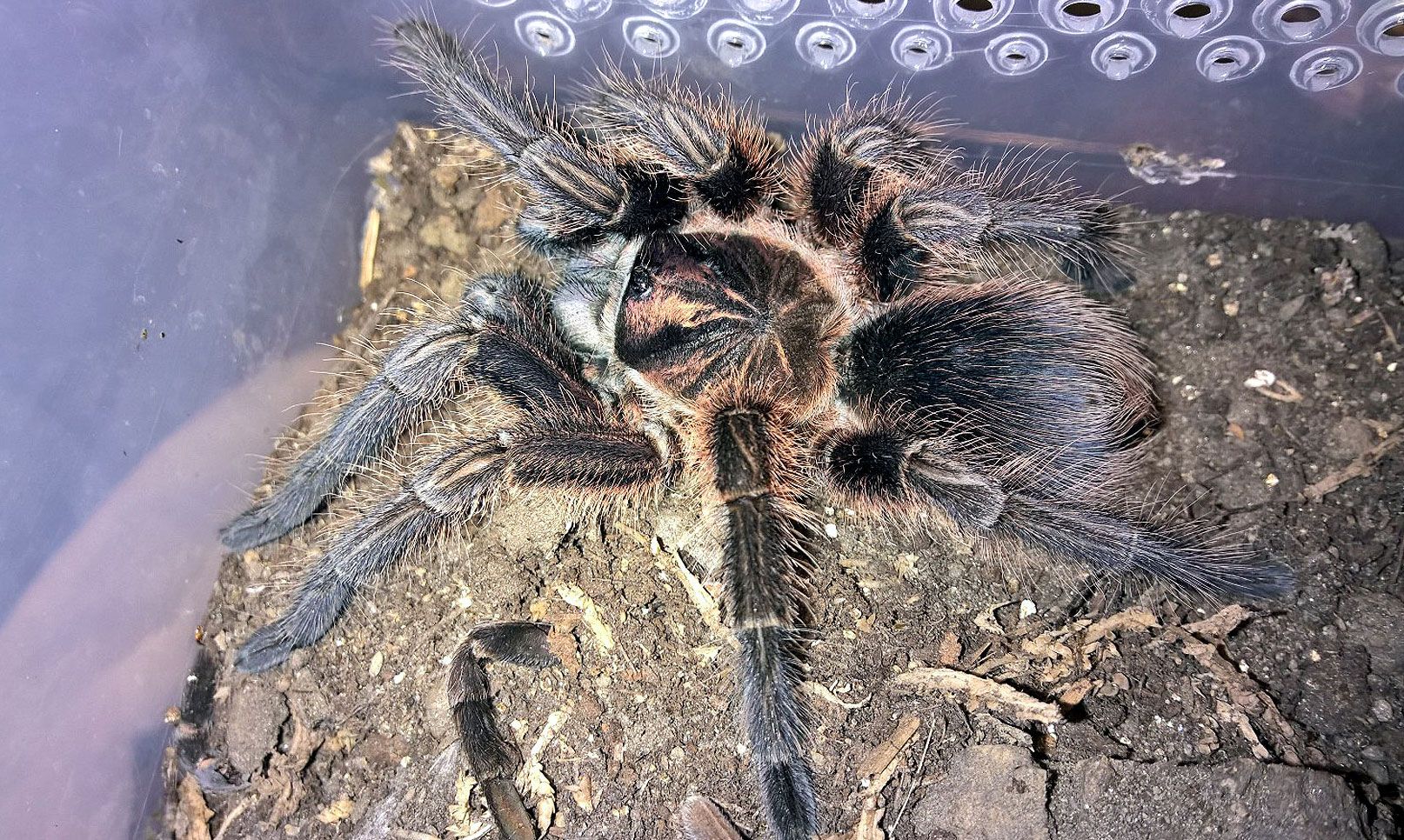
The Phormictopus cancerides was both my introduction to the amazing genus Phormictopus as well as fast-growing tarantulas in general. The first time I watched my brilliant blue sling race across its enclosure to violently subdue a cricket, I was in love. Having only kept more slow-growing “beginner” species for a while, I was shocked by this species’ ferocious hunting skills and super-fast growth rate. Not only did the sling molt frequently, but it also put on a great deal of size with each molt. With one molt in particular, my spider seemingly went from a 2.5” (6.3 cm) blue juvenile to a 4” (10) sub-adult. That molt was one of the most profound appearance and size changes I have ever witnessed from a single shed.
I’ve raised up four P. cancerides over the years (as well as several other species of Phormictopus) and all have had great feeding responses and fast growth rates through the first year or two of their lives. Folks picking up slings can expect to have a 4” spider sporting its adult colors within a year. Although their growth rates after the 5” (12.7 cm) mark tend to slow down compared to some of the other spiders coming up on this list, one can still expect to have a 6”+ spider in a few years. A personal favorite of mine, the Phormictopus Cancerides is a large, hardy, very fast-growing spider that should be a staple in any collection.
Xenesthis sp. Blue “Colombian Lesserblack”
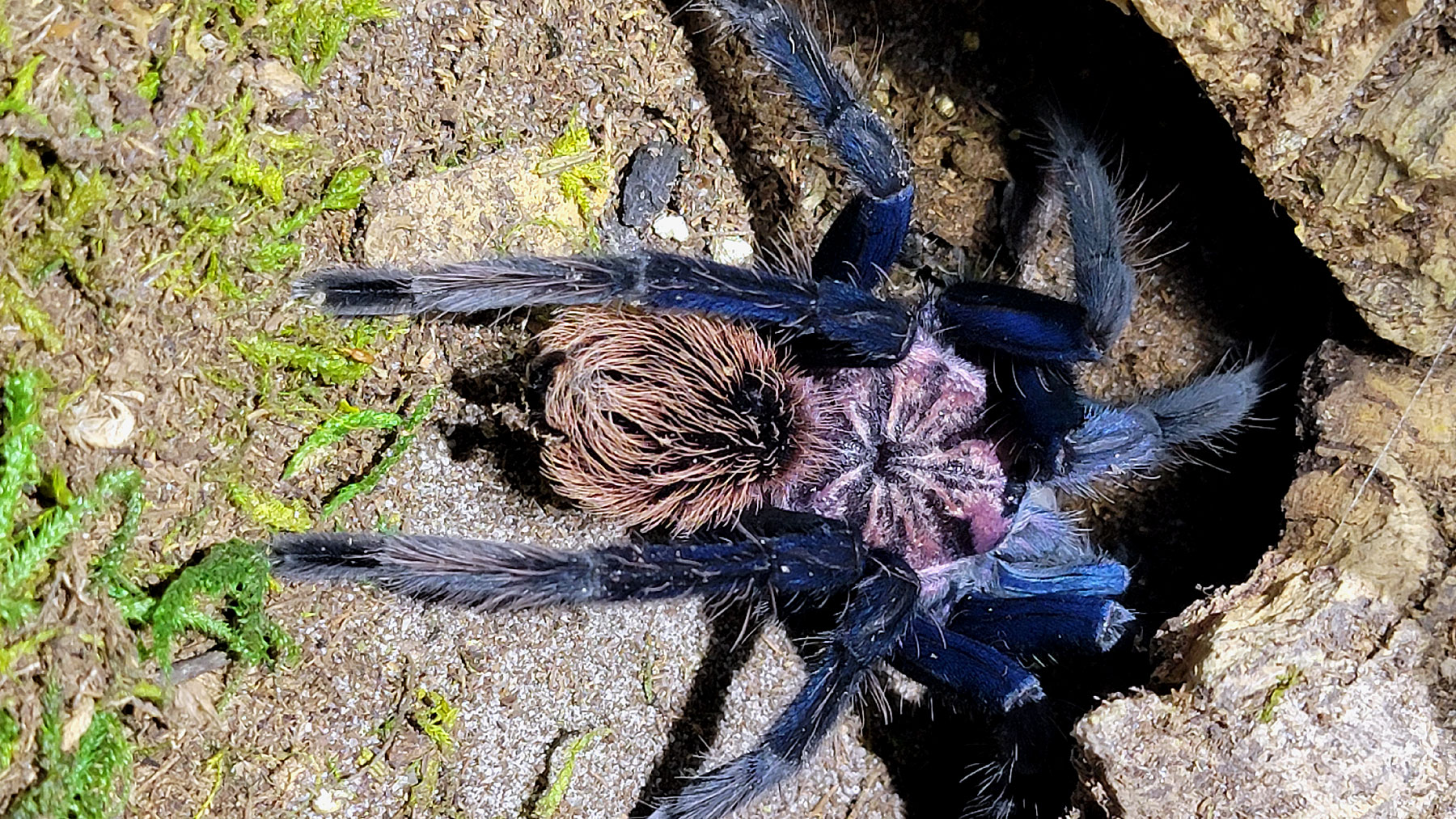
I acquired my Xenesthis sp. Blues in August of 2020, and at that time, the smallest of my three was a leggy 1.5” (3.8 cm) sling. Being only my second species of Xenesthis, I was delighted to see that the blues had the same epic feeding response as my previously acquired X. immanis. Not only would my blues sprint across the enclosure to snag a cricket, but they would often end up on their backs after catching it. Watching these guys hunt truly became one of the highlights of feeding time. As they proved to be little eating machines, it wasn’t long before each of them molted…and put on massive size in the process.
Now, only nine months removed from when I first obtained them, that little gangly sling is now almost 4.5” (11.4 cm) in leg span and is sporting some adult colors. It definitely didn’t take long for these gorgeous little spiders to pack on the size. Considering that they all have another four months before we hit the one-year mark, I don’t think that they’ll have any difficulty hitting the 5” (12.7 cm) mark in that time. And, like other species on this list, the growth rate is similar across the genus. I currently have 7 different species of Xenesthis, and all of them are growing like weeds. Although the high prices for Xenesthis species can be a bit daunting, those who pick one up will be happy to know that they won’t remain fragile slings for long.
Monocentropus balfouri “Socotra Island Blue Baboon”
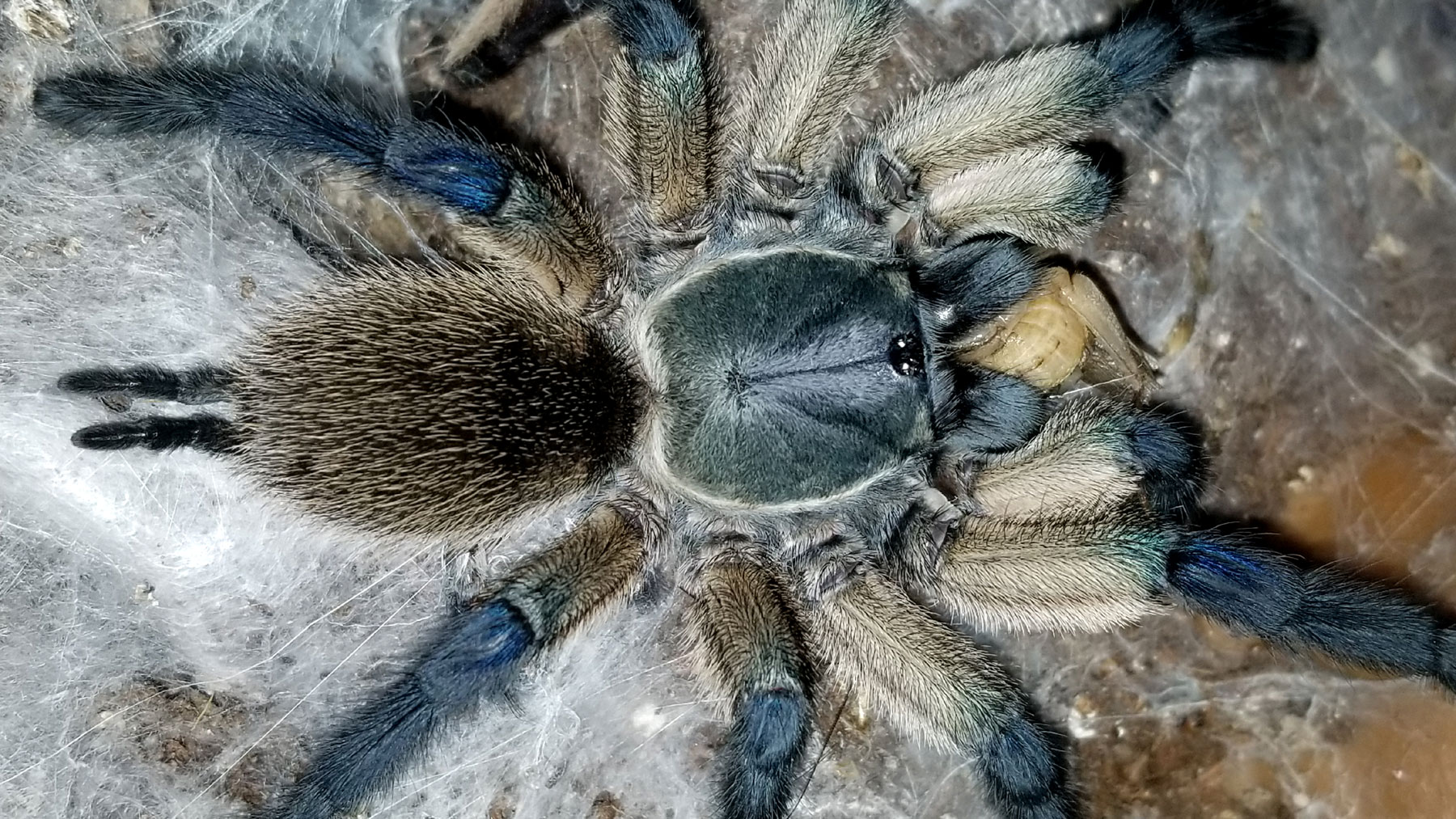
Now, this species comes with a bit of a caveat, as the first three M. balfouris I raised were kept separately, and they grew quite slowly. In this instance, I’m referring to the 9 that I kept in a communal setup. I picked up this group in June of 2016 as .5 and .75” 1.25-2 cm) slings. Once they settled into their new enclosure, they would group feed on pre-killed roaches together twice a week. Although I never saw any molt, and they rarely dragged up their old sheds, the spiders were obviously growing…and growing quickly. Almost a year to the day that I got them, I had to rehouse them all into a much larger enclosure. At this time, they were all between 3-4” (7.6-10 cm) and sporting their gorgeous adult colors. Considering that adults usually reach about 5” or so, that’s really good growth. Even more shocking was when I got my first mature male in October of 2017 only 16 months after acquiring him.
When I set up the communal, it was to document its progress as the spiders grew. One of the most surprising outcomes was just how FAST the spiders grew up. Although it took the female that I raised separately about 4 years to go from a 1.5” juvenile to a full adult, it took the females in the communal group only half that time. The spiders raised together just seemed to be more bold and ravenous when it came to hunting, whereas the ones raised separately were more timid and picky. Whatever the cause for the different growth rates, I couldn’t ignore that those communal balfouris have amazing growth rates, hence their place on this list.
Theraphosa blondi “Goliath Birdeater”
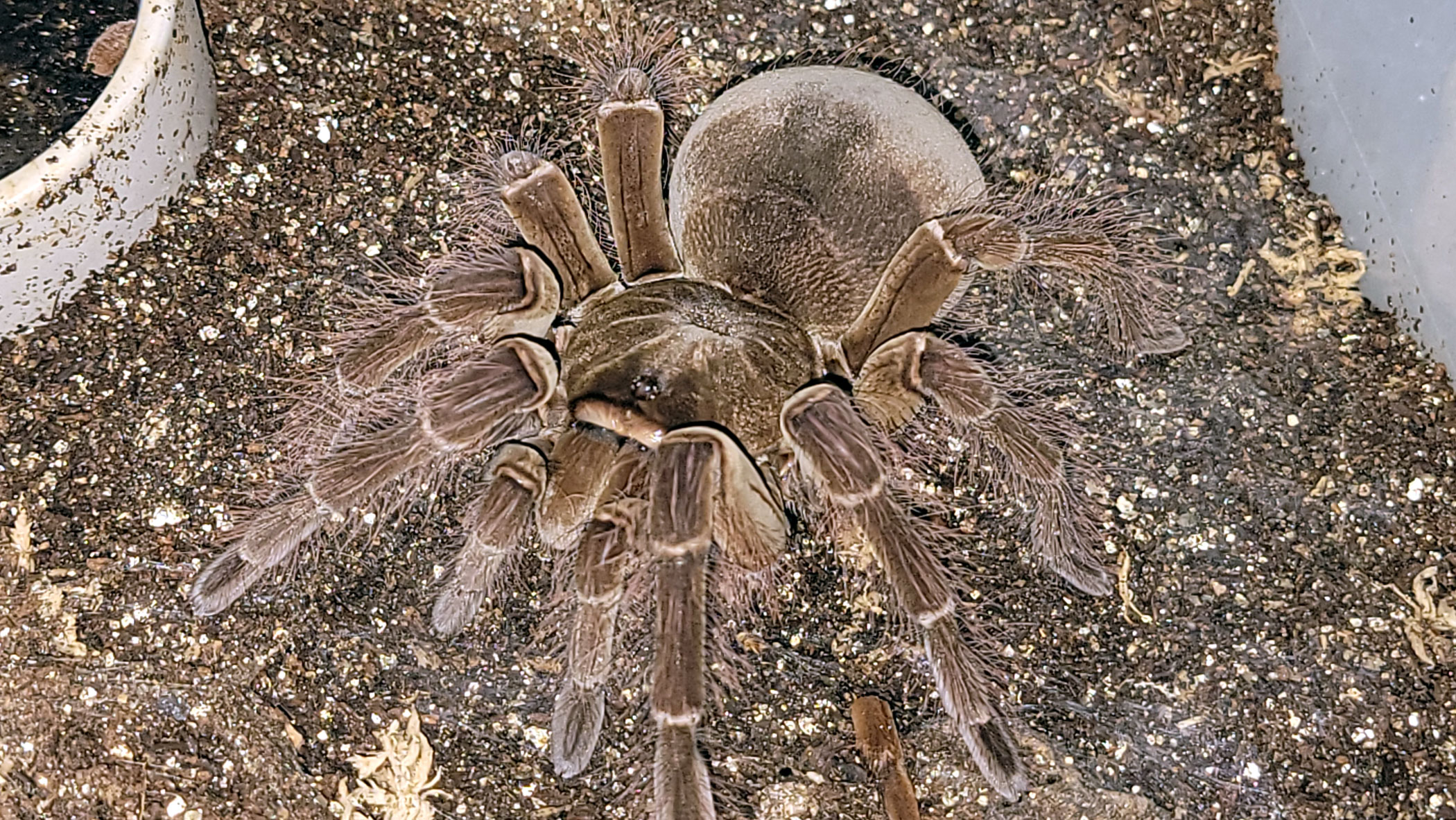
One of the largest tarantulas in the world also has one of the fastest growth rates. Of all the spiders I have kept, none has grown quite as quickly as my Theraphosa species.
Because this is such a massive spider, with adults hitting 10-12” (25-30.5 cm) in leg span, even a juvenile can be a massive spider.
I acquired both of mine as 1.5” (3.8 cm) slings back in the summer of 2018, and like my T. stirmis, these guys were fantastic hunters with seemingly insatiable appetites. And, also like my stirmis, they molted frequently and put on a ton of size with each molt. After a year’s time, the smallest of my specimens was around 5” with the larger of the two being around 5.5” (14 cm). To put that in perspective, these young adults were larger than many full-grown tarantulas of other species…in only a year’s time! Now almost eight years old, both of my specimens are close to the 10″ (25.4 cm) mark and still growing. They still have their amazing appetites, with each taking several crickets or adult B. dubia roaches with each feeding.
And, again, this list could easily include this species’ cousins, the T. stirmi and T. apophysis. In fact, my T. stirmi not only matched the growth rate of my T. blondi, but it did so back when the temperatures in my tarantula room were much cooler. Regardless of which Theraphosa species you keep, expect amazing growth rates and an awesomely huge spider.
What Other Keepers Are Saying
Now, as I was genuinely curious to hear which species other keepers would choose as their fastest-growing, I put the call out on YouTube and Facebook, asking folks to name their top three fastest-growing tarantulas. Dozens of keepers chimed in with their experiences, and the results were quite interesting to say the least. Although many mentioned ones on my list like, T. blondi, P. cambridgei, P. regalis, and C. darlingi, among others, there were three species mentioned repeatedly that I did not choose. So, without further ado, let’s check out the top three fastest growers as determined by keepers that did not make my original list.
Number three was a definite shocker to me, as although mine grew well for that genus, they definitely didn’t burn up the growth charts. However, the keepers have spoken, and number three on the list was the T. albopilosus or Curly hair tarantula. When I came across the first comment mentioning this species as a fast grower, I chalked it up to an anomaly. However, the votes just kept coming!


Many already name the T. albopilosus as one of the best beginner species due to its calm temperament, and now its stock will likely go up as folks consider it to be one of the fastest-growing tarantulas available.
The next on the list did surprise me much, as over the years, many keepers have told me that their specimens grew very quickly. And, although my first lovely lady took her sweet time putting on size, the slings that I recently purchased are growing like weeds. The number two species picked by keepers is everyone’s favorite cuddly orange fluffball, the P. murinus or OBT. Many folks chimed in with anecdotes of their males maturing in a year or less or their females hitting 3 to 4 inches in 12 months. Erica McAlister explains:

So, although my adult took about three years to hit 4”, I certainly can’t discount the fact that others obviously have had much different experiences with their OBTs’ growth rates.
Finally, the number one species on this list came as absolutely NO surprise to me. In fact, although mine have never grown particularly fast, I’ve had dozens of keepers tell me over the years that theirs are some of the fastest-growing tarantulas they have ever kept. I was even going to include this species as an honorable mention because I was afraid of the hate I would get should I omit it from the list. Coming in at number one is the Lasiodora parahybana or “Salmon pink birdeater.” This big, beefy terrestrial makes it onto many beginner species lists and tends to be in demand with keepers who want an extra-large spider but who don’t feel that they are ready for Theraphosa species. And those that love this species often point to its super-fast growth rate as one of the reasons. For example, Amberly Hoffman states:

I’ve raised four LPs from slings over the years, and I’ve never experienced a very fast growth rate with them, at least early on. David Andrzejewski from Erie Arachnids sums up my experiences when he says

Our experiences aside, it appears that WE might be the anomalies, as the vast majority of keepers tout this species for its fast growth rate. As a result, the L. parahybana has definitely earned its spot on this list.
FASTEST GROWING GENERA
Now, between my list and feedback from keepers who chimed in with their own lists of fastest-growing species, there were a handful of genera that really stood out as featuring many fast growers.
The most obvious genus to get a lot of votes was probably Theraphosa. Not only do T. blondi, stirmi, and aphophysis make up the three largest tarantulas in the world, but they are also recognized as being VERY fast-growing, especially in that first year of life. Many folks report their specimens reaching 6” or more in the first 12 months that they keep them. Now, it can take several years for one of these spiders to hit the fabled full-grown 10-12” mark, but folks can still expect to have a huge spider in their collection before too long.
The next genus mentioned frequently was Phormictopus, with many describing the genus as a whole as quite fast-growing. From my own experience, I can say that Phormictopus atrichomatus, cancerides, green, and Dominican purple all reached 5 inches or more in their first year with me. Although my P. auratus grew much more slowly, a few folks touted theirs as having fast growth rates as well. Bottom line, I’ve kept 15 species/variants of Phormictopus, and they have all proven to have faster-than-average growth.
Of course, new world terrestrial spiders weren’t the only ones to get some love. My favorite arboreal genus, Poecilotheria, also had several votes. Asked which were his fastest-growing tarantulas, Zachary Cline replied, “Any of my pokies. They molt far more frequently (and gain appropriate size) than any of my other Old World species.” Zachary wasn’t alone in his thinking either, as several folks either chose just “pokies” as their answer, or named species like P. regalis, vittata, rufilata, sub fusca, or ornata as their fastest growers.
And finally, one more genus of arboreal spiders got some love from the keepers for being very fast-growing. Many folks mentioned that the genus Psalmopeous has some of the fastest-growing spiders, with P. irminia, cambridgei, and pulcher being mentioned several times each. I have to wholeheartedly agree, as not only did P. cambridgei make it onto my list, but I saw great growth with my P. irminia, victori, pulcher, and ecclesiasticus as well.
 Tom's Big Spiders