Custom Dubia Roach Enclosure and Care

Over the past six months, my tarantula collection had grown a great deal in both the quantity of Ts kept and the size of individual specimens. I now had several adult/sub-adult Ts that required larger prey items, and I was looking for an alternative to the crickets. I decided that it was now time for me to start raising my own food source. So, a couple months ago, I purchased my first dubia roach starter colony of 125+ roaches. After doing some online research on dubia husbandry and breeding in which I discovered dozens of enclosure designs and roach-chow recipes, I was ready to set up my own colony.

What follows is what I have come up with to house and feed my roaches. This is, by no means, the only way to do it, nor can I take credit for coming up with these designs or methods. This is, however, what is currently working for me.

Start with a 7 gallon Sterilite Stacker Tote

I picked up my 7 gallon Sterilite at my local Walmart. You can definitely use a larger size of container, and many do, but I needed something that would fit comfortably on a shelf that I already used. Although these containers are offered in clear plastic, you want something that blocks most of the light out (roaches, as you may know, are NOT fond of the light).

UPDATE 11/2016: My colony grew rather quickly, so I now use a 58-quart Sterilite container.

I found this to be a great size for my roach colony enclosure.

I found this to be a great size for my roach colony enclosure.

Add some ventilation.

I always have some of these convenient plastic vents on hand from Round Vents , so I used them for my enclosure. These 3″ vents only run $1.32 each, and I find cutting two holes to install the vents MUCH easier and faster than drilling dozens of air holes. However, either way would work.
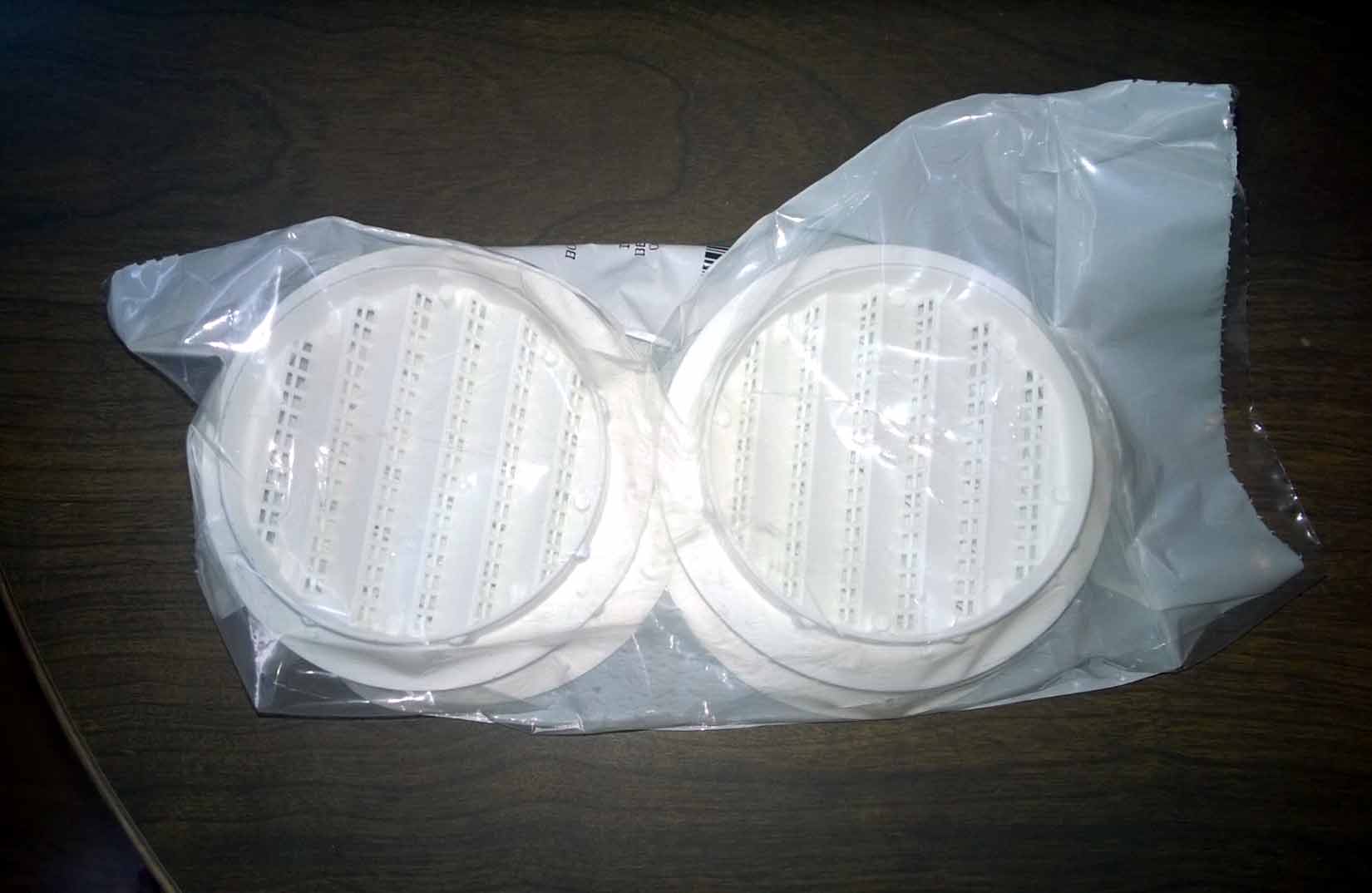
3" white plastic vents from Round Vents.

3″ white plastic vents from Round Vents.

To install them, I just used a 3″ hole saw and my cordless drill to make a hole on either side of the container. I used hot glue around the edges then just popped them in. (Again, you can drill a series of holes, and it will serve the same purpose and cost a bit less).

The vents have been installed on opposite end of the Sterilite enclosure. Vents should be closer to the top.

The vents have been installed on opposite end of the Sterilite enclosure. Vents should be close to the top.

Start saving those egg cartons!

You’ll need something inside the enclosure for the roaches to climb on and hide in. Cardboard egg cartons or egg trays work perfectly. If you have the forethought (and you eat a lot of eggs) save some of the ones you get when you buy eggs from your local grocer. You can also find them at tractor or farming supply stores. I bought mine at a local Agway. Many use the 6 x 6 egg trays, but for my smaller enclosure, the regular 2 x 6 egg cartons fit better. The larger trays can be purchased in bulk online.

Put these inside your enclosure for the roaches to climb on and hide in.

Put these inside your enclosure for the roaches to climb on and hide in.

 Roaches need food bowls, too.

It makes it MUCH easier to clean and feed your roaches if you supply food bowls. For mine, I used two Ziploc small square containers (5″x 5″), which I trimmed down with a pair of scissors to fit better and to add an entrance for the smaller roaches. One of these I fill with fresh organic fruit (nectarines, oranges, peaches, strawberries, grapes, apples, etc.). The other I fill with my homemade “roach chow”.

Two of these are supplied: one for fresh fruit and the other for the dry roach chow.

Two of these are supplied: one for fresh fruit and the other for the dry roach chow.

 Carefully fit everything into the enclosure.

On one end, stand up the egg cartons. I have two rows of five in mine, and the roaches seem to do fine. At the other end, place the two food bowls with the openings facing the egg cartons. When you get your roaches, carefully dump them on the egg cartons; they will quickly scramble down between them to hide.

The roaches will climb and hide in the egg cartons. The two food bowls contain fruit and roach chow.

The roaches will climb and hide in the egg cartons. The two food bowls contain fruit and roach chow.

A word about roach food.

It’s a fact: roaches will eat just about anything. As a result, there is no set, scientific diet for your feeder roaches. Do a quick search online, and you’ll find dozens, if not hundreds, of possible food choices. Moistened dog food, chicken mash, crushed cereal, organic tabbouleh…all are on the menu. While researching, I stumbled upon this cheap, simple recipe for “roach chow”, and so far it’s worked great. There are only two ingredients.

Flaked fish food.

Whole Oats

Goldfish flakes and whole oats combined and blended make great roach food.

Goldfish flakes and whole oats combined and blended make great roach food.

Just drop the oats and flakes in a blender (I do about 60/40 oats to flakes), blend to a powdery mash. Simple. I purchase large canisters of both, then blend up extra so that I always have it on hand. As both the flakes and oats can be purchased at Walmart for a few dollars, you can make enough food for months without hurting your wallet. I supplement the roach chow with fresh fruit to provide a more balanced diet. For water, I spray down one side of the enclosure just above the fruit dish every night, which has been fine and keeps things from getting too moist.

UPDATE 11/2016:  I have altered my roach chow recipe a bit. I now use oats, corn meal, and fish flakes in a 40/40/20 ratio or so. I drop these in a blender, grind them up good, then store them in an airtight container.

I also don’t offer fruit as often anymore, as it spoils very quickly (especially during the summer) and attracts fruit flies. I’ve switched to mostly carrots, potatoes, and some apples.
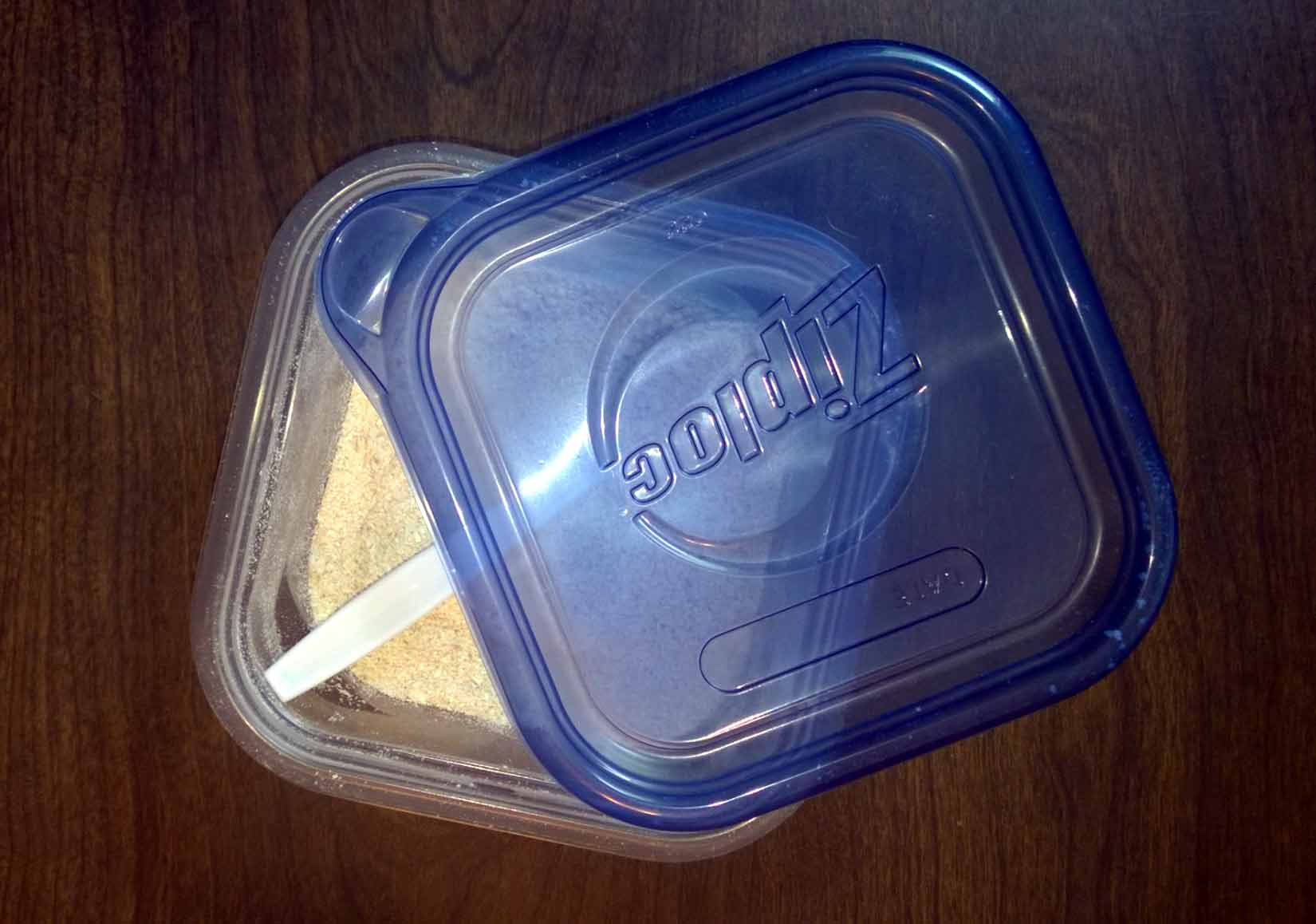
My container of "roach chow" (blended oats and fish flakes).

My container of “roach chow” (blended oats and fish flakes).

The hotter, the better.

If you want happy roaches and an ever-growing supply of feeders, you’d better be prepared to jack up those temperatures. Dubia thrive in warm environments. and you’ll need to keep them in the mid 80s to mid 90s if you’d like them to mate and reproduce. As these temps are too high for many T species, you will likely have to keep your feeders in a separate room. During the dog days of summer, I keep mine in my attic, where temps are almost always around 88-90 degrees.

UPDATE 11/2016: They do not need temps in the high 80s to low 90s to reproduce. Mine are kept much of the year in the 70s, and they still have young. That said, you get more offspring the warmer you keep them. If you can’t get your room temperatures up high enough to stimulate faster reproduction, you can use a heat mat on one side of the enclosure to raise temps inside. If you’re using a Sterilite bin, try mounting the heat mat on a wall, then position the cage next to it.

Keep in mind that high temperatures will cause fresh fruit to rot very quickly, so be sure to change the fruit bowl often to avoid fruit flies and decomposition.

In the winter months, they should really be kept 65-70 minimum. However, although this will be high enough to keep them alive, they will not be reproducing.

Cleaning is breeze.

My wife and I clean our colony every week, and we’ve found that it’s quite simple. Just lift out the egg cartons and place them in an empty cardboard box while you work. Remove the food dishes and any stragglers, then just dump the feces (which is tiny and dry) into the garbage. Use a damp cloth to clean up the bottom, dry it, then put everything back in. They are actually quite clean overall, and produce no real odor.

Simple and cheap!

So, there you have it. Again, this is not the only way to keep roaches, but this is how I’m currently keeping mine. It is also quite inexpensive to put together, costing around $20 for everything.  However, feel free to experiment or do whatever works for you. Dubia, generally speaking, are quite hardy and will adapt to other food sources or set ups.
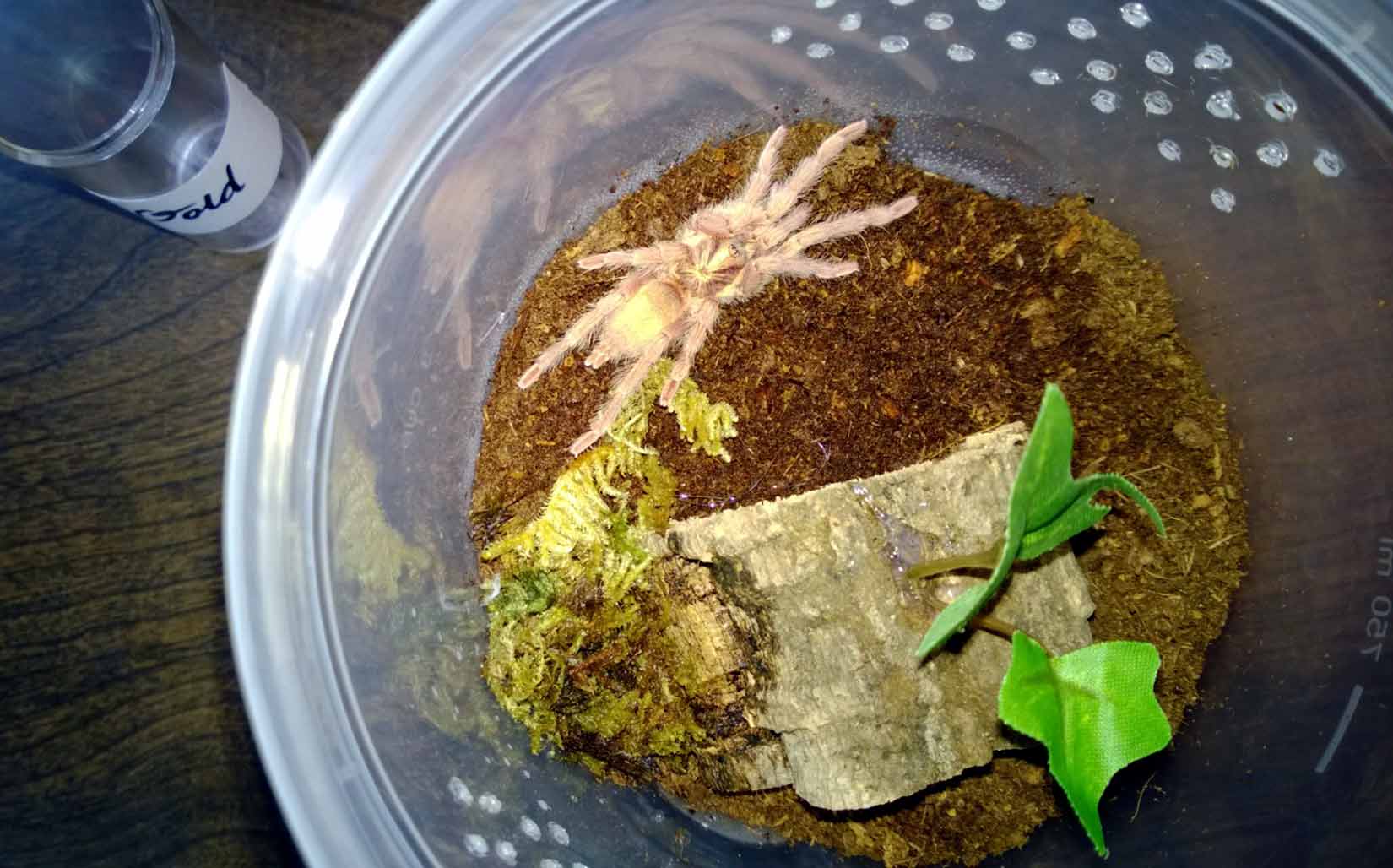


Peekaboo…My O. philippinus Makes a Cameo!

Well, look who popped out to say hello!

Okay, I know I already posted a short video featuring this same O. philippinus (Philippine Tangerine) in the process of dragging a cricket into its den, but this time I caught the entire “hunt.” Even better, my juvenile O. philippinus actually completely emerged from its den for a few seconds.

Now, I’m fortunate in that my other O. philippinus constructed a den down the side of its enclosure, so I get to see him all of the time. Still, for this other specimen who usually comes out only at night when I’m in bed, this was pretty special.

Note: This species requires moist substrate, so I periodically moisten the coco fiber to keep it comfortable. The majority of of the water percolates through the substrate, keeping the lower levels (where its den is) moist. The water on the side evaporates before morning. I had applied water shortly before this video was shot.

H. incei gold Feeding Video

I recently acquired a trio of juvenile/sub-adult H. incei golds, and I immediately discovered what a truly beautiful and interesting species they are. These lively little dwarfs sport gorgeous gold and orange tones that make them wonderful display spiders. They also like to decorate their enclosures with copious amounts of thick webbing, making them one of the more prolific webbers of the species I keep.

One of my H. incei golds after being housed. Not the best picture, as the flash has washed out it's colors.

One of my H. incei golds after being housed. Not the best picture, as the flash has washed out it’s colors.

All three have been excellent eaters, snatching medium crickets from the mouths of their burrows with lightning speed. Although they were furnished with identical enclosures with cork barks and starter burrow holes dug into the substrate, only two of my H. incei golds adopted these as homes. Both of these two dug deep burrows before lining the opening of their dens in a liberal coating of silk.

The third built what I can best describe as a silken teepee over its cork bark hide. This specimen did not dig, but instead sits on the surface, sometimes beneath its hide, waiting for prey. It makes for a wonderful showcase animal, as it is more often than not visible. It is this T that is featured in the feeding video.

A modified Ziploc container. This H. incei dug a deep burrow; the circle marks the lower chamber.

A modified Ziploc container. This H. incei dug a deep burrow; the circle marks the lower chamber.

I keep my H. incei golds in the same temperatures as my other Ts; high 70s during the day with low 70s at night. I also keep the substrate for these guys on the moist side (not wet), by sprinkling water on the surface twice a week. They are currently eating one medium cricket every three or four days.

While feeding my surface-dwelling incei, I decided to get a bit of video with my cell phone. Below is a brief clip of my little guy snatching up a cricket. My apologies for the raucous soundtrack; it is covering up my daughter telling me a story in the background. 🙂

For lovers of dwarf tarantula species, or even just those who want a gorgeous, heavy-webbing T, the H. incei gold makes a wonderful pet.


L. parahybana Feeding Video and Husbandry Notes

After 17+ years of keeping a G. porteri, and with no idea that the tarantula hobby had exploded over the past two decades, I decided that I wanted to see what kinds of species were currently available. To say the number of animals available in the trade was overwhelming would be an understatement, and I soon found myself compiling lengthy lists of potential candidates. After several months of research, I decided on two slings; a Chromatopelma cyaneopubescens (GBB) and a Lasiodora parahybana (LP).

I purchased my LP sling in October of 2013 at a size of about 3/4″ or so. This species has a reputation for being a very fast grower with some keepers reporting their LPs reaching 4″ in a year. Mine has molted five times in the time I’ve kept it, and in that time, it has grown to about 1.75″.  I wouldn’t say this is the fastest-growing T I keep, but it molts like clockwork every two months, and puts on a little size each time.

Besides their awesome adult size (8″ is the norm with 10″ possible), it was their rather simple husbandry that attracted me to this species. I keep mine fairly dry and only moisten the substrate in the corner once a week, letting it dry out in between. I’ve provided my 3″ female with a water dish, which I overflow to provide a moist spot. Usually, it quickly ends up filled with dirt. The substrate is a 50/50 mix of coco fiber and sphagnum peat moss, and for the slings, I give them several inches of depth as they like to dig.

For the first five months I kept my LP, I rarely saw it. The little guy had dug an extensive burrow beneath the surface, and he would only pop out to snatch a prey item. There was a two-month period where I never saw it at all. When entering premolt, it would often close off  the entrance of its burrow for weeks at a time. Eventually, the hole would reopen, and I would catch a glimpse of my slightly-larger LP.

I keep my LPs at the same temps as my other Ts; high 70s during the day and low 70’s at night. They are great eaters, only refusing a meal if in premolt. Like my P. cancerides, they usually attack their prey with gusto, often rushing at it from across the enclosure.

As slings, LPs are quite skittish, and will quickly bolt or dash down into their hides with the slightest disturbance. My female is a bit more brave, often sitting right out in the open instead of using her hide.

I know keep three LPs; two slings and the gorgeous female my wife gave me for my birthday. I look forward to the day that these beasties mature into an 8″+ behemoths.

Below is a recent feeding video featuring my 1.75″ juvenile.

Box of Roaches … A Review of Jeremy Stichler!

Having amassed a collection of 47 tarantulas and counting that now includes many larger spiders, I was finding it more difficult to keep adequate food supplies handy. Although I’ve used mainly crickets for prey, I also keep a small quantity of Blaptica dubia and Blatta lateralis roaches. Having found that the dubias were easier to maintain and relatively odorless, I started keeping a lookout for a fairly priced starter colony.

While perusing the for sale page on Arachnoboards, I stumbled on an ad for 125 count starter colony of large Blaptica dubia for only $27 shipped. The vendor was Jeremy Stichler (Jerm357) who had several pages of sparkling reviews on the boards. Having priced out starter colonies before, I was expecting to pay much more for this many roaches (and that was not counting the 10% overcount he offered on top of it). Even better, he guaranteed all larger roaches unless specified that you wanted smaller ones.  I jumped at this tremendous bargain and immediately emailed Jeremy.

Communication was excellent, as Jeremy emailed me back immediately with payment information. Correspondence was friendly and very professional, which is always a huge plus in my book.  He also shipped quickly, and my package was mailed USPS Priority on that Monday and arrived on Wednesday.

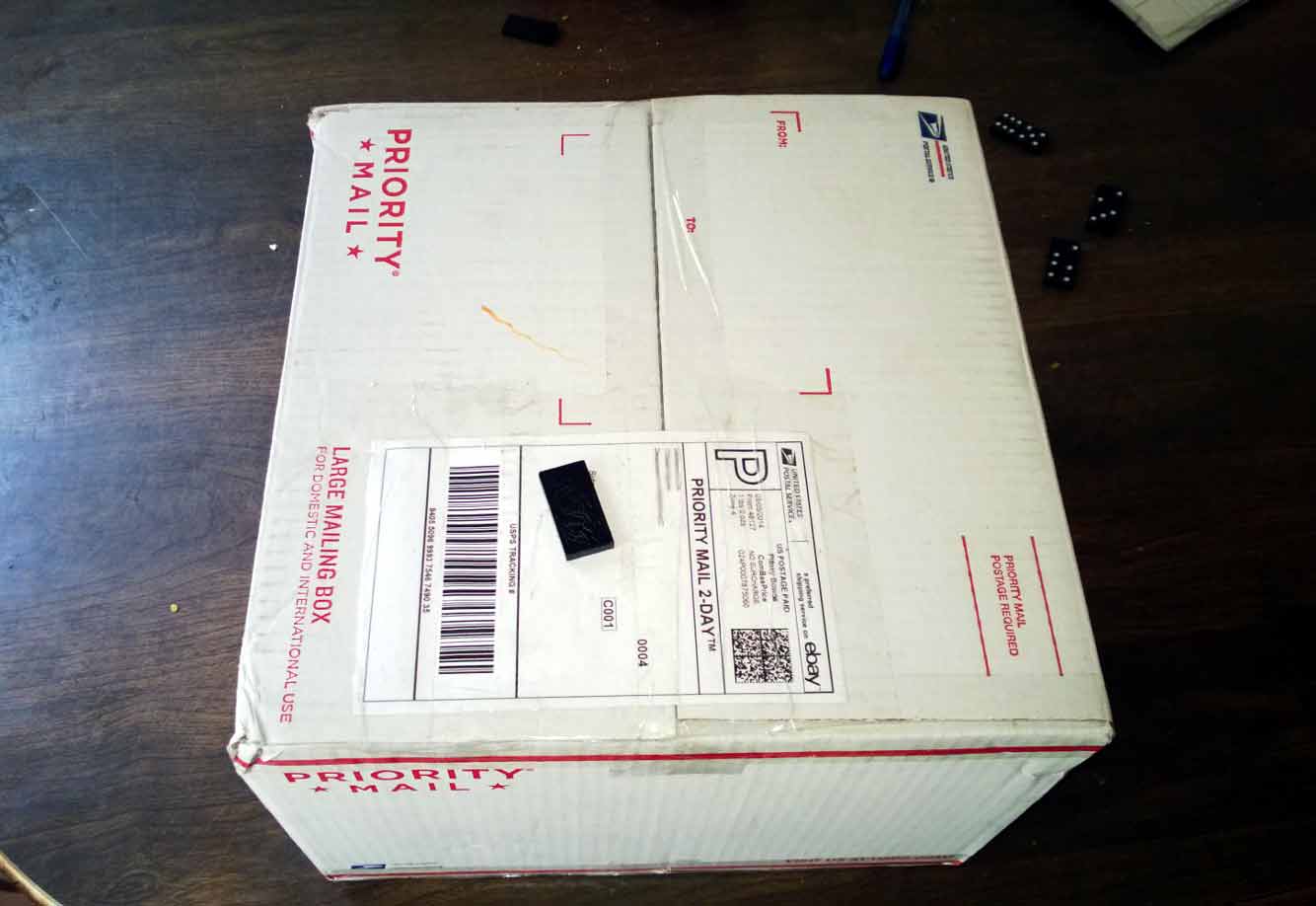
Box arrived in great shape.

Box arrived in great shape.

Packing was excellent, with the roaches double-boxed and insulated with newspaper. There wasn’t a single dead roach in the bunch, and all were quite lively when I opened the package. In fact, one of the larger males quickly shot out of the package and landed on my arm. Now, I know I have dozens of giant, hairy spiders, and most would find that frightening, but I don’t think I’d ever seen a roach that big. And, perhaps I panicked just a bit when I tried to quickly brush it off and the little beast barely budged. Wow, those suckers are strong…

After opening the first box, I discovered a second box safely nestled in a bed of newspaper. (Note: Notice my 3-year-old's creepy Mega Blok figure. Those little pagan-looking totems are all around my house. Creepy!)

After opening the first box, I discovered a second box safely nestled in a bed of newspaper. (Note: Notice my 3-year-old’s creepy Mega Blok figure. Those little pagan-looking totems are all around my house. Should I be worried?)

The second box is now open. A piece of cardboard serves as a spacer. You can now see some of the roaches...yum!

The second box is now open. A piece of cardboard serves as a spacer. You can now see some of the roaches…yum!

With the cardboard moved aside, you can now see more of the little buggers.

With the cardboard moved aside, you can now see more of the little buggers.

With the cardboard (and some of the roaches) out of the way, you can now see a bunch of very large and healthy roaches.

With the cardboard (and some of the roaches) out of the way, you can now see a bunch of very large and healthy roaches.

All of the roaches have been rehoused in their new home (I will post later about their new quarters), and all are eating well. I honestly couldn’t have been more happy with my purchase from Mr. Stichler. I wouldn’t hesitate to buy from him again.

This was an A+ experience, and I would highly recommend Jeremy Stichler to any hobbyist looking for a dubia feeder roach starter colony.


Pamphobeteus antinous

As my T collection grows and I gain experience with different species, I’m finding that I’m developing an affinity for the larger South American Ts. Don’t get me wrong, there is definitely a place in my collection for some of the slow-growing genera, like aphonopelma, grammostola, and brachypelma. Many of the species in these genera are simply gorgeous, and their slow growth rate means that I’ll have these guys for many years. However, for the impatient keeper in me, the faster-growing, aggressive eaters are just a thrill to watch. Recently, I decided to investigate some new  species for potential purchase, and I wanted something big and feisty.

While perusing the Net-Bug site, I came across a Pamphobeteus antinus, or “Steely Blue Leg”, female for sale. I had researched several species in the Pamphobeteus genus many months back, and at that time, I wasn’t sure I was ready for a T that required a bit more humidity. Having gained some experience since then and become more skilled at maintaining humidity in the enclosures, I decided that I was ready for this species.

My 3.5" P. antinous female.

My 3.5″ P. antinous female.

For my new acquisition’s home, I set up a large Kritter Keeper with about 5″ of a moist 50/50 peat moss and coco fiber mix. As the heavily-vented tops of KKs allow for too much ventilation for species requiring higher humidity, I used contact paper to block off much of the top and sides while still allowing for cross ventilation. Using a 5″ cork bark round, I sunk part of into the ground as a starter burrow and covered it with soil and sphagnum moss. As I want to maintain a higher level of humidity, I also provided her with a large water dish. Once a week, I sprinkle water on her substrate and on the sphagnum moss (think a good, quick rain shower) to keep the substrate from drying out too much. For temperatures, she is kept in the low 70s during the night, and high 70s/80 during the day.

A large Kritter Keeper modified to accommodate a species with higher humidity requirements.

A large Kritter Keeper modified to accommodate a species with higher humidity requirements.


It didn’t take long for the P. antinous to create an impressive burrow. Gnawing through the bottom of the cork bark, she dug straight to the bottom, constructing a small compartment in the lower corner. Here she sits until she detects prey items above. Alerted to a meal, she bolts from her hide, her lithe legs tapping against the plastic as she scrambles for the surface. Out of all of my Ts, this is the first one I’ve actually HEARD coming for a cricket. The speed and ferocity she displays when attacking her food easily rivals that of my P. cancerides. Right now, she gets four large crickets, or two 1+” dubia roaches, a week (this species is known for being a good eater).

My P. antinous inside its den (back view).

My P. antinous inside its den (back view).

With my female still sporting her immature reddish-brown colors, I will look very forward to seeing if she gets any of her “steely blue” coloration on next molt. Also, as this is also considered to be a species with a fast growth rate, I will be anticipating quite a size jump. Although I’ve only owned her for a couple months, my P. antinous is proving to be one of my most interesting tarantulas.


P. cancerides Feeding Video

Dinner Time!

One of the thrills of keeping tarantulas, in my opinion, is watching them stalk and snatch their prey. I know for anyone who doesn’t keep Ts, this probably sounds a bit strange or sick even. However, it’s not that I don’t feel a bit of sympathy for the prey items after they are unwittingly dropped into an enclosure, or when they wander around the unfamiliar terrain, blissfully unaware that they are mere inches away from their doom. No, I do feel bad for the poor roaches, crickets, or meal worms.

However, I’d be lying if I didn’t admit to holding my breath a bit in anticipation as one of these brutal hunters senses its next meal. I can’t help but to get a bit excited watching these fascinating predators in action.

Recently, I was able to capture my 3″ P. cancerides as it ambushed its latest meal, a large cricket. As mentioned in earlier posts, I find these particular spiders go after prey with an energy and ferocity that surpasses that of many of the other species I keep. Although the following video doesn’t depict a particularly impressive take-down, I still think it’s a fascinating look at one of these amazing creatures as it captures its prey (and a healthy reminder of just how fast these guys can move). Enjoy!

Note: My apologies for the music; I was so absorbed in catching this feeding, that I didn’t realize that my three-year-old was screaming in the background. Trust me…the music is better.

Orphnaecus philippinus – Philippine Tangerine

My juvenile O.philippinus.

My juvenile O.philippinus.

A sleek, secretive Tarantula, and a unique-looking species, the Oprhanaecus philippinus, or Philippine Tangerine, is a species that should enjoy more popularity in the pet trade. From the Philippines, this old world tarantula and obligate burrower thrives in warmer and more humid conditions. Unlike many terrestrial species, O. philippinus have lithe frames with long, slender legs, a pill-shaped abdomen and an overall sleeker build. At a max length of around 6″, this is an impressive animal. A gorgeous orange/tangerine color overall, these Ts have shorter hair, which gives them a very soft, velvety appearance.

My 2+" O. philippinus hiding in its den a week after molting.

My 2+” O. philippinus hiding in its den a week after molting.

Despite being an old word species, my O. philippinus slings would much rather flee to their burrows than stand and fight. They are obligate burrowers, and they require deep substrate so that they can construct  suitable dens. This is a species that requires a more humid climate, and for them to thrive, they do need slightly moist substrate. When presented with two starter dens, one on the dry side of the enclosure and one on the moister side, both of mine chose the moist side to create their homes.

For substrate, I keep them on a mixture of coco fiber and peat moss with a bit of vermiculite mixed in on the bottom to help maintain moisture. I will then sprinkle water in occasionally to keep the surface just a bit moist. The majority of the water will percolate down the sides of the enclosure keeping the lower levels more damp than the upper levels. This allows my T to burrow and chose the level of moisture it needs. I also allows for water to evaporate more slowly, keeping the humidity up.

Once its den is constructed, the O. philippinus will wait just inside the entrance hole for a prey item to stumble by. When the unfortunate insect is sensed, the O. philippinus will launch out of its hole, ambushing the insect and grabbing its meal. It will then drag the item back into its den so that it can eat in private. In my experience, they are voracious eaters who will only refuse a meal when in premolt. When mine were about 2″, they had no problem taking down larger crickets. I feed them appropriately-sized cricket or roach every three days or so.

As far as a downside for these wonderful creatures, there are few. Humidity and moisture requirements can make the husbandry a little trickier. Moisten substrate too much, and you run the risk of creating hospitable conditions for mold and mites. Keep it too dry, and your O. philippinus is likely to dehydrate. Moist substrate AND proper ventilation is key. They are also VERY fast, and can go from crouching in a corner to out of the enclosure in a blink of an eye. Keepers not used to keeping faster species could find this shocking.

For temperatures, they are kept at mid to low 70s although they will thrive at temps in the low 80s as well. As with most species, higher temps will bring faster metabolisms and growth rates. I’ve kept mine for about a year, and in that time they have gone from 1.25″ slings to 3.5″ sub-adults. I have not noticed a significant difference in growth rate between the winter months where they are kept mid to low 70s and the summer when temps are high 70s to low 80s.

O.-philippinus-Jan

O. philippinus Pulling a Cricket into It’s Den

http://www.youtube.com/watch?v=nLGd8t02hsk Because they spend the majority of the time in burrows and normally venture out only at night, sightings of your prized pet may be rare. Personally, I enjoy the thrill I get when I catch one of my slings out and about; or when I witness one snag a prey item. They are an amazing , beautiful, and unique tarantula that would make an excellent addition to any collection.