Site Update – Husbandry Notes by Species!

When I first started Tom’s Big Spiders, it was really only to share some of my cool experiences in the tarantula hobby. I honestly never expected anyone to discover or read what I was writing; instead, it was more to serve as a fun outlet (and to spare my family and friends from having to listen to prattle on about bugs). However, little by little, I actually developed an audience as the content evolved from fun molt and feeding posts to more informative husbandry and species notes. With folks actually reading what I was writing, I focused less on the fluff and more the informative and hopefully educational articles.

As a site that was basically created with no real audience in mind, I didn’t give a heck of a lot of thought on how to arrange it (or on the name, for that matter!). However, as I wrote more and more content, and saw what folks were reading and searching for, it quickly became apparent that I needed some way to organize information so it was easier to find. Therefore, some new pages evolved out of the mix: added were Resources, Vendor Reviews, and finally the most popular page, Beginner Guides. 

I also created the Topic Index page, which was supposed to act as a site map of sorts, but it quickly became outdated and was mostly ignored. Particularly, the species-specific husbandry articles were getting overlooked as there was no real clearly designated page for them.Folks were often asking if I could talk about species I had already covered because they couldn’t find the post.

Well, that’s finally been fixed…introducing the Species Husbandry Notes page.

Having done husbandry articles or videos on 40+ species , it was high time I created a page just for species care. I didn’t just want it to be a list of names though…it needed to have some visual flair and possibly a quick way for folks to identify the challenge level of each species. I spend a lot of time trying to get good photos of all my Ts, so I definitely had a lot of material to work with. After a few hours on Photoshop, I came up with what I hope will be a visually-appealing and useful system.

Each species’ name bar is color-coded to indicate the potential level of “challenge.” These designations are based on ease of husbandry, temperament, speed, and venom potency, and are only meant to serve as guidelines for those new to the hobby or species. Obviously, keeper experience and ability, as well as variations in individual specimens’ behavior can be hugely important as well (and can’t really be factored in). Bottom line, if the spider is labeled orange or red, spend a little more time researching its temperament and husbandry needs.

HUSBANDRY-NEW

The colors work as follows:

  1. Green – Beginner
  2. Yellow– Intermediate
  3. Orange – Advanced
  4. Red – Expert

If I’ve done a husbandry blog on the species, just click on the photo to be sent to it. If there’s no article yet, you’ll be sent to the husbandry video on YouTube (my goal is to eventually get write-ups for all of the species).

Hopefully, this will make it easier for folks to find the info they need while affording them the opportunity to peruse all of the species husbandry notes if they feel so inclined. I have 33 of the spiders up as I write this, and my goal is to create guides for all of the 60+ species I keep. Also, I will continue to periodically update articles with the very latest observations, notes, and photos to ensure that all posts are current.

Again, thank you to all who currently use Tom’s Big Spiders as one of your sources for tarantula information!

Tom


Hysterocrates gigas – “Cameroon Red Baboon”

A gorgeous, if a bit reclusive, baboon species.

H.-gigas-full

Back in August of 2014, I ordered a couple .75-1″ Hysterocrates gigas slings from Jamie’s tarantulas. At this time, I had been acquiring several baboon species, and I had become fascinated with the gigas since discovering YouTube footage of one seemingly diving into water and swimming. I had never heard of this behavior from  a tarantula before, so I decided that I definitely needed one in my ever-expanding collection.

Upon receiving the two timid slings, I housed them in 32 oz Ziploc deli containers. The T. gigas is a fossorial species that loves to build intricate and extensive burrows, so the taller cups allowed for several inches of moist substrate for tunneling. Within a day of being introduced to their new homes, both of my slings burrowed straight to the bottom.

The first several months I kept my gigas slings, I rarely saw them. I keep a number of fossorial speices, and I usually have good luck catching them out and about in the morning when I come down for work and first turn on the lights. These guys, however, were much more reclusive and difficult to spot. Occasionally, I’d catch a glimpse of a back leg as one quickly slunk down into its burrow, but that was about it.

I did know that they were eating well. Twice a week or so, I would drop in a cricket, and it was almost always gone by morning. On the rare instance that the prey item was still there the next day, I would just assume the spider was in premolt and wait a week to try again. Due to the amount they were eating, I guessed that they had to have put on quite a bit of size during this period. However, the fleeting glimpses I was able to catch of them made it difficult to assess their size.

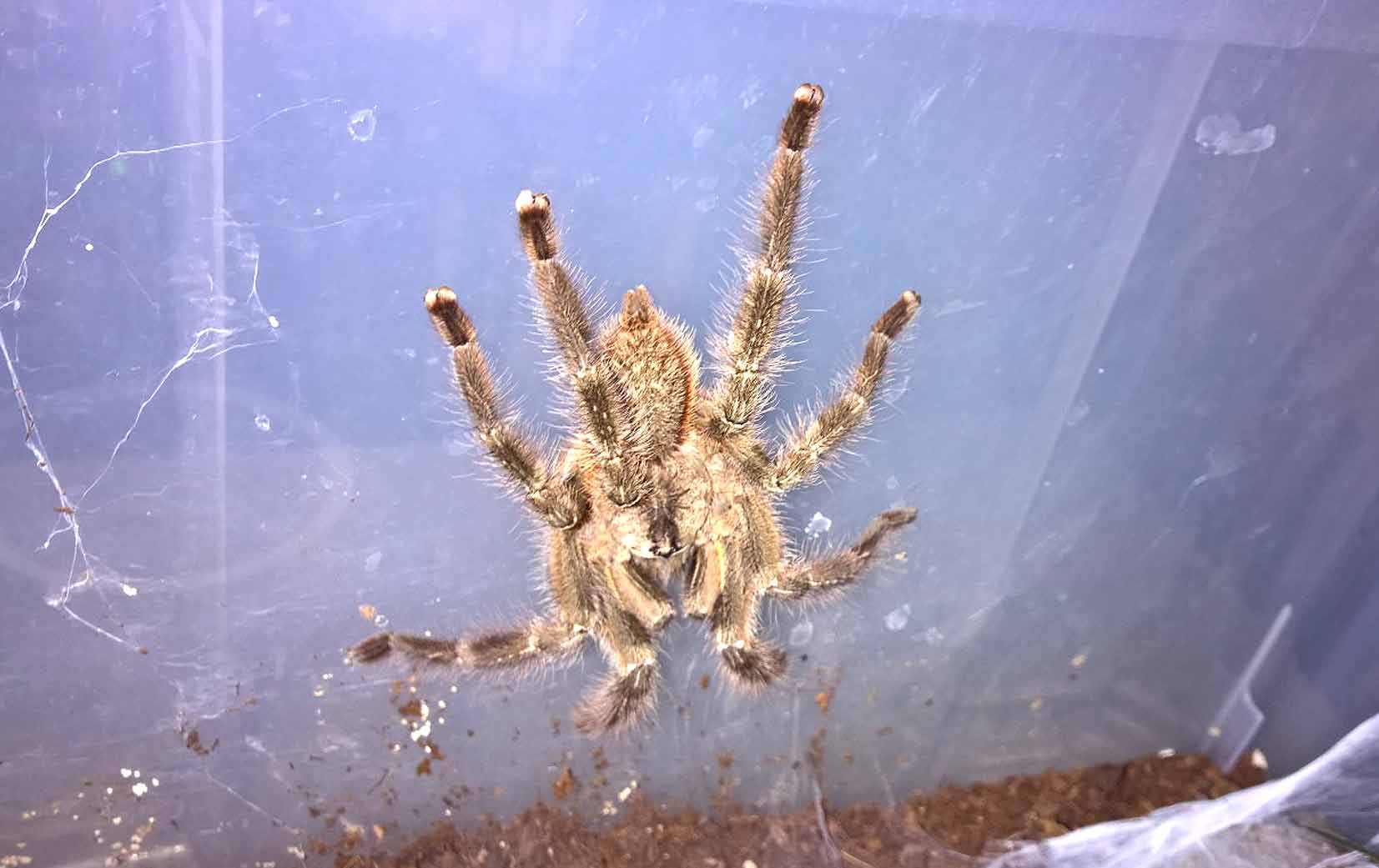
My H. gigas young adult retreating to her den.

My H. gigas young adult retreating to her den. Check out those thick back legs…

For temperatures, they were kept 72-75° in the winter and 75-80° in the summer months. I didn’t notice any difference in how much they ate due to seasonal temperature changes. This is a species that does not tolerate dry conditions, so I made sure to keep the substrate moist by periodically pouring water in and letting it percolate down the sides of the enclosure. This helped to keep the lower levels of its den damp even as the top of the substrate dried out a bit. I also provided each with a small water dish (both were unceremoniously buried several times).

Definitely a fast-growing tarantula.

Finally, in March of 2015, about 7 months after I first acquired them, I opened one of the enclosures to find a gigas perched right on the surface. I was floored. My little sling was now easily a 3″ tarantula. I had heard that this species had a fast growth rate, but I wasn’t prepared to discover a spider this large. It was time for a rehousing.

The H. gigas is an Old World species recognized as having a nasty disposition and a potent bite, so I was particularly cautious when rehousing these two. They both proved to be a bit skittish, but I saw no defensive behavior from either. That said, tarantulas are known to experience temperament changes as they mature, so they could easily develop a bit more attitude in the future. Many keepers have reported that their specimens are quite defensive and willing to bite. Currently, both of my specimens are spending more time on the surface, and I usually catch them out in the mornings. If disturbed, they will immediately bolt back to their burrows (which made getting these photos a joy!).

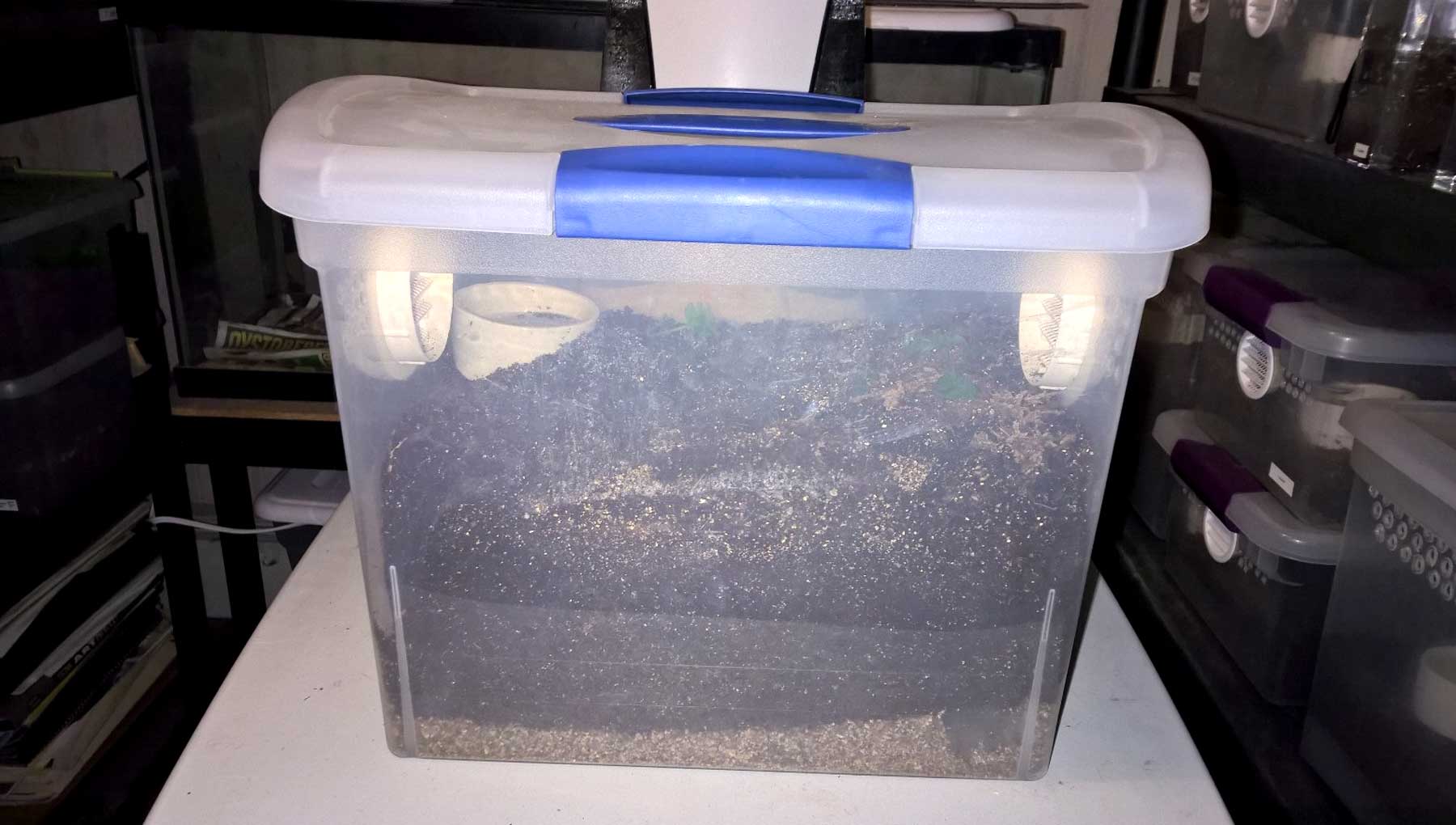
My, H. gigas enclosure

My, H. gigas enclosure

Now that they are about 5″ each, they are housed in large Sterilite plastic containers with about 7″ of moist substrate and water bowls. Both  dug to the bottom and have excavated huge burrows beneath the surface.  I currently feed them each one large dubia roach once a week. After their next molts, I will likely rehouse them into their final enclosures, which will offer a bit more space and about 10″ of moist soil to dig in. I’m also still giving some thought to creating a custom enclosure for one that would allow for a deep water area in one end. It sure would be cool to observes some of that swimming behavior in  person…

The H. gigas is readily available in the hobby with slings usually fetching about $15-20. For those interested in fast-growing Old World fossorial species, that price is an absolute steal. This is a beautiful and interesting species, if a bit shy, and a wonderful to addition to any baboon tarantulas enthusiast’s collection.

Tom’s Big Spiders on Facebook.

Toms-big-spiders-facebook

This is just going to be a very brief post to let those interested know that I now have a Facebook page for Tom’s Big Spiders. I’ve had a lot of folks ask if I was on Facebook, and although I’ve had a personal account for years, I rarely use it. However, after some encouragement from a couple hobbyist, I’ve decided to get the page I set up last year going. I will be posting articles from TBS and videos on my YouTube channel, as well as other less formal stuff.

Bear with me as I try to figure out how to use FB again…boy it’s been a while!

Tom’s Big Spiders on Facebook

Tom

Breeding Project: Poecilotheria Regalis

What better way to start the new year than with some breeding projects?

With many of my females maturing, it’s time for me to get going on some of the breeding projects I’ve been anticipating. First up is a pairing between my mature male and female Poecilotheria regalis. I was very fortunate that this male and female, purchased separately as a sling and a juvenile respectively, matured at about the same time. Although I was cutting it a bit close (the male had his final molt a couple months ago), everything eventually fell into place nicely.

Background

7" mature female P. regalis

7″ mature female P. regalis

The female was purchased as a 2.25″ unsexed juvenile about 22 months ago. Her last molt was on December 2, and since then I’ve fattened her up a bit with three large dubia roaches and a hissing cockroach.  She is currently about 7″ in length.

6.5" male P. regalis

6.5″ male P. regalis

The male was purchased about 14 months ago as a 1.5″ sling and had its final molt in early November. He’s been observed tearing down sperm webs a couple times over the past several weeks, so he’s been ready to go.  Although I would have ideally used this male earlier to breed, I wanted to wait until my female molted out one more time and gained a bit more size. He is currently about 6.5″.

Introducing the male and female.

I’d considered a few ways to introduce the two potential mates to each other. Courtships can last quite a while for Pokies, and I reasoned that I might not be able to sit by with a camera and hope to catch the process. I was also hoping to leave them overnight as to offer a dark, noise-free breeding environment. As Poecilotheria species are rather tolerant of each other (as evidenced by the many successful communal set-ups out there), most keepers reported that they allowed the two specimens to remain in the same enclosure unsupervised anywhere from overnight to a week. I planned to keep them together for an evening.

I had read about “shark tanking/shark caging”, which is when the male is added to the female’s enclosure for a few days while inside a smaller enclosure to protect him. The idea is to allow the pair to get accustomed to each other while still keeping the male our of harm’s way. Eventually, the male is released so that he can mate, hopefully with less risk of getting eaten by the female.

I know that several keepers have used this technique with some success, but the breeders who I have spoken to had not used shark tanking with the successful pairings of their Poecilotheria species. Also, the size of my female’s enclosure wouldn’t have allowed the space needed for this practice, so it became a moot point.

I also considered capturing the male and carefully introducing him directly into the female’s enclosure. Again, however, I worried that the size of the enclosure might not be conducive, as a spooked male might run directly into the female, getting munched before he could do his thing. Also, if the male was able to successfully insert, my female’s enclosure would offer minimal space for escape should she then decide she was hungry.

After measuring the two containers that housed my specimens, I decided that I would buy a much larger enclosure that would accommodate both the cages. With this setup, I would be able to put both enclosures in, open the tops, and let the spiders find each other on their own. This would avoid spooking the tarantulas during the introduction and allow them to encounter each other as they might in the wild. This breeding tank also offered plenty of free space should the male need to beat a hasty retreat.

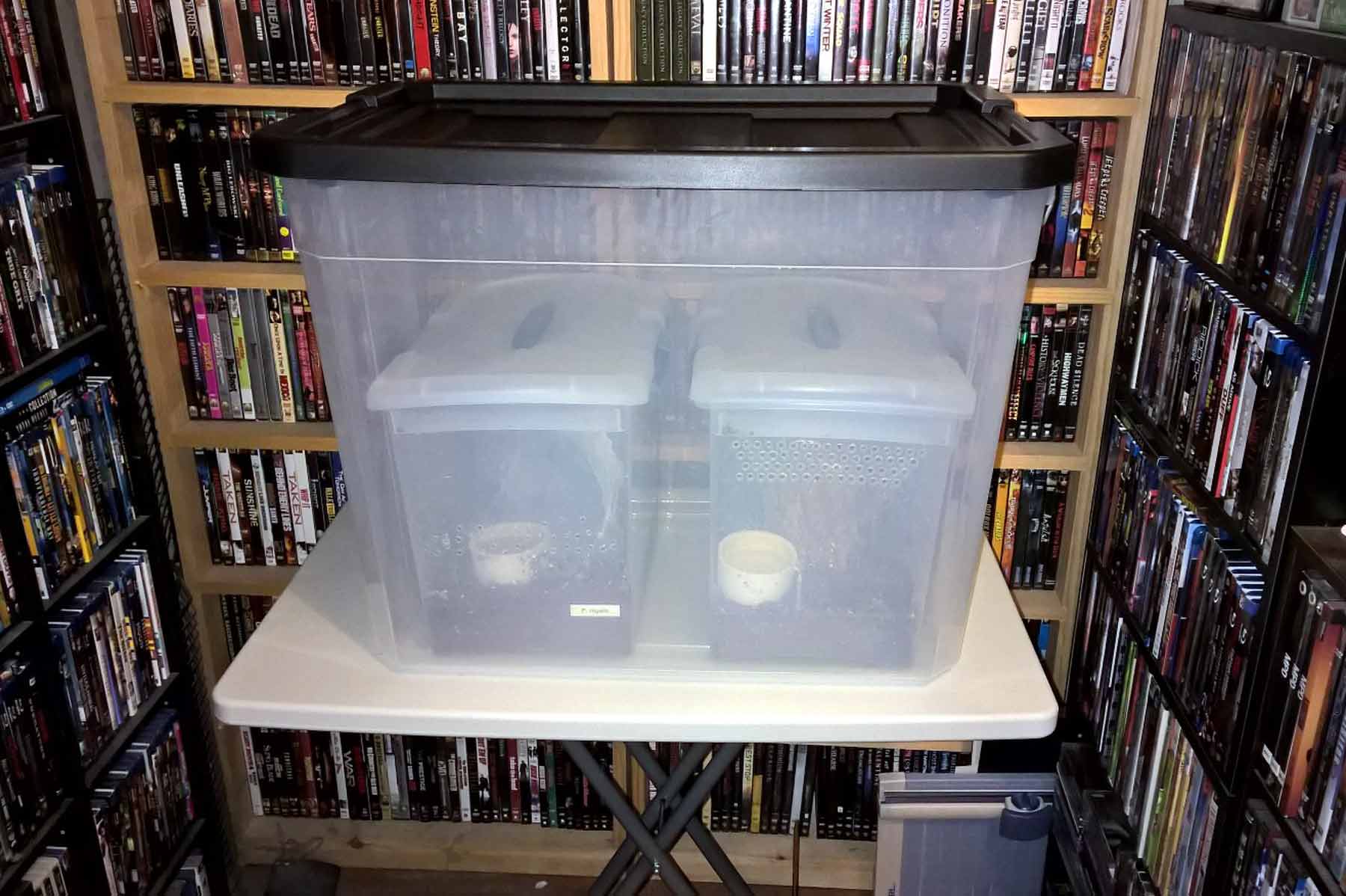
A "breeding chamber" for my P. regalis pair. Both pokie enclosures were place inside this larger enclosure and their lids removed.

A “breeding chamber” for my P. regalis pair. Both pokie enclosures were place inside this larger enclosure and their lids removed.

The tank I chose was a 27-gallon latch-able Sterilite container that offered enough floor space and height to allow the spiders to mingle on neutral territory. I used my soldering iron to put ventilation holes in both sides to allow for air flow, and I placed it on a small table in a corner of my tarantula room that doesn’t get much traffic.

The pairing

I placed both enclosures in the breeding chamber earlier in the day, but I waited until the evening to take the tops off. Within an hour, both had started to crawl out of their cages to explore. Just before bed, I observed both the female and the male drumming their legs as they courted. I’m taking this as a good sign that their may have been an insertion after I went to bed. When I turned the lights out, they were still at opposite ends of the enclosures continuing their courtship ritual.

I left them in unsupervised overnight, and when I checked on them in the morning, both were fine and perched in opposite ends of the larger enclosure. All told, they spent about 14 hours together, with about 10 of that being in darkness. I left them a bit while I had my morning coffee so I was awake enough to wrangle them both back into their cages. As it turns out, I didn’t need the coffee; each had returned to his and her respective enclosures while I was gone. I couldn’t have asked for an easier pairing.

The next step

Although I’m pretty optimistic that the two mated last night, I’m going to go ahead and try again next weekend while I still have the male. After that, it will be a watch-and-wait game as I hope to discover the female is gravid. With any luck, I’ll have a sac in a few months. I will not only post a blog update if I have any news, but I will also update this post.

Next up … it’s time to find a date for my female P. vittata.

Wish me luck!

Sexing Tarantulas Using Molts

Title-pic
For most tarantula keepers, females are where it’s at.

It’s not that we don’t have love for their male counterparts. In fact, some male species like Phormictopus and Pamphobeteus are more colorful and stunning than the females. No, in most instances, the reason comes down to longevity and their ability to produce young. Female tarantulas are much more long-lived than their male counterparts, often thriving decades after the males have matured and expired. Females can also be bred to produce slings, an integral and fascinating part of the hobby for many.

The story is a bit different for male tarantulas. Some species of male tarantulas can mature in just over a year, leaving you with a leggy, antsy boy who wanders around his enclosure in a desperate attempt to fulfill his life’s goal to mate with a willing female. At this point, the best thing you can do for this tarantula that you have lovingly raised and cared for is to ship him off to someone with a female for breeding, leaving you with an empty cage. Sure, you can do do a breeding trade for half of the slings a successful pairing produces, but not all attempts end in viable sacks, and some end with the male being unceremoniously munched.

Those who enjoy raising tarantulas (and who don’t feel like paying the higher prices for sexed females) will often pick up spiderlings. As small slings are often difficult, if not impossible, to sex accurately, you never know exactly what you’re getting when you pick up a tiny spiderling. Many keepers (myself included) will pick up three or more slings of the same species at a time to increase their chances of getting a female. You then feed them, love them, and watch for signs that you might have hit the spider jackpot with a female.

Female C. cyaneopubescens molt (GBB)

Female C. cyaneopubescens molt (GBB)

Sometimes you notice one growing faster than the others, and immediately suspect a male. After all, males in many species will grow and mature faster. Other times, you see the spider’s underside pressed up against the side of its enclosure and you swear you see female parts. And still others, you’ll latch on to some physically dimorphic feature, like color or patterning, in hopes that it indicates a female.

Any keeper who has patiently waited to sex a spider they have raised from the sling stage has undoubtedly experienced the thrill of discovering they have raised a young lady … or the letdown that their beloved pet is a more short-lived male.

How do you sex a tarantula?

There are several methods keepers to use to determine the sex of their tarantulas, but many are not very accurate or require the keeper to have plenty of experience as well as a keen understanding of the anatomy of many species.

One method used to sex tarantulas is ventral sexing, which entails examining the tarantula’s ventral area (the bottom of the tarantula) around the epigastric furrow to try to determine its gender. The epigastric furrow is an opening between the set of book lungs closest to the cephalothorax (body) of the spider. Folks using this method will compare the curve of the furrow, the distance between the anterior book lungs, and the angle of the lungs to determine gender.

In females of some species, the epigastric furrow is more pronounced with what can be described as “lips”. In others, it is not nearly as pronounced. This method takes plenty of practice and knowledge of what both the female and male characteristics of each species are. Keepers attempting this technique will want to do some research and get some photos of both males and females for comparison.

A ventral shot of an A. insubtilis. This specimen was likely male.

A ventral shot of an A. insubtilis. This specimen was likely male.

Personally, I don’t even try to sex via ventral shots anymore, as I don’t feel that I’m particularly good at it, and it’s often not very accurate. Sure, some species like some of the Poecilotheria sport some fairly obvious lady parts early on, but others can be quite misleading and difficult to determine. Arachnoboards has a wonderful area where keepers can post ventral shots of their Ts so that others can determine the sex, but due to the trickiness of using this technique, many of the responses are just guesses (as evidenced by the same spiders being proven to be a different sex later on). Still, if you attempt this method, try posting a good ventral photo up on this board to get some other opinions.

There is also the epiandrous fusillae method.  With this technique, the keeper looks for epiandrous fusillae, or a second set of micro spinnerets used by mature male tarantulas to create sperm webs.  This is a technique that requires a keen eye and a lot of practice, so it might not be the most appropriate for some keepers, especially those new to the hobby.

Sexing your spider using the molt

The best way to your tarantula is to examine its exuvia or molted exoskeleton. An intact molt from a larger specimen (smaller specimens may require use of a microscope) can be examined for evidence of the female’s spermathecae, or the receptacle the female that stores the male’s sperm in. This organ is often described as a little “flap” or “pouch” above the epigastic furrow.

Although this method can be tricky at first, especially with smaller specimens, it’s the most accurate and easy to practice. All you need is an intact molt, some good lighting, and you can give it a shot. Here’s how to go about it:

A comparison of molts from a 3.5" male and a 3.5" female T. stirmi. The piece of paper on the female molt is showing the "flap".

A comparison of molts from a 3.5″ male and a 3.5″ female T. stirmi. The piece of paper on the female molt is showing the “flap”.

1. First off, you’ll want to do some research and find reference photos for both a male and female of the species you want to sex. I would encourage folks to hop on Arachnoboards’ Tarantula Sexing board and check out some of the shots there, or do a Google or Bing image search and study some of those. Every species is different, so looking at a molt from a L. parahybana might not be useful for determining the sex of a GBB. 

2. Next, you need a molt that has the abdomen flesh containing the book lungs intact. If the abdomen has been completely shredded in this area, you will find it difficult or impossible to sex the molt. I try to grab the molts from spiders I want to sex right after they molt (as long as I can do it without disturbing the tarantula). 

3. You need to soften up the exuvia, or molt, to make it less fragile and more pliable. I use a very small spray bottle and give it a few squirts. I then wait a few minutes for the molt to soften up. Other folks will drop the molt into a dish of warm water for a minute or so. Either of these methods work, just use care when handling the molt not to tear it or get urticating hairs on you. You may also want to put it on a piece of paper towel to wick up some of the excess water.

4. Position the molt so that the fangs are facing up and the molt is on its “back” on your well-lit working area. I like to use white plates myself, but a piece of foam board would be great if you want to pin the molt down. Now, carefully spread out the legs and unfurl the abdominal skin if it has become twisted. Work slowly and carefully, as the area that you need to sex the molt is VERY fragile and will tear. I will usually use toothpicks and cotton swaps to unfurl mine. You want to open up this abdominal skin so that you can see the underside of the area where the two sets of book lungs are.

G-PORTERI-LABELED-NEW

5. Now, some folks will immediately spot a slit between the set of book lungs closest to the body and think that they have a girl. Not so. This slit is found on both males and females. What you are looking for is a pronounced “flap” or the spermathecae, which will be above the epigastic furrow if present. The smaller the specimen, the more difficult this area can be to see. I often use a magnifying glass or take a close-up photo with my phone to get a better look. On well-developed females, you can even take a small piece of paper and slide it behind the flap to be sure.

UPDATE-FURROW

If you find the spermathecae, congratulations … it’s a girl! If not, and you are sexing a largerer specimen, you are likely looking at a male. You can always try again on a future molt to double-check.

Now this all sounds quite simple, but it’s not always that cut and dry. Some species don’t develop enough for the casual keeper to sex until later in their life cycles. Also, males from some species will have organs that can be mistaken for spermathecae, meaning that sexing those species can be a bit more challenging. If you are trying to sex your pet, you should spend some time researching and examining molt photos from both the males and females of the species. For some wonderful reference diagrams of the spermathecae of females from different species, check out this site. A Google search will also bring up several useful photos, and you can also check the sexing topic on Arachnoboards and compare the photos.

L. itabunae female molt with the spermathecae highlighted.

L. itabunae female molt with the spermathecae highlighted.

Recognizing mature males

It should be mentioned that mature males can be quite easy to sex, and you will often hear keepers refer to their males as “hooking out.” This expression comes from the fact that males from some species develop tibial “hooks” behind the knees of their first set of walking legs upon maturing. The key word here is “some”, as many species will not present this feature while others, like some in the Avicularia genus, will have hooks too small to see.

An illustration of a male tarantula. Some species don't have tibial hooks, so it is better and more accurate to look for the emboli.

An illustration of a male tarantula. Some species don’t have tibial hooks, so it is better and more accurate to look for the emboli.

Honestly, the phrase should be changed to “bulbing out” or something similar, as keepers should be keeping an eye out for another telltale feature; namely the bulb-like emboli at the end of the male pedipalps. The pedipalps are the shorter set of appendages inside the first set of walking legs that look like shorter legs. When a male spider has his ultimate molt, he develops emboli, or essentially the male’s sexual organ used to deliver the sperm to the female, on the end of his pedipalps. Instead of the ends of these appendages looking like the rest of the tarantula’s “feet”, they will instead be round and bulbous (some keepers refer to them as “boxing” gloves).

A comparison of a mature male's pedipalps (with emboli) and a mature female's.

A comparison of a mature male’s pedipalps (with emboli) and a mature female’s.

Because all male tarantulas will develop this feature, it makes more sense to look for emboli when trying to determine if your spider is a mature male or not.

Not only do males mature much faster than their female counterparts, but there are often many physical differences between a male and female of the same species. First off, males tend to be thinner and “leggier” than the girls, who are much more heavy-bodies. Many male tarantulas have different colorations than females, with some being very pronounced. Female L. violceopes, for example, sport gorgeous iridescent blues and purples upon reaching maturity. Males, on the other hand, are brownish to olive in color. Some males also mature at a much smaller size than the females of the same species; this can lead to some confusion for keepers who discover that their gangly male is done growing at 5″ and will never reach the 7″ max size of the females they’ve read about.

Unfortunately, many of these features won’t appear until the specimen’s ultimate molt, so those using this “method” would literally be discovering their pet’s sex at the latest possible opportunity.

Lots of practice is required!

No matter what method you choose to try to sex your specimen, research and practice are key. I have literally examined over a hundred molts now and spent countless hours staring at sexed molts on my computer screen. And although I feel like I’ve definitely got the hang of it, I still have difficulties at times. I’m certainly not yet an expert yet. When you’re first starting out, be sure to try and sex every molt you can. Do you have specimens that are already sexed male or female? If so, examine and photograph their molts as practice and to use as references.

With all of the variations between species, it can be very difficult to know what to look for. I would encourage anyone attempting to sex their T to look up the species first and find out all you can about it’s anatomy or any sexual dimorphism. Some questions you should be researching are:

Are their differences in colorations, marking, or bandings between the sexes?

Is this a species that can be sexed ventrally with accuracy?

What is the shape of the female’s spermathecae?

At what size to the genders become apparent enough to accurately sex by molt?

Does the male of this species have an organ that could be mistaken for a spermathecae?

Does the male of this species have tibal hooks?

Sexing may seem daunting and confusing at first, but with enough practice, most keepers will be successfully identifying the genders of larger specimens in no time. And honestly, the first time you examine a molt and discovering that the sling you have raised for a year is a little lady makes all of the effort and frustration worth it.

* Note: I will continue to update this blog with photos of sexed molts. It’s my hope that this can be a resource for some looking for reference photos.

Tarantula Care Sheets – An (Un)necessary Evil

No-care-sheets


We’ve all done it.

While perusing a tarantula site, you come across a new species that totally catches your eye, but whose care and husbandry you are unfamiliar with. Eager to learn about this specimen, you hop onto Google (or bing, if you’re an iconoclast) and frantically type in the scientific name of species as well as the following words…

CARE SHEET

As you start clicking on the results, one-by-one, your excitement inevitably turns into confusion … and later frustration.

You see, each of the care sheets you read seems to contradict the one you read before it. One says the species enjoys low humidity while a second says they’ll die if not kept moist. One lists an ideal temperature range of 68-80° while another explains that temps below 80° can be deadly. A fourth sheet says the species can reach a maximum size of 9″ while a fifth states the size taps out at around 5″.

Now what?

Most of us learned years ago that the internet can be a literal sewer of misinformation and lies spoken as irrefutable truth. It takes a bit of patience, internet savvy, and general common sense to wade through the knee-high piles of internet detritus to find those useful and accurate nuggets of information.

Never is this principle more clear than when searching for information on tarantulas.. The amount of misinformation online is staggering, and it often feels like the bad information far outnumbers the good.

Care-sheet-nightmares-final

The fact is, many of tarantula care sheets are just plain WRONG.

For the sake of this argument, let’s define “care sheets” as those brief, usually single-page basic care instructions for specific pets or animals. These sheets usually offer the basics like what and when to feed, ideal temperatures, humidity, and set-up. They are basically distilled, stripped-down instruction manuals for your exotic pet.

There’s a reason experienced keepers abhor care sheets, and that’s because most offer incomplete or incorrect information. Many present outdated information that, if used, could lead to the death of your beloved spider. Others are written by folks who have little to no experience in the hobby who, in their misguided attempts to share their love for the arachnoculture, simply regurgitate earlier information they read on another inaccurate site or blog (or, even better, cut and paste from a Wikipedia page). Although I can appreciate wanting to write about an activity you love, doing so with no valid experience is a bit irresponsible.

Look at some care sheets for common species and you’ll soon see it; several different pages offering the EXACT same information, word for incorrect word. In some of the more comical examples, they even share the same typos and grammatical mistakes.

GBB-DEATH-FINAL

Personally, when I look for information, I’m looking to hear from folks who have successfully kept the species I’m researching. I don’t want some generic and random temperature ranges and bogus humidity requirements from some self-professed tarantula expert whose only experience comes from incorrectly keeping a G. rosea for ten years. In the very least, I want notes from someone who has proven they have kept this species alive and thriving for a reasonable amount of time.

The problem for many is that to correctly research a specimen, it takes time and patience, and those are two things that many of us lack. Care sheets offer a quick and easy read; something we can glance over in less than five minutes and feel that we’ve been adequately informed. However, as many in the hobby will point out, tarantula keeping is NOT something you want to take a haphazard approach to.

If you really want to learn about that new species, here’s how to go about it.

Tips for finding accurate information

1. Check the message boards for information and to speak to other keepers.

Arachnoboards and The British Tarantula Society forums are both amazing places to get current and relevant information about tarantulas. Start by using the forums’ search functions to find archived info about these animals. Look specifically for posts made by those who actually keep the species you’re looking for. If you still have questions, make a post and ask folks for their opinions on how they keep these species.

2. Speak to reputable dealers and breeders and ask for advice.

Many of the tarantula vendors online are very experienced and willing to help with your questions. In my personal experience, Jamie from Jamie’s Tarantulas and Paul from Pet Center USA are both incredibly approachable and eager to help. If you have a question about a species and are having no luck finding information, don’t forget to use the dealer as a resource.

3. Check the dates of the information you find.

The hobby is constantly evolving, with new species being introduced often. When searching for specific care notes, whether it be on a website or, even better, a dedicated forum, check to make sure that the information was posted recently. That’s not to say that older information can’t be correct; however, you’ll want to cross-reference it with a more current source to be certain.

4. Check the credentials of those offering advice.

If you’re on a reputable forum like Arachnoboards, or getting advice directly from a breeder, you’re likely in good shape. However, if you stumble on a tarantula site purporting to proffer expert advice, be sure to research the credentials and experience of the folks running it. Anyone can set up an intuitive and professional site these days, and a slickly-designed web presence does not necessarily equal quality information. When in doubt, don’t hesitate to toss the person an email inquiring about what species they currently keep. If they don’t or haven’t kept the species you are researching, move on.

5. Compare, compare, compare…

If you stumble across what you think is a good source, don’t stop there. Take the time to look at what some other keepers say. Then, when you’ve got a few sources, take a moment to compare and contrast them. What are the commonalities? Where do they differ? Are there questions that aren’t yet answered? If not, continue to research (or see numbers 1 and 2 of this list).

Take your time and do it right…your Ts will appreciate it.

In the early days of tarantula keeping, before Google became the go-to research tool, the only way T keepers could find information was to read often outdated books or speak with other dealers and keepers. Back then, photocopied care sheets detailing rudimentary animal care were commonly handed out at pet expos or in pet stores so that the customer had an idea of how to care for his/her new pet.

Back then, this was a necessary evil.

However, the hobby has grown immensely in the past twenty years, and advent of this little thing called “the internet” has made it simple to locate accurate and appropriate information for just about any species. Static, archaic, and often just plain inaccurate care sheets should be allowed to go the way of aquarium gravel for substrate.

It might take a little extra effort, but the next time you want to learn about a new species, take some time to do some research and to reach out to those who have experience. You’ll not only receive richer, more useful information than any care sheet could provide, you might just also make a new friend in the hobby.

Quick and Easy DIY Tarantula Enclosure – Arboreal

A simple, attractive, and stackable arboreal enclosure.

Having spent the last year burying and repurposing just about every conceivable container for use as tarantula cages, I’ve finally settled on a few sizes and styles that I plan to use from this point on.

Enclosure-sterilite

I’ve found the large Sterilite Show Off containers, which are designed to hold hanging files, are very versatile and perfect for both fossorial (burrowing) and arboreal enclosures. Measuring 15.25″L x 9.75″ W x 11.5H, they leave plenty of depth for deep substrate or height needed when housing an arboreal.

If I’d planned ahead, I might have ordered some 3″ plastic vents from roundvents.com, However, this would have been a more aesthetic choice; holes work just as well.

To put together one of these enclosures, all you’ll need is:

  • Sterilite container
  • Soldering iron (for burning holes)
  • Glue gun
  • Substrate (I’m using a mixture of top soil, coco fiber, peat, and a bit of vermiculite).
  • Sphagnum moss
  • Cork bark flat
  • Water dish
  • Fake plants (optional)

1. Ventilating the enclosure

First off, if you find yourself making a lot of DIY tarantula cages, then immediately head over to Amazon and invest in a soldering iron. The one I use is manufactured by J&L, and it costs just over $10 (money VERY well spent).

Enclosure-iron

Using the soldering iron, I make a series of holes horizontally starting about an inch below the lip of the container. As you’ll be housing large juveniles to adults in this setup, you can use a bit more pressure on the iron to make larger holes. I will do about five to six rows of these on each side, spacing the holes about 1/4″ apart or so. For the arboreal enclosure, you are going to have more vertical space, so it’s okay to put holes lower on the side of the enclosure. However, for a fossorial species, you’ll want to keep the holes toward the top to allow for adequate substrate depth.

You can add holes to the other sides as well if you prefer, but keep in mind that if you’re trying to create a micro-climate, too much ventilation will make it very difficult for you to maintain optimum conditions. I do not add holes on the lid, as this just allows moisture to evaporate faster.

2. Add the substrate.

This one is pretty self-explanatory. For an arboreal enclosure, you want to add 2-3″ of packed-down substrate. Appropriate substrate can be coco fiber (Eco-earth), peat, organic (no animal products added) top soil, or any mixture of the those. For more on substrates, feel free to check out this link.

3. Arrange the water bowl and cork bark

Because we’re setting up an arboreal enclosure, we’re going to be using a cork bark flat set at an angle. Now, cork bark can be quite pricey when purchased at a pet store, so I’ve been buying mine from New England Herpetoculture (NE Herp). Not only do they carry an amazing supply of everything you would need to decorate an enclosure (fake plants, bamboo, cork bark, etc.), but their prices are fantastic. A 13-16″ long slab costs about $10 and yields you enough bark for about three enclosures if you section it.

You want to lay your piece of cork bark at an angle, wedging the bottom of it into the substrate so that it doesn’t slip down. When positioning it, try to ensure that it doesn’t cover up your air holes as well.

Enclosure-top-down

I will usually put the water dish at the base of the cork bark, just off to the side. You don’t have to get fancy with what you use for your dish, either. Some folks use souffle cups or other “found” items. I like to use these small, white ceramic water dishes that I found at Petco. I know Petco has a rep for being over-priced, and the items sold in their brick and mortar stores usually are. However, if you sign up for their online newsletter, you’ll discover that they are constantly having 25-40% sales, often with free shipping after a certain amount. I usually end up paying only about $1 per water bowl, which I think is pretty darned good. I’ve also managed to score some gorgeous fake plants there for 50% off.

4. Add some sphagnum moss.

I generally buy long fiber sphagnum moss from my local Home Depot. It’s about $5 a bag, and it is enough to set up several enclosures. I add the moss behind the cork bark (my poecilotheria species like to use it to build “curtains”) and around the water bowl. For species that require a little more humidity, you can moisten down the moss to help keep the moisture levels up.

5. Decorate!

Now, if I’m being honest, the majority of my enclosure setups are rather spartan. However, for some of my big arboreals, I like to go the extra mile. Not only does it make for a beautiful display enclosure, but by adding some faux foliage, I give my spider more places to hide.

For this enclosure, I used my glue gun to glue some plastic leaves to my piece of cork bark. I also added an artificial plant next to the cork bark to give the animal more security (and, it looks darn pretty). I purchased both of these on sale at Petco during a 40% off sale. For the leaves, I buy the plastic vines then just pop the leaves off to use as needed.

6. Finally … add your spider!

It takes me about an hour to set up three or four of these enclosures, and most of that time is spent melting the ventilation holes in the plastic. As for cost, the Sterilite container retails for $5.99, the water dish was $0.99, the cork bark was about $3, and the plant (which is optional) was $5.99. So, this enclosure cost me about $16. Considering that it will housing my gorgeous, and pricey, female P. metallica, I think it’s well worth it.

Enclosure-stacked

Ken The Bug Guy – A Review

Dealer Ken

Another Wonderful Experience!

I’ve actually ordered from Ken The Bug Guy several times over the past year, and all of my experiences have been positive. Ken always has a wonderful and varied selection of animals, and he is quite well-respected in the business, so it’s a no-brainer to order when I see something I like.

This review is of my most recent purchase made on November 28th. With several of the dealers offering great savings through Black Friday/Cyber Monday sales, I spent a couple days of cross-referencing my wish list with the stock each vendor carries to determine who I should buy from. After much deliberation, I decided that Ken carried the most species I was currently looking to acquire, and the 30% off sale he was running made the prices ridiculously reasonable.

The website does not always accurately reflect stock.

Now, I’ve ordered from Ken’s four times now, and this is not in any way meant to be a knock, but it’s something that anyone looking to order from his site needs to be aware of. Ken does a lot of business, whether it be through trades, shows, or his website, and sometimes animals listed on his site are not in stock when you try to place your order. On three separate occasions, I’ve placed an order and received an email saying that something I wanted was no longer available. When this occurs, Ken will immediately offer a full or partial refund your or allow you to make a substitution. Other times, he will offer a size upgrade that more than makes up for the inconvenience. When I place an order now, I shoot him an email at the same time and ask him to just let me know if something is out of stock so I can substitute.

As always, great communication and fast shipping.

With a huge sale going on, I anticipated that this would be the case with my most recent order. Although two of the tarantulas I ordered weren’t in stock, the ones he offered to substitute for them were worth far more than the originals. Suffice it to say, I was left very happy with the final transaction. As usual, Ken’s communication is always excellent, and he responds to all emails promptly and politely. He communicated with me repeatedly throughout the transaction, and answered all of my emails within hours of me sending them.

With the amount of business he was doing during this sale, I anticipated that there might be a delay shipping my package. I was delighted when I got the shipping notification from FedEx on Sunday saying my package would be arriving on Tuesday. My package was available for pick up at my local FedEx on time and as expected.

Excellent packing and very healthy spiders.

Okay, so for anyone who usually reads my reviews, you know that I like to take pictures of the unpacking. Well, full disclosure: I was so focused on unpacking and rehousing six fast, venomous Ts, that I completely forgot to break out the camera. Whoops! I can tell you that the box was expertly packed with a foam lining and moistened newspaper as cushioning. He also included three heat packs, as temps in my area were hovering around freezing, and the animals were safe and warm when I opened the box.

Now, I mentioned it in an earlier review, but it bears repeating: well-packed tarantulas make the rehousing process so much easier and less stressful. Each specimen was packed in a plastic dram bottle lined with rolled paper towel. To get them out, I needed only to pull the paper towel plug blocking the opening, then use tongs to slide the paper towel tube out. I could then either just use a paintbrush to gently prod the T out, or I could unroll the towel tube to free the animal (in one case, I left the animal in the towel tube in the new enclosure so the T could come out on its own). Very simple!

Kens-Pachy-open

My new E. pachypus in the bottle with the paper towel lining removed.

My new E. pachypus in the bottle with the paper towel lining removed.

Kens-pacy-towel

All of my new animals were in great shape and, in many cases, larger than I had expected. Even better, all six of them ate their first meals within 24 hours of being unpacked (the three Poecilotheria species I got ate the same night). It has been about a week since the package arrived, and they have continued to eat and adapt to their new homes.

For those looking for a great variety of tarantula species, expert packing, quick shipping, and excellent communication, make sure to give Ken the Bug Guy a try!

Check out Ken’s selection HERE!

Great Basin Serpentarium – A Review

A fantastic spider shopping experience!

I recently discovered Great Basin Serpentarium while perusing the For Sale/Trade/Want to Buy section on Arachnoboards. I had been on the lookout for some T. stirmi slings, and GBS was offering 1.5 spiderlings for $90 each. Checking out the rest of the list of Ts for sale, I was excited to discover the they were also offering many other species I had been looking for. The prices were quite good, and I was floored to learn that they offered $20 FedEx next day shipping with any order of totaling $100 or more. 

I shot the owner, J Mugleston, an email query about a possible purchase, and he got back to me within the hour. In fact, his communication throughout the entire experience was exemplary with all of my emails being answered promptly and politely. Last Friday, I put my order in for seven slings: 2 T. stirmi, 2 P. muticus, 2 M. cabocla, and 1 B. auratum.

Mr. Mugleston worked with me to ship my items to the local FedEx on a day of my choice, and I picked up my package yesterday. The box was labeled “Harmless Invertebrates”, which I though was a nice touch (the clerk at the counter actually handled my package as if it were dynamite!).

My package for GBS. LOVE the labeling!

My package for GBS. LOVE the labeling!

My new acquisitions were very well packed in a box lined with foam insulation and crumpled newspaper as padding. A heat pack was included, which was great due to the unseasonably cold temps we’ve had in my state. Each spider was packed in a plastic dram vial in moistened paper towel, and the bottle lids were taped with electrical tape. These little guys were well-protected during shipping.

My package from Great Basin Serpentarium. My Ts were warm and very well packed.

My package from Great Basin Serpentarium. My Ts were warm and very well packed.

I should mention that the way the tarantulas were packed in the vials made it VERY easy to get them out for rehousing. The paper towels were packed in tightly enough to protect the T, but loose enough that towel could be carefully pulled out of the vial and unrolled to safely free the animal. This made rehousing these little guys a breeze.

The vials holding my new slings from GBS. All were well packed and labeled.

The vials holding my new slings from GBS. All were well packed and labeled.

The slings themselves were in fantastic shape, and it was obvious that they were healthy and well cared for. All were lively during rehousing, and all but one has already eaten (one of my P. muticus slings was a bit too busy burrowing to grab a snack).

Great prices, communication, and shipping costs!

I could not be more pleased with my experience with Great Basin Serpentarium. The prices, especially with the $20 next day shipping, were fantastic, Mr. Mugleston’s communication was outstanding, my order was perfectly packed, and the animals arrived healthy and lively. I would definitely recommend GBS to other tarantula enthusiasts, and I will definitely be shopping there again in the future.

And…a couple pics of my new acquisitions!

My new .75" P. muticus sling.

My new .75″ P. muticus sling.


My new 1/5" T. stirmi sling.

My new 1/5″ T. stirmi sling.


Phlogius crassipes (Australian Barking Spider)

 A tarantula from down under!

My 2.5" P. crassipes sling.

My 2.5″ P. crassipes sling.

Anyone who grew up watching Steve Irwin, AKA ‘The Crocodile Hunter”, knows that Australia is home to some of the most stunning and awe-inspiring wildlife on the planet. Heck, I still own the carpet python I bought after seeing him handle (and get bit!) by one. When I stumbled across my first photo of a species of tarantula from Phlogius genus, and discovered that it was from Australia, I knew that I would eventually keep one.

With a common name of “Eastern Tarantula”  or the more colorful variations of “Queensland Whistling Spider” or “Australian Barking Spider”, this thick-legged Old World species can reach lengths of 8 inches. It earned the name “whistling” or “barking” spider because this species stridulates, or uses hairs on its body to produce a loud “hissing” sound when it’s agitated. And for those who don’t heed this warning, its large fangs can deliver a potent bite.

Deep, moist substrate = happy spider!

I purchased a 1.5″ sling from Anastasia at Net-Bug back in April of this year, and it has quickly become one of my favorite species. So far, my P. crassipes has been a fast-growing species, molting twice in my care and putting on about an inch in size. As a sling, it started off as a chocolate brown color, although as an adult it will be mature into a smoky dark brown/black coloration.

In Australia, this species lives in deep, moist burrows and enjoys a higher-humidity environment. Keeping that in mind, I gave my sling an enclosure with four inches of moist substrate so that it could create its own burrow. I set the enclosure up in much the same way I do with all of my moisture-dependent species. After laying a half inch of wet vermiculite on the bottom, I then packed down a mixture of peat moss and coco fiber with some vermiculite added for water retention and percolation. I don’t add too much vermiculite as it can make the soil difficult to pack for the burrowing species.

The soil should be moist, but not wet. A good test is to squeeze your mixture in your hand. If you can squeeze water out of it, it’s too moist. However, if it sticks together and holds its shape without water dripping from it, it’s just right.

The enclosure itself is a modified plastic Sterilite storage container. I keep a water bowl in the enclosure at all times, and I will re-moisten the substrate once a week. I do not spray, but rather use a clean water bottle with holes melted in the top to “make it rain”, so to speak. I also allow water to dribble down into the burrow. This keeps the lower levels of his den moist, and keeps the humidity in the enclosure up as it slowly evaporates.

The custom enclosure for my P. crassipes sling.

The custom enclosure for my P. crassipes sling.

For temperatures, my P. crassipes is kept between 72 and 78º. Although I’ve read reports of people keeping them at higher temperatures (mid-80s is mentioned quite a bit), I’ve found that mine has been thriving with more moderate highs and lows.

A lightning-fast eating machine!

Within a day, my P. crassipes had dug a burrow all the way down to the bottom of the enclosure with two different entrances. It then created a “volcano” shaped structure over the top of the substrate and webbed around this. He likes to sit at the top of this construct with his legs just poking out as he waits for prey. As soon as a prey item hits the substrate, he tenses up and prepares to hunt.

This species has proven to be a fantastic eater. It receives 2-3 medium crickets a week, and so far it has yet to refuse a meal.  When I once dropped in a large cricket, this amazing little predator had no problem snatching it up. Speaking of snatching up prey…

These guys are FAST.

Besides more specific moisture requirements and an Old World bite potency, keepers need to be aware of this species’ speed. I’ve been dazzled on a couple occasions by just how fast my little guy can move. I once watched him bolt out of his “volcano”, snatch up a cricket, and retreat back into his den in a blink of an eye.

The footage below was meant to be a feeding video, but he unfortunately didn’t snag the cricket here. Still, it serves as a wonderful example of just how quickly they can move. So far, my sling is more skittish than defensive, although this could change at any time. With his speed, this T could easily bolt out of his enclosure if I’m not careful.

A fantastic tarantula for those who like thick, sleek, fast species.

The P. crassipes’ potent bite, skittish and sometimes defensive nature, and tremendous speed mean that this guy probably isn’t for the novice keeper. Those use to keeping slower, more docile species might find the crassipes a bit overwhelming. However, any keeper experienced with faster Old World Ts would likely find the P. crassipes to be an amazing and rewarding animal to keep.