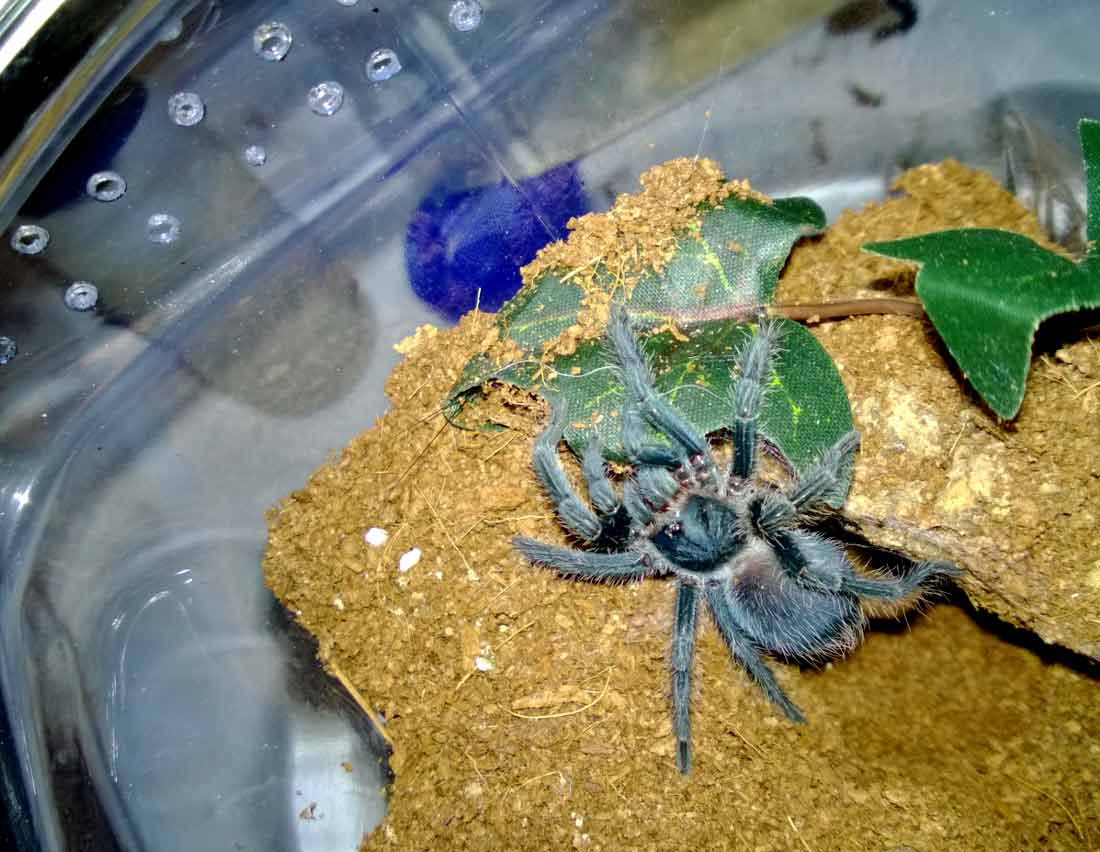
Poecilotheria vittata (Ghost Ornamental)

Possibly the most exotic and beautiful of all the genera of tarantulas, in my opinion, is Poecilotheria. These large, graceful, lightning-fast arboreal tarantulas originate from India and Sri Lanka and are known for their lithe, athletic builds and amazingly striking patterns and colorations that make them experts at camouflage.

My female P. vittata (upper right) using it's amazing camouflage to blend in with it's surroundings in the classic pokie pose.

My female P. vittata (upper right) using it’s amazing camouflage to blend in with it’s surroundings in the classic pokie pose.

Although quite beautiful and striking, Poecilotheria possess a combination of speed and a higher venom potency (per bite reports) that make them more of an advanced species (or one for the the cautious and aware keeper). It has been said that the the speed of a Pokie, as enthusiasts amicably refer to them, must be experienced to be truly appreciated. A keeper used to working with slower species might find himself ill-prepared to deal with a 9+” spider that can be out of its cage and on your arm faster than you can blink.

Still, those experienced in keeping these amazing creatures adore them for their beauty and elegance, and argue that, for the experienced keeper, they are a most rewarding animal to keep. The majority of the species in this group can be described as more secretive and skittish than aggressive, and many will resort to sitting still and using their natural camouflage to hide them as a first line of defense. A keeper who is aware of his animal, its habits, and its location, and who avoids spooking it, will likely have little problems.

When selecting my first pokie, I hit the message boards, reading first hand accounts from those who had successful kept Poecilotheria for years. As this was going to be my first pokie, I specifically wanted one of the species known for being “calmer” and less prone to be defensive. P. regalis and P. vittata were both mentioned repeated as good beginner pokies, so I kept my eyes open. When Ken the Bug Guy offered a 3″ female P. vittata on his site, I jumped at it.

When she arrived, I was pleasantly surprised to discover her to be a full 5″ (Ken often gives his customers a bit of a size upgrade). As I wanted this T to be one of my display tarantulas, I purchased an 8″x8″x12″ Exo Terra Nano for her, along a water dish, a cork bark slab, and Flukers bendable vines to create some more hiding areas. I arranged the tank in such a way to give her several places to hide and to feel secure. Although I keep the substrate mostly dry, I overflow the water dish a bit each time I water her, and let it dry out in between.

Because the screen top of the Exo Terra provides a lot of extra ventilation, I keep the substrate partially damp and the water dish full. The evaporation of water from the wide water dish keeps the enclosure from drying out too much without the need to spray and unnecessarily disturb the T.

My P. vittata hanging out on the side of her enclosure after a meal.

My P. vittata hanging out on the side of her enclosure after a meal.

My P. vittata is an excellent eater, and I always get a thrill when I see her perk up from wherever she is hiding after sensing a prey item nearby. Often when she hunts, I get glimpses of her blinding speed as she pounces for the kill. Besides keeping the humidity in her enclosure a bit higher than I do for many of my other Ts, I also have to do a bit more maintenance than usual. As arboreals often do, my vittata frequently shoots her feces around the enclosure, hitting the glass and producing some rather unsightly white drips and spatters. These can be carefully cleaned off with wet paper towels (no cleaner).

My P. vittata settling down to enjoy a fat cricket.

My P. vittata settling down to enjoy a fat cricket.

Before cleaning or feeding, I will tap the enclosure a couple times to “warn” her that I am coming. This will cause her to hide and hunker down wherever she is at, allowing me to carefully open the cage to drop in a cricket or to clean. If she is at the front door when I want to open up, I wait until she is in a more safe location at the back of the tank.

My P. vittata quickly became one of my favorite Ts. She is just gorgeous to look at, and spends much of her time out in the open for us to admire. When she does hide, my family and I enjoy trying to see how quickly we can pick her out of her surroundings. I am very much looking forward to her next molt and watching as she develops her striking adult coloration. At a max size of 7+ inches, she is sure to grown into a beautiful showcase tarantula.

A ventral shot of my P. vittata spread out on her enclosure door.

A ventral shot of my P. vittata spread out on her enclosure door.

However, having seen how quickly she can move, and understanding that a bite from this species would be VERY unpleasant, I completely recognized why Poecilotheria are considered to be an advanced species. This is not an animal to be trifled with, and it deserves not fear, but a healthy measure of respect and attention.


Euathlus sp. red

I will admit, when I first read about the Euathlus sp. red (Chilean Flame), I was immediately turned off by the word “dwarf”. Having kept a G. porteri for over 16 years, I was now learning about the truly amazing varieties of tarantulas available, and I was particularly intrigued by the species that offered impressive sizes. Somehow, a T that would max out around 3.5″ didn’t really appeal to me. My interest in Ts had yet to graduate from the “I want something huge and impressive” stage, and I was consequently overlooking some species due to size alone.

Still, as I frequented Arachnoboards, reading about other keepers’ experiences with these wonderful animals, my interest grew. Although there were some negatives—slings were notorious for refusing food, and their adult counterparts we also prone to fasting—there were many positives. Those who owned them gushed about Euathus sp. red’s gentle and inquisitive nature and its understated beauty.

Euathlus-sp.-Red-WEB

Euathlus sp. Red adult female 3.5″

Around early December, my wife and I decided that we would get my two middle children (8 and 10) each a tarantula for the holiday. They had been both showing plenty of interest in the hobby, and we thought them capable of caring for them with supervision. As luck would have it Jamie’s Tarantulas was offering sub-adult Euathlus sp. reds for the holiday, and I remembered their reputation for being a wonderful beginner’s species. I bought one for each of the kids then, almost as a after thought, grabbed a third for myself.

Check out my girl in the video below!

It didn’t take long for us to discover why those who kept Euathlus sp. reds gushed about the species. This tarantula can best be described as curious and inquisitive. While almost all of my Ts bolt or hide when I open their enclosures, all three Euathuls sp. reds come calmly up to the breach and try to climb out. It’s not a mad-dash escape, or a fear-induced exodus—no, it’s more like a, “Hey, what’s going on out here?” stroll.

Although I make it a point to not try to handle my Ts, I’ve found myself in an impromptu handling session with mine several times. Whenever I open its enclosure for maintenance or a feeding, mine will calmly crawl out of the hatch and onto my hand. Once there, she normally just cozies up to my thumb and hangs out. The behavior is quite adorable, and dare I say it, this is the one T I keep that I have no reservations about calling “cute”.

Euathuls sp. red after she crawled out of her enclosure and into my hand. Note: I normally do not handle my Ts

Euathlus sp. red after she crawled out of her enclosure and into my hand. Note: I normally do not handle my Ts

A word of caution, however; although they normally present a calm, gentle demeanor, these little guys can really bolt when spooked. Once, when startled, mine scurried down my hand and back into its enclosure in the blink of an eye. It served as a reminder of why great care always needs to be taken to ensure the safety of a the T when attempting to handle.

Speaking of  speed, these guys can be amazingly fast and aggressive eaters. Mine have only refused a meal when in premolt, and generally exhibit a strong feeding response. I once saw mine leap at a roach from a few inches away; to say the sudden display of spider athleticism stunned me would be an understatement.

Their husbandry is quite simple; mine are kept in round Kritter Keepers with a diameter of about 1o” and a height of about 4″. These give them a little extra space to explore, which they do quite frequently. I do, however, make sure that there isn’t too much distance between the top of the enclosure and the substrate. These little guys will climb, and you don’t want them injured or killed from a fall. For substrate, I use a dry cocofiber with a bit of vermiculite mixed in. They have a small water bowl, which I overflow a bit, and access to fresh water at all times. This can prove to be a bit challenging, as they just LOVE to bury their bowls. All are also provided with hides, which they have generally used only during premolt. The humidity is kept low, and temperatures range from mid 70s during the day, low 70s at night.

For those looking for an excellent beginner T with a lot of personality and easy care requirements, you can’t do much better than the Euathlus sp. red. They also possess an understated beauty that makes them wonderful showcase pieces; the reds that give them their common name of Chilean Flame really pop after a molt. Their gentle disposition, inquisitive nature, and small stature also make them wonderful ambassadors to folks who fear large spiders.


Aphonopelma schmidti Molt

Back in October of last year, I was perusing the Jamie’s Tarantulas website when I noticed a species listed that I hadn’t seen before. The Aphonopelma schmidti (Superstition Mountain Tarantula, among other more colorful common names) being offered was a 1.75-2″ female. I was immediately struck by the beautiful earthy tones of the adults—stunning blonds and rich reddish-browns—so I did some research on the personality and husbandry requirements. Described as a shy, somewhat skittish T, the A. schmidti required dry substrate deep enough for burrowing, low humidity, and room temperatures. Perfect. As the females posted on Jamie’s site generally don’t last long, I quickly purchased her.

A. schmidti

A photo of my A. schmidti shortly after I acquired her in October of 2013.

When she arrived, I was immediately captivated by her giant abdomen, which seemed ridiculously out of proportion when compared to the rest of her body. After setting up her enclosure, being sure to add enough dry coco fiber to allow her to dig, I allowed her to sit and acclimate to her new surroundings. As stated in the accounts I had read, she immediately started digging and bulldozing her enclosure. However, unlike other burrowing species I keep, she never seemed quite satisfied with her work. Several times, she would completely bury herself for a few weeks, only to pop up again later through a brand new den entrance. Over the course of a month, she buried her cork bark hide, a plant, and two water dishes.

Despite her mammoth rump, she did not appear to be in premolt and still ate. She did prove to be a bit of a finicky and shy eater, as she would often run from crickets or roaches that were put in alive and kicking but would readily take a pre-killed one placed at the mouth of her burrow. In late December, she refused a meal, signifying that she had eaten enough and, possibly, had begun her premolt period. I couldn’t wait to see what she would look like with a fresh exoskeleton. So, I waited…

…and waited…

…and waited…

…and waited.

January passed, then February, then March. Let’s just say, Aphonopelma’s distinction as slow growers is well deserved. Over this time, I made over a dozen more acquisitions. And as some of my other Ts molted three times, warranting rehousings, my little A. schmidti sat in the corner of her little burrow, only emerging periodically to drink or to endlessly rearrange her substrate.

Then, finally, it happened. Last Friday, as I was getting ready for work, I noticed that she was upside-down. When I returned home that evening, it was to a freshly-molted T(FINALLY!).

A. schmidti post molt

My A. schmidti three days after a long-overdue molt.

With her tones becoming closer to adult coloration, I was reminded of what attracted me to this species in the first place. She now sports a strikingly blond carapace, redish-brown hairs on the abdomen, and a lightening of the color on her legs below the femurs. Although I haven’t been able to get a good measurement yet, she looks to be about 2.25-2.5″. Again, a slow grower, but well worth the wait.

For those looking for an active, fast-growing species, an A. schmidti might not be for you. Although the non-stop digging and tunneling can be amusing, this is a T that can be quite secretive and will spend a lot of its time hiding in its den. Still, their husbandry is quite simple, and they are pretty little Ts who will likely outlive some of the faster-growing species, and when they do molt, it really is cause to celebrate. Personally, I think that the A. schmidti would make a wonderful first T for the patient keeper.

P. cancerides Fresh After Molt

P. cancerides Juvenile

Newly-Molted P. cancerides Juvenile (3″)

After just writing that I was excited to see how my two P. cancerides juveniles would look after their latest molts, I discovered that one had actually molted yesterday. In this photo, you can see the freshly-molted specimen standing next to its discarded exoskeleton. Not only did this particular T go from about 2.5″ to 3+” with this latest molt, but it is also now sporting more of an adult coloration. Gone are those beautiful blues replaced by a more muted blue-gray with striping and reddish hairs on the abdomen. Still, I’m loving this new look, and once again, I’m floored by not only the new length, but also the girth attained through this latest molt.

As its current enclosure is only about 4″ square, he/she will be getting  rehouse as soon as the new exoskeleton has hardened.

Phormictopus cancerides

Late last year, while looking for interesting new species of Ts to possibly add to my collection, I encountered P. cancerides (Hispaniola Giant or Haitian Brown) slings on several sites. A couple of the descriptions I read didn’t make them sound particularly interesting, with cancerides being described as good eaters, but fast and skittish tarantulas that mature into large 7+ inch brown females or purplish male adults. Still, the slings were gorgeous, sporting a gorgeous blue sheen, and the fast growth rate was a plus. After weeks of reading personal accounts from those who kept this species, and finding them all to be enthusiastically positive about these animals, I decided to pick a couple slings up from Jamie’s Tarantulas.

I’m so glad that I did.


P. cancerides sling 1.75"

P. cancerides sling when first procured in November, 13. 1.5″

P. cancerides has quickly become one of my favorites. My juveniles have a vicious feeding response, stalking their prey with a fast, no-nonsense approach that I’ve only seen in my female L. parahybana. My large P. cancerides will literally leap at prey at an awesome speed. However, as described, they are more skittish than aggressive, choosing to flee into their dens rather than stand their grown or hair kick when their enclosures are opened. I’ll be interested to see how their temperaments change as they mature.

Speaking of dens, both of my juveniles are ambitious burrowers, constructing huge underground caves for their dens. However, unlike some of my other burrowing species, they spend much of their time standing boldly out on the surface for easy viewing. No matter time of day, they are usually right out in the open, ready for another meal.


P. cancerides

Same P. cancerides a week after molting, now 2.25″

As for the rate of growth, my two larger specimens have only molted once in my care. However, the amount of size gained between molts was nothing sort of amazing. My slings started off at a thin 1.5 inches, but grew to an impressive and robust 2.25″ after molting (see photos). More than just the length was the thickness of the spiders; they went from looking like little bluish garden spiders to hairy mini Ts. Both of my cancerides are in pre-molt again, and I can’t wait to see how much they grow this time around.

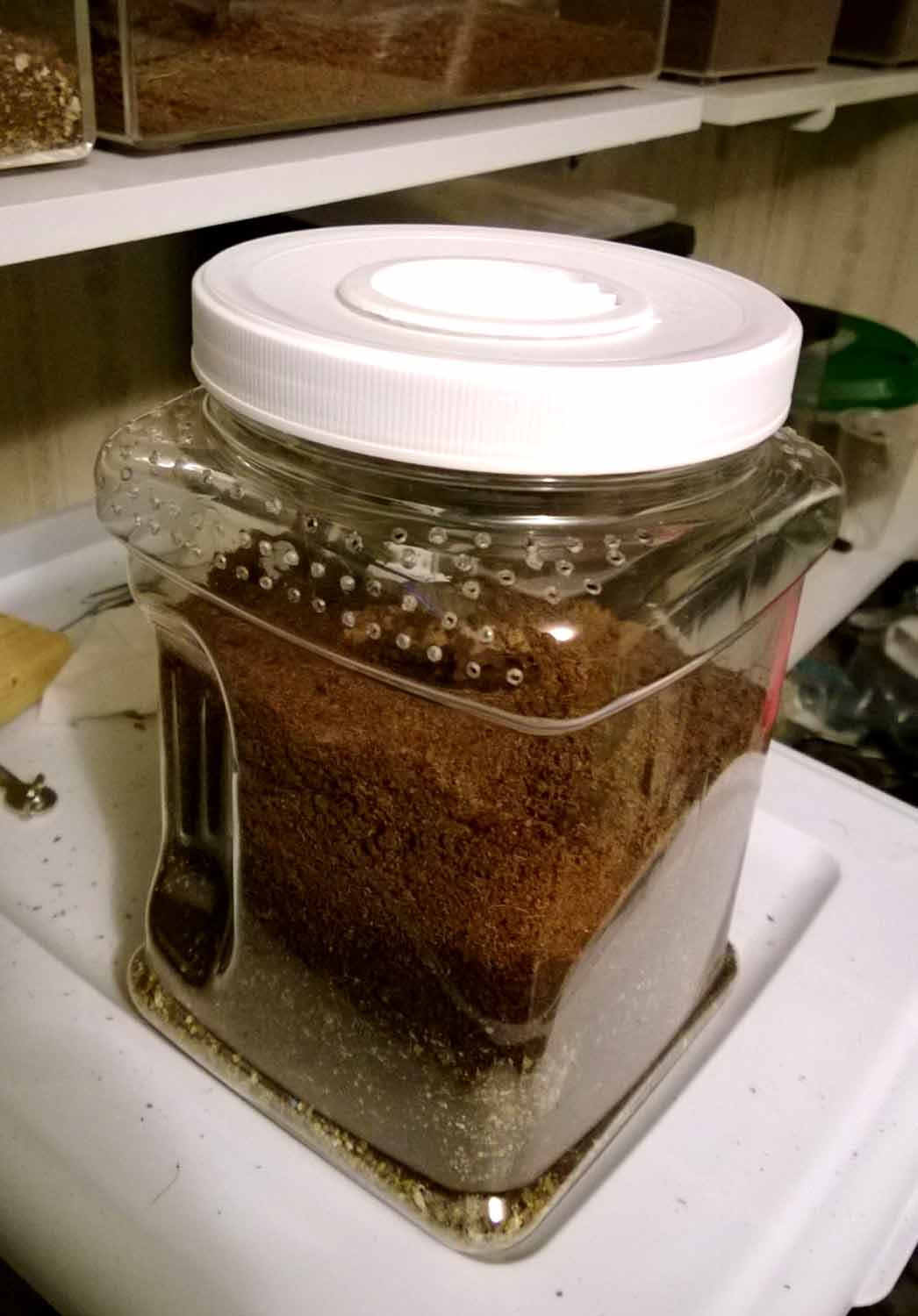
Their care has proven to be quite simple: I keep both of mine in plastic jars measuring 4.5 L x 4.5 W x 7″ H filled to a couple inches from the top with a mixture of coco fiber and sphagnum peat moss (with a layer of vermiculite at the bottom to retain moisture). This gives them plenty of space for burrowing, and the layer of vermiculite at the bottom allows for better moisture retention and a humidity gradient. The top of the substrate is mostly dry, although I overflow the water bowl on one side; the bottom of the substrate is damp. I do not mist, and instead pour water in a corner and allow it to percolate down to the lower levels.

The enclosure is well-ventilated with a round 2″ vent in the top and strategically place air holes in the sides to supply cross ventilation. The temperature is around 70 degrees at night with a high of about 78 degrees in the day. These two are fed medium crickets or roaches twice a week.

P. cancerides enclosure

Custom P. cancerides enclosure made from plastic cereal canister.

I recently picked up a third P. cancerides, a 1″ sling from Net-Bug, in hopes of increasing my chances of procuring a female. If my current trio turn out to be all males, I will look forward to buying more slings and growing some more. This is definitely a species I’m interested in breeding in the future. For someone with some T keeping experience, P. cancerides is a beautiful, fast growing, hardy tarantula that would make a perfect addition to any collection.