Michael Jacobi’s Spider Shoppe – A Review

I had first heard of Micheal Jacobi when I purchased the Kindle edition of his TARANTULAS book from the Animal Planet Pet Care Library. I very much enjoyed this book, and found it to be a very accessible read and an excellent introduction to tarantula keeping. About that same time, I stumbled across an advertisement for his online store, Micheal Jacobi’s Spider Shoppe. I knew that it would only be a matter of time before I placed my first order with him, as he had a very diverse selection in stock, and his prices were quite fair.

Well, last week I was given a little extra incentive to do so when Michael announced a three-day blowout sale in preparation for a trip he was taking oversees. To receive the price list, folks needed only to be signed up for his newsletter (or sign up before the sale). I immediately jumped on the site and signed up.

Man, am I glad that I did.

The list was extensive, and the prices were amazing (and I honestly thought his prices were good already). Unfortunately, the sale started on a Wednesday, and I didn’t get paid until Friday, so I missed out on a couple fantastic deals (I almost bought them anyway, but I didn’t want my wife to kill me). I was able to grab three .5″ C. darlingi slings ($10 each), three 1.5″ H. incei gold juveniles ($20 each), and one 1.5″ P. regalis juvenile ($25).

Despite the fact that Mr. Jacobi was obviously fielding dozens of emails and pulling stock, his communication was excellent. When a T I wanted had sold out, he responded immediately with the info so that I had an opportunity to quickly adjust my order. Payment info and shipping info was sent promptly, and although I expected a delay in shipping due to the volume of business he was doing, my package was shipped as soon as I gave the go ahead. He even sent a little FAQ-style email with a lot of useful information and tips. Very cool.

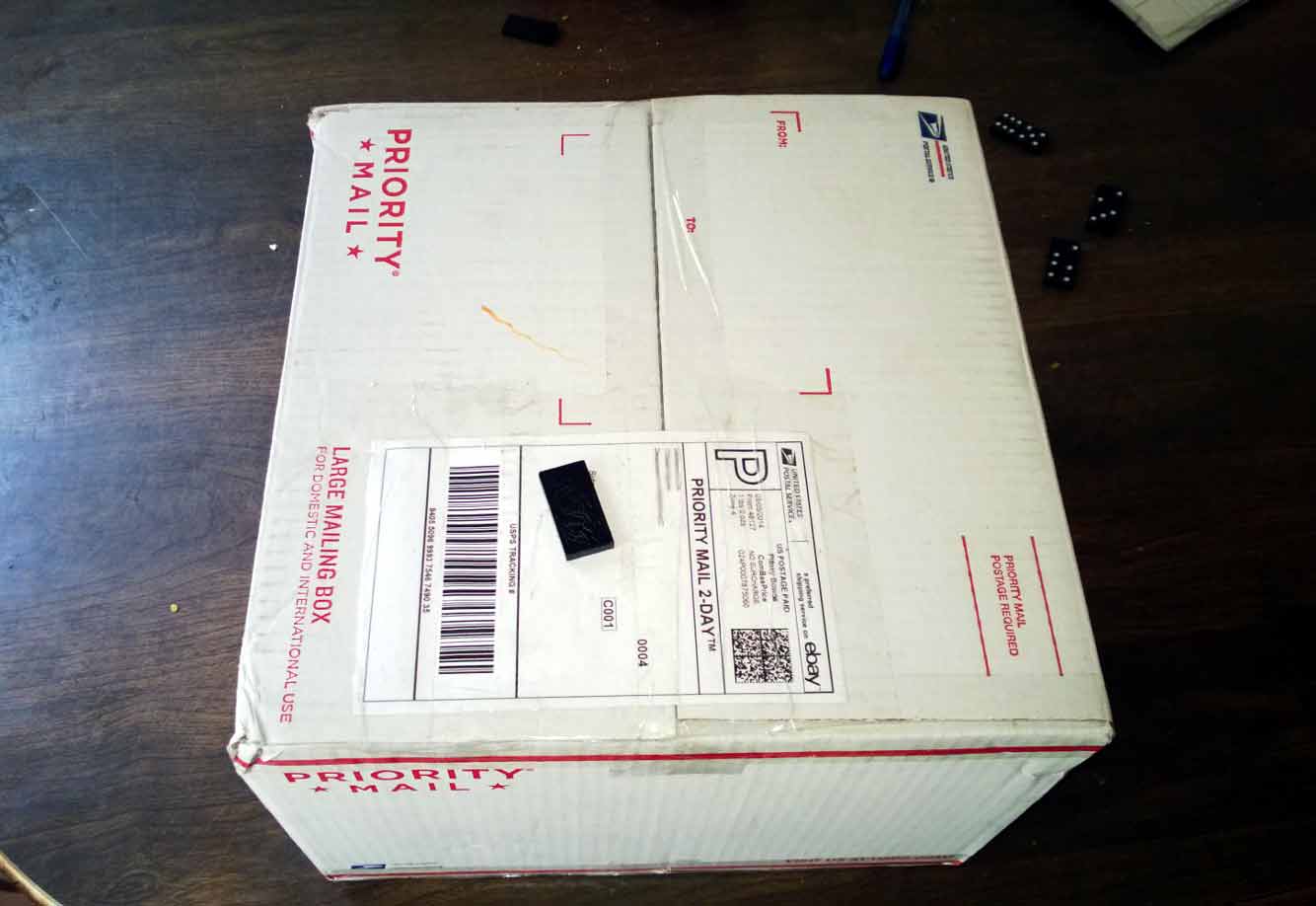
Box was well packed and properly labeled to prevent damage.

Box was well packed and properly labeled to prevent damage.

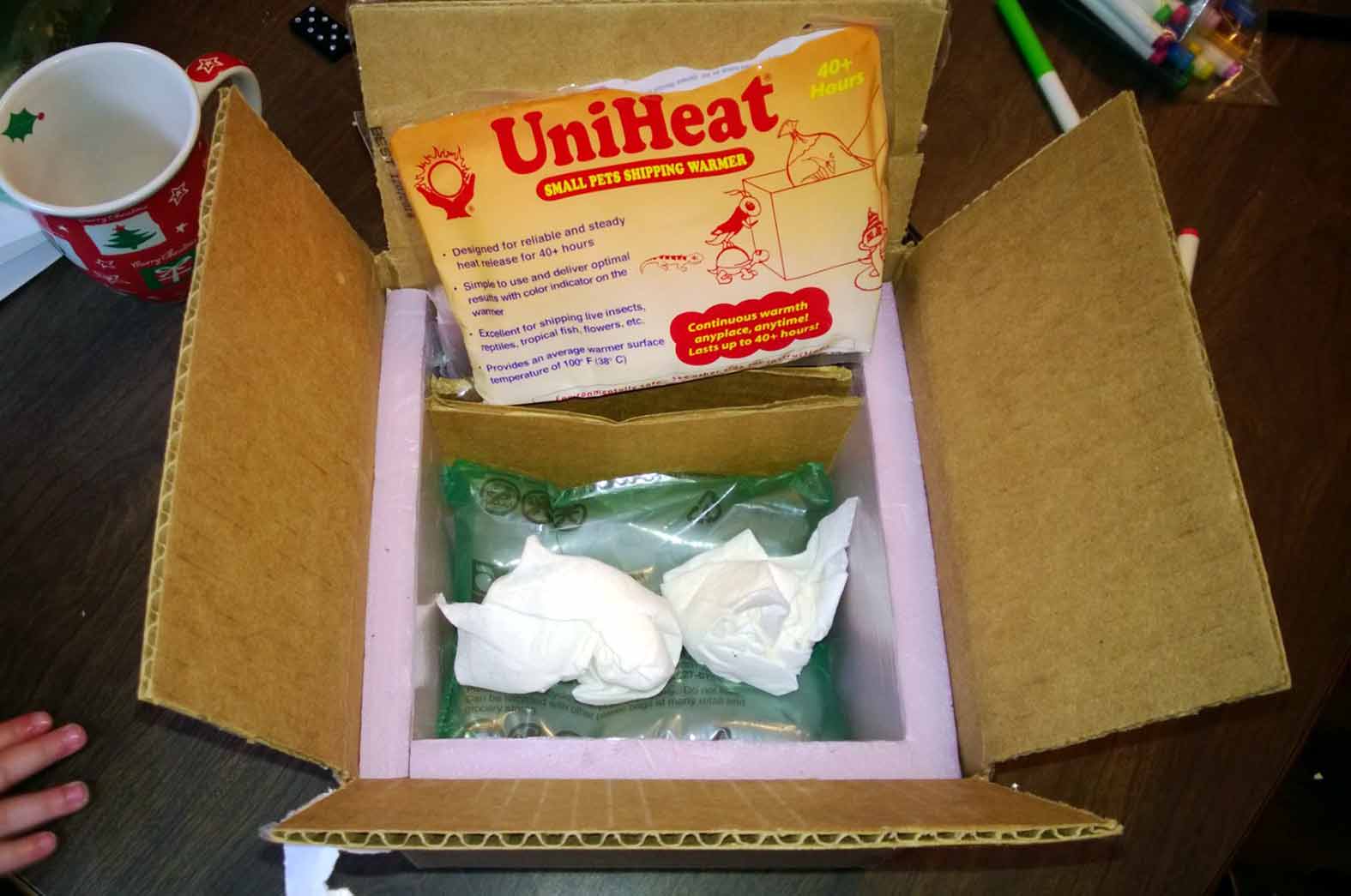
Packing was excellent, with foam insulation, heating pack, and air bag padding inside the box. Individual tarantulas were well-packed in dram bottles and the drams were then taped up in another layer of thick paper towel for added shock protection.

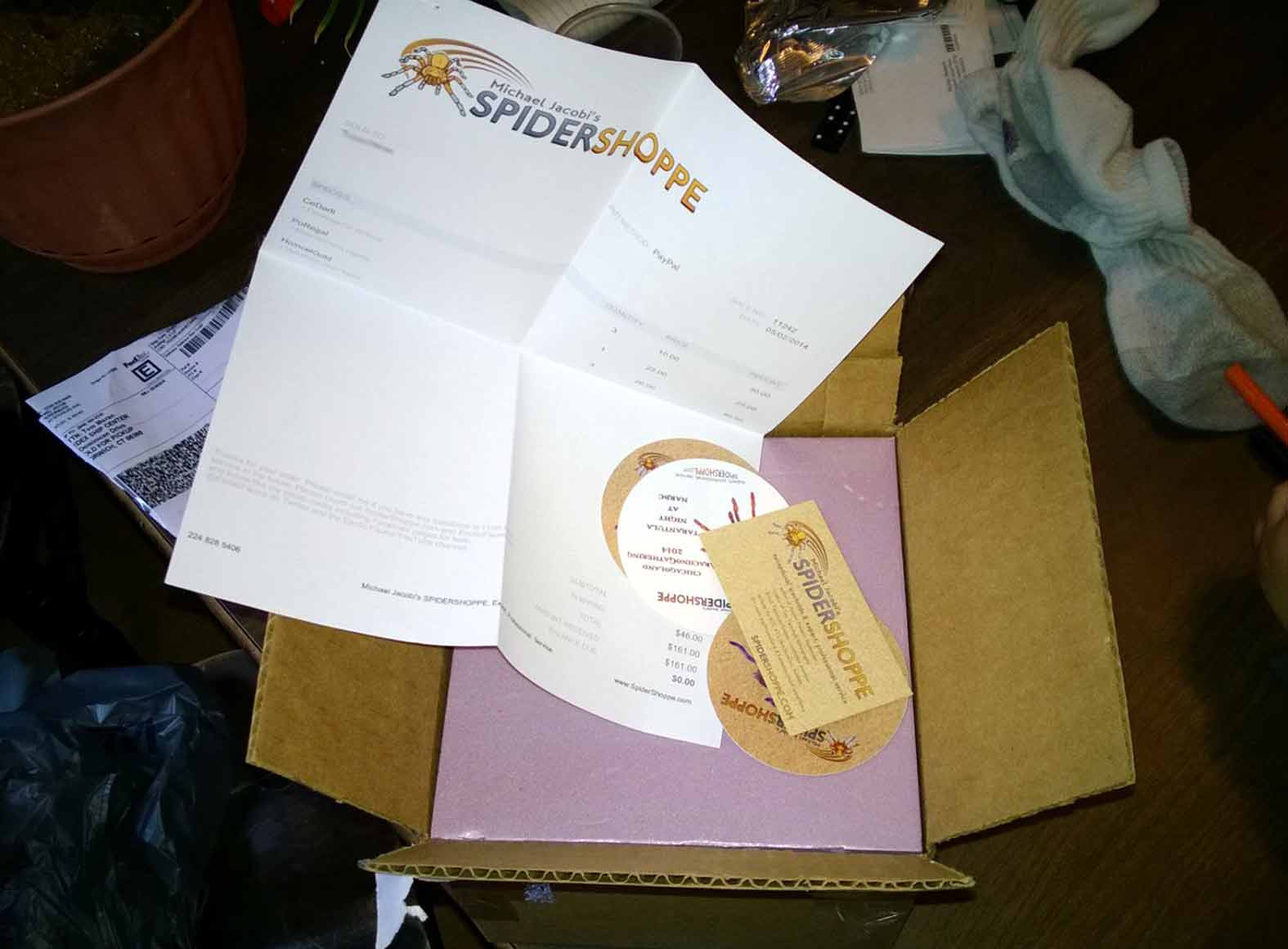
The box opened and showing the receipt, a business card, and some very cool stickers.

The box opened and showing the receipt, a business card, and some very cool stickers.

The box opened with the top piece of foam and a couple pieces of padding removed. Spiders are well packed in dram bottles  surrounded by a layer of thick paper towel.

The box opened with the top piece of foam and a couple pieces of padding removed. Spiders are well packed in dram bottles surrounded by a layer of thick paper towel.

The tarantulas themselves were lively and in excellent health. Even cooler, every one I ordered was much larger than I was expecting. The C. darlingis all measured about an inch, and two of the H. inceis were about 1.75″ with the third a beefy 2+”.

And the P. regalis? Well, I haven’t gotten an accurate measurement yet, but this “1.5” inch juvenile is actually over 3″. What a fantastic surprise and a discovery that made this purchase even more of a phenomenal bargain.

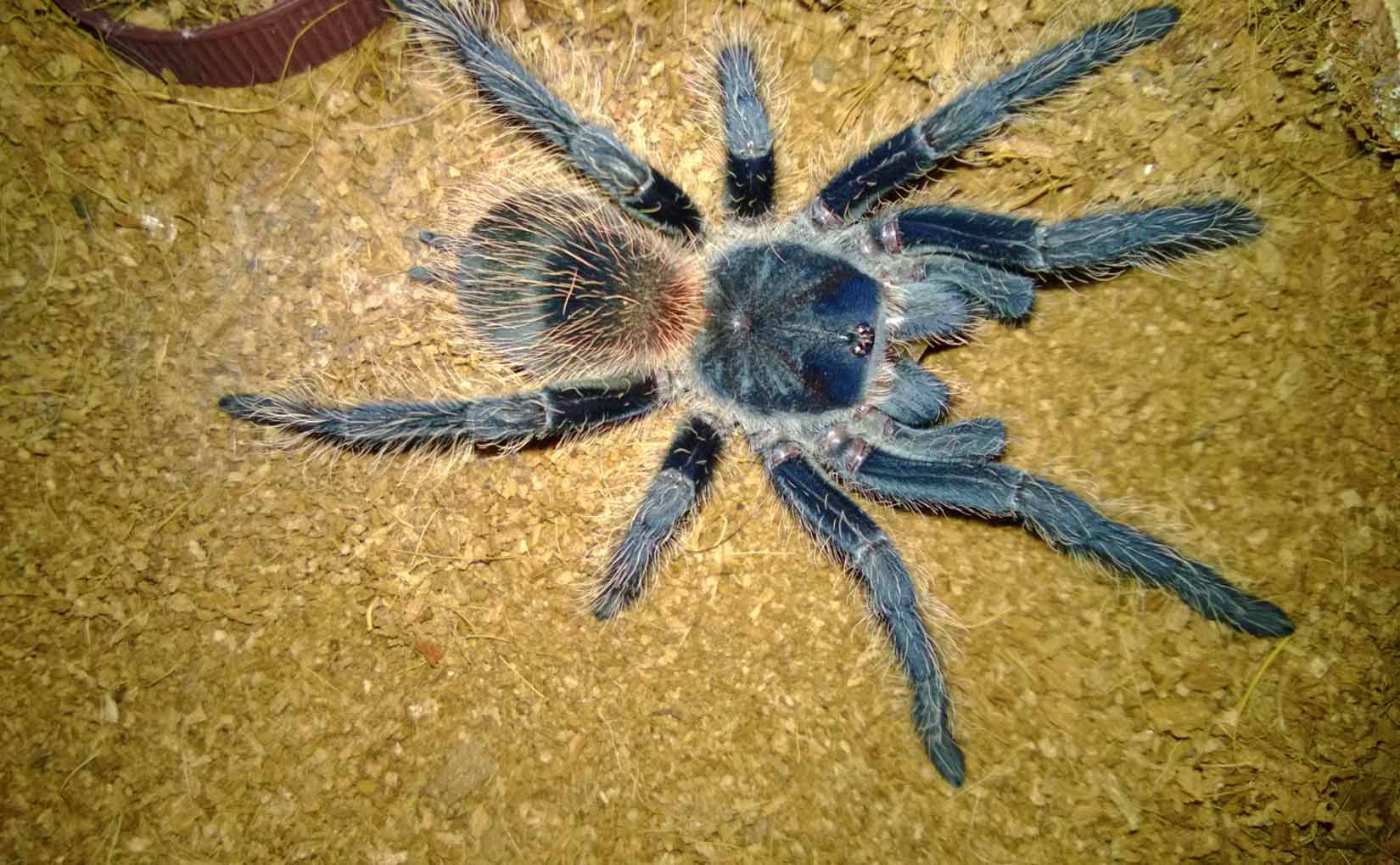
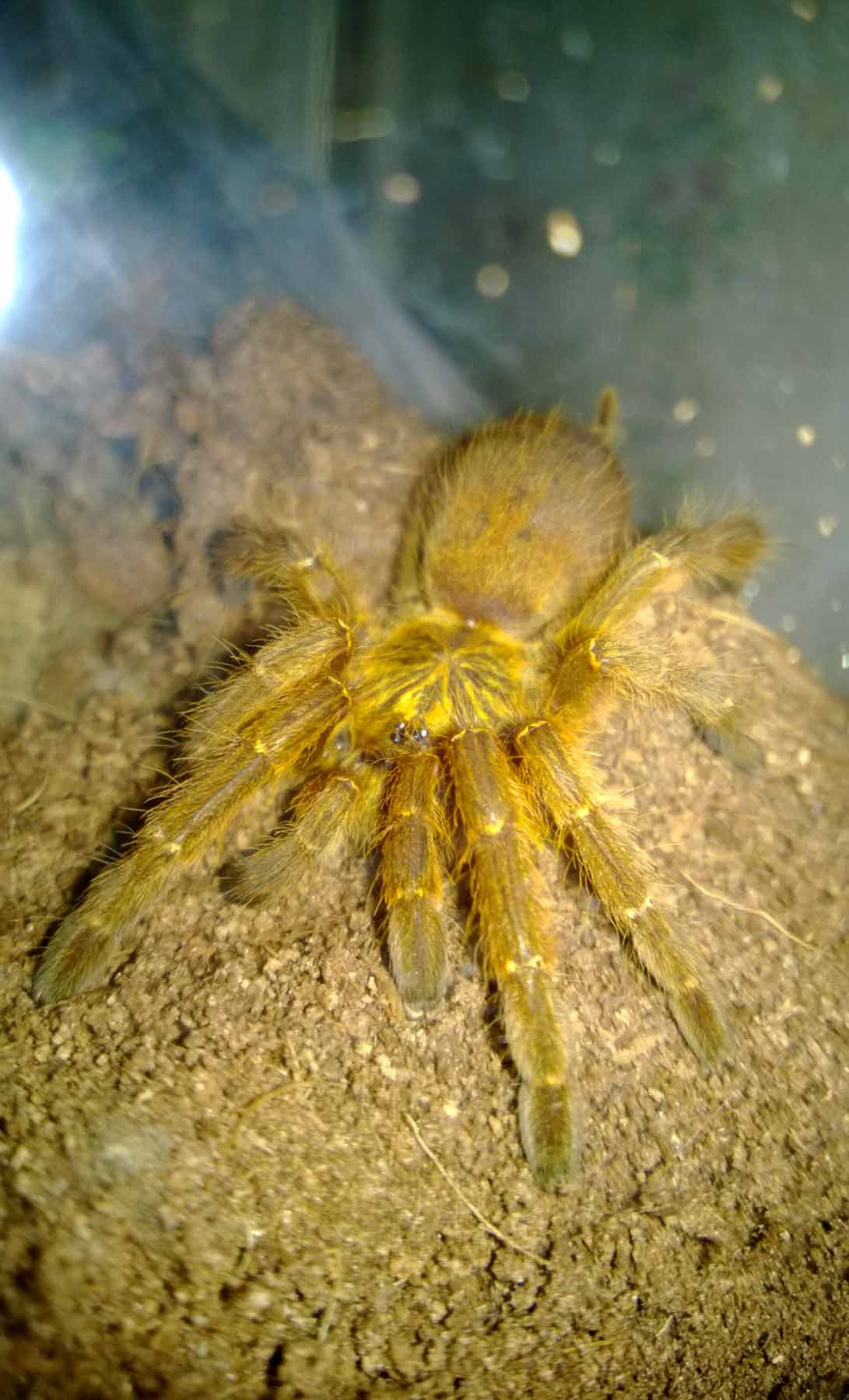
One of the three H. incei juveniles purchased from Michael Jacobi. Unfortunately, my picture doesn't really capture the amazing color.

One of the three H. incei juveniles purchased from Michael Jacobi. Unfortunately, my picture doesn’t really capture the amazing color.

Speaking of lively, one of the C. darlingi slings launched itself from container after I removed the piece of paper towel blocking holding it in. To say that the little bugger was fast would be an understatement. Luckily, I always work over either a box or large plastic bin to prevent escapes. After leaping from the dram onto my hand, he actually ran off of my hand and right into his new enclosure. Thanks, buddy!

I could not be more pleased with my purchase from Micheal Jacobi’s Spider Shoppe. The prices were amazing, the communication was outstanding, the packing was perfect, and the animals were in great shape. This was an A+ experience, and I would definitely recommend Mr. Jacobi to any enthusiast looking for a professional and trustworthy vendor.

A quick note: as Michael will be travelling extensively over the next several months, his online store will not list tarantulas for sale for time being. Those interested in pricing or ordering will want to sign up for his newsletter.


Box of Roaches … A Review of Jeremy Stichler!

Having amassed a collection of 47 tarantulas and counting that now includes many larger spiders, I was finding it more difficult to keep adequate food supplies handy. Although I’ve used mainly crickets for prey, I also keep a small quantity of Blaptica dubia and Blatta lateralis roaches. Having found that the dubias were easier to maintain and relatively odorless, I started keeping a lookout for a fairly priced starter colony.

While perusing the for sale page on Arachnoboards, I stumbled on an ad for 125 count starter colony of large Blaptica dubia for only $27 shipped. The vendor was Jeremy Stichler (Jerm357) who had several pages of sparkling reviews on the boards. Having priced out starter colonies before, I was expecting to pay much more for this many roaches (and that was not counting the 10% overcount he offered on top of it). Even better, he guaranteed all larger roaches unless specified that you wanted smaller ones.  I jumped at this tremendous bargain and immediately emailed Jeremy.

Communication was excellent, as Jeremy emailed me back immediately with payment information. Correspondence was friendly and very professional, which is always a huge plus in my book.  He also shipped quickly, and my package was mailed USPS Priority on that Monday and arrived on Wednesday.

Box arrived in great shape.

Box arrived in great shape.

Packing was excellent, with the roaches double-boxed and insulated with newspaper. There wasn’t a single dead roach in the bunch, and all were quite lively when I opened the package. In fact, one of the larger males quickly shot out of the package and landed on my arm. Now, I know I have dozens of giant, hairy spiders, and most would find that frightening, but I don’t think I’d ever seen a roach that big. And, perhaps I panicked just a bit when I tried to quickly brush it off and the little beast barely budged. Wow, those suckers are strong…

After opening the first box, I discovered a second box safely nestled in a bed of newspaper. (Note: Notice my 3-year-old's creepy Mega Blok figure. Those little pagan-looking totems are all around my house. Creepy!)

After opening the first box, I discovered a second box safely nestled in a bed of newspaper. (Note: Notice my 3-year-old’s creepy Mega Blok figure. Those little pagan-looking totems are all around my house. Should I be worried?)

The second box is now open. A piece of cardboard serves as a spacer. You can now see some of the roaches...yum!

The second box is now open. A piece of cardboard serves as a spacer. You can now see some of the roaches…yum!

With the cardboard moved aside, you can now see more of the little buggers.

With the cardboard moved aside, you can now see more of the little buggers.

With the cardboard (and some of the roaches) out of the way, you can now see a bunch of very large and healthy roaches.

With the cardboard (and some of the roaches) out of the way, you can now see a bunch of very large and healthy roaches.

All of the roaches have been rehoused in their new home (I will post later about their new quarters), and all are eating well. I honestly couldn’t have been more happy with my purchase from Mr. Stichler. I wouldn’t hesitate to buy from him again.

This was an A+ experience, and I would highly recommend Jeremy Stichler to any hobbyist looking for a dubia feeder roach starter colony.


Pamphobeteus antinous

As my T collection grows and I gain experience with different species, I’m finding that I’m developing an affinity for the larger South American Ts. Don’t get me wrong, there is definitely a place in my collection for some of the slow-growing genera, like aphonopelma, grammostola, and brachypelma. Many of the species in these genera are simply gorgeous, and their slow growth rate means that I’ll have these guys for many years. However, for the impatient keeper in me, the faster-growing, aggressive eaters are just a thrill to watch. Recently, I decided to investigate some new  species for potential purchase, and I wanted something big and feisty.

While perusing the Net-Bug site, I came across a Pamphobeteus antinus, or “Steely Blue Leg”, female for sale. I had researched several species in the Pamphobeteus genus many months back, and at that time, I wasn’t sure I was ready for a T that required a bit more humidity. Having gained some experience since then and become more skilled at maintaining humidity in the enclosures, I decided that I was ready for this species.

My 3.5" P. antinous female.

My 3.5″ P. antinous female.

For my new acquisition’s home, I set up a large Kritter Keeper with about 5″ of a moist 50/50 peat moss and coco fiber mix. As the heavily-vented tops of KKs allow for too much ventilation for species requiring higher humidity, I used contact paper to block off much of the top and sides while still allowing for cross ventilation. Using a 5″ cork bark round, I sunk part of into the ground as a starter burrow and covered it with soil and sphagnum moss. As I want to maintain a higher level of humidity, I also provided her with a large water dish. Once a week, I sprinkle water on her substrate and on the sphagnum moss (think a good, quick rain shower) to keep the substrate from drying out too much. For temperatures, she is kept in the low 70s during the night, and high 70s/80 during the day.

A large Kritter Keeper modified to accommodate a species with higher humidity requirements.

A large Kritter Keeper modified to accommodate a species with higher humidity requirements.


It didn’t take long for the P. antinous to create an impressive burrow. Gnawing through the bottom of the cork bark, she dug straight to the bottom, constructing a small compartment in the lower corner. Here she sits until she detects prey items above. Alerted to a meal, she bolts from her hide, her lithe legs tapping against the plastic as she scrambles for the surface. Out of all of my Ts, this is the first one I’ve actually HEARD coming for a cricket. The speed and ferocity she displays when attacking her food easily rivals that of my P. cancerides. Right now, she gets four large crickets, or two 1+” dubia roaches, a week (this species is known for being a good eater).

My P. antinous inside its den (back view).

My P. antinous inside its den (back view).

With my female still sporting her immature reddish-brown colors, I will look very forward to seeing if she gets any of her “steely blue” coloration on next molt. Also, as this is also considered to be a species with a fast growth rate, I will be anticipating quite a size jump. Although I’ve only owned her for a couple months, my P. antinous is proving to be one of my most interesting tarantulas.


Lasiodora itabunae

A couple months ago, I saw a listing for Lasiodora itabunae slings on Ken the Bug Guy’s website, and I was immediately intrigued. I hadn’t heard of this species of Lasiodora before, and some research didn’t bring up much in terms of first-hand reports on their upkeep. Either they were fairly new to the hobby, or just hadn’t caught on with enthusiasts. As I own three Lasiodora parahybana’s and love them, I decided it would be fun to try out one of its relatives.

My L. itabunae a week after its most recent molt. It morphed from a light reddish-brown to steely blue with red hairs on its abdomen.

My L. itabunae a week after its most recent molt. It morphed from a light reddish-brown to steely blue with red hairs on its abdomen.

I ordered what was supposed to be a 1.5 inch L. itabunae, but I was pleasantly surprised to discover that my new acquisition was just over three inches (thanks for the upgrade, Ken!). At the time, the spider was a light, reddish-brown with a very bald, fleshy-toned abdomen. I set him up in his new enclosure, and he ate immediately. I was instantly impressed by the ferocity and speed in which it attacked and subdued its prey.

After reading a handful of firsthand husbandry accounts, I set the enclosure up identically to my L. parahybana, with a cork bark hide, dry coco fiber substrate deep enough for burrowing, and a water bowl. Temperatures are about 70 at night and 78-80 during the day. When watering it, I let the water overflow a bit, but I never spray it for humidity.

It became apparent very early on that this spider was going to be a voracious eater. It spent only a week hiding meekly in its core bark burrow, then it sat boldly on top of it, seemingly waiting for me to drop a cricket in. Twice, it caught the prey before it could hit the substrate. The other times, it would bolt across the cage, snatching the cricket in the blink of an eye. Next to my P. cancerides juveniles, this might be my favorite T to feed.

My 4+" L. itabunae likely waiting for its next meal.

My 4+” L. itabunae likely waiting for its next meal.

About two weeks ago, my itabunae molted, and the transformation was amazing. Not only did it pick up close to an inch of size, but it also sported brand new colors. The reddish-brown was replaced by a beautiful steely blue, and its abdomen was now highlighted by red hairs. He’s a truly gorgeous T.

My L. itabunae stretching out after a recent molt.

My L. itabunae stretching out after a recent molt.

For folks interested in large terrestrial Ts with easy care requirements and an awesome feeding response, consider L. itabunae. I will definitely be looking to acquire more slings of this amazing species.


C. cyaneopubescens (GBB) Molt

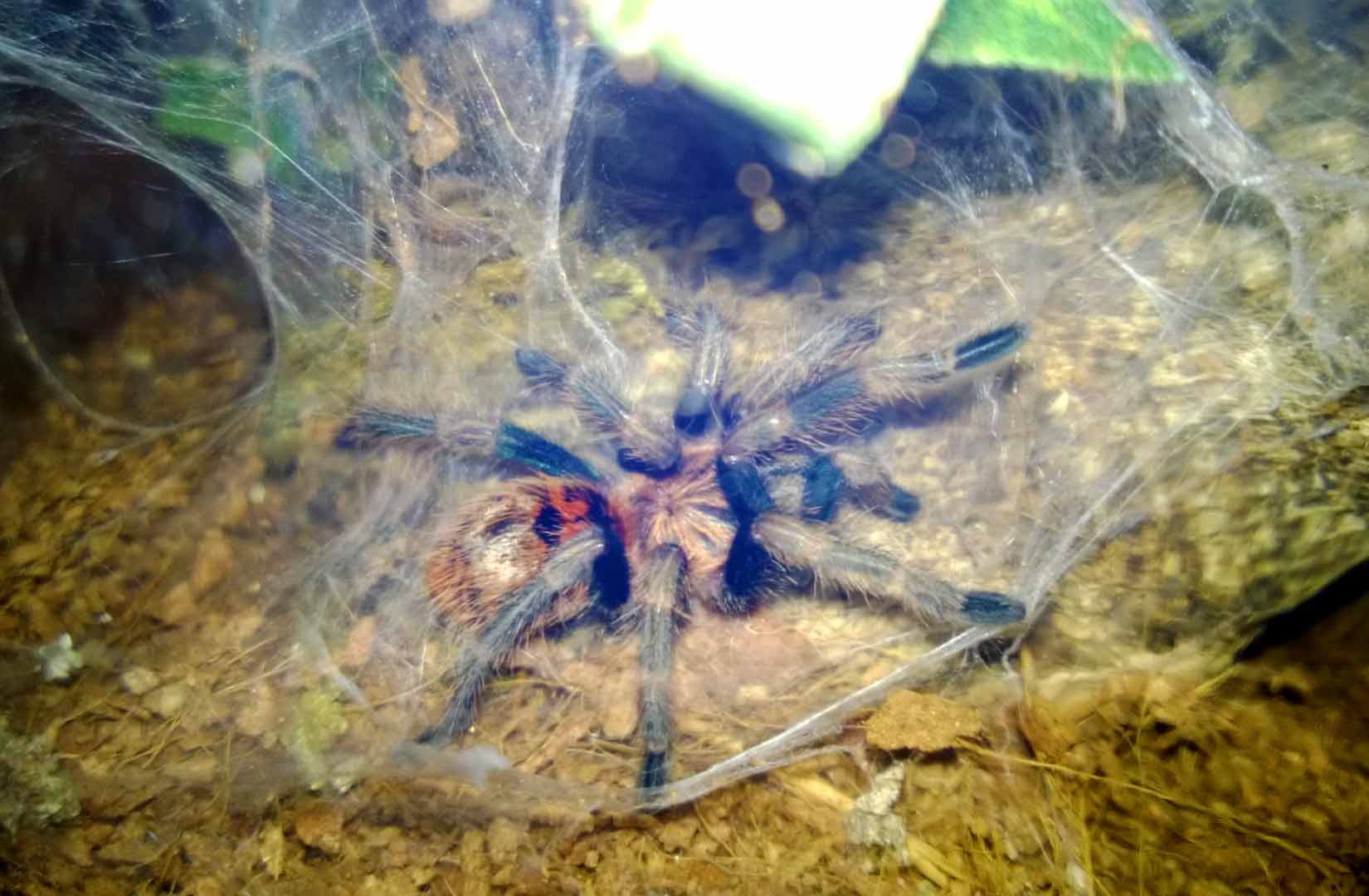
One of the most colorful and visually striking tarantulas available is the Chromatapelma cyaneopubescens, also know as the Green Bottle Blue or GBB for short. I purchased my first GBB as a sling back in October of last year, and have since picked up another. Over this six month period, my first GBB has molted four times, growing from a .75″ sling to a 2+” juvenile. With each molt, it has acquired more and more of her adult coloration. This weekend, it molted again, and along with about .25″ of growth, it’s also picked up a bit more of the adult orange on its abdomen and slightly darker legs below the femurs.


My C. cyaneopubescens before its recent molt

My C. cyaneopubescens before its recent molt


My C. cyaneopubescens on its back during a molt.

My C. cyaneopubescens on its back during a molt.


My C. cyaneopubescens after its recent molt.

My C. cyaneopubescens after its recent molt.

Unfortunately, the last picture was shot through some of the web, which mutes some of the colors through the milky veil. It now has much more orange on the abdomen, and it really pops much more than I was able to capture in this photograph. I will be eagerly awaiting to see what coloration changes the next molt brings.

Orphnaecus philippinus – Philippine Tangerine

My juvenile O.philippinus.

My juvenile O.philippinus.

A sleek, secretive Tarantula, and a unique-looking species, the Oprhanaecus philippinus, or Philippine Tangerine, is a species that should enjoy more popularity in the pet trade. From the Philippines, this old world tarantula and obligate burrower thrives in warmer and more humid conditions. Unlike many terrestrial species, O. philippinus have lithe frames with long, slender legs, a pill-shaped abdomen and an overall sleeker build. At a max length of around 6″, this is an impressive animal. A gorgeous orange/tangerine color overall, these Ts have shorter hair, which gives them a very soft, velvety appearance.

My 2+" O. philippinus hiding in its den a week after molting.

My 2+” O. philippinus hiding in its den a week after molting.

Despite being an old word species, my O. philippinus slings would much rather flee to their burrows than stand and fight. They are obligate burrowers, and they require deep substrate so that they can construct  suitable dens. This is a species that requires a more humid climate, and for them to thrive, they do need slightly moist substrate. When presented with two starter dens, one on the dry side of the enclosure and one on the moister side, both of mine chose the moist side to create their homes.

For substrate, I keep them on a mixture of coco fiber and peat moss with a bit of vermiculite mixed in on the bottom to help maintain moisture. I will then sprinkle water in occasionally to keep the surface just a bit moist. The majority of the water will percolate down the sides of the enclosure keeping the lower levels more damp than the upper levels. This allows my T to burrow and chose the level of moisture it needs. I also allows for water to evaporate more slowly, keeping the humidity up.

Once its den is constructed, the O. philippinus will wait just inside the entrance hole for a prey item to stumble by. When the unfortunate insect is sensed, the O. philippinus will launch out of its hole, ambushing the insect and grabbing its meal. It will then drag the item back into its den so that it can eat in private. In my experience, they are voracious eaters who will only refuse a meal when in premolt. When mine were about 2″, they had no problem taking down larger crickets. I feed them appropriately-sized cricket or roach every three days or so.

As far as a downside for these wonderful creatures, there are few. Humidity and moisture requirements can make the husbandry a little trickier. Moisten substrate too much, and you run the risk of creating hospitable conditions for mold and mites. Keep it too dry, and your O. philippinus is likely to dehydrate. Moist substrate AND proper ventilation is key. They are also VERY fast, and can go from crouching in a corner to out of the enclosure in a blink of an eye. Keepers not used to keeping faster species could find this shocking.

For temperatures, they are kept at mid to low 70s although they will thrive at temps in the low 80s as well. As with most species, higher temps will bring faster metabolisms and growth rates. I’ve kept mine for about a year, and in that time they have gone from 1.25″ slings to 3.5″ sub-adults. I have not noticed a significant difference in growth rate between the winter months where they are kept mid to low 70s and the summer when temps are high 70s to low 80s.

O.-philippinus-Jan

O. philippinus Pulling a Cricket into It’s Den

http://www.youtube.com/watch?v=nLGd8t02hsk Because they spend the majority of the time in burrows and normally venture out only at night, sightings of your prized pet may be rare. Personally, I enjoy the thrill I get when I catch one of my slings out and about; or when I witness one snag a prey item. They are an amazing , beautiful, and unique tarantula that would make an excellent addition to any collection.

Euathlus parvulus (Formerly Paraphysa parvula)

Note: The species formally called “Paraphysa parvula” is now to be called “Euathlus Parvulus.” Paraphysa is no longer valid. This article has been amended to reflect this change in taxonomy. 

The Euathlus parvulus (formally Paraphysa parvula), or “Chilean Gold burst” as it’s commonly referred to, is a beautiful little T from Chile. Reaching a medium size of around 4″, these tarantulas generally have a calm, sweet disposition. I purchased my girl as a sub-adult from Jamie’s Tarantulas in October of 2013, and she has become one of my favorites.

My 3.5

My 3.5″ female P. parvula.

I keep my E. parvulus identical to how I keep my G. porteri. She is housed in an 8″x8″x16″ acrylic cage with bone dry coco fiber substrate, and water dish, and a cork bark hide. Temps for her high 70s during the day and a drop to high 60s/low 70’s at night. This T does well in lower humidity, and does not warrant overflowing the water dish or moistening the substrate.

Her behavior would likely earn her the dubious title of “pet rock”, as she enjoys just sitting out in the open in one spot for long stretches of time. Very occasionally, she will actually use her cork bark for a day. Still, there is something about her calmness that I rather enjoy, and she’s the only tarantula I own who I would describe as dainty.

Check out my girl in the video below.

I once read a forum post in which a E. parvulus was referred to as “a typical big brown spider.”  Not true at all, although I would concede to truly appreciate the beauty of this species, you need to get them under a light. In the right lighting, E. parvulus sport some amazing colors and distinguishing features. This spider’s carapace is a stunning gold, lending the inspiration for its common name, and its legs sport white hairs that give them a shimmering silvery appearance. The abdomen is covered with reddish hairs that rise in a series of diagonal ridges converging on a mirror patch. As evidenced by the photo below, E. parvulus are anything but a plain brown.

A 3.5

A 3.5″ P. parvula under the light. Notice the very striking and varied tones.

Although I can’t speak for slings, my female is a great eater and has yet to refuse a meal. I currently feed her a variety of items, including crickets, superworms, dubia roaches, B. lat roaches, wax worms, and meal worms. She hasn’t demonstrated a preference, as she quickly snatches up whatever is provided to her.

For those looking for a more active T, the E. parvulus’ sedentary lifestyle might be a bit of a turn off. However, those looking for T with a gentle disposition, easy care requirements, and a pretty appearance would find a P. parvula to be a welcomed part of their collection.

A note about “At a Glance”: The temperatures and humidity levels listed are what mine is most often kept at and are in no way meant to be be “ideals”. The humidity in my home can drop to the teens in the winter or be as high as 90% during the summer.


Tarantula Enclosures – Premium and DIY

Perhaps one of the most fun facets of T keeping is the never ending quest for the perfect tarantula enclosure. Whether you’re a money-is-no-object keeper interested in assembling the most aesthetically pleasing enclosures, or a more frugal enthusiast who wants to save precious funds for future spider purchases, there are literally thousands of options available. Once you are thoroughly hooked on the hobby, you will find yourself wandering the container section of your local Dollar Tree, Walmart, or craft store measuring up plastic canisters for size, price, and alter-ability.  And, for your “showcase” spiders, there are many attractive options that won’t break the bank.

As I’ve done a lot of experimenting with enclosures, both professionally constructed and “found” varieties, here I will present some of the ones I’ve continued to use along with some of the pros and cons. These enclosures are listed in no certain order.

Adult Tarantula Cage from Jamie’s Tarantulas

Retail: $64 (With substrate, moss, cork bark, and water dish, $84)

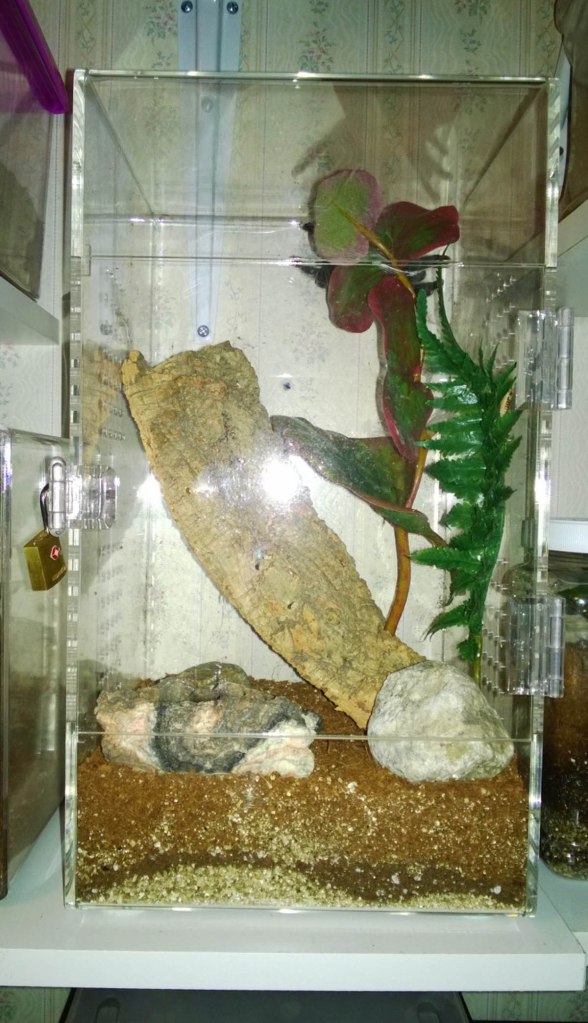
For keepers looking for a more attractive home in which to house their Ts, but who don’t want to pay upwards of $100 for a cage, Jamie’s acrylic tarantula enclosures are fantastic. These 8″x8″x14″ cages are perfect for most large tarantulas sized 4″ to 7″. She offers the option of purchasing just the cage, or you can get the Complete Cage package with all the fixings for $20 more. The crystal clear acrylic offers complete viewing from all angles, and the hinged door can be locked for security. Also, I have found these enclosures to be much more durable and well-constructed than other acrylic enclosures I have used.

CAGE Acrylic

Acrylic tarantula cage from Jamie’s Tarantula – Terrestrial set up.
CAGE Acrylic arb

Acrylic tarantula enclosure from Jamie’s Tarantula – Arboreal Set-up

Even cooler, the cages are specially designed so that they can be used as both terrestrial OR arboreal cages. I have three of these beauties; two house terrestrial Ts, and the other is set up for my arboreal A. metallica. The air vents on both sides allow for good cross-ventilation while keeping in precious humidity. Both sizes are offered in either Terrestrial and Arboreal versions.

Spiderling and  Juvenile Enclosures from Jamie’s Tarantulas

Retail $7.95-$13.95

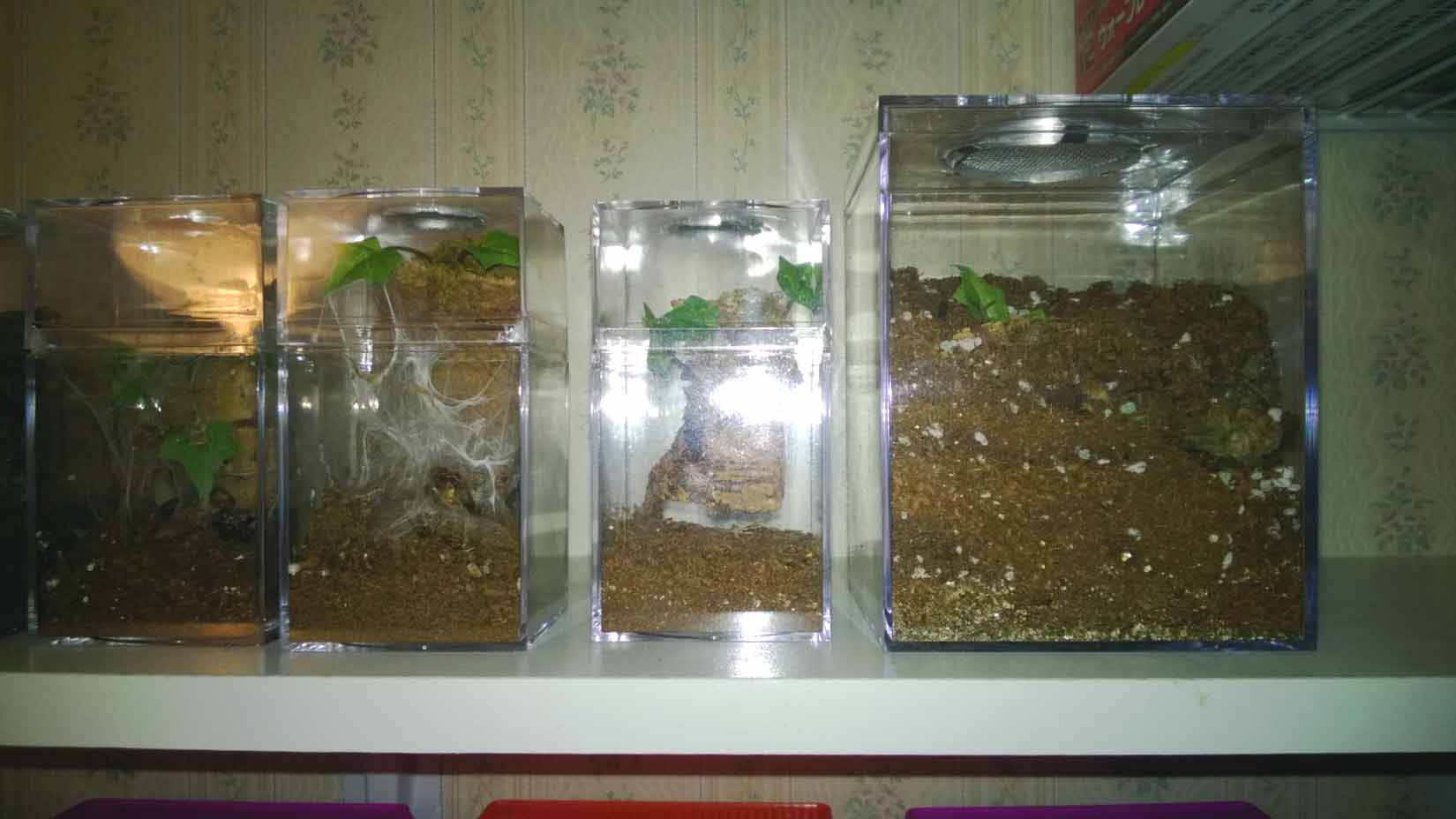
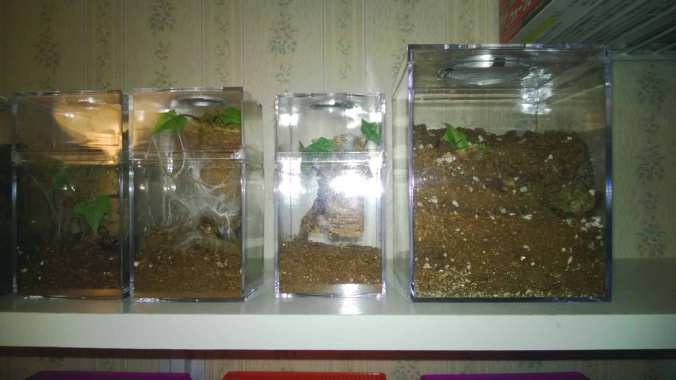
For slings and juveniles, Jamie also offers Spiderling and Juvenile Enclosure kits. These wonderful and affordable cages come with all of the fixings (substrate, moss, silk plant, cork, and water dish for the juveniles), and they are often offered as a package deal with a sling or juvie. I’m particularly enamored with the spiderling kits, as the offer great visibility and seem to limit the chance for escape when opening for feeding. When buying from Jamie’s, I also find it incredibly convenient that I can get my sling and the enclosure at one place.
Spiderling and Juvenile Enclosures from Jamie's Tarantulas. These are sold as kits with all of the fixings.

Spiderling and Juvenile Enclosures from Jamie’s Tarantulas. These are sold as kits with all of the fixings.

Exo Terra Nano Glass Terrarium

Various sizes /Retail: $34.99-$67.99

These all-purpose terrariums are gorgeous, and with prices starting at $34.00 (or even less expensive if you catch them on sale on the Petco website). The black framing looks very sharp, as does the foam faux-rock background. These tanks also offer two ways to access them, with both a front door and a removable screen top.

It should be mentioned, these are not designed exclusively for tarantulas, and some models suffer from some design issues that make then less than ideal. For example the unique venting system beneath the door prevents owners from packing in more than a couple inches of substrate in the bottom. With 5 or more inches of space between the top and the substrate, a plump climbing terrestrial T could fall and injure itself.
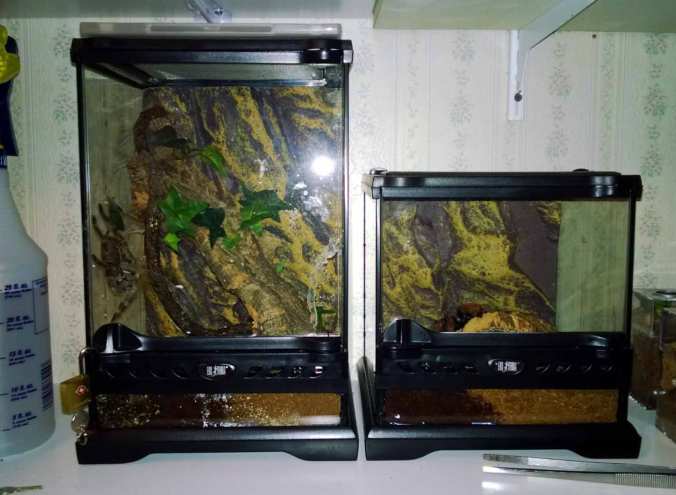
An Exo Terra Nano Tall (left) and regular 8 x 8 x 8.

An Exo Terra Nano Tall (left) and regular 8 x 8 x 8.

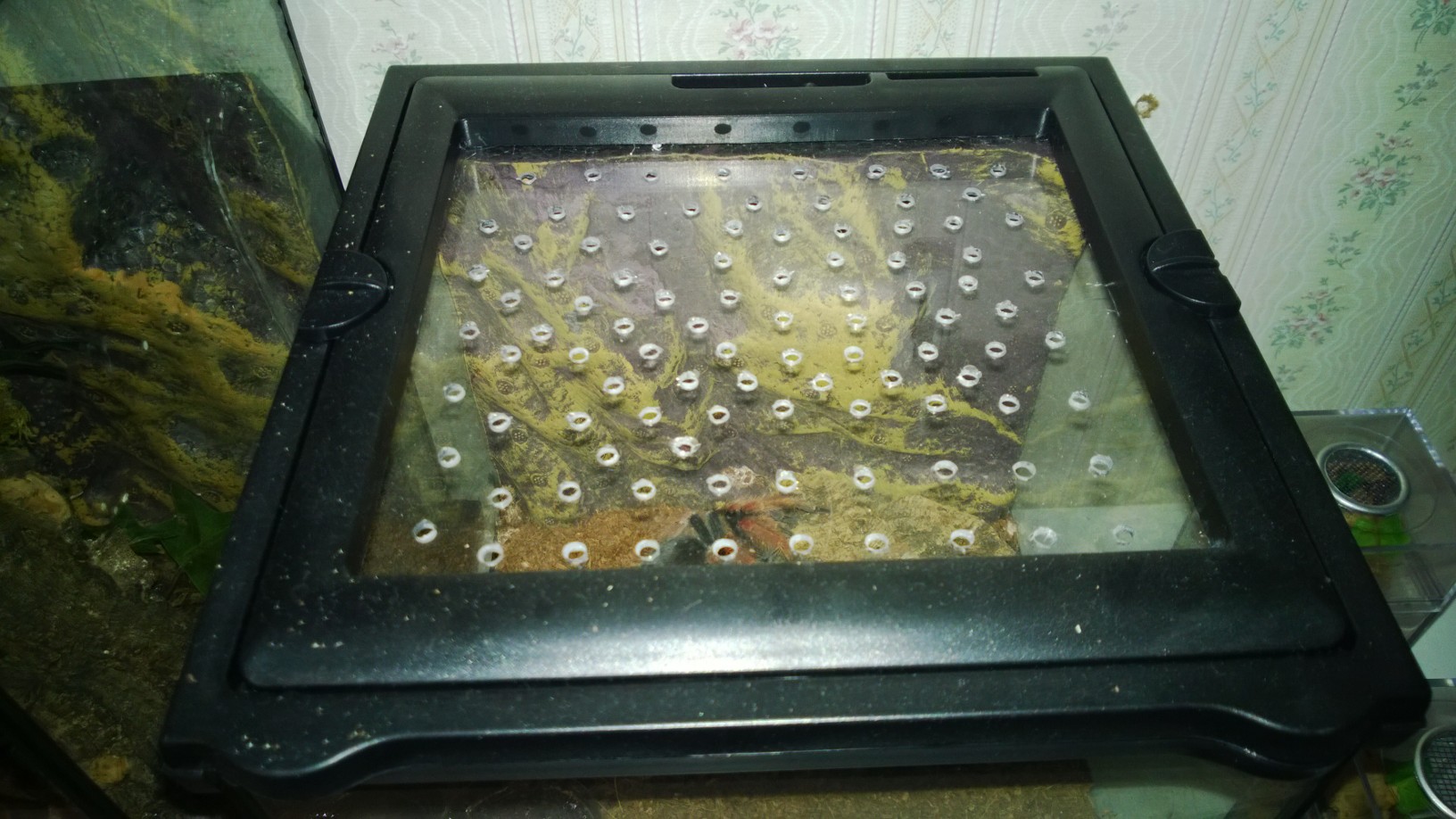
Also, the screen top can be a problem for terrestrial Ts whose legs can become stuck in it. To combat this issue, the cage top can be altered by ripping out the screen and replacing it with Plexiglass with several breathing holes drilled into it (see below).

CAGE Exo top

The top of a Exo Terra Nano, modified for a terrestrial T. The screen has been removed and replaced with ventilated Plexiglas.

The Exo Terra Tall, on the other hand, makes a fantastic home for an arboreal with no modifications. The 8″x8″x12″ tall enclosure is the perfect size for a medium arboreal species, and makes for a stunning display. For species that require a higher humidity, you can block off part of the screen top with saran wrap or plastic (as I have done with the one housing my P. vittata), to slow evaporation. And, for a T who may get 7″ or longer, the larger Exo Terra Mini Tall (12″x12″x18″) will do. These larger models feature two opening doors, which can make cleaning or feeding faster species a bit easier.

Kritter Keepers/Pet Keepers (both trademarked and generic)

Various sizes / Retail: $3.99-$19.99

These clear plastic containers with colored plastic lids are produced by several different companies, come in many different sizes, and are made to house small animals including hermit crabs, fish, reptiles, and insects. They also happen make quite good homes for tarantulas and have become a staple for keepers looking for attractive, low-cost enclosures.

Medium Sized Kritter Keeper/Pet Keeper. I use these to house my juveniles.

Medium Sized Kritter Keeper/Pet Keeper. I use these to house my juveniles.

These nifty little cages are great for burrowing Ts due to their depth, and the covers have wonderful little windows on the top that double as a feeding hatch. They can be found online through Amazon and Petco.com (Once again, Petco’s sales and free shipping can really make these a steal), and Walmart even carries the medium sized cages in their fish section.

As for cons, there are only a couple issues. First, larger holes where the handle connects to the lid, and another round hole meant for running tubing, can both be potential escape routes for small and determined Ts. It’s best to fill these three holes up with a little hot glue before using the enclosure. Also, because the entire lid is vented, water and moisture will evaporate quickly in the winter months. To combat this issue, use plastic wrap and tape to close of some of the vents.

Sterilite Plastic Storage Containers

Numerous sizes / $1-$15

The go to enclosure for T enthusiasts with huge collections. These plastic containers come in just about every imaginable size, and they are generally quite inexpensive, with many of the larger sizes going for less than $3. Sterilite even makes a set that locks securely and is designed to stack (see photo below).

To make the ventilation holes in cages meant to house slings, there are a couple alternatives. The easiest is to use a soldering iron (the one I use was about $10 on Amazon, and has been a dream). The tip of this iron comes to a conical point, meaning that you can use various levels of pressure to make any size hole you need. I can use just the tip to make tiny holes for small spider enclosures, or use more pressure to make up to .24″ holes for larger ones.

A more time-consuming way to create the holes is to heat a very small nail on an oven burner, pick it up with pliers and use it to melt holes through the plastic. I will actually use several nails on a burner so that I always have a hot one ready. You can usually put three to five holes in before having to trade nails. A word of caution: make sure to have adequate ventilation, as the plastic fumes can be dangerous.

For cages meant to house larger Ts, a power drill is the easiest and fastest way to perforate the plastic for ventilation. When positioning holes I try to create cross ventilation by putting some holes lower on one side and higher on the other.

A Sterilite plastic container modified to house tarantula slings.

A Sterilite plastic container modified to house tarantula slings.

 For a step-by-step tutorial on how to create a custom enclosure using Sterilite containers, click!

Mainstay Plastic Canisters

2-Quart and 1-Gallon Sizes / $1.99-$3.99

I love these plastic canisters. The 2-quart size is perfect for juvenile arboreals or terrestrial burrowing species. These inexpensive plastic jars can be found at any Walmart, and are easily ventilated using the hot nail method. As I wanted adequate ventilation, I used a 2″ hole saw and aquarium silicone to put a 2″ inch vent in the lid.
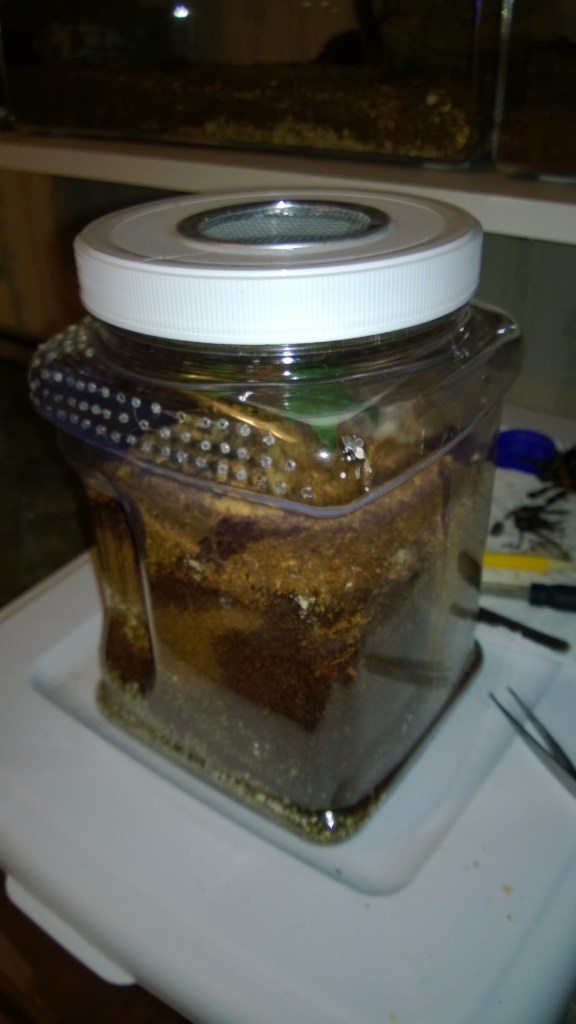
Plastic canister modified with lid vent and side ventilation holes.

Plastic canister modified with lid vent and side ventilation holes.

Ziploc or Tupperware Plastic Containers 

Various sizes / small 3 for $3.57 / medium 2 for $2.57

There are dozens of these types of containers on the market; I just happen to prefer the Ziploc Twist ‘n lock for the wonderful screw on caps. Like the other plastic containers, these can be vented using the hot nail method. The small containers are perfect for terrestrial slings, and the taller medium sized ones are great for arboreals in need of climbing room.
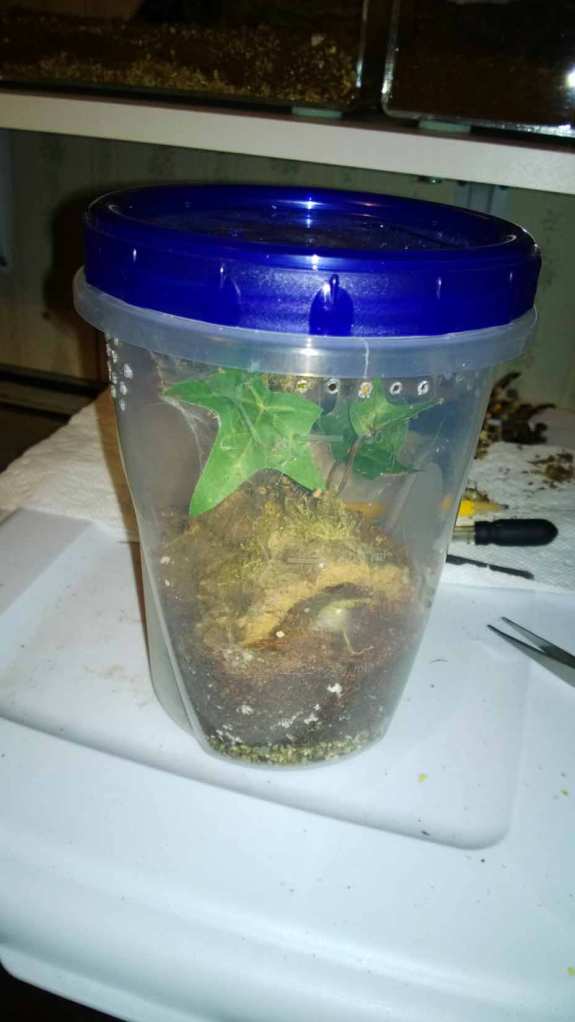
Ziploc container modified to house arboreal tarantula.

Ziploc container modified to house arboreal tarantula.

At the time of this blog, I have several other containers that I will be altering and trying out as enclosures, and I will surely add to this list as I discover new possibilities.

Also, I should point out that I did not include two of the most popular enclosures used by hobbyists. Clear plastic pill bottles and plastic deli cups are immensely popular due to their very low cost and practicality, and many keepers swear by them. It just so happens that I currently use neither, as I prefer Jamie’s spiderling enclosures. However, as my collection grows, and I get into breeding, this is likely to change.

For a comparison of some Tarantula sling enclosure alternatives, click away!

Pterinochilus murinus or OBT

The P. murinus is quite infamous in the tarantula keeping hobby. Referred to by the common nickname, OBT (which can stand for “Orange Baboon Tarantula” or the slightly more colorful “Orange Bitey Thing”), this gorgeous and hardy tarantula is known for its blinding speed, potent venom and highly defensive disposition. Unlike other Ts who would rather run than throw up a threat pose, OBTs are known to stand their ground, slapping with their legs and striking in all directions when agitated.

OBTs are said to be one of the easiest tarantulas to breed and, as a result, they are quite inexpensive and common in the hobby. Most dealers carry the .5+” slings for $20 and under, and several will give out P. murinus slings as freebies. Folks who find themselves a recipient of one of these tiny, bashful chocolate brown slings will soon find themselves in possession of a bold orange ball of fury.

My P. murinus sling at about 1". Notice the chocolaty brown tones.

My P. murinus sling at about 1″. Notice the chocolaty brown tones.

Their care is quite simple, leading to some folks mistakenly (in my opinion) referring to OBTs as a good starter species. They prefer bone dry substrate and enough substrate in which to dig, and they are generally recognized as being near indestructible. I keep my three on dry coco fiber with small water dishes in the corner of the enclosure. I’ve never seen them drink, and my female especially likes to drop her boluses in her bowl.

Although this species is sometime called “semi-arboreal”, my three have constructed deep dens beneath the substrate. OBTs are normally prolific webbers, and they will often fill their cages over time with thick curtains of silk. A search on Youtube or Google will produce plenty of images and videos of industrious OBTs who have webbed up their entire enclosures. Although my sling is out most of the time, both of my juveniles have exhibited nocturnal tendencies, and I normally only see them out if I sneak down at night.

My juvenile male, about 2.75" taking a rare stroll outside of his den.

My juvenile male, about 2.75″ taking a rare stroll outside of his den.

All three of my OBTs are fantastic eaters, only refusing a meal when in premolt. In my experience, they have a medium growth rate, with frequent moltings but with less of a jump in size with each one. I purchased my sling at .5″ from Jamie’s Tarantulas in October of 2013, and it is now about 1.5″ after four molts. My juvenile pair, purchased from Arachnids RVA in December, have molted once each and are now just shy of 3″.

The sling is still quite skittish, choosing to run and hide if I so much as tap its enclosure. My juvenile female, on the other hand, has no problem throwing up a threat posture if she gets caught out in the open (see video up above!).  Still, she would much rather disappear into her burrow if afforded the opportunity. OBTs are old world tarantulas, meaning that their main defense when threatened is to bite. I don’t doubt that either of my pets would use his or her fangs if threatened.

My famale OBT standing outside of her den (it's a rarity to catch her outside)

My famale OBT standing outside of her den (it’s a rarity to catch her outside)

With its brilliant orange coloration and yellow starburst pattern on its carapace, the P. murinus is, in my opinion, easily one of the most beautiful tarantulas available. Its hearty constitution, ease of care, and availability also make for an enticing package. However, this is a fast animal, moving much more quickly than human reflexes can react to. And, being a defensive old world species, it will not hesitate to bite. A quick search of OBT bite reports should make it very apparent that this isn’t a creature you want to get tagged by. Keepers who purchase this animal because they are amused by its ornery personality and dramatic threat displays and want to show their friends are really keeping it for the wrong reason.

Although there are exceptions, most new keepers or first-time T owners would find the P. murinus to be a bit overwhelming to own. The message boards are full of posts by P. murinus owners who are terrified of their animals. Rehousings, cleanings, and feedings all have to be conducted with a great measure of care and concentration. Those new to the hobby or unaccustomed to faster-moving tarantulas could soon find themselves with a pet they are ill-equipped to deal with.

Poecilotheria vittata (Ghost Ornamental)

Possibly the most exotic and beautiful of all the genera of tarantulas, in my opinion, is Poecilotheria. These large, graceful, lightning-fast arboreal tarantulas originate from India and Sri Lanka and are known for their lithe, athletic builds and amazingly striking patterns and colorations that make them experts at camouflage.

My female P. vittata (upper right) using it's amazing camouflage to blend in with it's surroundings in the classic pokie pose.

My female P. vittata (upper right) using it’s amazing camouflage to blend in with it’s surroundings in the classic pokie pose.

Although quite beautiful and striking, Poecilotheria possess a combination of speed and a higher venom potency (per bite reports) that make them more of an advanced species (or one for the the cautious and aware keeper). It has been said that the the speed of a Pokie, as enthusiasts amicably refer to them, must be experienced to be truly appreciated. A keeper used to working with slower species might find himself ill-prepared to deal with a 9+” spider that can be out of its cage and on your arm faster than you can blink.

Still, those experienced in keeping these amazing creatures adore them for their beauty and elegance, and argue that, for the experienced keeper, they are a most rewarding animal to keep. The majority of the species in this group can be described as more secretive and skittish than aggressive, and many will resort to sitting still and using their natural camouflage to hide them as a first line of defense. A keeper who is aware of his animal, its habits, and its location, and who avoids spooking it, will likely have little problems.

When selecting my first pokie, I hit the message boards, reading first hand accounts from those who had successful kept Poecilotheria for years. As this was going to be my first pokie, I specifically wanted one of the species known for being “calmer” and less prone to be defensive. P. regalis and P. vittata were both mentioned repeated as good beginner pokies, so I kept my eyes open. When Ken the Bug Guy offered a 3″ female P. vittata on his site, I jumped at it.

When she arrived, I was pleasantly surprised to discover her to be a full 5″ (Ken often gives his customers a bit of a size upgrade). As I wanted this T to be one of my display tarantulas, I purchased an 8″x8″x12″ Exo Terra Nano for her, along a water dish, a cork bark slab, and Flukers bendable vines to create some more hiding areas. I arranged the tank in such a way to give her several places to hide and to feel secure. Although I keep the substrate mostly dry, I overflow the water dish a bit each time I water her, and let it dry out in between.

Because the screen top of the Exo Terra provides a lot of extra ventilation, I keep the substrate partially damp and the water dish full. The evaporation of water from the wide water dish keeps the enclosure from drying out too much without the need to spray and unnecessarily disturb the T.

My P. vittata hanging out on the side of her enclosure after a meal.

My P. vittata hanging out on the side of her enclosure after a meal.

My P. vittata is an excellent eater, and I always get a thrill when I see her perk up from wherever she is hiding after sensing a prey item nearby. Often when she hunts, I get glimpses of her blinding speed as she pounces for the kill. Besides keeping the humidity in her enclosure a bit higher than I do for many of my other Ts, I also have to do a bit more maintenance than usual. As arboreals often do, my vittata frequently shoots her feces around the enclosure, hitting the glass and producing some rather unsightly white drips and spatters. These can be carefully cleaned off with wet paper towels (no cleaner).

My P. vittata settling down to enjoy a fat cricket.

My P. vittata settling down to enjoy a fat cricket.

Before cleaning or feeding, I will tap the enclosure a couple times to “warn” her that I am coming. This will cause her to hide and hunker down wherever she is at, allowing me to carefully open the cage to drop in a cricket or to clean. If she is at the front door when I want to open up, I wait until she is in a more safe location at the back of the tank.

My P. vittata quickly became one of my favorite Ts. She is just gorgeous to look at, and spends much of her time out in the open for us to admire. When she does hide, my family and I enjoy trying to see how quickly we can pick her out of her surroundings. I am very much looking forward to her next molt and watching as she develops her striking adult coloration. At a max size of 7+ inches, she is sure to grown into a beautiful showcase tarantula.

A ventral shot of my P. vittata spread out on her enclosure door.

A ventral shot of my P. vittata spread out on her enclosure door.

However, having seen how quickly she can move, and understanding that a bite from this species would be VERY unpleasant, I completely recognized why Poecilotheria are considered to be an advanced species. This is not an animal to be trifled with, and it deserves not fear, but a healthy measure of respect and attention.