If I Knew Then What I Know Now -Tarantulas FAQ

Or, the very basic information every new tarantula keeper needs to know.

Anyone who has followed my blog or YouTube page has likely heard me talk about the first tarantula I ever acquired. About 20 years ago, after being an arachnophobe for my entire life, I decided that I would get a tarantula to help me get over my irrational fear. This was an animal that fascinated me as much as it terrified me, and I was hoping that handling a big, hairy spider would be an eventual cure. Finding one for sale in the Bargain News, I drove to a fellow exotic pet keeper’s home to procure my new pet. $20 later, I was the proud owner of Grammostola porteri (which I knew only as a “Rose Hair” tarantula). Although I had several dozen snakes at the time, this fluffy little spider was the biggest “oddity” in my collection, and folks often asked to see her when they visited

The fact that this tarantula survived all of my husbandry missteps and general arachno-ignorance those first few years (there wasn’t a lot of great information back in the mid-’90s!) is a testament to just how hardy this species is. Every mistake that could be made, I likely made it, and I truly feel terrible for my poor girl … hence why she has a fancy cage kept right in the center of my vast collection now!

I spend a lot of time talking to new keepers, and when I get asked questions that they think might be foolish or obvious, I try to point out that it really doesn’t feel like that long ago that I had the very same questions. We all start somewhere and, for some of us, many mistakes were made along the way. After doing some reminiscing about my beginnings in the hobby, I thought it might be fun to put together a list of some of the information I wish I knew back then along with some anecdotes about by own missteps and misinformation. With any luck, this will be a fun and informative way for those new to the hobby to learn some basic information about these fascinating creatures while I share some personal (and sometimes embarrassing) anecdotes. For those who are more established, perhaps you will have some stories of your own to add…

And now, things I wish I knew when I first started keeping Ts!

A tarantula on its back is not dead; it’s simply molting. I worry that this misconception has lead to much misery and more than a few dead spiders. During my first year keeping my G. porteri, I discovered her on her back one morning. I called my wife over, and we were both very upset that I had apparently lost my spider. As luck would have it, I had to go to work, so I left her in her enclosure with the full intent of burying her later. When I returned home that night, I opened her cage and stared in total confusion. Not only was my girl still alive, there were now TWO tarantulas in the enclosure!

Itabunae-post-molt

My L. itabunae just moments after fully casting off its old exoskeleton.

It took me a few minutes to realize that my T hadn’t miraculously spawned a duplicate a-la Gremlins; she had molted her exoskeleton. I had come dangerously close to burying my new pet alive. Sadly, I’m not the first keeper to experience this, and I’ve heard many horror stories about owners who mistakenly tossed their pets thinking them dead. When tarantulas molt, they turn onto their backs for the process. If you see your tarantula on its back, there is no need to panic. Sit back, relax, and enjoy one of nature’s most fascinating events.

Mature males live far shorter lives than females. The second tarantula I ever bought was an adult Aphonopelma seemanni that I acquired at a reptile convention. I took my new pet home, built him what I thought was an awesome enclosure with deep substrate, a pre-made burrow in florist’s foam, and a water dish. I put it in its new home and waited for it to acclimate and eat.

Well, it never did. Instead, it spent all of it’s time climbing the enclosure walls in a seemingly endless effort to escape. I couldn’t figure out what I had done wrong, and I worried that my husbandry was leading to his restlessness. My fears were seemingly realized when, several months later, my new pet curled up and died.

It was years before I stumbled onto an article about spiders that helped me to understand what really happened. My A. seemanni had been a mature male at the end of its life cycle. Many mature male spiders don’t eat ever again and spend all of their time wandering and looking for a female. At this point, they are on borrowed time; they will either be devoured by the female during copulation, or die of old age. A dealer had likely unloaded this specimen on me as it had either already bred or he didn’t have use for it.

Over the past several years, I’ve talked to many folks who were either sold a mature male, or had a sling mature into one and had no idea why it was restless and wouldn’t eat. This can be very upsetting to folks who blame their husbandry for nature taking its course.

There are major differences between Old World and New World tarantulas. For years, I thought that a tarantula bite was like a bee sting. Luckily, this wive’s tale didn’t end up biting me (no pun intended) in the can. At the same show I bought my A. seemanni at, a dealer was selling a magnificent and terrifying spider labeled “Thailand Black Tarantula.” This large ebony beauty was in a five gallon tank, and it was baring its fangs and spastically slapping at anything that moved (which, in this crowded show, was a lot). I was totally enamored with this animal, and came very close to buying it. Although my wife worried about it’s temperament, I assured her that if it did bite me, it would only be about as bad as a bee sting.

WRONG!

The fact is, HAD I bought that T, and HAD it bitten me, I would have been in for a very nasty surprise. As an Old World species, this tarantula’s bite was medically significant. Although the bite wouldn’t have killed me, I would have been in excruciating pain and suffered other complications like cramping, nausea, and vomiting.

New World species, or tarantulas from North America, South America, and the Caribbean islands, kick urticating hairs from their abdomens as a means of defense. These barbed, irritating hairs get caught in skin, eyes, and nasal passages causing extreme discomfort. New World species have weaker venom, and in many instances, their bites are about the same as a bad bee sting. However, the hairs can be just as nasty and effective.

NEW-WORLD-COMPARISON

Old World species of tarantulas (Ts from Asia, Africa, Australia, etc) on the other hand, lack the urticating hairs of their New World counterparts and will therefore use their fangs and more potent venom for defense. Although a bite from an Old World species won’t kill you, it can cause excruciating pain, dizziness, full body cramping, and nausea. Simply put, the can put a real hurtin’ on you. These fast ‘n feisty spiders demand a bit more caution and experience to care for.

I still talk to many folks who are new to the hobby that don’t realize that the “bee sting” comparison is a myth and don’t know the difference between New and Old World tarantulas. Even more disconcerting, I have many try to tell me that they’re not worried about being bitten by a T because it can’t kill them. Yikes. For those interested in learning more about tarantula bites, you can check out the article “A Word About Tarantula Bites”.

You don’t have to handle your tarantulas to be a “real” keeper. When folks find out that I have tarantulas, one of first questions they usually ask is, “do you hold them?” Back when I first got my G. porteri, my friends and family were constantly asking when I would handle her, and I’ll admit to feeling like a bit of a chicken for having never attempted it. After all, that was the point I got her, right?

Finally, the day came. Mustering up all of my courage, I sat her enclosure on my floor, opened it up, and set my hand inside. Using my other hand and a paintbrush, I carefully poked her back legs. With a speed I had never seen from her before, she wheeled around and latched onto the brush with her legs and fangs.

And this sudden violence, a feeding response most likely, shocked me so badly, that I actually passed out. Yup, like out cold.

I woke up a bit later, confused,light-headed, and slumped against the wall, to find my girl perched right at the lip of her enclosure almost as if she was laughing at me. I regained my composure, shooed her back into her cage, and decided that was the last time I would ever attempt to hold a tarantula.

Since that embarrassing experience, I’ve completely overcome my fear of spiders, and I’ve actually held a few of them without incident. However, I choose not to handle them anymore as they get nothing out of it and I know that if I get bit, I’m likely to toss the T, hurting or killing it.

Euathlus sp. red

Euathlus sp. red after she crawled out of her enclosure and into my hand. Note: I normally do not handle my Ts

Now, can you hold your pet? If you’ve done the research and have a tractable specimen, of course. However, handling is certainly not mandatory, and many serious keepers have a hands-off policy with their arachnids. I’ve spoken to many new keepers who seem to think that all “expert” tarantula keepers hold their animals, which is definitely not the case. It’s personal decision best left up to the responsible keeper to decide.

Care sheets and their “ideal” temperatures are total nonsense.  When I first acquired my G. porteri, I got a tri-folded care sheet from a convention that supposedly detailed the correct husbandry for this species. This document mentioned “ideal” temperatures in the 8os and (wait for it) humidity levels around 80%. Even worse, it suggested using heat lamps or heat rocks for added warmth and recommended spraying the T and its enclosure once a week.

Of course, this is a species that does well in temps in the mid 60s, so this ideal of 80 is nonsense. At the time, I didn’t realize that, so I used to keep the enclosure dangerously close to one of my snake’s heat lamps to keep it nice and warm. It was a minor miracle that I didn’t fry my poor spider doing this, as the heat could have very well have dehydrated my G. porteri.

Even worse, this guide made me think that I had to keep my spider moist, when in fact, this species abhors moisture. For a while, I kept half of the substrate in the enclosure moist, as I thought that this species needed high humidity. It was only after I noticed that she seemed to avoid the wet areas like the plague that I stopped the needless spraying and just started using a water dish.

As it stands, this bogus care sheet led to me accidentally torturing my poor spider with inhospitable conditions (although it could have been much worse). The fact is, generic care sheets usually do more harm than good, and anything mentioning “ideal” temperatures or humidity requirements should immediately tossed in the garbage. I would be willing to bet that many tarantulas are lost due to folks obsessing over false temperature and humidity requirements. Pet stores will often try to sell folks supplementary heat items, like lamps, heat rocks, and mats, and the fact is, these can prove deadly to tarantulas. In most cases, no supplementary heat is needed; they do fine at room temperature.

For more on temperature and humidity, check out “Humidity, Temperature, and Tarantulas“. Or discover more about why care sheets are to be avoided in “Tarantula Care Sheets – an Unnecessary Evil”.

When a tarantula buries itself, there’s no need for panic. Although I never had a problem with my G. porteri burrowing, this became a issue for me when I got my first slings. After about a month of watching my Lasiodora parahybana sling take down every prey item I dropped into its enclosure, I awoke one morning to discover that it had completely closed off the entrance to its den.

Was this purposeful? Had the den caved in? Was it dead? How would it eat?

As the days passed with no sign of my LP, my anxiety grew. I was convinced that the little guy was dead, and I even made the terrible mistake of trying to push a roach into the area I thought to be its webbed up its den entrance (something one should never do). I continued to keep a corner of the substrate moist, and just assumed that I had lost my first sling. Luckily, after a bit of research, I learned that this was normal behavior, and I decided to leave the poor thing along. Sure enough, about a month later, it reopened the mouth of its burrow and sat at the top, hungry and a bit larger.

The fact is, when a tarantula buries itself, it’s the T’s way of putting up the “Do Not Disturb” sign. This is a very natural occurrence, and the keeper just has to trust that their spider knows what it’s doing. It’s not buried alive, it’s not starving, it’s not dead … it just wants to be left alone for a bit. Still don’t believe me? Check out “Help…My Tarantula Buried Itself!”.

Tarantulas can be terrestrial, arboreal, or fossorial. Back when I first got into the hobby, I was heavily into snakes and attended many reptile conventions. At these events, there were always a few dealers who were peddling tarantulas with most displaying them in large terrariums to garner a bit of extra attention. I keenly remember that a few of the species seemed particular ornery as they sat in the center of barren enclosures on a couple inches of vermiculite, angrily slapping at everything.

I now realize that part of the problem was that many of these species were being kept incorrectly, either due to display purposes or just bad husbandry. Back then, I could remember dealers telling folks that all species do well in a 10 gallon aquarium with a couple inches of substrate. This one size fits all approach to tarantulas was of course quite wrong.

I now know that there are three basic types of tarantulas.

Terrestrial tarantulas live on the ground and do well with a few inches of substrate and a hide (often a piece of cork bark). It should be noted that many terrestrial species will burrow as slings, but will outgrow this behavior and stay out in the open as they mature.

Fossorial tarantulas live in burrows under ground. These species need deep substrate to construct their homes, and do not need to be offered hides as they will dig their own. Many fossorial species will spend the majority of their time underground, proffering their keepers only glimpses of their front legs as they wait for prey.

Arboreal tarantulas live off the ground in trees in their natural habitat. These species need more height for their enclosures and branches or cork bark to climb on. For most, substrate depth isn’t important as they will spend the majority of their time on the decorations or walls.

In the same vein, there are also arid species that require dry substrate and moisture-dependent species that need moist substrate to thrive. A keeper who does his or her research will be careful to consider all of these factors when setting up a proper home for a new spider.

Tarantulas are amazing escape artists. This one almost bit me in the butt with my A. seemanni. The first tank I put her in was meant for fish, so the acrylic top had a smallish hole in it for a filter. Considering that this tarantula was about 5″ long, I figured there was no way he could fit through the hole.

Boy was I wrong.

While at work, I got a frantic call from my mother who was babysitting my son at my apartment. Mom was terribly arachnophobic, and it took a lot of convincing to get her to come to my home because of the spiders. Well, while she was there, my A. seemanni squeezed out of the hold and was sitting right on top of the enclosure when she entered the room. She grabbed her keys and my son and refused to come back.

Although the story is quite funny now, this oversight on my part could have led to the death of my spider. The fact is, these animals can squeeze through any gap that will allow their carapaces to fit through. They are also quite strong and able to lift up the corners of unsecured tank tops. Do you have a fancy enclosure with wire mesh vents? Well, you might want to replace them as tarantulas can chew right through them with little effort.

When choosing a home for your new acquisition, it’s always important to make sure that it is secure enough to adequately contain your new ward.

chewed-vent

A wire mesh vent that my L. itabunae nearly chewed completely through.

Tarantula common names, although sometimes cool, are often quite useless. For years, I referred to my G. porteri as my “Rose Hair” or simply my “rosie”. I was used to referring to my pets by breed names, like labrador retrievers, pit bulls, etc for my dogs, or common names for snakes, like boa, corn, or king. It never occurred to me that I should ever have to learn the scientific name of anything.

Unfortunately, the hobby is rife with overlapping, inaccurate, or just plane bogus common names for the various species of tarantulas available. There are so many “bird eaters” and “striped legged” spiders currently available that it’s enough to make a person’s head spin. In some instances, species don’t have common names at all. The fact is, those truly into the hobby only use the scientific names when describing their animals. Most tarantulas dealers also list their stock alphabetically by scientific name, with many not including the common name at all.

Now, that’s not to say that there is anything wrong with using common names. It’s just with the amount of overlap and the fact that some are literally made up by dealers, the best way to accurately identify a tarantula (or theraphosidae) is by their scientific names. Those interested in learning a bit more about scientific names can check out “Tarantulas – The Importance of Learning (and Using!) Scientific Names”.

Tarantula can drink just fine out of water dishes. For the first several months I kept my G. porteri, I had a chunk of natural sponge in its water dish. After all, I was told that tarantulas couldn’t drink from just a normal dish, and that they needed a sponge to “suck the water out with their fangs.”

I can’t even begin to explain how embarrassingly wrong this is.

First off, tarantulas have mouths to drink and eat. Their fangs are meant to inject venom, not to suck up water like two pointy straws. Trust me, I’ve seen mine drink directly from their water dishes many times. Secondly, sponges are incredibly unsanitary and will soon turn a water bowl into a veritable petri dish of bacteria. They serve no purpose in a tarantula’s home.

This hobby is ridiculously addictive. If you’ve been keeping tarantulas for a while, this needs no further explanation. If you’re brand new to this amazing hobby, consider yourself warned…

Did I miss anything? What do you wish you knew before getting into the hobby? Please, chime in using the comments section!

Tom Patterson – Dealer/Breeder Review (100% Positive!)

Possibly the best tarantula ordering experience I have ever had.

My new N. tripepii female courtesy of Tom Patterson.

My new N. tripepii female courtesy of Tom Patterson.

When people order tarantulas online, they generally go to the major vendors. Folks like Jamie’s Tarantulas, Pet Center USA, and Swift’s Invertebrates have stellar and well-deserved reputations for carrying a variety of stock and for their dependability and professionalism. The fact is, when buying and shipping living animals, you want to make sure you order from the best. Due to the volume of animals these larger dealers move, there are always plenty of glowing reviews to read if one does just a bit of research, and their names quickly come up in any search for those selling tarantulas.

However, what often gets overlooked is that there are many awesome breeders out there who have been in the business for a long time and who offer great service with spectacular deals. Some of these same dealers are the ones who supply stock to the “big name” vendors as well. Unfortunately, these folks can be a little more difficult to find, especially for those new to the hobby who don’t know where to look.

Tom Patterson (aka “Philth” on Arachnoboards) has been in the business for a long time, and he has a sterling reputation. Although I’ve come close to ordering from him many times due to his propensity to carry some of the more unique species I’m looking for, I didn’t pull the trigger until recently when I saw that he was selling some Vitalius paranaensis juveniles for a great price. After going through his recent price list, I found that he had several species I was interested in, and that it was finally time to place an order from him.

Boy, am I glad that I did.

Tom carries a good variety of tarantula species, including many that he breeds and produces himself. Those into other inverts will also find some cool arachnids, like trap doors and true spiders, as well. As far as tarantulas go, he has a good mix of some hobby staples, like G. pulchripes, Hapalopus sp. “Colombia large”, and P. cambridgei as well as unique and hard to find spiders like V. paranaensis, P. crassipes, and Aphonopelma crinirufum . For folks looking for larger sexed specimens, he regularly posts young adult females for sale as well.

His prices were great, with the $25 P. crassipes slings, $50 4″ Sericopelma sp. “Santa Catalina” juveniles, and the $50 3″ P. muticus juveniles really jumping out at me. I also grabbed up a 5″ Nhandu tripepii sexed female, as I had been eyeing this species for a while. Tom doesn’t currently have a website, but instead periodically lists his stock on the For Sale section of Aracnoboards or in the Captive Bred Inverts – Classifieds on Facebook. Ordering was simple; I emailed him a list of the species I wanted to order, and Tom responded immediately with a Paypal invoice. Tom’s communication was excellent, and all of my emails were answered within an hour.

My new L. crotalus being rehoused. This unique species was one of FOUR freebies.

My new L. crotalus being rehoused. This unique species was one of FOUR freebies.

Because weather in my area was quite cold, we both decided it would be in the best interest of the animals to wait to ship until we got a few days of higher temps. During the wait time, I asked to add another spider to my order, and Tom was happy to accommodate me, quickly sending me a new invoice. When it looked like we’d get a stretch of warmer temps, Tom contacted me immediately to arrange shipping. He was happy to have my package held at my local FedEx facility (in fact he encouraged it), and my spiders were shipped overnight promptly.

What an amazing box of spiders.

All of my new animals arrived safely and in great shape. The box was foam lined and contained a heat pack, and each of the spiders was packed in its own vial, which was wrapped in multiple layers of newspaper, then cushioned with packing peanuts.

And, what could make this transaction even sweeter? How about FOUR freebies. FOUR. For those who watch the video above, my shock is genuine. I’m used to getting some of the “give-away” species like LPs and B. albos, but what he included was unreal. Added to my order was a 3″ P. muticus, an L. crotalus juvenile, a Lampropelma sp. “Borneo black” sling, and a Phlogius sp. “Eunice” juvenile.  What was already going to be one of the coolest boxes of spiders I’ve ever received was just made twice as cool by the awesome freebies.

Just WOW.

3" P. muticus juvenile rehousing.

3″ P. muticus juvenile rehousing.

Take the chance and order directly from breeders

My experience ordering from Tom Patterson was utterly perfect. Even if you took out the extra four (again FOUR) freebies, this would still be an excellent deal and transaction all around. Great selection, prices, communication, and packing made this purchase and amazing experience. There isn’t a doubt that I’ll be ordering from Tom again in the future, and I would encourage anyone looking for tarantulas to check out his listings.

NOTE: To view Tom’s Arachnoboards Classifieds posts, you have to be a member and signed in. If the link doesn’t open, I would encourage folks to create an account if only just to be able to view the For Sale/Trade/Want to Buy section. I will also be blogging his price lists whenever he posts one.

http://arachnoboards.com/threads/theraphosids-mygalomorphs-true-spiders.280239/

Facebook: https://www.facebook.com/tom.patterson.351?fref=pb_friends

Tom’s Current Price List:

Thereaphosidae spiderlings

Aphonopelma cf burica “blue chelicerae” (AKA Aphonopelma crinirufum )
1″ $40.00

Augacephalus ezendami
2″ $30.00

Chaetopelma olivaceum
1″ $25.00

Cyriocosmus bertae
1/8″ $20.00

Grammostola pulchripes
2″ $30.00

Heterothele gabonensis
1/4″ $25.00

Kochiana brunnipes
1/8″ $15.00

Lampropelma sp. “Borneo Black”/Phormingochilus sp. “Borneo black”/ Lampropelma nigerrimum arboricola
3/4″ $25.00 each

Pamphobetues fortis
3″ $50.00

Pelinobius muticus
3″ $50.00 each

Phlogius crassipes
1″ $25.00

Phlogius sp. “Eunice”
2″ $45.00

“Phrixotrichus” scrofa ( Paraphysa scrofa)
1″ $20.00

Poecilotheria smithi (suspected males)
4″ $60.00

Psalmopeous cambridgei
1″ $20.00

Pseudhapalopus spinulopalpus
1″ $40.00 each

Sericopelma sp.”Santa Catalina”
4″ $50.00

Vitalius paranaensis
2″ $50.00

Thereaphosidae females

Hapalopus sp. “Columbia large”
3″ $85.00

Heterothele villosella
3″ $75.00

Nhandu tripepii
5″ $179.00

Poecilotheria tigrinawesseli
5.5″ $200.00

Mygalomorphae

Cyclocosmia torreya
1.5″ $40.00 each

Macrothele calpeiana
1/4″ $30.00 each

Araneomorphae

Africactenus poecilus
Hatchling $10.00 each

Ctenidae sp. “Cameroon Red Fang”
1″ well started taking crickets $25.00 each

Cupiennius salei
Hatchlings $25.00

Heteropoda hosei
1″ well started taking crickets.$25.00

Heteropoda sp. “burgundy”
1″ well started taking crickets $25.00

Heteropoda sp “Sumatra violet”
Hatchlings $15.00

Kukulcania hibernalis WC females
2″-3″ $19.00

Viridasius sp.”Madagascar”
Hatchlings, taking crickets $25.00 each

Terms of Service
Live Arrival Guarantee
Purchase price must be over $25. Payments accepted , Paypal ( Tompatterson77@gmail.com ) or Postal money orders. Shipping is $40 overnight FedEx only. Live arrival guaranteed. You must accept package on first delivery attempt. Temperature must be below 90°F or above 40°F. Must be 18 or older to purchase. U.S. sales only.
Refund Policy
Issues with shipment must be reported to me via (email, phone, Facebook) by 8 PM the night off delivery. Photo’s of DOA’s must be provided, or the deceased animal must be shipped back to me within 24 hours of receiving the package, at the purchasers expense. Refunds are money back without shipping cost reimbursed, or replacement spiders of equal value shipped at the purchasers expense. Not responsible for carrier delays. Freebies do not fall under the LAG

Tarantula Controversies #1: The OBT as a Beginner T

Recently, I sat down to write an article about some of the divisive, hot-button topics that dog the tarantula hobby and often ensnare uninitiated keepers in heated debates. These are subjects that new hobbyists are often interested in learning about, but an internet search or an innocent forum query produces two equally heated and opposing answers. My hope was to present both sides of these gray-area arguments so that keepers could develop their own informed opinions.

Please take a moment to participate in the poll above. Thanks!

As this feature took shape, it was apparent that there were enough of these topics that to try to cover them in one blog post would prove daunting (not to mention provide for a particularly long-winded blog post). The logical decision was to instead cover these topics as a series, focusing on one issue at a time. And, I could think of no better way to kick off this feature than by starting with one of the most incendiary topics in the hobby today…

Should OBTs be kept by beginners?

AOBT

Background

Like politics, climate change, taxes, gun control, or any other hot button issues sure to spawn heated debates, the subject of OBTs in the hands of beginners is perhaps one of the most divisive and incendiary topics in the hobby today. At least once a week, some unsuspecting newcomer will start an OBT thread on Arachnoboards that quickly de-evolves from a constructive discussion to ruthless one-sided admonishment replete with petty name calling. Things heat up so quickly when this infamous animal is mentioned, that threads have been known to hit several pages in an hour.

Talk about a popcorn thread.

When I first got seriously into the hobby and was spending the majority of my free time researching which tarantula I might want to get next, I stumbled upon a blog post titled “Top Ten Beginner’s Tarantulas”. As it was currently the top site to come up with my search, I assumed that the blog must be a fairly reputable source. Although the majority of this article listed spiders I had already read were good beginners, #10 on the list was one I hadn’t encountered before…an OBT.

The Pterinochilus murinus was a stunning orange tarantula, and I was immediately fascinated by this gorgeous animal. Although the author of this list mentioned that this species was an Old World with a “bad attitude and dangerous venom”, the majority of the post detailed the ease of husbandry and hardiness. This spider immediately shot to the top of my wish list, and I set off to do some more research on it. Had I not spent the next several days scouring the boards for more info about this species, I might have immediately hopped over to Jamie’s tarantulas and snatched up a couple of the slings she had for sale.

However, a quick search revealed that this was a bit more than a spider with a “bad attitude”; in fact, this animal was literally infamous for its vicious temperament, blinding speed, potent venom, and propensity for biting. A quick review of Arachnoboard’s Bite Report section convinced me that this was a spider not to be trifled with. It didn’t take me long to determine that I wasn’t ready for the feisty beauty affectionately referred to as the “Orange Bitey Thing”.

Not all newer keepers wait to acquire this fascinating and notorious T, and this can prove quite problematic to hobbyists that consider this  species to be an “expert-level” spider. They believe that the P. murinus is potentially dangerous tarantula that is best kept in the hands and collections of seasoned keepers. However, not all agree with this assessment. On the other side of the fence, hobbyists argue that this species is okay for beginners. Although this used to be an argument favored more by folks newer to the hobby, I’ve seen at least one reputable breeder and several experienced hobbyists come out in support of this idea. Below are the arguments and counter arguments and how they usually break down. For clarity, stances supporting OBTs for beginners will be in GREEN; stances against will be in RED.

The Arguments

Ease of care is what defines a good “beginner” tarantula, and there is none easier than the OBT  The P. murinus is widely recognized as one of the hardiest Ts on the market. They do well set up as terrestrials or semi-arboreals, meaning they can adapt to just about any enclosure type. They have no moisture or temperature requirements and thrive on bone dry substrate; many folks don’t even give them water dishes due to their propensity to web them over. OBTs eat well and grow fast, meaning your precious spider will be out of its fragile sling stage quickly. Finally, they are readily available in the hobby and quite inexpensive, which makes them a great, low-risk introductory spider.

As for the OBT’s legendary and unpredictable temperament, some argue that the notoriety it receives for being hyper aggressive and fast actually renders them predictable. Informed newbies who acquire this animal will have already heard scores of stories about its nasty nature and will likely be overly cautious when working with it. Although this spider is more of a handful than other beginner tarantulas, a bit of caution and common sense would go along way. For those just getting into the hobby, this would be a great hands-off introduction to tarantula keeping.

Temperament MUST be considered when choosing a beginner tarantula, and the OBT’s attitude renders it inappropriate for a beginner. Folks in this camp tend agree that there’s more to a good “beginner level” tarantula  than ease of husbandry. Although the OBT is an undeniably hardy tarantula, with many joking that they can thrive if kept on shattered glass for a substrate, their temperaments, speed, and venom potency render them potentially dangerous in the hands of people who don’t have a lot of experience keeping tarantulas.

Although ease of husbandry is definitely a priority, temperament should also be a consideration, especially for species packing medically significant bites. A mistake with a docile tarantula, like a Grammostola or Brachypelma, could lead to a bite that is little more annoying than a bee sting; a mistake with an OBT could lead to a hospital visit. Bites from this species can lead to excruciating pain, nausea, cramping, and other unpleasant symptoms in a full-grown adult.

Transfers are also a major part of husbandry, and this is an area where OBTs can be their most troublesome. Escapes are a major concern for those working with tarantulas, and a keeper not used to these spiders’ sudden speed bursts often experience the panic of suddenly having a large spider on the loose in his or her home. For slower New World terrestrial species, this isn’t as much of an issue as they are usually easily cupped and returned to their enclosures. As for the OBT, these speedy little devils can be a nightmare to wrangle.

With proper research, and new keeper can prepare to correctly care for an OBT.  Any responsible hobbyist is sure to do adequate research for any species he or she is looking to acquire, and it’s no different with the P. murinus. Keepers new to the hobby can prepare to receive an OBT by spending some time researching this species. This research should include speaking to experienced folks, watching the YouTube videos illustrating their speed and attitude, and reading accounts from those who keep them. 

These folks also argue that NO ONE is ever really ready for a defensive and unpredictable species like the OBT, and even an experienced keeper isn’t necessary going to be any more prepared for an escape or a bolting spider than someone new to the hobby. After all, isn’t an experienced keeper who’s getting an OBT for the first time in the same boat as a newbie as neither has kept this species before? Experience is gained by doing, so the best thing to do before procuring this species is to read up and prepare.

Research isn’t enough; experience is necessary. On the other side of this debate are generally more experienced keepers and those newer to the hobby who feel that reading about a species is in no way the same as the experience garnered from actually keeping them. Many of these folks have been around long enough to see inexperienced keepers acquire this species only to later become afraid of it, and some have even acquired OBTs from folks who became terrified of them. Respect for any tarantula is necessary, but fear can can be dangerous to the keeper and the spider. This intimidation can lead to poor husbandry, as the keeper is unable to clean or rehouse their pet.

Keepers who have already worked with calmer species for a while will have honed basic skills like cleanings, feedings, and rehousings, which will make dealing with a spider that can be this defensive, fast, and unpredictable much safer. They argue that an experienced keeper getting a P. murinus for the first time might not have experience with that particular spider, but their hands-on experience with other species and an understanding of T keeping fundamentals will leave them much better prepared for mishaps.

Many keepers believe in the “Ladder System”, or the idea that people new to the hobby should work their way up to more advanced Old World species only after gaining experience by working with more docile New World beginner species. In this scenario, a keeper might start by keeping a “calm” species like a B. smithi or B. albopilosum before “graduating” to something a bit larger and more feisty, like an A. geniculata. After spending a couple years with these species, this keeper might then move to getting a beginner Old World, like E. pachypus or C. darlingi.

In this system, the keeper spends time working with tarantulas for at least a couple years as he or she develops the skills and instincts needed to successfully and safely deal with advanced species like the OBT. Proponents of this system argue that reading about spiders only gets you so far; the best knowledge comes from actually keeping them. They believe that inexperienced keepers that skip this step are setting themselves up for problems. For example, you wouldn’t give someone with only a few months of experience driving a moped a Ninja to ride; they would have to work up to the more advanced bike.

Obviously, many folks new to the hobby have kept OBTs over the years without incident, so it’s no big deal. Head to any online tarantula vendor to check out their stock, and you’re likely to find that they have plenty of P. murinus slings available for purchase (and at really low prices). The OBT has been a hobby staple for quite some time, and there’s a good chance that the majority of the hundreds, if not thousands, of slings sold each year are going to folks who are not tarantula keeping experts.

The fact is, for all of the alarm and condemnation when a newbie to the hobby procures this species, there really aren’t a lot of reports out there about a newbie losing, getting bit by, or being overwhelmed by his/her new pet. After all, if hundreds or thousands of these spiders are out there, there should in the very least be dozens of bite reports, right? In several instances, those who have been in the hobby for a while will eventually admit to acquiring an OBT early on and raising it without incident, seemingly debunking the theory that they are an “expert species”.

It puts the hobby at risk. For folks on this side of the fence, the issue also goes beyond the welfare of the individual keeper and spider; they feel that a well-publicized bite report could lead a species ban or a ban on tarantula keeping in general. In all likelihood, the majority of bites aren’t reported on public forums, meaning there is no way to tell how folks are handling this animal. However, many feel that all it would take is for one bite report to make the news in a sensationalized manner for the hobby to be put in jeopardy.

If we’re being honest, tarantula keeping is a bit of an eccentric, niche hobby. Anyone who has been in the hobby a while has gotten used to the strange, often judgmental looks when you tell folks that you like to collect giant spiders. And, as many people are very ill-informed about these animals, fallacious stories abound about deadly spiders capable of horrendous violence against their keepers and their unsuspecting families. One publicized trip to the emergency room could lead to a campaign to ban these animals by an over-zealous politician.

On a personal note, I live in Connecticut where it is already illegal to sell venomous animals (including tarantulas) in pet stores and at public conventions. Even worse, after the highly-publicized chimp attack in 2009, legislators proposed a bill that would have banned ALL exotic pets. Folks who worry about a partial or full ban on the hobby are not being alarmists; it could happen.

My $0.02.

Again, like many debatable topics, this topic really isn’t a black and white issue. If you’re a keeper who is still panicking because your spider has buried itself for a molt or who has never had to transfer a spider from one enclosure to another, you really should avoid the OBT until you have some more experience. I do feel that base experience is necessary before one attempts to keep an OBT, but I also feel the amount of experience needed is going to vary greatly from keeper to keeper. Are the majority of new keepers ready for an OBT? I’ve spoken to many over the years, and my experience tells me “no.” There are just so many basic skills necessary for this hobby that are much more easily mastered and perfected with slower New World species. However, there are those I have encountered who are more than ready, and do a great job transitioning well into keeping this feisty T.

Again, it’s not black and white.

I’ve seen many instances of new keepers announcing that they’re ready for an OBT only weeks after posting a  panicked cry for help because their T has flipped to molt. Or, they post that the transfer of their B. smithi was a total debacle, then later explain that the same thing won’t happen if they get a P. murinus. These are the types of alarming statements that raise the ire of more experienced keepers and get those OBT threads heating up…

Furthermore, I truly believe that if you’re taking to a public forum to ask if you are ready, the answer is most assuredly NO. As much as many folks would like to pretend that there are some set ground rules for who can get an OBT and when, that’s really not the case. Asking folks on a forum only evidences that the keeper is probably not ready for this animal and is looking for confirmation from other keepers (and believe me, that keeper will get it!). Ultimately, it’s up to the individual to make the responsible and informed decision as to if he or she is ready for this animal.

I do feel strongly that this is an species that should only be purchased by someone who, in the very least, has the basics of husbandry under control. This means, cleaning, recognizing common issues, feeding, transferring, and other common housekeeping aspects. As many accidents and escapes happen during rehousings, I believe that it’s particularly important that keepers have a practiced and safe system for transfers. Once you have the basics of tarantula keeping down and you’ve worked with a few species of spiders, then it might be time to consider some more advanced species.

Again, fear is dangerous in this hobby, and this species is one of the “scarier” spiders available. If you’re thinking of getting an OBT, but the idea of having one of these speedy orange devils scares you a bit, wait. Respect and caution is paramount when dealing with fast-moving defensive spiders; fear can lead to mistakes which then lead to a bite or a dead spider.

I do believe that some individuals are just more inherently capable of correctly caring for an OBT and dealing with its attitude without as much experience as others. That’s a fact. However, it’s not up to me or other keepers to determine who those folks are. I have noticed that many of the folks that post about getting one on the forums seem to be the ones I would rather not have them.

I also think that this species should be for adults only. There is also the very real issue of younger keepers who are still living at home acquiring this species. Although OBTs will not kill you with their venom, a bite from this species will definitely make an adult individual miserable. Now, imagine for a moment that one of these spiders escapes and ends up biting the family dog, cat, or a child in the house. By their nature, teenagers, can be a bit reckless. Heck, I used to be one, and I still marvel at some of the less-than-informed decisions I’ve made. Hop on YouTube and you can find a plethora of videos featuring younger keepers proudly displaying reckless behavior with their Ts, and more than a few featuring the OBT.

Obviously, there are likely some fine young keepers out there who innately possess the maturity and skills needed to safely care for this animal. However, I do think that parents need to be informed and a big part of the decision process for a teen who is looking to acquire a P. murinus, as a mistake could affect the whole household. In the very least, a younger keeper still living at home needs to do his or her best to inform parents or anyone else in the household about these animals so that a decision can be made as a family as to whether or not to keep one.

Final thoughts

The P. murinus is a gorgeous and amazing species of tarantula that I personally believe is a great addition to any collection. That being said, it’s notoriety as a vicious, unpredictable speed demon is well deserved, meaning that this is a species not to be trifled with. A quick glance at bite reports for this species illustrate that it is quick to bite, will bite repeatedly, and its strong venom can produced intense pain and lingering full-body cramping.

In other words, the OBT has all the makings for a really bad day.

That said, responsible keepers with a modicum of common sense and a basic understanding of tarantulas and their husbandry might be tempted to keep this unique an notorious spider. However, before any hobbyist, new or experienced,  brings one of these Ts into the home, she should ask herself, “am I ready?”

Bumba cabocla “Brazilian Redhead” Husbandry

A gorgeous beginner-friendly species.

B.-cabocla

When I first encountered this unique tarantula, it was known as the Maraca cabocla or “Brazilian Redhead”, and I was immediately enamored with its build (and, if I’m being honest, with its funny name). With its deep red carapace and long, lithe, tapered legs, it bore more than a passing resemblance to a true spider, and I wondered why this species wasn’t more prevalent in the hobby. While doing research on its husbandry, I discovered that information was rather sparse and often conflicting. Some kept it dry while others kept it moist. Some reported fast growth rate while other reported less frequent molts with modest size gains. I was fortunate enough to find tips from a keeper who had successfully bred this species to get me started. Having kept these guys for a while, and with several folks asking me about their care, I figured it was time to share some of my observations.

A hardy species offering some husbandry wiggle room.

I acquired my two slings about a year ago at about .3” or so. Both were housed in dram bottles with about 2.5” of moist substrate, and both quickly dug a system of complex tunnels straight down to the bottom. It seems if given the substrate depth, this species will dig. Over time, I allowed the substrate to dry out a bit and just periodically moistened part of it by carefully pouring some water down the sides of the bottles. Although I’ve heard some keepers report that their B. caboclas gravitated toward moisture, mine haven’t shown any preference for it. In their natural habitat, this species experiences a several months long dry period followed by a rainy period, so it seems to be physiologically equipped to deal with the two extremes.

My B. cabocla specimens have proven to be slower growers.  Both are currently kept at temperatures that range 72-76 in the winter and about 75-80 in the summer. Since I acquired them, they have both molted about three times each and are both just over 1” in size now. Both are now showing some of their adult colorations as well, which is quite cool. As tiny slings, I would feed them pre-killed baby crickets or pieces of mealworm. When still very small, my two specimens were not particularly voracious eaters; they would occasionally refuse meals when not in premolt and seemed intimidated by live prey. Once they put on a bit of size, they seemed to develop better prey responses. Mine now have no trouble chasing down small crickets.

I have spoken to a keeper who has experienced slightly faster growth rates with hers as she keeps it in warmer temperatures year round. As always, warmer temps will lead to faster metabolisms and growth rates, so it’s very possible that caboclas kept at higher temps will grow much faster than mine have.

A note about burrowing…

During the first winter that I kept my cabocla slings, both buried themselves, covering up the entrances to their burrows completely. In one instance, I was able to see the sling at the bottom of his burrow through the pill bottle. The other sling, however, covered up all openings, and it almost appeared that the tunnels had possibly collapsed. Now, I warn keepers all of the time not to disturb their spiders if they should bury themselves. After all, tarantulas know what they are doing, and if they suddenly disappear into their dens, you can bet that there’s a good reason for it. However, after three months of seeing no signs of life, I succumbed to my impatience and carefully dug through the sub to find the little guy. What I first mistook to be a shriveled corpse proved to be a molt; the actually spider, a bit larger now and obviously upset, popped out a moment later.

That’s the last time I don’t follow my own advice.

Now that the slings have put on a bit of size, I have moved them both to16-oz deli cups with a couple inches of substrate, cork bark for hides, and bottle cap water dishes. Both have taken to the hides and have done a bit of digging.

Temperament-wise, they have proven to be a bit skittish, often bolting directly to their burrows when disturbed. Once the largest of the slings hit the 1” mark, it began hanging out on the surface much more and seems a bit less likely to run when disturbed. It also has no problems chasing down and subduing small crickets, seemingly having outgrown its fear of moving prey. As far as the experience level needed for this species, I would think that it could easily be kept by someone new to the hobby as long as they were cognizant of it’s flighty behavior.

Check out one of my B. cabocla slings in the video below!

For those looking for a unique, beautiful, medium-sized T that’s tough as nails, the B. cabocla should definitely be a consideration. I’ve been seeing more an more of these guys on the market, and I’m hoping that they start getting the attention that they deserve.

Breeding Project: Poecilotheria Regalis

What better way to start the new year than with some breeding projects?

With many of my females maturing, it’s time for me to get going on some of the breeding projects I’ve been anticipating. First up is a pairing between my mature male and female Poecilotheria regalis. I was very fortunate that this male and female, purchased separately as a sling and a juvenile respectively, matured at about the same time. Although I was cutting it a bit close (the male had his final molt a couple months ago), everything eventually fell into place nicely.

Background

7" mature female P. regalis

7″ mature female P. regalis

The female was purchased as a 2.25″ unsexed juvenile about 22 months ago. Her last molt was on December 2, and since then I’ve fattened her up a bit with three large dubia roaches and a hissing cockroach.  She is currently about 7″ in length.

6.5" male P. regalis

6.5″ male P. regalis

The male was purchased about 14 months ago as a 1.5″ sling and had its final molt in early November. He’s been observed tearing down sperm webs a couple times over the past several weeks, so he’s been ready to go.  Although I would have ideally used this male earlier to breed, I wanted to wait until my female molted out one more time and gained a bit more size. He is currently about 6.5″.

Introducing the male and female.

I’d considered a few ways to introduce the two potential mates to each other. Courtships can last quite a while for Pokies, and I reasoned that I might not be able to sit by with a camera and hope to catch the process. I was also hoping to leave them overnight as to offer a dark, noise-free breeding environment. As Poecilotheria species are rather tolerant of each other (as evidenced by the many successful communal set-ups out there), most keepers reported that they allowed the two specimens to remain in the same enclosure unsupervised anywhere from overnight to a week. I planned to keep them together for an evening.

I had read about “shark tanking/shark caging”, which is when the male is added to the female’s enclosure for a few days while inside a smaller enclosure to protect him. The idea is to allow the pair to get accustomed to each other while still keeping the male our of harm’s way. Eventually, the male is released so that he can mate, hopefully with less risk of getting eaten by the female.

I know that several keepers have used this technique with some success, but the breeders who I have spoken to had not used shark tanking with the successful pairings of their Poecilotheria species. Also, the size of my female’s enclosure wouldn’t have allowed the space needed for this practice, so it became a moot point.

I also considered capturing the male and carefully introducing him directly into the female’s enclosure. Again, however, I worried that the size of the enclosure might not be conducive, as a spooked male might run directly into the female, getting munched before he could do his thing. Also, if the male was able to successfully insert, my female’s enclosure would offer minimal space for escape should she then decide she was hungry.

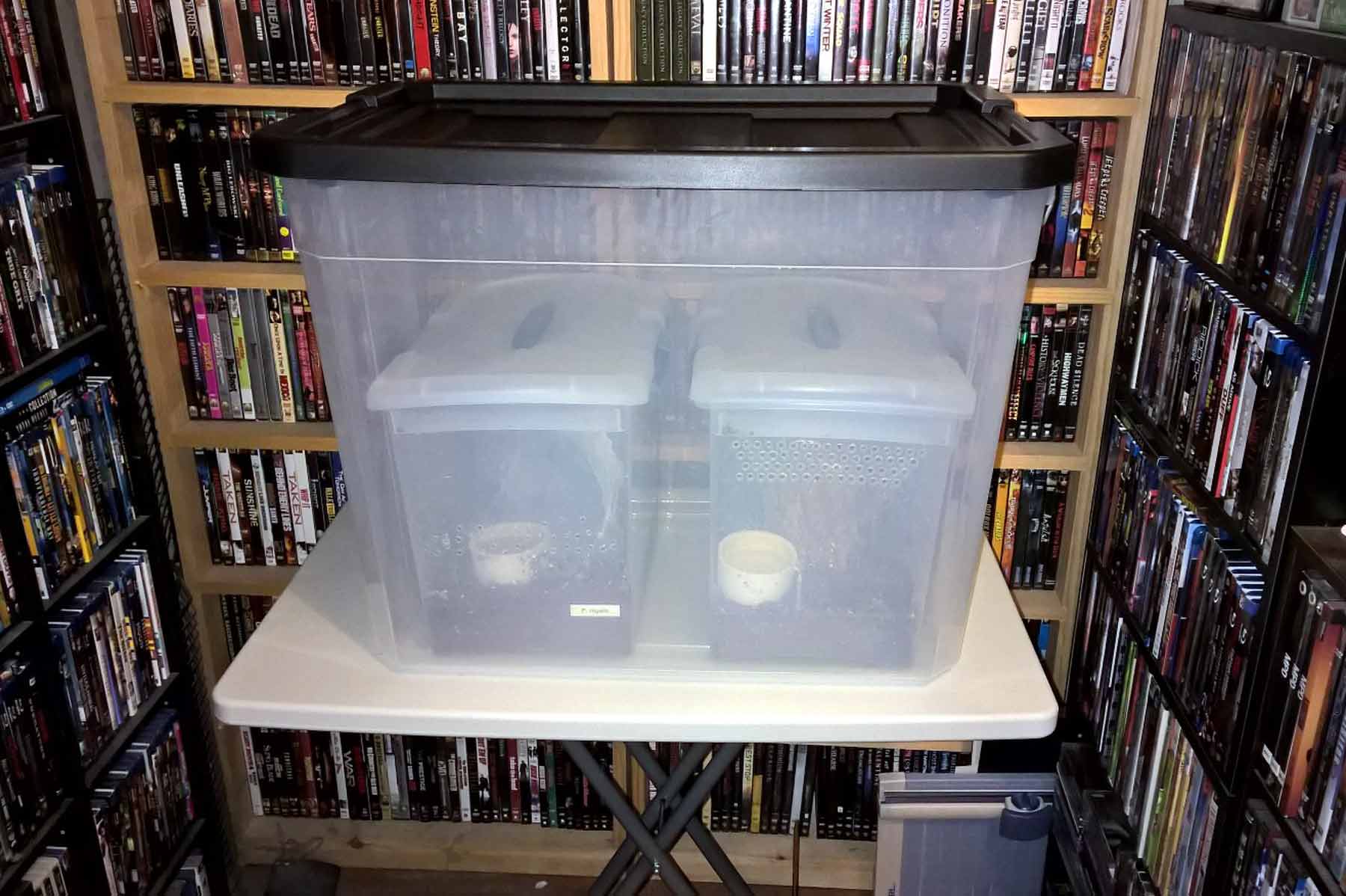
After measuring the two containers that housed my specimens, I decided that I would buy a much larger enclosure that would accommodate both the cages. With this setup, I would be able to put both enclosures in, open the tops, and let the spiders find each other on their own. This would avoid spooking the tarantulas during the introduction and allow them to encounter each other as they might in the wild. This breeding tank also offered plenty of free space should the male need to beat a hasty retreat.

A "breeding chamber" for my P. regalis pair. Both pokie enclosures were place inside this larger enclosure and their lids removed.

A “breeding chamber” for my P. regalis pair. Both pokie enclosures were place inside this larger enclosure and their lids removed.

The tank I chose was a 27-gallon latch-able Sterilite container that offered enough floor space and height to allow the spiders to mingle on neutral territory. I used my soldering iron to put ventilation holes in both sides to allow for air flow, and I placed it on a small table in a corner of my tarantula room that doesn’t get much traffic.

The pairing

I placed both enclosures in the breeding chamber earlier in the day, but I waited until the evening to take the tops off. Within an hour, both had started to crawl out of their cages to explore. Just before bed, I observed both the female and the male drumming their legs as they courted. I’m taking this as a good sign that their may have been an insertion after I went to bed. When I turned the lights out, they were still at opposite ends of the enclosures continuing their courtship ritual.

I left them in unsupervised overnight, and when I checked on them in the morning, both were fine and perched in opposite ends of the larger enclosure. All told, they spent about 14 hours together, with about 10 of that being in darkness. I left them a bit while I had my morning coffee so I was awake enough to wrangle them both back into their cages. As it turns out, I didn’t need the coffee; each had returned to his and her respective enclosures while I was gone. I couldn’t have asked for an easier pairing.

The next step

Although I’m pretty optimistic that the two mated last night, I’m going to go ahead and try again next weekend while I still have the male. After that, it will be a watch-and-wait game as I hope to discover the female is gravid. With any luck, I’ll have a sac in a few months. I will not only post a blog update if I have any news, but I will also update this post.

Next up … it’s time to find a date for my female P. vittata.

Wish me luck!

Sexing Tarantulas Using Molts

Title-pic
For most tarantula keepers, females are where it’s at.

It’s not that we don’t have love for their male counterparts. In fact, some male species like Phormictopus and Pamphobeteus are more colorful and stunning than the females. No, in most instances, the reason comes down to longevity and their ability to produce young. Female tarantulas are much more long-lived than their male counterparts, often thriving decades after the males have matured and expired. Females can also be bred to produce slings, an integral and fascinating part of the hobby for many.

The story is a bit different for male tarantulas. Some species of male tarantulas can mature in just over a year, leaving you with a leggy, antsy boy who wanders around his enclosure in a desperate attempt to fulfill his life’s goal to mate with a willing female. At this point, the best thing you can do for this tarantula that you have lovingly raised and cared for is to ship him off to someone with a female for breeding, leaving you with an empty cage. Sure, you can do do a breeding trade for half of the slings a successful pairing produces, but not all attempts end in viable sacks, and some end with the male being unceremoniously munched.

Those who enjoy raising tarantulas (and who don’t feel like paying the higher prices for sexed females) will often pick up spiderlings. As small slings are often difficult, if not impossible, to sex accurately, you never know exactly what you’re getting when you pick up a tiny spiderling. Many keepers (myself included) will pick up three or more slings of the same species at a time to increase their chances of getting a female. You then feed them, love them, and watch for signs that you might have hit the spider jackpot with a female.

Female C. cyaneopubescens molt (GBB)

Female C. cyaneopubescens molt (GBB)

Sometimes you notice one growing faster than the others, and immediately suspect a male. After all, males in many species will grow and mature faster. Other times, you see the spider’s underside pressed up against the side of its enclosure and you swear you see female parts. And still others, you’ll latch on to some physically dimorphic feature, like color or patterning, in hopes that it indicates a female.

Any keeper who has patiently waited to sex a spider they have raised from the sling stage has undoubtedly experienced the thrill of discovering they have raised a young lady … or the letdown that their beloved pet is a more short-lived male.

How do you sex a tarantula?

There are several methods keepers to use to determine the sex of their tarantulas, but many are not very accurate or require the keeper to have plenty of experience as well as a keen understanding of the anatomy of many species.

One method used to sex tarantulas is ventral sexing, which entails examining the tarantula’s ventral area (the bottom of the tarantula) around the epigastric furrow to try to determine its gender. The epigastric furrow is an opening between the set of book lungs closest to the cephalothorax (body) of the spider. Folks using this method will compare the curve of the furrow, the distance between the anterior book lungs, and the angle of the lungs to determine gender.

In females of some species, the epigastric furrow is more pronounced with what can be described as “lips”. In others, it is not nearly as pronounced. This method takes plenty of practice and knowledge of what both the female and male characteristics of each species are. Keepers attempting this technique will want to do some research and get some photos of both males and females for comparison.

A ventral shot of an A. insubtilis. This specimen was likely male.

A ventral shot of an A. insubtilis. This specimen was likely male.

Personally, I don’t even try to sex via ventral shots anymore, as I don’t feel that I’m particularly good at it, and it’s often not very accurate. Sure, some species like some of the Poecilotheria sport some fairly obvious lady parts early on, but others can be quite misleading and difficult to determine. Arachnoboards has a wonderful area where keepers can post ventral shots of their Ts so that others can determine the sex, but due to the trickiness of using this technique, many of the responses are just guesses (as evidenced by the same spiders being proven to be a different sex later on). Still, if you attempt this method, try posting a good ventral photo up on this board to get some other opinions.

There is also the epiandrous fusillae method.  With this technique, the keeper looks for epiandrous fusillae, or a second set of micro spinnerets used by mature male tarantulas to create sperm webs.  This is a technique that requires a keen eye and a lot of practice, so it might not be the most appropriate for some keepers, especially those new to the hobby.

Sexing your spider using the molt

The best way to your tarantula is to examine its exuvia or molted exoskeleton. An intact molt from a larger specimen (smaller specimens may require use of a microscope) can be examined for evidence of the female’s spermathecae, or the receptacle the female that stores the male’s sperm in. This organ is often described as a little “flap” or “pouch” above the epigastic furrow.

Although this method can be tricky at first, especially with smaller specimens, it’s the most accurate and easy to practice. All you need is an intact molt, some good lighting, and you can give it a shot. Here’s how to go about it:

A comparison of molts from a 3.5" male and a 3.5" female T. stirmi. The piece of paper on the female molt is showing the "flap".

A comparison of molts from a 3.5″ male and a 3.5″ female T. stirmi. The piece of paper on the female molt is showing the “flap”.

1. First off, you’ll want to do some research and find reference photos for both a male and female of the species you want to sex. I would encourage folks to hop on Arachnoboards’ Tarantula Sexing board and check out some of the shots there, or do a Google or Bing image search and study some of those. Every species is different, so looking at a molt from a L. parahybana might not be useful for determining the sex of a GBB. 

2. Next, you need a molt that has the abdomen flesh containing the book lungs intact. If the abdomen has been completely shredded in this area, you will find it difficult or impossible to sex the molt. I try to grab the molts from spiders I want to sex right after they molt (as long as I can do it without disturbing the tarantula). 

3. You need to soften up the exuvia, or molt, to make it less fragile and more pliable. I use a very small spray bottle and give it a few squirts. I then wait a few minutes for the molt to soften up. Other folks will drop the molt into a dish of warm water for a minute or so. Either of these methods work, just use care when handling the molt not to tear it or get urticating hairs on you. You may also want to put it on a piece of paper towel to wick up some of the excess water.

4. Position the molt so that the fangs are facing up and the molt is on its “back” on your well-lit working area. I like to use white plates myself, but a piece of foam board would be great if you want to pin the molt down. Now, carefully spread out the legs and unfurl the abdominal skin if it has become twisted. Work slowly and carefully, as the area that you need to sex the molt is VERY fragile and will tear. I will usually use toothpicks and cotton swaps to unfurl mine. You want to open up this abdominal skin so that you can see the underside of the area where the two sets of book lungs are.

G-PORTERI-LABELED-NEW

5. Now, some folks will immediately spot a slit between the set of book lungs closest to the body and think that they have a girl. Not so. This slit is found on both males and females. What you are looking for is a pronounced “flap” or the spermathecae, which will be above the epigastic furrow if present. The smaller the specimen, the more difficult this area can be to see. I often use a magnifying glass or take a close-up photo with my phone to get a better look. On well-developed females, you can even take a small piece of paper and slide it behind the flap to be sure.

UPDATE-FURROW

If you find the spermathecae, congratulations … it’s a girl! If not, and you are sexing a largerer specimen, you are likely looking at a male. You can always try again on a future molt to double-check.

Now this all sounds quite simple, but it’s not always that cut and dry. Some species don’t develop enough for the casual keeper to sex until later in their life cycles. Also, males from some species will have organs that can be mistaken for spermathecae, meaning that sexing those species can be a bit more challenging. If you are trying to sex your pet, you should spend some time researching and examining molt photos from both the males and females of the species. For some wonderful reference diagrams of the spermathecae of females from different species, check out this site. A Google search will also bring up several useful photos, and you can also check the sexing topic on Arachnoboards and compare the photos.

L. itabunae female molt with the spermathecae highlighted.

L. itabunae female molt with the spermathecae highlighted.

Recognizing mature males

It should be mentioned that mature males can be quite easy to sex, and you will often hear keepers refer to their males as “hooking out.” This expression comes from the fact that males from some species develop tibial “hooks” behind the knees of their first set of walking legs upon maturing. The key word here is “some”, as many species will not present this feature while others, like some in the Avicularia genus, will have hooks too small to see.

An illustration of a male tarantula. Some species don't have tibial hooks, so it is better and more accurate to look for the emboli.

An illustration of a male tarantula. Some species don’t have tibial hooks, so it is better and more accurate to look for the emboli.

Honestly, the phrase should be changed to “bulbing out” or something similar, as keepers should be keeping an eye out for another telltale feature; namely the bulb-like emboli at the end of the male pedipalps. The pedipalps are the shorter set of appendages inside the first set of walking legs that look like shorter legs. When a male spider has his ultimate molt, he develops emboli, or essentially the male’s sexual organ used to deliver the sperm to the female, on the end of his pedipalps. Instead of the ends of these appendages looking like the rest of the tarantula’s “feet”, they will instead be round and bulbous (some keepers refer to them as “boxing” gloves).

A comparison of a mature male's pedipalps (with emboli) and a mature female's.

A comparison of a mature male’s pedipalps (with emboli) and a mature female’s.

Because all male tarantulas will develop this feature, it makes more sense to look for emboli when trying to determine if your spider is a mature male or not.

Not only do males mature much faster than their female counterparts, but there are often many physical differences between a male and female of the same species. First off, males tend to be thinner and “leggier” than the girls, who are much more heavy-bodies. Many male tarantulas have different colorations than females, with some being very pronounced. Female L. violceopes, for example, sport gorgeous iridescent blues and purples upon reaching maturity. Males, on the other hand, are brownish to olive in color. Some males also mature at a much smaller size than the females of the same species; this can lead to some confusion for keepers who discover that their gangly male is done growing at 5″ and will never reach the 7″ max size of the females they’ve read about.

Unfortunately, many of these features won’t appear until the specimen’s ultimate molt, so those using this “method” would literally be discovering their pet’s sex at the latest possible opportunity.

Lots of practice is required!

No matter what method you choose to try to sex your specimen, research and practice are key. I have literally examined over a hundred molts now and spent countless hours staring at sexed molts on my computer screen. And although I feel like I’ve definitely got the hang of it, I still have difficulties at times. I’m certainly not yet an expert yet. When you’re first starting out, be sure to try and sex every molt you can. Do you have specimens that are already sexed male or female? If so, examine and photograph their molts as practice and to use as references.

With all of the variations between species, it can be very difficult to know what to look for. I would encourage anyone attempting to sex their T to look up the species first and find out all you can about it’s anatomy or any sexual dimorphism. Some questions you should be researching are:

Are their differences in colorations, marking, or bandings between the sexes?

Is this a species that can be sexed ventrally with accuracy?

What is the shape of the female’s spermathecae?

At what size to the genders become apparent enough to accurately sex by molt?

Does the male of this species have an organ that could be mistaken for a spermathecae?

Does the male of this species have tibal hooks?

Sexing may seem daunting and confusing at first, but with enough practice, most keepers will be successfully identifying the genders of larger specimens in no time. And honestly, the first time you examine a molt and discovering that the sling you have raised for a year is a little lady makes all of the effort and frustration worth it.

* Note: I will continue to update this blog with photos of sexed molts. It’s my hope that this can be a resource for some looking for reference photos.

Euathlus sp. red Husbandry Video

With school in full swing (I’m a teacher by trade), I’ve had less time to sit in front of the computer and write my blog posts. Writing time has basically been limited to weekends for the time being.

However, as I am always diddling around in my tarantula room, it is quite convenient to whip out the camera and catch some footage as I work. It’s been a bit of an awkward transition (talking to an audience you can’t see is a LOT different from teaching a classroom full of kids), but I’m actually finding it a lot of fun.

This video was particularly fun to film, as this cute little girl just did not want to stay in her enclosure! She is easily the most inquisitive tarantula I keep.

A little side note: if you’re interested in this species and you find one for sale, buy it.  With Chili closing it’s borders to the exportation of their species (many of the young adults offered on the market were wild caught) and with few people breeding them, the Euathlus is becoming very difficult to come by.

Phormictopus atrichomatus – Husbandry and Rehousing Video

When I noticed some chunky yellow mold forming in my P. atrichomatus‘ den, I figured it was time for this specimen to get a new home. I’m guessing that the little guy left a bolus or two down in the moist lower levels of the enclosure, which led to the break out. Now, normally I don’t freak out if I find a bit of mold in an enclosure; if kept in check, it poses no threat to the animals. I will just used a spoon to spot clean and let the affected area dry out. However, as this mold was inaccessible, and the spider would outgrown the enclosure with its next molt, a rehousing was in order.

Because my daughter, Sid, has been encouraging me to do more YouTube videos, we broke out the camera and headed out to the garage to make a rehousing/husbandry video. I’m hoping that folks that aren’t enamored with my often long-winded care blogs might find the videos a bit more accessible (and my daughter not-so-secretly hopes these vids will launch her YouTube career…).

A typical fast-growing, hardy Phormictopus species

Although I cover most of this species husbandry in the video, I’ll share a bit more in-depth info for those who don’t watch it.

I picked a trio of these guys up as 1.25″ slings  from NERD back in April and, like my other Phormictopus species, they’ve proven to be voracious eaters and fast growers. The largest of the three is now pushing 3″ or so, and the other two are around 2.5″. As slings, I keep all of my Phormictopus on deep, moist substrate. All have exhibited a propensity to burrow, so I encourage the behavior. Slings are a beautiful shade of blue, and despite having burrows, most will remain visible at the entrances as they wait for prey.

As they hit the juvenile stage (about 1.75-2.5″ or so), I don’t worry much about keeping the substrate moist. At this point, they will have a larger water dish for drinking and humidity, and I’ll pour some water over the substrate every month or so, letting it dry out in between. I still give them deep substrate to burrow in, which allows the deeper portions to remain moist and maintain more humidity. However, I’ve observed that by the time they hit the 3″ mark, most will stay right on the surface and will only race to their dens when spooked.

These guys like to eat

Like Theraphosa and Pamphobeteus species, Phormictopus are great eaters and fast growers. Even though mine are kept on the cooler end at times (70-26 in the winter and 75-80 in the summer) they still grow like weeds. The size gained between molts is truly impressive, with larger specimens picking up an inch (and quite a bit of thickness) during a shed.

With that quick growth comes a healthy appetite, and my Phormictopus species gobble up crickets and roaches like they’re tic tacs. I generally feed my juvenile 3-4 crickets at time, and watching these spiders scramble to snatch them all up is incredibly entertaining. They will literally zigzag across the enclosure at startling speed as they chase down crickets.

A large, “spirited” terrestrial

Although this is a very hardy tarantula with relatively simple husbandry requirements, it might not make the best beginner T. Phormictopus species grow into rather large, quick tarantulas with plenty of attitude, which could make them quite intimidating to those used to calmer terrestrials. As slings, species in this genus tend to be more skittish than defensive.

However, with size comes attitude.

I have observed that their infamous attitudes seem to start to manifest more as they get larger. My sub-adult specimens are quite bold and wont hesitate to stand their ground or come at you when you disturb their enclosure. Although I have yet to have one flick hair, I have seen some fangs. An amazing feeding response coupled with a defensive nature can make for some heart-stopping moments with these guys. Although I’ve been fortunate in that most of my Phormictopus species tarantulas have been relatively calm, I have seen what can happen when a large specimen is spooked (or mistakes the tongs for a cricket). Personally, I love their spirited behavior, but other keepers might find it a bit off-putting.

However, for those with some experience under their belts who are interested in large, fast-growing terrestrial tarantulas, P. atrichomatus or any other Phormictopus species should not be overlooked.


Tarantulas – The Application

Tarantulas-The-App-Title-fl

Simply the BEST application for tarantula record keeping!

For those of us who get seriously bit by the hobby and find ourselves keeping dozens of these fuzzy little arachnids, a conundrum soon presents itself.

How do we keep track of data?

Many hobbyists find it necessary to track feedings, molts, enclosure cleanings, temperatures and other observations about their pets. This information can prove very useful in recognizing patterns and behaviors and for noticing when something might be amiss. What is the average time between molts for a certain specimen? What was the feeding schedule during that period? Was there any difference in growth rate when the temps dropped for the winter? These are all some questions I’ve actually posed and answered using data.

When my collection first grew from one specimen to 10, I found it easy to record feeding and molts on the family calendar. However, my Norman Rockwell wall calendar was soon so filled with tarantula names and observations that we didn’t have room for birthdays. It quickly became apparent that I would need a better way of recording and organizing my data.

I would need to do some homework.

I hopped online and Googled “tarantula journal” and “tarantula record keeping”, but my searches really didn’t yield much in the way of results. It looked for a while like I would have to come up with my own system using a notebook to journal. It wasn’t until I signed onto Arachnoboards one day and noticed a simple little post that all of that changed.

“So I made an application…”

The main page displays all of your tarantulas (names are customizable)

The main page displays all of your tarantulas (names are customizable)

That was the thread’s title, and I was immediately intrigued as I clicked on the link to read more. Reading the post that described this app, my excitement built. An app designed specifically to track tarantula data? Unlimited slots for larger collections? To say that I was excited as I quickly clicked the link to download this app would be an understatement. After installing it on my Kindle Fire, my excitement only grew as I played around with the program and familiarized myself with its many outstanding features.

Did it offer the ability to track feedings, molts, and date of acquisition?

Yes.

Could you add photos of your specimens?

Yes!

Were you able to select venom potency and behavior, each with its own handy symbols?

Yes, yes, and Yes.

Customizing listings for all of your tarantulas is simple.

Customizing listings for all of your tarantulas is simple.

And there is just so much more. The app’s creator, Erick Banaag, didn’t just stop there; he continued to tweak, improve, and perfect this tool. Over the last couple years, Erick listened to user feedback and suggestions as he continued to evolve the program to include more and more information and features. The result is the most comprehensive tarantula app ever offered. The amount of data it allows you to track is just staggering, and the number of available components will appeal to both the novice and expert tarantula keeper. Whether you have 10 tarantulas or 100, this amazing little app has something for you.

I’ve been using the app for well over a year, and it’s worked flawlessly for me (and even if I ever did find a bug, Erick has continued to provide support and updates for the program, so a fix is always on the way). I’ve actually made it an integral part of my ritual for receiving new tarantulas. After unpacking and rehousing my latest acquisitions, I take a picture and add the new specimens to my app. 

With the latest version of this stellar application now available, I reached out to Erick to find out a little more about the creation of this wonderful tool and the man behind it.

TBS: Thanks so much for taking the time to chat with us! To start off, I guess the first thing folks are wondering is how did you get the idea for the tarantula app? How did this project come around?

Erick: To be honest, it is not my original idea. When I started with the hobby I found a free app that allows for only a few entries and you’ll have to pay to get more slots. As cheap as I am, I decided to make my own. I wasn’t really planning on releasing the app to the public since it wasn’t my idea and it was around 70 to 80% similar, but I’m happy I did. It has now grown so much and a lot of the features were from user suggestions. Without users’ input/suggestions, the app would not be what it is now.

TBS: How does one go about creating an application? Do you have previous programming experience?

Erick: I’m a software consultant in a small company here so I do have software development experience. 🙂

TBS: Were there any challenges in creating an application with so many features and so much customization? The amount of information it allows you to track is staggering, so I imagine that all of these features didn’t come without a fair share of programming headaches.

Erick: I did have to learn android development, but I already had some background of the programming language used.

Starting was the difficult part since I don’t have a lot of knowledge with the android platform. But after everything was setup, the programming wasn’t really that bad. The only problem that I encountered is the notification for feeding calculation part which has three customizable settings and I think it still has some bugs in it. 😉

TBS:  Something that has really impressed me having downloaded this app early on is just how much work you’ve done to constantly improve upon it. You have your own dedicated thread on Arachnoboards in which you announce new versions and take feedback from the keepers who actually use it. About how many versions have there been, and how many hours do you spend on each version?

Erick: Since the debut, there have already been 55 version releases. I usually spend around 8 to 10 hours, depending on the update; maybe longer if there are big changes to be done. Or even under an hour for really small quick fixes.

TBS:  What type of response have you received from the app? Everyone I’ve encountered has loved it. I’m assuming the response has been quite positive?

Erick: So far the majority are positive responses. I also get emails every once in a while letting me know how happy they are with the app, which also makes me very happy.

TBS: Which devices does the app currently work on? I’m a bit of an iconoclast with my Windows phone, so I use the app on my Kindle Fire (and it works fantastically).

Erick: The list of compatible devices on my website is currently based on user responses and email messages. But based on the three app stores that the app is currently listed in, it should be compatible with the majority, if not all, of the android devices available on the market as long as they are running android 2.1 and up.

TBS: Are there any plans for an ios version in the future?

Erick: I’ve been planning to port the app to iOS, but unfortunately my time and, most importantly, knowledge of the platform is very very limited.

TBS: With all of the revisions you’ve made to this application, I can only imagine that you’re currently working on the latest additions and fixes. Can you tell us or hint at what might be coming next?

Erick: Unfortunately, my to-do list now is mostly bug fixes with only one update, which is a request I got from Arachnoboards. If you use the feeding feature by long pressing an entry in the list, the request is to make it so that if you press on one side, it will update the feeding date. Press on the other side, and it will update the watering date.

I sometimes get emails or even Facebook private messages from users suggesting features but now most are bug reports.

TBS: If I’m not mistaken, you currently live in the Philippines. When I first started my blog, I was surprised to discover that many of my visitors are from the Philippines (third only to views from the United States and UK). In the US, tarantula keeping is still a bit of a niche hobby that is currently gaining more popularity. How popular is the hobby in your country? Where do folks get their tarantulas? Mail order, local pet stores, etc?

Erick: I would say the hobby is still young here in the Philippines though getting more and more popular at a really fast pace.

Tarantulas are easy to find here, if you know where to look for them. There are plenty of selling groups, and finding a seller close by is pretty easy. Some would do mail orders for rare species that only a few big dealers would sell through the mail.

TBS: One of my favorite tarantula species is the Orphnaecus philippinus, a species native to the Philippines. Do you keep any of the indigenous species you can find there?

Erick: I currently don’t own any local species. My focus is shifting to arboreals, and I’ve been searching for local arboreals, which seem to be very difficult to come by.

TBS: I figured that anyone who would spend hours programming an app for tarantula keepers probably had tarantulas himself. What species do you current keep?

What is your favorite species (or genus)?

Erick: I currently own 26 tarantulas, majority are old worlds and about half are arboreals which are mostly Poecilotheria species. So I have to say my favorites are pokies. 🙂

TBS: Again, Erick, thank you so much for your time! I’m sure I speak for many people when I say thank you for all of your hard work on this app. I can’t wait to continue to watch it evolve and, hopefully, reach even more keepers.

Find this application now on the main site , or on Google Play!

For those interested, you can follow the update thread on Arachnoboards.

Supported Devices:

Samsung Galaxy Spica running 2.1
Samsung Galaxy S3
Samsung Galaxy S4
Samsung Galaxy Note
Samsung Galaxy Note 2
Samsung Galaxy Note 3
Samsung Galaxy Tab 3 7.0
Samsung Galaxy Tab 3 8.0
Samsung Galaxy Tab S
Samsung Galaxy Ace Plus S7500
Amazon Fire HDX 7 WAN (3rd Gen)
Amazon Kindle Fire HD 7 (3rd Gen)
Amazon Fire HD 8.9 WAN (2nd Gen)
Amazon Fire HDX 7 WiFi (3rd Gen)
Amazon Fire HD 8.9 Wifi (2nd Gen)
Amazon Fire HDX 8.9 WAN (3rd Gen)
Amazon Fire HDX 8.9 WiFi (3rd Gen)
Amazon Kindle Fire (1st Gen)
Amazon Kindle Fire (2nd Gen)
Amazon Kindle Fire HD 7 (2nd Gen)
HTC One
HTC One Mini
HTC One (M8)
Lenovo IdeaTab A1000
LG Nitro
Motorola DROID RAZR M
Motorola RAZR i
Nexus 4
Nexus 5
Nexus 7
Sony Xperia U
Sony Xperia S
Sony Xperia Z2
Sony Xperia Z3
Verizon LG G3
Wolfgang AT AS45qHD
ZTE Vital N9810

Harpactira pulchripes (Golden Blue Leg Baboon)

H.-pulchripes-NEWEST

The new “jewel” of the hobby.

Over the years, there have been dozens of newly introduced tarantulas species that have caught the eyes of hobbyists with their undeniable beauty and the appeal of being a rarity in the hobby. More recently, the Poecilotheria metallica and Monocentropus balfouri were two spiders that delighted keepers with their gorgeous blues while draining wallets with their steep costs for even the smallest slings. Even today, with both species being readily available in the hobby, they still command high prices.

Today, many keepers consider the Harpactira pulchripes, a striking orange bodied and metallic blue legged beauty, the hobby’s latest crown jewel. This relatively new African species pops up on many keepers’ wish lists, and folks who manage to acquire one proudly share photos like a rich kid showing off his new sports car. And like a status car, these little spiders can come with a shocking price tag that many find ridiculous.

The fact is, new species, especially African ones like the Harpactira pulchripes are first collected and bred by Europeans and exported to the United States in limited quantities. Couple the cost of legally importing tarantulas into the US with their initial limited availability, and you have the makings of one pricey T.

Check out my female in action in the video below!

Early on, the only folks generally interested in paying these prices, often reaching well over $1,000 for a pair, are breeders looking to be the first to breed the species stateside (and make a pretty profit in the process). Other interested hobbyists will often wait a year or two until a new species is successfully bred a couple times, bringing batches of more affordable slings into the marketplace.

When I first saw a photo of a H. pulchripes, I had only been really into the hobby for a short time and I had no idea that I was viewing a newly introduced spider. I was therefore shocked when I saw that .5″ slings were going for about $500. It didn’t take me long to abandon all hope of acquiring this gorgeous spider any time soon.

H. pulchripes adult.

H. pulchripes adult.

In about January of last year, I got a lead that one of the breeders I normally buy from was expecting a shipment of babies, and slings would be available for $300 each or $275 a piece if you bought three. Although I considered making a purchase, that was a still a bit out of my price range. Over the next several months, I watched as prices for .5″ slings decreased from this price point to as low as $225 from one dealer. With a few folks managing to produce slings in the US, prices were already falling.

1" H. pulchripes sling

1″ H. pulchripes sling

Finally, I found an offer that was almost too good to be true. Stamps Tarantulas was offering 2.5″ sexed female juveniles for $300. Even better, he was having a 25% off everything sale. I would be able to get a guaranteed female for less than I almost paid for a single unsexed sling. I jumped at the opportunity and placed my order.

Now, there was a slight mix-up with my order, which lead to me being sent a 1″ sling instead of my female. Steven was quick to rectify the situation, and when all was said and done, I was the proud owner of both a H. pulchripes sling and a sexed juvenile female. To say I was a happy customer would be the understatement of the year (thanks, Steven!).

Enclosures and setup

I used a basic setup for both specimens, a modified 1 quart clear plastic canister for the sling and a 1.5 gallon Sterilite container for the juvenile. I modified both to add ventilation (holes for the canister and round vents for the Sterilite container).

H. pulchripes sling enclosure

H. pulchripes sling enclosure

H. pulchripes sling set up

H. pulchripes sling setup

For substrate, I used a mostly-dry combination of peat and coco fiber. After packing this down in the enclosures, I packed some dry substrate on the top. Both were offered cork bark with some plastic leaves for a hide, and I used my finger to pre-start a burrow for each under the cork bark.

The juvenile has a milk cap for a water bowl, and I keep it filled with fresh water (although my girl has enjoyed filling it with dirt). The sling will be getting a water bottle cap for a dish soon. For the time being, I use a water dropper to add some moisture to the plastic plant and webbing in case it wants a drink.

Both specimens took to their burrows the first night, and they have spent several weeks burrowing a bit and webbing up around the entrances. Although each has constructed a fairly deep burrow in the substrate, they are both out and visible quite often (the sling does move to one of its holes whenever I disturb its enclosure).

H. pulchripes juvenile setup

H. pulchripes juvenile setup

A beauty with a voracious appetite

Both of my pulchripes have been great eaters. I drop a cricket in overnight, and it’s always gone in the morning. When I first got my sling, I didn’t have a cricket small enough for it as I was expecting a 2.5″ juvenile. Therefore, I dropped in a pre-killed cricket for it to scavenge feed on. When I checked in the morning, the sling had dragged the carcass beneath the cork bark and had devoured the entire thing. On average, I feed this specimen three times a week. While the weather is warm, I’ll be taking advantage of its higher metabolism to grow it out of the more fragile sling stage faster.

The juvenile has had no trouble taking down medium-sized crickets; I just drop them in at night, and they’re gone in the morning. She has currently sealed herself up in her burrow for premolt, so I’m eagerly awaiting the impending shed. Before she stopped eating, I was feeding her on a twice a week schedule.

Like most of my baboons, the H. pulchripes  don’t get as fat in the booty as some of my New World terrestrial Ts get when they are about to molt. Despite powering down several crickets, their abdomens never seem to get overly plump.

As I acquired these guys in the summer, temps in my tarantula room have been between high 70s to low 80s. I’m assuming that when the winter comes and temps are in the low to mid 70s, their metabolisms will slow down a bit and molts will come more infrequently.

Not as high-strung as most baboons

So far, both H. pulchripes have been relatively calm when compared to other “baboon” species of tarantulas I keep. The female in particular is fairly low-key, staying out in the open most days and calmly seeking shelter if I disturb her enclosure. The sling is a bit more skittish, but so far she is nowhere near as flighty as my M. balfouri, C. darlingi, or my P. murinus juveniles.

This doesn’t mean that I let my guard down with these spiders as I’ve seen their speed and know what they are capable of. The H. pulchripes is a lightening-fast Old World species capable of delivering a very painful, possibly debilitating bite. Also, tarantulas often change disposition after a molt, so I know that the next shed could bring different or more extreme behaviors. Caution and care always need to be exercised with Old Worlds species.

But, is it worth it?

There’s really no denying that the H. pulchripes is a striking tarantula, but is it really worth the money? I guess the answer to this question would vary from keeper to keeper. Some folks who aren’t particularly enamored with the look of this animal would likely argue “no way.” Even many of those who find this species desirable would likely choose to wait until prices fall considerably before trying to procure one. For breeders who are looking to make an investment in an uncommon species, I would guess it would be an enthusiastic “YES.”

Personally, I love baboon species, and I was enamored with the color of this tarantula the first time I saw it. While researching it, I also learned that there wasn’t a lot of care information out there yet for this species, so I was enticed by the idea of possibly getting to blog about its husbandry for future keepers.  And I know I already have one female, so a breeding project will definitely be in the future… I’m quite pleased with my purchase, and I’m looking forward to growing these two to adulthood.