Possibly the best tarantula ordering experience I have ever had.
My new N. tripepii female courtesy of Tom Patterson.
When people order tarantulas online, they generally go to the major vendors. Folks like Jamie’s Tarantulas, Pet Center USA, and Swift’s Invertebrates have stellar and well-deserved reputations for carrying a variety of stock and for their dependability and professionalism. The fact is, when buying and shipping living animals, you want to make sure you order from the best. Due to the volume of animals these larger dealers move, there are always plenty of glowing reviews to read if one does just a bit of research, and their names quickly come up in any search for those selling tarantulas.
However, what often gets overlooked is that there are many awesome breeders out there who have been in the business for a long time and who offer great service with spectacular deals. Some of these same dealers are the ones who supply stock to the “big name” vendors as well. Unfortunately, these folks can be a little more difficult to find, especially for those new to the hobby who don’t know where to look.
Tom Patterson (aka “Philth” on Arachnoboards) has been in the business for a long time, and he has a sterling reputation. Although I’ve come close to ordering from him many times due to his propensity to carry some of the more unique species I’m looking for, I didn’t pull the trigger until recently when I saw that he was selling some Vitalius paranaensis juveniles for a great price. After going through his recent price list, I found that he had several species I was interested in, and that it was finally time to place an order from him.
Boy, am I glad that I did.
Tom carries a good variety of tarantula species, including many that he breeds and produces himself. Those into other inverts will also find some cool arachnids, like trap doors and true spiders, as well. As far as tarantulas go, he has a good mix of some hobby staples, like G. pulchripes, Hapalopus sp. “Colombia large”, and P. cambridgei as well as unique and hard to find spiders like V. paranaensis, P. crassipes, and Aphonopelma crinirufum . For folks looking for larger sexed specimens, he regularly posts young adult females for sale as well.
His prices were great, with the $25 P. crassipes slings, $50 4″ Sericopelma sp. “Santa Catalina” juveniles, and the $50 3″ P. muticus juveniles really jumping out at me. I also grabbed up a 5″ Nhandu tripepii sexed female, as I had been eyeing this species for a while. Tom doesn’t currently have a website, but instead periodically lists his stock on the For Sale section of Aracnoboards or in the Captive Bred Inverts – Classifieds on Facebook. Ordering was simple; I emailed him a list of the species I wanted to order, and Tom responded immediately with a Paypal invoice. Tom’s communication was excellent, and all of my emails were answered within an hour.
My new L. crotalus being rehoused. This unique species was one of FOUR freebies.
Because weather in my area was quite cold, we both decided it would be in the best interest of the animals to wait to ship until we got a few days of higher temps. During the wait time, I asked to add another spider to my order, and Tom was happy to accommodate me, quickly sending me a new invoice. When it looked like we’d get a stretch of warmer temps, Tom contacted me immediately to arrange shipping. He was happy to have my package held at my local FedEx facility (in fact he encouraged it), and my spiders were shipped overnight promptly.
What an amazing box of spiders.
All of my new animals arrived safely and in great shape. The box was foam lined and contained a heat pack, and each of the spiders was packed in its own vial, which was wrapped in multiple layers of newspaper, then cushioned with packing peanuts.
And, what could make this transaction even sweeter? How about FOUR freebies. FOUR. For those who watch the video above, my shock is genuine. I’m used to getting some of the “give-away” species like LPs and B. albos, but what he included was unreal. Added to my order was a 3″ P. muticus, an L. crotalus juvenile, a Lampropelma sp. “Borneo black” sling, and a Phlogius sp. “Eunice” juvenile. What was already going to be one of the coolest boxes of spiders I’ve ever received was just made twice as cool by the awesome freebies.
Just WOW.
3″ P. muticus juvenile rehousing.
Take the chance and order directly from breeders
My experience ordering from Tom Patterson was utterly perfect. Even if you took out the extra four (again FOUR) freebies, this would still be an excellent deal and transaction all around. Great selection, prices, communication, and packing made this purchase and amazing experience. There isn’t a doubt that I’ll be ordering from Tom again in the future, and I would encourage anyone looking for tarantulas to check out his listings.
NOTE: To view Tom’s Arachnoboards Classifieds posts, you have to be a member and signed in. If the link doesn’t open, I would encourage folks to create an account if only just to be able to view the For Sale/Trade/Want to Buy section. I will also be blogging his price lists whenever he posts one.
Ctenidae sp. “Cameroon Red Fang”
1″ well started taking crickets $25.00 each
Cupiennius salei
Hatchlings $25.00
Heteropoda hosei
1″ well started taking crickets.$25.00
Heteropoda sp. “burgundy”
1″ well started taking crickets $25.00
Heteropoda sp “Sumatra violet”
Hatchlings $15.00
Kukulcania hibernalis WC females
2″-3″ $19.00
Viridasius sp.”Madagascar”
Hatchlings, taking crickets $25.00 each
Terms of Service
Live Arrival Guarantee
Purchase price must be over $25. Payments accepted , Paypal ( Tompatterson77@gmail.com ) or Postal money orders. Shipping is $40 overnight FedEx only. Live arrival guaranteed. You must accept package on first delivery attempt. Temperature must be below 90°F or above 40°F. Must be 18 or older to purchase. U.S. sales only. Refund Policy
Issues with shipment must be reported to me via (email, phone, Facebook) by 8 PM the night off delivery. Photo’s of DOA’s must be provided, or the deceased animal must be shipped back to me within 24 hours of receiving the package, at the purchasers expense. Refunds are money back without shipping cost reimbursed, or replacement spiders of equal value shipped at the purchasers expense. Not responsible for carrier delays. Freebies do not fall under the LAG
Recently, I sat down to write an article about some of the divisive, hot-button topics that dog the tarantula hobby and often ensnare uninitiated keepers in heated debates. These are subjects that new hobbyists are often interested in learning about, but an internet search or an innocent forum query produces two equally heated and opposing answers. My hope was to present both sides of these gray-area arguments so that keepers could develop their own informed opinions.
Please take a moment to participate in the poll above. Thanks!
As this feature took shape, it was apparent that there were enough of these topics that to try to cover them in one blog post would prove daunting (not to mention provide for a particularly long-winded blog post). The logical decision was to instead cover these topics as a series, focusing on one issue at a time. And, I could think of no better way to kick off this feature than by starting with one of the most incendiary topics in the hobby today…
Should OBTs be kept by beginners?
Background
Like politics, climate change, taxes, gun control, or any other hot button issues sure to spawn heated debates, the subject of OBTs in the hands of beginners is perhaps one of the most divisive and incendiary topics in the hobby today. At least once a week, some unsuspecting newcomer will start an OBT thread on Arachnoboards that quickly de-evolves from a constructive discussion to ruthless one-sided admonishment replete with petty name calling. Things heat up so quickly when this infamous animal is mentioned, that threads have been known to hit several pages in an hour.
Talk about a popcorn thread.
When I first got seriously into the hobby and was spending the majority of my free time researching which tarantula I might want to get next, I stumbled upon a blog post titled “Top Ten Beginner’s Tarantulas”. As it was currently the top site to come up with my search, I assumed that the blog must be a fairly reputable source. Although the majority of this article listed spiders I had already read were good beginners, #10 on the list was one I hadn’t encountered before…an OBT.
The Pterinochilus murinus was a stunning orange tarantula, and I was immediately fascinated by this gorgeous animal. Although the author of this list mentioned that this species was an Old World with a “bad attitude and dangerous venom”, the majority of the post detailed the ease of husbandry and hardiness. This spider immediately shot to the top of my wish list, and I set off to do some more research on it. Had I not spent the next several days scouring the boards for more info about this species, I might have immediately hopped over to Jamie’s tarantulas and snatched up a couple of the slings she had for sale.
However, a quick search revealed that this was a bit more than a spider with a “bad attitude”; in fact, this animal was literally infamous for its vicious temperament, blinding speed, potent venom, and propensity for biting. A quick review of Arachnoboard’s Bite Report section convinced me that this was a spider not to be trifled with. It didn’t take me long to determine that I wasn’t ready for the feisty beauty affectionately referred to as the “Orange Bitey Thing”.
Not all newer keepers wait to acquire this fascinating and notorious T, and this can prove quite problematic to hobbyists that consider this species to be an “expert-level” spider. They believe that the P. murinus is potentially dangerous tarantula that is best kept in the hands and collections of seasoned keepers. However, not all agree with this assessment. On the other side of the fence, hobbyists argue that this species is okay for beginners. Although this used to be an argument favored more by folks newer to the hobby, I’ve seen at least one reputable breeder and several experienced hobbyists come out in support of this idea. Below are the arguments and counter arguments and how they usually break down. For clarity, stances supporting OBTs for beginners will be in GREEN; stances against will be in RED.
The Arguments
Ease of care is what defines a good “beginner” tarantula, and there is none easier than the OBT The P. murinus is widely recognized as one of the hardiest Ts on the market. They do well set up as terrestrials or semi-arboreals, meaning they can adapt to just about any enclosure type. They have no moisture or temperature requirements and thrive on bone dry substrate; many folks don’t even give them water dishes due to their propensity to web them over. OBTs eat well and grow fast, meaning your precious spider will be out of its fragile sling stage quickly. Finally, they are readily available in the hobby and quite inexpensive, which makes them a great, low-risk introductory spider.
As for the OBT’s legendary and unpredictable temperament, some argue that the notoriety it receives for being hyper aggressive and fast actually renders them predictable. Informed newbies who acquire this animal will have already heard scores of stories about its nasty nature and will likely be overly cautious when working with it. Although this spider is more of a handful than other beginner tarantulas, a bit of caution and common sense would go along way. For those just getting into the hobby, this would be a great hands-off introduction to tarantula keeping.
Temperament MUST be considered when choosing a beginner tarantula, and the OBT’s attitude renders it inappropriate for a beginner. Folks in this camp tend agree that there’s more to a good “beginner level” tarantula than ease of husbandry. Although the OBT is an undeniably hardy tarantula, with many joking that they can thrive if kept on shattered glass for a substrate, their temperaments, speed, and venom potency render them potentially dangerous in the hands of people who don’t have a lot of experience keeping tarantulas.
Although ease of husbandry is definitely a priority, temperament should also be a consideration, especially for species packing medically significant bites. A mistake with a docile tarantula, like a Grammostola or Brachypelma, could lead to a bite that is little more annoying than a bee sting; a mistake with an OBT could lead to a hospital visit. Bites from this species can lead to excruciating pain, nausea, cramping, and other unpleasant symptoms in a full-grown adult.
Transfers are also a major part of husbandry, and this is an area where OBTs can be their most troublesome. Escapes are a major concern for those working with tarantulas, and a keeper not used to these spiders’ sudden speed bursts often experience the panic of suddenly having a large spider on the loose in his or her home. For slower New World terrestrial species, this isn’t as much of an issue as they are usually easily cupped and returned to their enclosures. As for the OBT, these speedy little devils can be a nightmare to wrangle.
With proper research, and new keeper can prepare to correctly care for an OBT.Any responsible hobbyist is sure to do adequate research for any species he or she is looking to acquire, and it’s no different with the P. murinus. Keepers new to the hobby can prepare to receive an OBT by spending some time researching this species. This research should include speaking to experienced folks, watching the YouTube videos illustrating their speed and attitude, and reading accounts from those who keep them.
These folks also argue that NO ONE is ever really ready for a defensive and unpredictable species like the OBT, and even an experienced keeper isn’t necessary going to be any more prepared for an escape or a bolting spider than someone new to the hobby. After all, isn’t an experienced keeper who’s getting an OBT for the first time in the same boat as a newbie as neither has kept this species before? Experience is gained by doing, so the best thing to do before procuring this species is to read up and prepare.
Research isn’t enough; experience is necessary.On the other side of this debate are generally more experienced keepers and those newer to the hobby who feel that reading about a species is in no way the same as the experience garnered from actually keeping them. Many of these folks have been around long enough to see inexperienced keepers acquire this species only to later become afraid of it, and some have even acquired OBTs from folks who became terrified of them. Respect for any tarantula is necessary, but fear can can be dangerous to the keeper and the spider. This intimidation can lead to poor husbandry, as the keeper is unable to clean or rehouse their pet.
Keepers who have already worked with calmer species for a while will have honed basic skills like cleanings, feedings, and rehousings, which will make dealing with a spider that can be this defensive, fast, and unpredictable much safer. They argue that an experienced keeper getting a P. murinus for the first time might not have experience with that particular spider, but their hands-on experience with other species and an understanding of T keeping fundamentals will leave them much better prepared for mishaps.
Many keepers believe in the “Ladder System”, or the idea that people new to the hobby should work their way up to more advanced Old World species only after gaining experience by working with more docile New World beginner species. In this scenario, a keeper might start by keeping a “calm” species like a B. smithi or B. albopilosum before “graduating” to something a bit larger and more feisty, like an A. geniculata. After spending a couple years with these species, this keeper might then move to getting a beginner Old World, like E. pachypus or C. darlingi.
In this system, the keeper spends time working with tarantulas for at least a couple years as he or she develops the skills and instincts needed to successfully and safely deal with advanced species like the OBT. Proponents of this system argue that reading about spiders only gets you so far; the best knowledge comes from actually keeping them. They believe that inexperienced keepers that skip this step are setting themselves up for problems. For example, you wouldn’t give someone with only a few months of experience driving a moped a Ninja to ride; they would have to work up to the more advanced bike.
Obviously, many folks new to the hobby have kept OBTs over the years without incident, so it’s no big deal.Head to any online tarantula vendor to check out their stock, and you’re likely to find that they have plenty of P. murinus slings available for purchase (and at really low prices). The OBT has been a hobby staple for quite some time, and there’s a good chance that the majority of the hundreds, if not thousands, of slings sold each year are going to folks who are not tarantula keeping experts.
The fact is, for all of the alarm and condemnation when a newbie to the hobby procures this species, there really aren’t a lot of reports out there about a newbie losing, getting bit by, or being overwhelmed by his/her new pet. After all, if hundreds or thousands of these spiders are out there, there should in the very least be dozens of bite reports, right? In several instances, those who have been in the hobby for a while will eventually admit to acquiring an OBT early on and raising it without incident, seemingly debunking the theory that they are an “expert species”.
It puts the hobby at risk.For folks on this side of the fence, the issue also goes beyond the welfare of the individual keeper and spider; they feel that a well-publicized bite report could lead a species ban or a ban on tarantula keeping in general. In all likelihood, the majority of bites aren’t reported on public forums, meaning there is no way to tell how folks are handling this animal. However, many feel that all it would take is for one bite report to make the news in a sensationalized manner for the hobby to be put in jeopardy.
If we’re being honest, tarantula keeping is a bit of an eccentric, niche hobby. Anyone who has been in the hobby a while has gotten used to the strange, often judgmental looks when you tell folks that you like to collect giant spiders. And, as many people are very ill-informed about these animals, fallacious stories abound about deadly spiders capable of horrendous violence against their keepers and their unsuspecting families. One publicized trip to the emergency room could lead to a campaign to ban these animals by an over-zealous politician.
On a personal note, I live in Connecticut where it is already illegal to sell venomous animals (including tarantulas) in pet stores and at public conventions. Even worse, after the highly-publicized chimp attack in 2009, legislators proposed a bill that would have banned ALL exotic pets. Folks who worry about a partial or full ban on the hobby are not being alarmists; it could happen.
My $0.02.
Again, like many debatable topics, this topic really isn’t a black and white issue. If you’re a keeper who is still panicking because your spider has buried itself for a molt or who has never had to transfer a spider from one enclosure to another, you really should avoid the OBT until you have some more experience. I do feel that base experience is necessary before one attempts to keep an OBT, but I also feel the amount of experience needed is going to vary greatly from keeper to keeper. Are the majority of new keepers ready for an OBT? I’ve spoken to many over the years, and my experience tells me “no.” There are just so many basic skills necessary for this hobby that are much more easily mastered and perfected with slower New World species. However, there are those I have encountered who are more than ready, and do a great job transitioning well into keeping this feisty T.
Again, it’s not black and white.
I’ve seen many instances of new keepers announcing that they’re ready for an OBT only weeks after posting a panicked cry for help because their T has flipped to molt. Or, they post that the transfer of their B. smithi was a total debacle, then later explain that the same thing won’t happen if they get a P. murinus. These are the types of alarming statements that raise the ire of more experienced keepers and get those OBT threads heating up…
Furthermore, I truly believe that if you’re taking to a public forum to ask if you are ready, the answer is most assuredly NO. As much as many folks would like to pretend that there are some set ground rules for who can get an OBT and when, that’s really not the case. Asking folks on a forum only evidences that the keeper is probably not ready for this animal and is looking for confirmation from other keepers (and believe me, that keeper will get it!). Ultimately, it’s up to the individual to make the responsible and informed decision as to if he or she is ready for this animal.
I do feel strongly that this is an species that should only be purchased by someone who, in the very least, has the basics of husbandry under control. This means, cleaning, recognizing common issues, feeding, transferring, and other common housekeeping aspects. As many accidents and escapes happen during rehousings, I believe that it’s particularly important that keepers have a practiced and safe system for transfers. Once you have the basics of tarantula keeping down and you’ve worked with a few species of spiders, then it might be time to consider some more advanced species.
Again, fear is dangerous in this hobby, and this species is one of the “scarier” spiders available. If you’re thinking of getting an OBT, but the idea of having one of these speedy orange devils scares you a bit, wait. Respect and caution is paramount when dealing with fast-moving defensive spiders; fear can lead to mistakes which then lead to a bite or a dead spider.
I do believe that some individuals are just more inherently capable of correctly caring for an OBT and dealing with its attitude without as much experience as others. That’s a fact. However, it’s not up to me or other keepers to determine who those folks are. I have noticed that many of the folks that post about getting one on the forums seem to be the ones I would rather not have them.
I also think that this species should be for adults only. There is also the very real issue of younger keepers who are still living at home acquiring this species. Although OBTs will not kill you with their venom, a bite from this species will definitely make an adult individual miserable. Now, imagine for a moment that one of these spiders escapes and ends up biting the family dog, cat, or a child in the house. By their nature, teenagers, can be a bit reckless. Heck, I used to be one, and I still marvel at some of the less-than-informed decisions I’ve made. Hop on YouTube and you can find a plethora of videos featuring younger keepers proudly displaying reckless behavior with their Ts, and more than a few featuring the OBT.
Obviously, there are likely some fine young keepers out there who innately possess the maturity and skills needed to safely care for this animal. However, I do think that parents need to be informed and a big part of the decision process for a teen who is looking to acquire a P. murinus, as a mistake could affect the whole household. In the very least, a younger keeper still living at home needs to do his or her best to inform parents or anyone else in the household about these animals so that a decision can be made as a family as to whether or not to keep one.
Final thoughts
The P. murinus is a gorgeous and amazing species of tarantula that I personally believe is a great addition to any collection. That being said, it’s notoriety as a vicious, unpredictable speed demon is well deserved, meaning that this is a species not to be trifled with. A quick glance at bite reports for this species illustrate that it is quick to bite, will bite repeatedly, and its strong venom can produced intense pain and lingering full-body cramping.
In other words, the OBT has all the makings for a really bad day.
That said, responsible keepers with a modicum of common sense and a basic understanding of tarantulas and their husbandry might be tempted to keep this unique an notorious spider. However, before any hobbyist, new or experienced, brings one of these Ts into the home, she should ask herself, “am I ready?”
When I first encountered this unique tarantula, it was known as the Maraca cabocla or “Brazilian Redhead”, and I was immediately enamored with its build (and, if I’m being honest, with its funny name). With its deep red carapace and long, lithe, tapered legs, it bore more than a passing resemblance to a true spider, and I wondered why this species wasn’t more prevalent in the hobby. While doing research on its husbandry, I discovered that information was rather sparse and often conflicting. Some kept it dry while others kept it moist. Some reported fast growth rate while other reported less frequent molts with modest size gains. I was fortunate enough to find tips from a keeper who had successfully bred this species to get me started. Having kept these guys for a while, and with several folks asking me about their care, I figured it was time to share some of my observations.
A hardy species offering some husbandry wiggle room.
I acquired my two slings about a year ago at about .3” or so. Both were housed in dram bottles with about 2.5” of moist substrate, and both quickly dug a system of complex tunnels straight down to the bottom. It seems if given the substrate depth, this species will dig. Over time, I allowed the substrate to dry out a bit and just periodically moistened part of it by carefully pouring some water down the sides of the bottles. Although I’ve heard some keepers report that their B. caboclas gravitated toward moisture, mine haven’t shown any preference for it. In their natural habitat, this species experiences a several months long dry period followed by a rainy period, so it seems to be physiologically equipped to deal with the two extremes.
My B. cabocla specimens have proven to be slower growers. Both are currently kept at temperatures that range 72-76 in the winter and about 75-80 in the summer. Since I acquired them, they have both molted about three times each and are both just over 1” in size now. Both are now showing some of their adult colorations as well, which is quite cool. As tiny slings, I would feed them pre-killed baby crickets or pieces of mealworm. When still very small, my two specimens were not particularly voracious eaters; they would occasionally refuse meals when not in premolt and seemed intimidated by live prey. Once they put on a bit of size, they seemed to develop better prey responses. Mine now have no trouble chasing down small crickets.
I have spoken to a keeper who has experienced slightly faster growth rates with hers as she keeps it in warmer temperatures year round. As always, warmer temps will lead to faster metabolisms and growth rates, so it’s very possible that caboclas kept at higher temps will grow much faster than mine have.
A note about burrowing…
During the first winter that I kept my cabocla slings, both buried themselves, covering up the entrances to their burrows completely. In one instance, I was able to see the sling at the bottom of his burrow through the pill bottle. The other sling, however, covered up all openings, and it almost appeared that the tunnels had possibly collapsed. Now, I warn keepers all of the time not to disturb their spiders if they should bury themselves. After all, tarantulas know what they are doing, and if they suddenly disappear into their dens, you can bet that there’s a good reason for it. However, after three months of seeing no signs of life, I succumbed to my impatience and carefully dug through the sub to find the little guy. What I first mistook to be a shriveled corpse proved to be a molt; the actually spider, a bit larger now and obviously upset, popped out a moment later.
That’s the last time I don’t follow my own advice.
Now that the slings have put on a bit of size, I have moved them both to16-oz deli cups with a couple inches of substrate, cork bark for hides, and bottle cap water dishes. Both have taken to the hides and have done a bit of digging.
Temperament-wise, they have proven to be a bit skittish, often bolting directly to their burrows when disturbed. Once the largest of the slings hit the 1” mark, it began hanging out on the surface much more and seems a bit less likely to run when disturbed. It also has no problems chasing down and subduing small crickets, seemingly having outgrown its fear of moving prey. As far as the experience level needed for this species, I would think that it could easily be kept by someone new to the hobby as long as they were cognizant of it’s flighty behavior.
Check out one of my B. cabocla slings in the video below!
For those looking for a unique, beautiful, medium-sized T that’s tough as nails, the B. cabocla should definitely be a consideration. I’ve been seeing more an more of these guys on the market, and I’m hoping that they start getting the attention that they deserve.
What better way to start the new year than with some breeding projects?
With many of my females maturing, it’s time for me to get going on some of the breeding projects I’ve been anticipating. First up is a pairing between my mature male and female Poecilotheria regalis. I was very fortunate that this male and female, purchased separately as a sling and a juvenile respectively, matured at about the same time. Although I was cutting it a bit close (the male had his final molt a couple months ago), everything eventually fell into place nicely.
Background
7″ mature female P. regalis
The female was purchased as a 2.25″ unsexed juvenile about 22 months ago. Her last molt was on December 2, and since then I’ve fattened her up a bit with three large dubia roaches and a hissing cockroach. She is currently about 7″ in length.
6.5″ male P. regalis
The male was purchased about 14 months ago as a 1.5″ sling and had its final molt in early November. He’s been observed tearing down sperm webs a couple times over the past several weeks, so he’s been ready to go. Although I would have ideally used this male earlier to breed, I wanted to wait until my female molted out one more time and gained a bit more size. He is currently about 6.5″.
Introducing the male and female.
I’d considered a few ways to introduce the two potential mates to each other. Courtships can last quite a while for Pokies, and I reasoned that I might not be able to sit by with a camera and hope to catch the process. I was also hoping to leave them overnight as to offer a dark, noise-free breeding environment. As Poecilotheria species are rather tolerant of each other (as evidenced by the many successful communal set-ups out there), most keepers reported that they allowed the two specimens to remain in the same enclosure unsupervised anywhere from overnight to a week. I planned to keep them together for an evening.
I had read about “shark tanking/shark caging”, which is when the male is added to the female’s enclosure for a few days while inside a smaller enclosure to protect him. The idea is to allow the pair to get accustomed to each other while still keeping the male our of harm’s way. Eventually, the male is released so that he can mate, hopefully with less risk of getting eaten by the female.
I know that several keepers have used this technique with some success, but the breeders who I have spoken to had not used shark tanking with the successful pairings of their Poecilotheria species. Also, the size of my female’s enclosure wouldn’t have allowed the space needed for this practice, so it became a moot point.
I also considered capturing the male and carefully introducing him directly into the female’s enclosure. Again, however, I worried that the size of the enclosure might not be conducive, as a spooked male might run directly into the female, getting munched before he could do his thing. Also, if the male was able to successfully insert, my female’s enclosure would offer minimal space for escape should she then decide she was hungry.
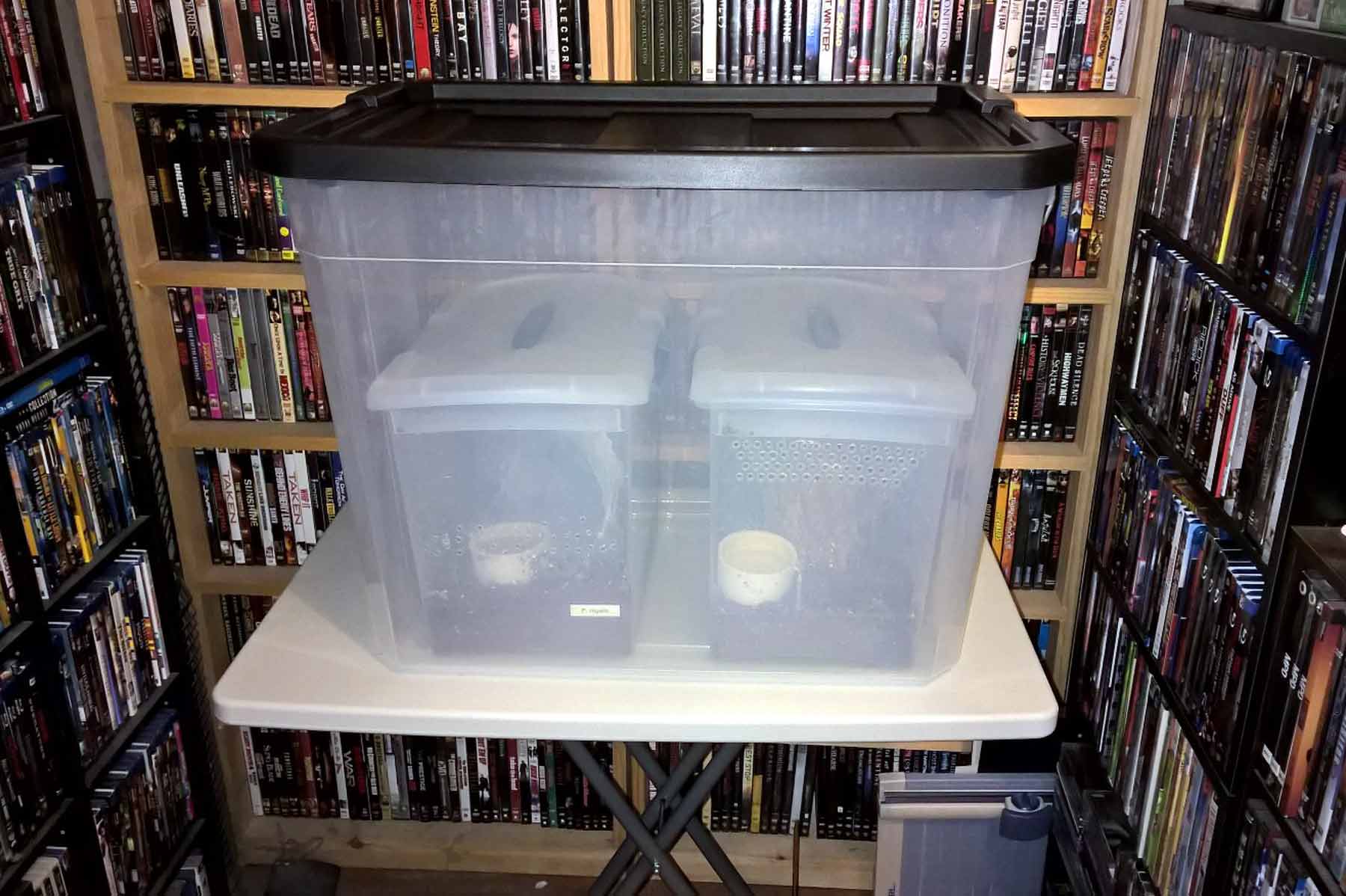
After measuring the two containers that housed my specimens, I decided that I would buy a much larger enclosure that would accommodate both the cages. With this setup, I would be able to put both enclosures in, open the tops, and let the spiders find each other on their own. This would avoid spooking the tarantulas during the introduction and allow them to encounter each other as they might in the wild. This breeding tank also offered plenty of free space should the male need to beat a hasty retreat.
A “breeding chamber” for my P. regalis pair. Both pokie enclosures were place inside this larger enclosure and their lids removed.
The tank I chose was a 27-gallon latch-able Sterilite container that offered enough floor space and height to allow the spiders to mingle on neutral territory. I used my soldering iron to put ventilation holes in both sides to allow for air flow, and I placed it on a small table in a corner of my tarantula room that doesn’t get much traffic.
The pairing
I placed both enclosures in the breeding chamber earlier in the day, but I waited until the evening to take the tops off. Within an hour, both had started to crawl out of their cages to explore. Just before bed, I observed both the female and the male drumming their legs as they courted. I’m taking this as a good sign that their may have been an insertion after I went to bed. When I turned the lights out, they were still at opposite ends of the enclosures continuing their courtship ritual.
I left them in unsupervised overnight, and when I checked on them in the morning, both were fine and perched in opposite ends of the larger enclosure. All told, they spent about 14 hours together, with about 10 of that being in darkness. I left them a bit while I had my morning coffee so I was awake enough to wrangle them both back into their cages. As it turns out, I didn’t need the coffee; each had returned to his and her respective enclosures while I was gone. I couldn’t have asked for an easier pairing.
The next step
Although I’m pretty optimistic that the two mated last night, I’m going to go ahead and try again next weekend while I still have the male. After that, it will be a watch-and-wait game as I hope to discover the female is gravid. With any luck, I’ll have a sac in a few months. I will not only post a blog update if I have any news, but I will also update this post.
Next up … it’s time to find a date for my female P. vittata.
Awesome intermediate species tarantulas with plenty of character.
Anyone that follows me on Tom’s Big Spiders, Tumblr, or YouTube has probably picked up on my Phormictopus obsession. I currently keep seven different Phormictopus species, and I am attempting to acquire all the species and color variations available. These spiders have quickly risen to the top of my list of favorite terrestrials. and I’m looking very forward to some future breeding projects with them.
But why the fascination?
I first encountered this genus while perusing the Jamie’s Tarantulas website for something new and interesting. She had just listed some Phormictopus cancerides or “Hatian Brown” slings for sale, and something about them caught my eye. At this point, I had a much smaller collection, and the majority of the specimens I was keeping were the more docile beginner terrestrials. I decided to do some research, and I discoved that most described the P. cancerides as a large brown, ornery tarantula with a bad attitude.
Phormictopus sp. purple
Large and brown? Having just acquired an A. versicolor and two C. cyaneopubescens, I was on the market for more colorful tarantulas. The idea of a “blah” brown spider didn’t quite appeal to me. Of course, after some investigating, I learned that males from this species were a gorgeous purple, and females were more a metallic bronze. This was far from just a big “brown” spider.
P. cancerides female
Ornery with a bad attitude? THAT, on the other hand, caught my attention. Most of the Ts I kept were quite calm and well-behaved, and I felt that it was time for me to graduate to something a bit more spirited and “advanced”. The idea of a larger, more feisty spider appealed to me. It wasn’t that I necessarily wanted to add a giant eight-legged terror to the collection, but I felt I was ready for the challenge if this species turned out to be less than friendly.
In my research, I also learned that this species apparently “required” moist substrate, which was a husbandry requirement that I hadn’t yet contended with. As I had my eye on some Asian terrestrials down the road, this would be a good stepping stone to keeping spiders with more complicated husbandry.
Beautiful blue slings with vicious appetites
After a week or so of research, I decided to pull the trigger and order two P. cancerides slings. When I unpacked them, I was immediately amazed by the color. These two little 1.25″ slings sported a gorgeous a metallic blue sheen that looked nothing like the supposed “brown” tones sported by their adult counterparts. I rehoused each and, as is usually my habit, I offered each its first meal.
And I instantly fell in love.
I watched in awe as one of these gorgeous blue slings bolted across the enclosure and LEAPED on a cricket with so much force that it actually rolled over onto its back for a few seconds while it wrestled with the bug on top of it. I had never seen anything like it. I quickly fed the other and was delighted to discover a similar response.
P. atrichomatus sling
Since then, I’ve discovered that all of my Phormictopus species attack their prey with the same fervor, and it honestly never gets old to see one of these guys launch itself at a roach or cricket.
As slings, Phormictopus species do appreciate deep, moist substrate, and the majority will burrow if given the opportunity. For substrate, I use a mix of topsoil, peat, and some vermiculite, and I keep it moist enough that it will hold its shape when squeezed but no water will drip out. As the spiders become established I let the top layers of the sub dry out a bit. This allows the T to burrow to the more moist depths to find the correct humidity level. If I need to add water, I’ll use the end of a paintbrush to carefully put some holes down the side of the enclosure and allow the water to filter down to the lower levels.
Phormictopus sp. purple sling
As slings, these guys are voracious eaters. During this period I will feed them 2-3 times a week, depending on the size of the prey. Unlike other species, I’ve found that Phormictopus have no trouble taking down larger prey, so I will often give my little ones crickets that aren’t much smaller than they are. They have only ever refused a meal when in heavy premolt, and even then I had one eat just a couple days before molting.
Get ready for an amazing growth rate
As I’ve stated in my other husbandry articles, my spiders are kept between 70-76° in the winter and about 75-80° in the summer. Although higher temps would obviously lead to faster metabolisms and growth, my Phormictopus species do very well in these ranges. Not only is this a species that will molt very regularly (at one point, mine were molting about every 5-6 weeks as slings), but the amount of size they gain between molts is amazing. After keeping slow-growing Brachypelmas and Grammostolas for a while, I was floored when my P. cancerides slings first molted, putting on about .5″ of size as well as impressive girth.
Although I started off with small slings, it didn’t take too many months or molts before I had large, hairy bronze spiders. In their first year, my 1.25″ P. cancerides slings reached about 3.5″ in size. Imagine the growth rate if they were kept at higher temps. On the other hand, my 1″ Phormictopus sp. purple slings grew from about 1″ to a leggy 3.75″ (I’m sure the fact that I bought them closer to the summer had something to do with the slightly faster growth rate). So far, my atrichomatus specimens, which I purchased in April as 1.25″ slings, are about 2.75″ or so.
Once mine hit about 2.5″ or so, I slow down the feeding schedule. I currently feed my juveniles a large cricket every five days. For my sub-adult specimens, they get a couple large (1-1.5″) dubia roaches once a week or so. If I have extra large crickets, I’ll sometimes toss a couple in as well for variety.
Housing for Phormictopus species
Due to the fast growth rate, I tend to house my Phormictopus species in larger enclosures than I would for other species. As slings, I usually use 2-quart clear plastic jars or the small Sterilite stackables containers (I believe it’s about 1.75 quarts or so). After filling them up with moist substrate, I supply them with a bottle cap water dish, a cork bark hide with a plant, and a starter burrow.
2-quart plastic canister (purchased at WalMart for about $2)
Although enclosures this size might seem a little large at first for a 1″ sling, they grow fast and need a bit of extra space to eliminate the need for frequent rehousings. Trust me, they will quickly grow into their new homes.
Small Sterilite stackable container.
Once my guys reach about 2.5-3″ or so, I will move them to their juvenile enclosures. For these, I use Sterilite clear plastic shoeboxes and set them up more like a terrestrial. They’ll get about 3″ of moist substrate, a cork bark hide, and a water dish. I find that at this size, my Phormictopus have become more bold and will mostly hang out in the open. They no longer burrow, but will retreat to a hide if disturbed.
My Phormictopus sp. blue female’s enclosure (a clear Sterilite shoe box)
My largest specimens (5″ or over) are currently housed in Sterilite 15-quart “ClearView” containers (purchased at the local Target). Once again, they are set up terrestrially with cork bark hide, water dish, and 3-4″ of damp substrate.
Although a lot of the early care information I read about Phormictopus indicated that they needed to be kept moist, I’ve discovered that they do fine if the sub dries out a bit in between as long as they are provided water dishes. Although I start all of mine on moist sub, I let it dry out a bit and periodically moisten down part of the dirt when they are near a molt. I’ve noticed that they don’t seem to gravitate to this moist area, and are quite content to sit on the dry end.
I will note that other keepers still make sure to keep their Phormictopus species moist at all times, and those interested in breeding are often much more careful in keeping the moisture levels up. However, unlike my Pamphobeteus and Theraphosa, I don’t obsess about it with these guys. If you buy one of these species and the enclosure dries up a bit, they will be fine as long as they have water.
A note about temperament
Phormictopus species have developed a bit of a reputation for being a bit ornery and defensive. I’ve found slings of this genus to be quite fast and skittish, often bolting around their enclosures or to their burrows if disturbed. As they gain some size, they become a bit more bold, often sitting out in the open when their enclosures are opened. Still, they can move quite quickly when motivated, and I’ve heard of instances where they are not reluctant to use their fangs.
Phormictopus sp. Purple
Out of the seven species I currently keep, I’ve only ever received a threat posture from my sp. purples; they seem to be a bit more high strung than my other species. Personally, I’ve found that if I’m careful not to disturb them when I perform maintenance or feed them, they are relatively calm when they get older. They also seem quite reluctant to kick hairs, which is a huge plus in my book. To date, only one has ever kicked hairs that I’ve witnessed.
Still, these guys get pretty large, with some reaching 8″, and their amazing feeding responses often have them charging anything that enters their enclosure (including a keeper’s tongs or paint brush). Caution should be exercised whenever feeding or performing routine maintenance.
A wonderful stepping stone to faster and feistier species.
For those who have successfully kept some of the beginner species and are looking to graduate to faster, more defensive intermediate species would do well to check out some of the spiders the Phormictopus genus has to offer. These are large, hardy, fast-growing tarantulas with relatively simple husbandry that are very similar to the super-popular Pamphobeteus species in terms of build and temperament.
It’s also worth mentioning that males of these species are often quite colorful, with some sporting beautiful purples and blues after their ultimate molts. This makes discovering that your spider is a male quite a rewarding experience…after all, who doesn’t like purple spiders?
For most tarantula keepers, females are where it’s at.
It’s not that we don’t have love for their male counterparts. In fact, some male species like Phormictopus and Pamphobeteus are more colorful and stunning than the females. No, in most instances, the reason comes down to longevity and their ability to produce young. Female tarantulas are much more long-lived than their male counterparts, often thriving decades after the males have matured and expired. Females can also be bred to produce slings, an integral and fascinating part of the hobby for many.
The story is a bit different for male tarantulas. Some species of male tarantulas can mature in just over a year, leaving you with a leggy, antsy boy who wanders around his enclosure in a desperate attempt to fulfill his life’s goal to mate with a willing female. At this point, the best thing you can do for this tarantula that you have lovingly raised and cared for is to ship him off to someone with a female for breeding, leaving you with an empty cage. Sure, you can do do a breeding trade for half of the slings a successful pairing produces, but not all attempts end in viable sacks, and some end with the male being unceremoniously munched.
Those who enjoy raising tarantulas (and who don’t feel like paying the higher prices for sexed females) will often pick up spiderlings. As small slings are often difficult, if not impossible, to sex accurately, you never know exactly what you’re getting when you pick up a tiny spiderling. Many keepers (myself included) will pick up three or more slings of the same species at a time to increase their chances of getting a female. You then feed them, love them, and watch for signs that you might have hit the spider jackpot with a female.
Female C. cyaneopubescens molt (GBB)
Sometimes you notice one growing faster than the others, and immediately suspect a male. After all, males in many species will grow and mature faster. Other times, you see the spider’s underside pressed up against the side of its enclosure and you swear you see female parts. And still others, you’ll latch on to some physically dimorphic feature, like color or patterning, in hopes that it indicates a female.
Any keeper who has patiently waited to sex a spider they have raised from the sling stage has undoubtedly experienced the thrill of discovering they have raised a young lady … or the letdown that their beloved pet is a more short-lived male.
How do you sex a tarantula?
There are several methods keepers to use to determine the sex of their tarantulas, but many are not very accurate or require the keeper to have plenty of experience as well as a keen understanding of the anatomy of many species.
One method used to sex tarantulas is ventral sexing, which entails examining the tarantula’s ventral area (the bottom of the tarantula) around the epigastric furrow to try to determine its gender. The epigastric furrow is an opening between the set of book lungs closest to the cephalothorax (body) of the spider. Folks using this method will compare the curve of the furrow, the distance between the anterior book lungs, and the angle of the lungs to determine gender.
In females of some species, the epigastric furrow is more pronounced with what can be described as “lips”. In others, it is not nearly as pronounced. This method takes plenty of practice and knowledge of what both the female and male characteristics of each species are. Keepers attempting this technique will want to do some research and get some photos of both males and females for comparison.
A ventral shot of an A. insubtilis. This specimen was likely male.
Personally, I don’t even try to sex via ventral shots anymore, as I don’t feel that I’m particularly good at it, and it’s often not very accurate. Sure, some species like some of the Poecilotheria sport some fairly obvious lady parts early on, but others can be quite misleading and difficult to determine. Arachnoboards has a wonderful area where keepers can post ventral shots of their Ts so that others can determine the sex, but due to the trickiness of using this technique, many of the responses are just guesses (as evidenced by the same spiders being proven to be a different sex later on). Still, if you attempt this method, try posting a good ventral photo up on this board to get some other opinions.
There is also the epiandrous fusillae method. With this technique, the keeper looks for epiandrous fusillae, or a second set of micro spinnerets used by mature male tarantulas to create sperm webs. This is a technique that requires a keen eye and a lot of practice, so it might not be the most appropriate for some keepers, especially those new to the hobby.
Sexing your spider using the molt
The best way to your tarantula is to examine its exuvia or molted exoskeleton. An intact molt from a larger specimen (smaller specimens may require use of a microscope) can be examined for evidence of the female’s spermathecae, or the receptacle the female that stores the male’s sperm in. This organ is often described as a little “flap” or “pouch” above the epigastic furrow.
Although this method can be tricky at first, especially with smaller specimens, it’s the most accurate and easy to practice. All you need is an intact molt, some good lighting, and you can give it a shot. Here’s how to go about it:
A comparison of molts from a 3.5″ male and a 3.5″ female T. stirmi. The piece of paper on the female molt is showing the “flap”.
1. First off, you’ll want to do some research and find reference photos for both a male and female of the species you want to sex. I would encourage folks to hop on Arachnoboards’ Tarantula Sexing board and check out some of the shots there, or do a Google or Bing image search and study some of those. Every species is different, so looking at a molt from a L. parahybana might not be useful for determining the sex of a GBB.
2. Next, you need a molt that has the abdomen flesh containing the book lungs intact. If the abdomen has been completely shredded in this area, you will find it difficult or impossible to sex the molt. I try to grab the molts from spiders I want to sex right after they molt (as long as I can do it without disturbing the tarantula).
3. You need to soften up the exuvia, or molt, to make it less fragile and more pliable. I use a very small spray bottle and give it a few squirts. I then wait a few minutes for the molt to soften up. Other folks will drop the molt into a dish of warm water for a minute or so. Either of these methods work, just use care when handling the molt not to tear it or get urticating hairs on you. You may also want to put it on a piece of paper towel to wick up some of the excess water.
4. Position the molt so that the fangs are facing up and the molt is on its “back” on your well-lit working area. I like to use white plates myself, but a piece of foam board would be great if you want to pin the molt down. Now, carefully spread out the legs and unfurl the abdominal skin if it has become twisted. Work slowly and carefully, as the area that you need to sex the molt is VERY fragile and will tear. I will usually use toothpicks and cotton swaps to unfurl mine. You want to open up this abdominal skin so that you can see the underside of the area where the two sets of book lungs are.
5. Now, some folks will immediately spot a slit between the set of book lungs closest to the body and think that they have a girl. Not so. This slit is found on both males and females. What you are looking for is a pronounced “flap” or the spermathecae, which will be above the epigastic furrow if present. The smaller the specimen, the more difficult this area can be to see. I often use a magnifying glass or take a close-up photo with my phone to get a better look. On well-developed females, you can even take a small piece of paper and slide it behind the flap to be sure.
If you find the spermathecae, congratulations … it’s a girl! If not, and you are sexing a largerer specimen, you are likely looking at a male. You can always try again on a future molt to double-check.
Now this all sounds quite simple, but it’s not always that cut and dry. Some species don’t develop enough for the casual keeper to sex until later in their life cycles. Also, males from some species will have organs that can be mistaken for spermathecae, meaning that sexing those species can be a bit more challenging. If you are trying to sex your pet, you should spend some time researching and examining molt photos from both the males and females of the species. For some wonderful reference diagrams of the spermathecae of females from different species, check out this site. A Google search will also bring up several useful photos, and you can also check the sexing topic on Arachnoboards and compare the photos.
L. itabunae female molt with the spermathecae highlighted.
Recognizing mature males
It should be mentioned that mature males can be quite easy to sex, and you will often hear keepers refer to their males as “hooking out.” This expression comes from the fact that males from some species develop tibial “hooks” behind the knees of their first set of walking legs upon maturing. The key word here is “some”, as many species will not present this feature while others, like some in the Avicularia genus, will have hooks too small to see.
An illustration of a male tarantula. Some species don’t have tibial hooks, so it is better and more accurate to look for the emboli.
Honestly, the phrase should be changed to “bulbing out” or something similar, as keepers should be keeping an eye out for another telltale feature; namely the bulb-like emboli at the end of the male pedipalps. The pedipalps are the shorter set of appendages inside the first set of walking legs that look like shorter legs. When a male spider has his ultimate molt, he develops emboli, or essentially the male’s sexual organ used to deliver the sperm to the female, on the end of his pedipalps. Instead of the ends of these appendages looking like the rest of the tarantula’s “feet”, they will instead be round and bulbous (some keepers refer to them as “boxing” gloves).
A comparison of a mature male’s pedipalps (with emboli) and a mature female’s.
Because all male tarantulas will develop this feature, it makes more sense to look for emboli when trying to determine if your spider is a mature male or not.
Not only do males mature much faster than their female counterparts, but there are often many physical differences between a male and female of the same species. First off, males tend to be thinner and “leggier” than the girls, who are much more heavy-bodies. Many male tarantulas have different colorations than females, with some being very pronounced. Female L. violceopes, for example, sport gorgeous iridescent blues and purples upon reaching maturity. Males, on the other hand, are brownish to olive in color. Some males also mature at a much smaller size than the females of the same species; this can lead to some confusion for keepers who discover that their gangly male is done growing at 5″ and will never reach the 7″ max size of the females they’ve read about.
Unfortunately, many of these features won’t appear until the specimen’s ultimate molt, so those using this “method” would literally be discovering their pet’s sex at the latest possible opportunity.
Lots of practice is required!
No matter what method you choose to try to sex your specimen, research and practice are key. I have literally examined over a hundred molts now and spent countless hours staring at sexed molts on my computer screen. And although I feel like I’ve definitely got the hang of it, I still have difficulties at times. I’m certainly not yet an expert yet. When you’re first starting out, be sure to try and sex every molt you can. Do you have specimens that are already sexed male or female? If so, examine and photograph their molts as practice and to use as references.
With all of the variations between species, it can be very difficult to know what to look for. I would encourage anyone attempting to sex their T to look up the species first and find out all you can about it’s anatomy or any sexual dimorphism. Some questions you should be researching are:
Are their differences in colorations, marking, or bandings between the sexes?
Is this a species that can be sexed ventrally with accuracy?
What is the shape of the female’s spermathecae?
At what size to the genders become apparent enough to accurately sex by molt?
Does the male of this species have an organ that could be mistaken for a spermathecae?
Does the male of this species have tibal hooks?
Sexing may seem daunting and confusing at first, but with enough practice, most keepers will be successfully identifying the genders of larger specimens in no time. And honestly, the first time you examine a molt and discovering that the sling you have raised for a year is a little lady makes all of the effort and frustration worth it.
* Note: I will continue to update this blog with photos of sexed molts. It’s my hope that this can be a resource for some looking for reference photos.
So, earlier this week I was a bit disappointed when one of my Monocentropus balfouri young adults molted into a mature male. Although the little guy is gorgeous with his metallic blue carapace and legs, it means he won’t be with me all that much longer.
Well, yesterday I was delighted to discover that one of my others molted, and it’s a girl! The little beauty was stretching out on the surface, so I took the opportunity to get some photos and this quick husbandry video.
If I were to make a list of best entry-level Old World tarantulas, the M. balfouri would likely be right at the top. This fossorial species is very simple to keep, needing only deep, dry substrate and a water dish to thrive. Mine do well in temperatures in the 70s, although higher temps would lead to faster metabolisms and growth.
Temperament-wise, they are quite calm compared to some of my other baboon species. I’ve found these guys to be more skittish than defensive, and to date I’ve only received one threat posture from any of them. When startled, they will usually just bolt to their dens and hide. That said, temperament can vary from specimen to specimen, and this species is quite fast and can pack a wallop of a bite, so caution is always advised.
Even better, of all of my fossorial species, my balfouris are usually quite visible, venturing out at night to hunt and sometimes just hanging out on the surface. This isn’t your standard “pet hole”, which is great as they’re just too darned pretty to spend all of their time hidden.
Although I feel like I tend to ramble a bit in all of my videos, this one might be even worse do the impromptu nature of it. I was basically snapping photos of this little girl when it dawned on me that I should get a video before she retreated to her den again. So, with little preparation, I set to it. You’ve been warned!
With school in full swing (I’m a teacher by trade), I’ve had less time to sit in front of the computer and write my blog posts. Writing time has basically been limited to weekends for the time being.
However, as I am always diddling around in my tarantula room, it is quite convenient to whip out the camera and catch some footage as I work. It’s been a bit of an awkward transition (talking to an audience you can’t see is a LOT different from teaching a classroom full of kids), but I’m actually finding it a lot of fun.
This video was particularly fun to film, as this cute little girl just did not want to stay in her enclosure! She is easily the most inquisitive tarantula I keep.
A little side note: if you’re interested in this species and you find one for sale, buy it. With Chili closing it’s borders to the exportation of their species (many of the young adults offered on the market were wild caught) and with few people breeding them, the Euathlus is becoming very difficult to come by.
When I noticed some chunky yellow mold forming in my P. atrichomatus‘ den, I figured it was time for this specimen to get a new home. I’m guessing that the little guy left a bolus or two down in the moist lower levels of the enclosure, which led to the break out. Now, normally I don’t freak out if I find a bit of mold in an enclosure; if kept in check, it poses no threat to the animals. I will just used a spoon to spot clean and let the affected area dry out. However, as this mold was inaccessible, and the spider would outgrown the enclosure with its next molt, a rehousing was in order.
Because my daughter, Sid, has been encouraging me to do more YouTube videos, we broke out the camera and headed out to the garage to make a rehousing/husbandry video. I’m hoping that folks that aren’t enamored with my often long-winded care blogs might find the videos a bit more accessible (and my daughter not-so-secretly hopes these vids will launch her YouTube career…).
A typical fast-growing, hardy Phormictopus species
Although I cover most of this species husbandry in the video, I’ll share a bit more in-depth info for those who don’t watch it.
I picked a trio of these guys up as 1.25″ slings from NERD back in April and, like my other Phormictopus species, they’ve proven to be voracious eaters and fast growers. The largest of the three is now pushing 3″ or so, and the other two are around 2.5″. As slings, I keep all of my Phormictopus on deep, moist substrate. All have exhibited a propensity to burrow, so I encourage the behavior. Slings are a beautiful shade of blue, and despite having burrows, most will remain visible at the entrances as they wait for prey.
As they hit the juvenile stage (about 1.75-2.5″ or so), I don’t worry much about keeping the substrate moist. At this point, they will have a larger water dish for drinking and humidity, and I’ll pour some water over the substrate every month or so, letting it dry out in between. I still give them deep substrate to burrow in, which allows the deeper portions to remain moist and maintain more humidity. However, I’ve observed that by the time they hit the 3″ mark, most will stay right on the surface and will only race to their dens when spooked.
These guys like to eat
Like Theraphosa and Pamphobeteus species, Phormictopus are great eaters and fast growers. Even though mine are kept on the cooler end at times (70-26 in the winter and 75-80 in the summer) they still grow like weeds. The size gained between molts is truly impressive, with larger specimens picking up an inch (and quite a bit of thickness) during a shed.
With that quick growth comes a healthy appetite, and my Phormictopus species gobble up crickets and roaches like they’re tic tacs. I generally feed my juvenile 3-4 crickets at time, and watching these spiders scramble to snatch them all up is incredibly entertaining. They will literally zigzag across the enclosure at startling speed as they chase down crickets.
A large, “spirited” terrestrial
Although this is a very hardy tarantula with relatively simple husbandry requirements, it might not make the best beginner T. Phormictopus species grow into rather large, quick tarantulas with plenty of attitude, which could make them quite intimidating to those used to calmer terrestrials. As slings, species in this genus tend to be more skittish than defensive.
However, with size comes attitude.
I have observed that their infamous attitudes seem to start to manifest more as they get larger. My sub-adult specimens are quite bold and wont hesitate to stand their ground or come at you when you disturb their enclosure. Although I have yet to have one flick hair, I have seen some fangs. An amazing feeding response coupled with a defensive nature can make for some heart-stopping moments with these guys. Although I’ve been fortunate in that most of my Phormictopus species tarantulas have been relatively calm, I have seen what can happen when a large specimen is spooked (or mistakes the tongs for a cricket). Personally, I love their spirited behavior, but other keepers might find it a bit off-putting.
However, for those with some experience under their belts who are interested in large, fast-growing terrestrial tarantulas, P. atrichomatus or any other Phormictopus species should not be overlooked.
With some encouragement from my 10-year-old daughter (who’s a bit YouTube obsessed), I’ve decided to post some more videos and work on my channel a bit. I’ve already filmed a couple transfer videos, and I’ll be doing some fun feeding features as well. However, as someone just asked me about how I care for my Pamphobeteus species, I figured it would be cool to start with a husbandry video about my Pamphobeteus species duran.
Instead of doing a normal husbandry blog, I broke out my Nokia 1520 and filmed the little guy/gal as I spoke. I won’t lie … this was a bit more fun than just sitting in front of the computer and writing about them. Hopefully, this is entertaining and not too irritating…







 Tom's Big Spiders