Harpactira pulchripes (Golden Blue Leg Baboon)

H.-pulchripes-NEWEST

The new “jewel” of the hobby.

Over the years, there have been dozens of newly introduced tarantulas species that have caught the eyes of hobbyists with their undeniable beauty and the appeal of being a rarity in the hobby. More recently, the Poecilotheria metallica and Monocentropus balfouri were two spiders that delighted keepers with their gorgeous blues while draining wallets with their steep costs for even the smallest slings. Even today, with both species being readily available in the hobby, they still command high prices.

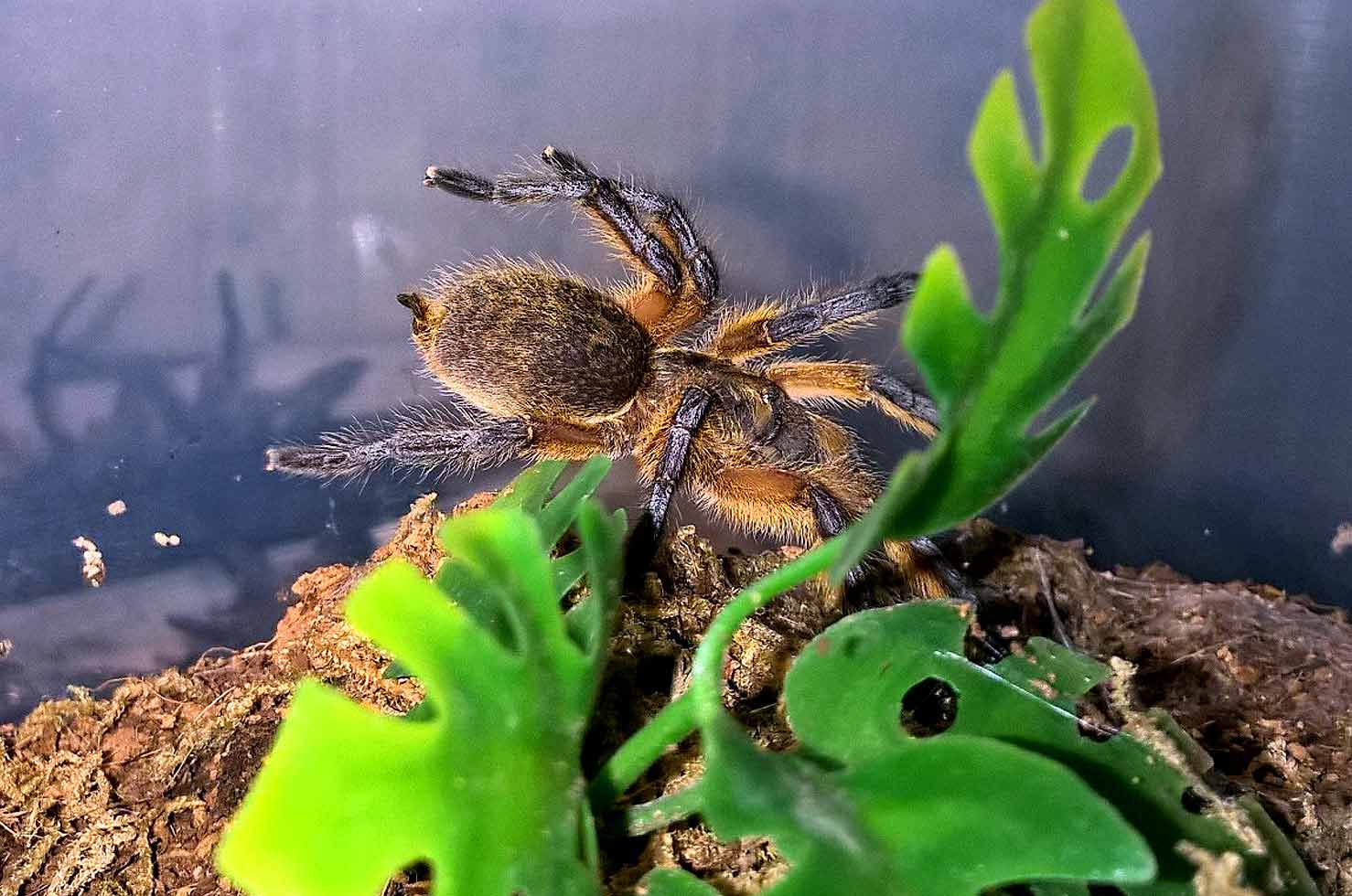
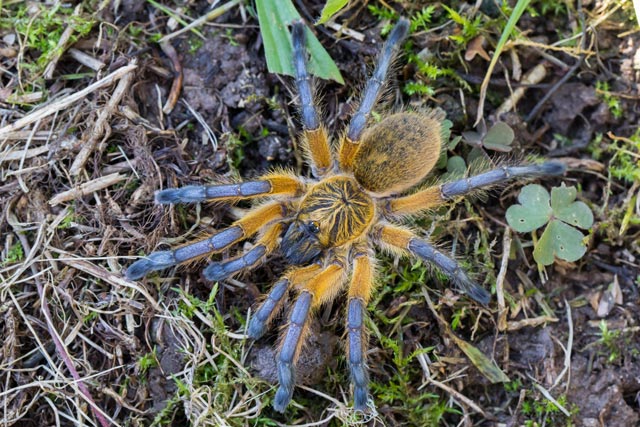
Today, many keepers consider the Harpactira pulchripes, a striking orange bodied and metallic blue legged beauty, the hobby’s latest crown jewel. This relatively new African species pops up on many keepers’ wish lists, and folks who manage to acquire one proudly share photos like a rich kid showing off his new sports car. And like a status car, these little spiders can come with a shocking price tag that many find ridiculous.

The fact is, new species, especially African ones like the Harpactira pulchripes are first collected and bred by Europeans and exported to the United States in limited quantities. Couple the cost of legally importing tarantulas into the US with their initial limited availability, and you have the makings of one pricey T.

Check out my female in action in the video below!

Early on, the only folks generally interested in paying these prices, often reaching well over $1,000 for a pair, are breeders looking to be the first to breed the species stateside (and make a pretty profit in the process). Other interested hobbyists will often wait a year or two until a new species is successfully bred a couple times, bringing batches of more affordable slings into the marketplace.

When I first saw a photo of a H. pulchripes, I had only been really into the hobby for a short time and I had no idea that I was viewing a newly introduced spider. I was therefore shocked when I saw that .5″ slings were going for about $500. It didn’t take me long to abandon all hope of acquiring this gorgeous spider any time soon.

H. pulchripes adult.

H. pulchripes adult.

In about January of last year, I got a lead that one of the breeders I normally buy from was expecting a shipment of babies, and slings would be available for $300 each or $275 a piece if you bought three. Although I considered making a purchase, that was a still a bit out of my price range. Over the next several months, I watched as prices for .5″ slings decreased from this price point to as low as $225 from one dealer. With a few folks managing to produce slings in the US, prices were already falling.

1" H. pulchripes sling

1″ H. pulchripes sling

Finally, I found an offer that was almost too good to be true. Stamps Tarantulas was offering 2.5″ sexed female juveniles for $300. Even better, he was having a 25% off everything sale. I would be able to get a guaranteed female for less than I almost paid for a single unsexed sling. I jumped at the opportunity and placed my order.

Now, there was a slight mix-up with my order, which lead to me being sent a 1″ sling instead of my female. Steven was quick to rectify the situation, and when all was said and done, I was the proud owner of both a H. pulchripes sling and a sexed juvenile female. To say I was a happy customer would be the understatement of the year (thanks, Steven!).

Enclosures and setup

I used a basic setup for both specimens, a modified 1 quart clear plastic canister for the sling and a 1.5 gallon Sterilite container for the juvenile. I modified both to add ventilation (holes for the canister and round vents for the Sterilite container).

H. pulchripes sling enclosure

H. pulchripes sling enclosure

H. pulchripes sling set up

H. pulchripes sling setup

For substrate, I used a mostly-dry combination of peat and coco fiber. After packing this down in the enclosures, I packed some dry substrate on the top. Both were offered cork bark with some plastic leaves for a hide, and I used my finger to pre-start a burrow for each under the cork bark.

The juvenile has a milk cap for a water bowl, and I keep it filled with fresh water (although my girl has enjoyed filling it with dirt). The sling will be getting a water bottle cap for a dish soon. For the time being, I use a water dropper to add some moisture to the plastic plant and webbing in case it wants a drink.

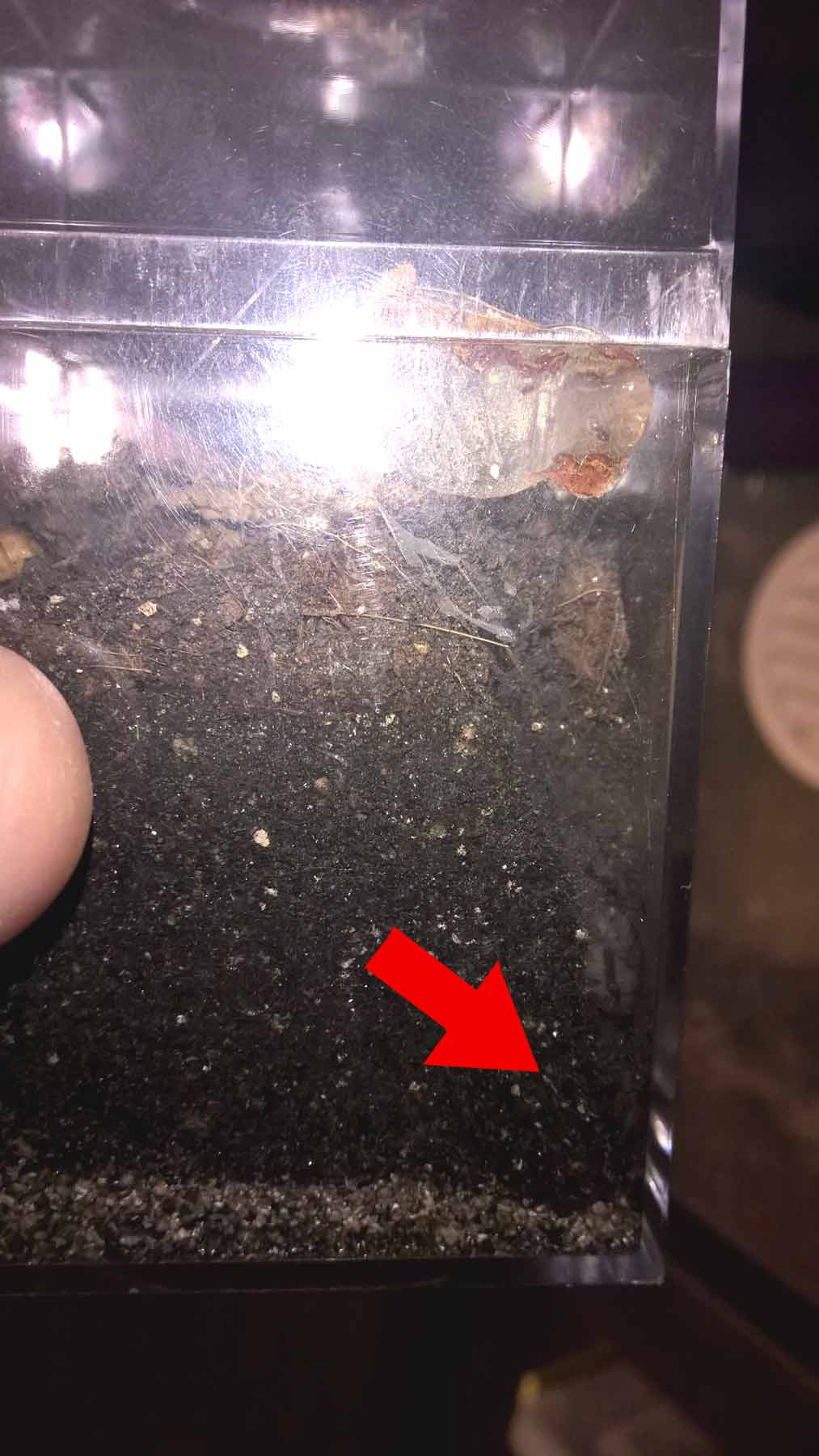
Both specimens took to their burrows the first night, and they have spent several weeks burrowing a bit and webbing up around the entrances. Although each has constructed a fairly deep burrow in the substrate, they are both out and visible quite often (the sling does move to one of its holes whenever I disturb its enclosure).

H. pulchripes juvenile setup

H. pulchripes juvenile setup

A beauty with a voracious appetite

Both of my pulchripes have been great eaters. I drop a cricket in overnight, and it’s always gone in the morning. When I first got my sling, I didn’t have a cricket small enough for it as I was expecting a 2.5″ juvenile. Therefore, I dropped in a pre-killed cricket for it to scavenge feed on. When I checked in the morning, the sling had dragged the carcass beneath the cork bark and had devoured the entire thing. On average, I feed this specimen three times a week. While the weather is warm, I’ll be taking advantage of its higher metabolism to grow it out of the more fragile sling stage faster.

The juvenile has had no trouble taking down medium-sized crickets; I just drop them in at night, and they’re gone in the morning. She has currently sealed herself up in her burrow for premolt, so I’m eagerly awaiting the impending shed. Before she stopped eating, I was feeding her on a twice a week schedule.

Like most of my baboons, the H. pulchripes  don’t get as fat in the booty as some of my New World terrestrial Ts get when they are about to molt. Despite powering down several crickets, their abdomens never seem to get overly plump.

As I acquired these guys in the summer, temps in my tarantula room have been between high 70s to low 80s. I’m assuming that when the winter comes and temps are in the low to mid 70s, their metabolisms will slow down a bit and molts will come more infrequently.

Not as high-strung as most baboons

So far, both H. pulchripes have been relatively calm when compared to other “baboon” species of tarantulas I keep. The female in particular is fairly low-key, staying out in the open most days and calmly seeking shelter if I disturb her enclosure. The sling is a bit more skittish, but so far she is nowhere near as flighty as my M. balfouri, C. darlingi, or my P. murinus juveniles.

This doesn’t mean that I let my guard down with these spiders as I’ve seen their speed and know what they are capable of. The H. pulchripes is a lightening-fast Old World species capable of delivering a very painful, possibly debilitating bite. Also, tarantulas often change disposition after a molt, so I know that the next shed could bring different or more extreme behaviors. Caution and care always need to be exercised with Old Worlds species.

But, is it worth it?

There’s really no denying that the H. pulchripes is a striking tarantula, but is it really worth the money? I guess the answer to this question would vary from keeper to keeper. Some folks who aren’t particularly enamored with the look of this animal would likely argue “no way.” Even many of those who find this species desirable would likely choose to wait until prices fall considerably before trying to procure one. For breeders who are looking to make an investment in an uncommon species, I would guess it would be an enthusiastic “YES.”

Personally, I love baboon species, and I was enamored with the color of this tarantula the first time I saw it. While researching it, I also learned that there wasn’t a lot of care information out there yet for this species, so I was enticed by the idea of possibly getting to blog about its husbandry for future keepers.  And I know I already have one female, so a breeding project will definitely be in the future… I’m quite pleased with my purchase, and I’m looking forward to growing these two to adulthood.

Power Feeding Tarantulas

Powerfeeding-for-dummies

Or, how to learn to stop worrying and just feed your tarantula when it’s hungry.

Power feeding: The act of accelerating an animal’s growth by increasing temperatures and the amount and/or frequency it is fed.

If you’ve been in the hobby for any amount of time, you’ve likely been privy to a debate between hobbyists about the virtues or dangers of feeding tarantulas too much. Although a less incendiary topic than handling, this subject of “power feeding” still manages to elicit some strong views as folks are seemingly split over whether this is a harmless practice or a detriment to tarantulas’ health and longevity.

I’ve had many new hobbyists contact me over years needlessly worrying about whether or not they are going to overfeed their tarantulas or concerned with this horrible thing called “power feeding” that they’ve heard about and been told to avoid. When I tell folks to feed their slings as often as they want, I often get a response along the lines of, “But isn’t that power feeding? Won’t that shorten the life of my T?” I’ve even be trashed by a concerned hobbyist that told me that feeding my animals more than once a month constituted animal abuse.

Okay then…

In many ways, the term “power feeding” has become a bit of a dirty phrase to some in the hobby … which is ironic, as many informed and experienced hobbyist would argue that it doesn’t even apply to tarantulas. The term actually originated in the herp hobby, particularly when breeding color morphs of ball pythons. While snake breeders have used power feeding for decades in order to quickly get their specimens to breedable size, the practice has been recognized for having adverse effects on the animals’ health. Therefore, the assumption is that the same practice would also be harmful for arachnids.

Unfortunately, comparing snakes to tarantulas, two very different organisms, doesn’t work in this instance. 

The fact is, many expert keepers feel that feeding your tarantulas as much as they will eat has no negative impact on their health and longevity. Although much has been said about the negative impacts it could have on an animal, they point to lack of scientific proof (and point to mounds of keeper anecdotal data that seems to dispel this idea). They argue that the worst that can happen from feeding a spider all it will eat is a fat tarantula that will fast for a while.

Many inexperienced hobbyists will understandably err on the side of caution and avoid this practice for the sake of their animals’ well being. They will unfortunately read about “power feeding” on some website and immediately worry that they might overfeed their pet. Due to this misinformation, they feel strongly that, by allowing their animal to “overindulge”, they are putting its health and lifespan at risk.

However, are they really extending their tarantulas’ lifespans, or is the idea of “power feeding” tarantulas only a myth?

First off, how would one “power feed” tarantulas?

Before we get any further, it’s important to define what supposedly constitutes “power feeding.” Although most folks think power feeding is just increasing the amount of food you give to your tarantula, it’s not quite that simple. To truly power feed, you need to do two things:

  1. Increase the temperature: To get the quick growth “power feeding” is meant to promote, you also need to stimulate the T’s metabolism. This is done by increasing the temperatures to the low 80s for most species. Basically, the warmer the surroundings, the faster your tarantulas will grow. If the temperature in your home is dipping to 68° F (20° C), then your T will not have the fast metabolism required for quick growth. For true “power feeding”, it’s more about speeding up the metabolism than just pumping your T full of food.
  2. Feed the tarantula as much as it will eat:  With its metabolism sped up, it’s now time to increase the frequency food is offered. This can be every day or every couple days, depending on the size of the meal. If you give your .5″ sling a medium cricket to scavenge feed on, it might only be need to be fed a couple more times before it’s ready to molt. If you are feeding smaller, more manageable-sized prey, then it may eat every day to every other day.

It’s really that simple. Unfortunately, many folks will try to feed their Ts more without providing a warmer environment. Doing so will likely result in a fat T who takes its time molting (trust me … I’ve done it). It’s important to remember that higher temperatures have more to do with growth rate than how often you feed.

Now, some folks seem to consider it “power feeding” when you feed a slings multiple times a week. Personally, I think that’s a bit ridiculous. Many tarantulas are at their most voracious when they are slings, and this is a great time to make sure they get as much food as they can take. If the temperatures are high enough, and they are well-fed, this will lead to faster growth (and get your animal out of the delicate sling stage earlier).

Many hobbyists reason that tarantulas know what they are doing; if they want to eat, they’ll eat. If they’re not hungry, they won’t. In the wild, it behooves a sling to grow as fast as possible to outgrow this vulnerable stage. As slings, these animals are at particular risk from predators and the elements. During times when prey is plentiful, they would likely eat as much and as often as possible in order to foster faster growth.

So, why wouldn’t this hold true in captivity?

Even in captivity, tarantulas are most vulnerable during their sling stage. At this time, they are prone to dehydration and extra susceptible to environmental factors like humidity and temperature. Many, if not most, of the sudden deaths reported by keepers are spiderlings. Therefore, many keepers will feed their sling much more often

Personally, I tend to feed my slings as much as they’ll eat in the summer when the temps are around 80 or so for just this reason. Once the sling hits about 1.25-1.5″, I slow the feeding down to one or twice a week (depending on the size of the prey). This has worked very well for me.

Is feeding slings as much as they will eat really “power feeding”? Most experienced keepers would argue NO. Eating while food is available is a natural adaptation that allows for them to quickly grow in the wild.

But what about the adults? Again, many would argue that the “power feeding” really doesn’t apply, at least not in the way it does with snakes. Keepers have discovered that tarantulas will only eat until a certain point, then they stop and prepare to molt. Furthermore, feeding them more often doesn’t make them molt faster; instead they will usually spend quite a bit of time fasting as their bodies have told them they’ve had enough. Therefore, feeding your larger specimen more often isn’t likely to lead to a faster growth rate the way it would with slings.

For example, I have a young adult P. cancerides who I fed large dubia roaches to several times a week. After about a month of living the high life, it stopped eating…and didn’t molt for almost five months. Feeding her as much as she would eat definitely didn’t speed up her growth.

There’s a lot of anecdotal evidence from experienced keepers that seems to indicate that “power feeding” really doesn’t apply to these animals. If that’s the case, then, folks who are choosing to feed their spiders multiple times a week aren’t doing their animals any harm.

Why might a keeper decide to feed her spiders more often?

A new keeper may be thinking, why might someone feed their spiders more often when they can get away with once week? There are a few solid reasons a keeper might partake in this practice.

The keeper is trying to grow a female to maturity faster for breeding purposes. If you’re a breeder with a young female you are hoping to mate, you may not want to wait the several years it could take for her to mature on a normal once a week feeding schedule. Breeders will often jack up the temps and feed females as much as they’ll eat in an attempt to get a breedable specimen faster. This is especially true for folks who pay huge amounts of money to import new species with the hopes of producing some of the first captive bred slings. In this case, the goal is to get a viable sack (and big money for the sought-after spiderlings) as quickly as possible.

The keeper is trying to mature a male faster for breeding purposes. So, you have your female ready, and you’re having a difficult time locating a mature male. Just like in the instance above, the keeper may try to mature a sling or juvenile male more quickly through power feeding to get a mature male faster.

The keeper is trying to grow his/her spiders out of the delicate sling stage faster. Personally, this is something I do. Tarantulas are at their most vulnerable during the sling stage, where they are much more sensitive to environmental conditions and husbandry mistakes. Personally, I want my tiniest guys out of this stage as quickly as possible, so I usually give them as much as they will eat until they reach about 1.25-1.5″ in DLS. At this point, I switch them back to a more normal schedule of about twice a week.

The keeper wants his/her tarantula to grow to adulthood faster for aesthetic reasons.  The fact is, when you tell people that you have tarantulas, they are expecting to see giant hairy spiders. Unfortunately, even the largest of these awesome beasts start off as tiny, fairly unimpressive slings. Some hobbyists opt to power feed in order to get a large display spider faster.

But does feeding your tarantula often shorten its life?

It should be noted that nothing has been done in terms of scientific research as to how power feeding might negatively impact a spider. Most of what we think we know is postulation and guesswork. Until someone does some controlled experiments comparing sac mates that are power fed to those who aren’t, we’ll have to continue with our own observations and anecdotal evidence.

That said, there are keepers that have been in the hobby for decades who seem to find that the idea of overfeeding a tarantula is simply foolish. Their years of collective experience in keeping and breeding has taught them that these animals do not experience the same health issues snakes or mammals would when fed regularly.

So, now that we’ve heard the benefits of feeding spiders whenever they’ll eat, what are some of the perceived issues surrounding this practice. Below is a list of the supposed cons according to folks who are against it.

  • Shortens the lifespan of the tarantula
  • Can cause molting issues
  • Stretched abdominal skin can rupture more easily
  • Some believe it can cause fertility issues in males and females (although this one had been disproved repeatedly)

Now, it must be mentioned that many of these side-effects, like molting and fertility issues, have all been disproved. There are plenty of breeders out there who have fed their Ts often to get them to breeding age, and none have reported issues. As for molting issues, some have argued that in species like Theraphosa stirmi, it can cause bad molts. However, many keepers feed this species as much as it will eat and have no issues whatsoever. Again, this appears to be a myth.

Now, it IS absolutely true that fat spiders are more prone to abdominal ruptures, so this is a very real concern.That said, a properly set up enclosure with the correct amount of substrate and ceiling height would seriously limit the chance of this happening.

But doesn’t “power feeding” reduce lifespans?

The answer is: if it does, it’s usually not enough to worry about. For most species, the only time feeding them more will make a difference on growth rate is when they are slings. As established, they are designed to eat as much as they can during this period, and well fed slings will grow faster than slings fed less often. That said, their growth rates will usually slow down a bit once they put on some size, so the amount of time supposedly sheered off their lifespans would be very short indeed.

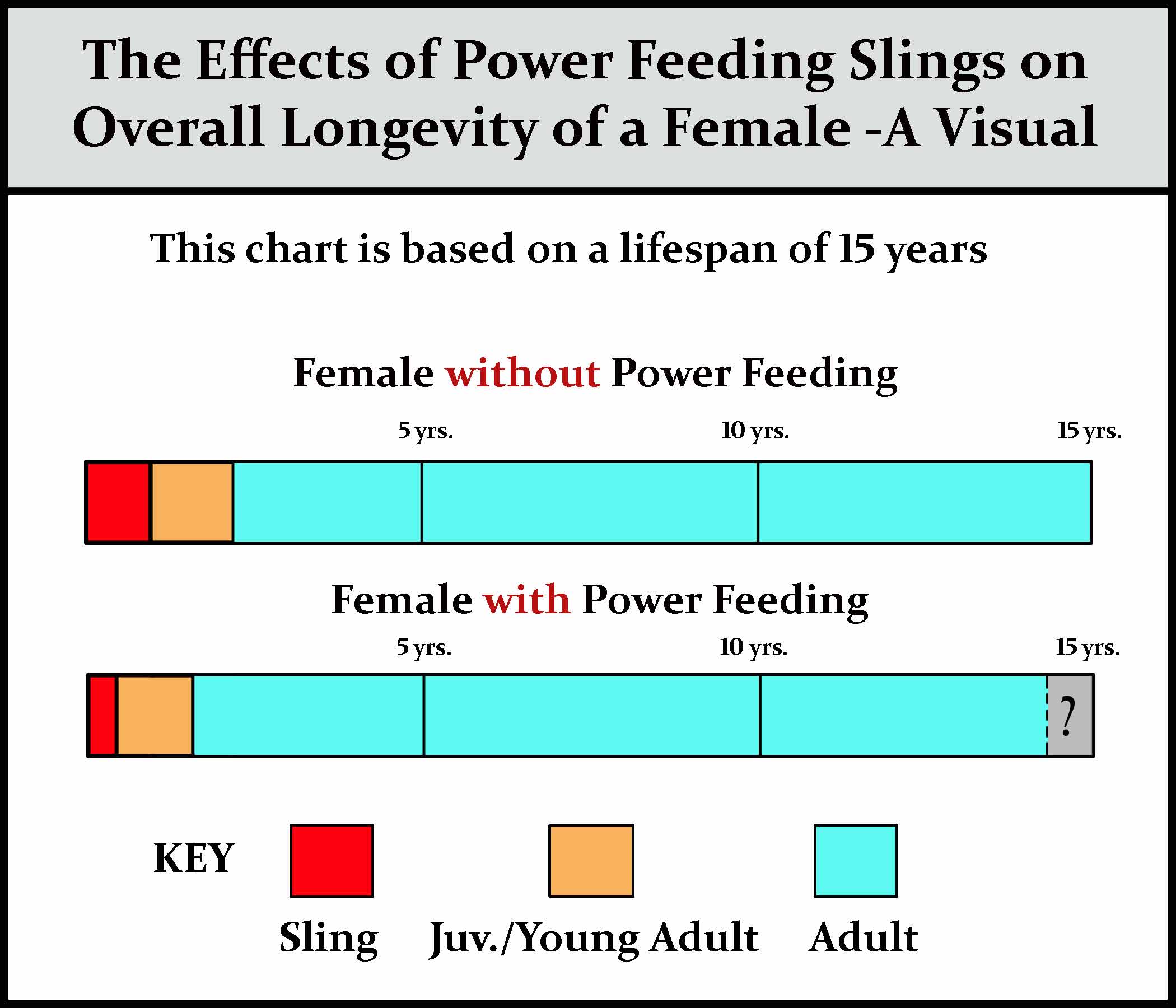
Take a look at the charts below. For the first one, I used a hypothetical female tarantula with an average lifespan of 15 years. Due to the longevity of this species, “power feeding” has a very nominal effect on the overall lifespan (the gray area designated by a “?”) In this instance, the amount of time potentially taken off of its life is a matter of months, not years. This is a very small amount of time in the grand scheme of things.

Now, this would be a female with a medium lifespan. Imagine if we were to use a Brachypelma, Aphonopelma, or Grammostola species female. Because they can live 25 years or more, the time power feeding one would take off of its lifespan would be negligible at best.

Personally, I think this is a worthwhile trade-off to ensure my spider better chances earlier in life.

Power-feeding-females-chart

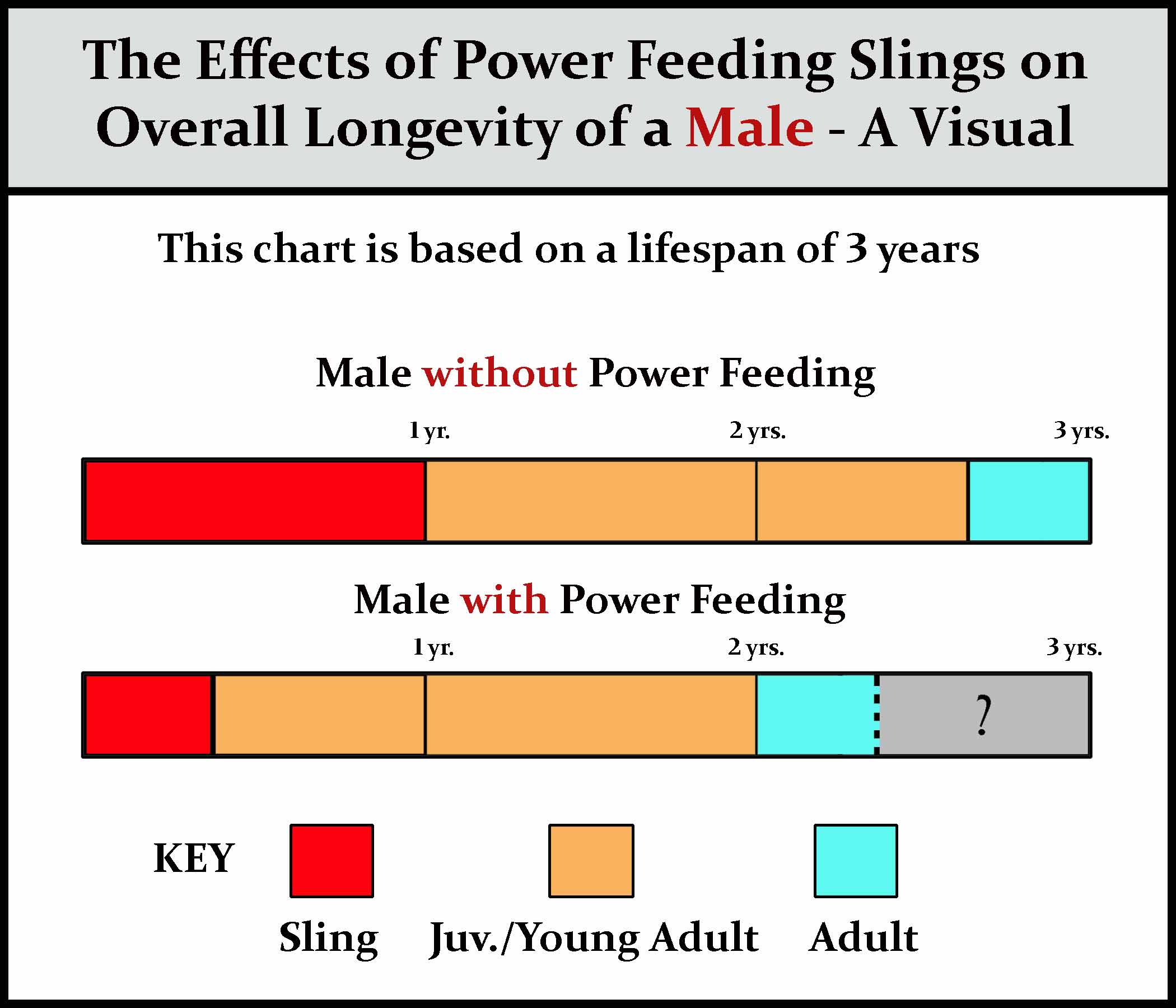
For males, it can be a little bit different. Obviously, males have shorter lifespans as it is, and most will outgrow their female counterparts in the same time span. Therefore, the accelerated growth earlier in the male’s life-cycle may have a more profound effect on its overall lifespan.

In the chart below, we look at a male tarantula with a lifespan of three years. Here, the sped up growth cycle eats away a higher percent of its life. That being said, if you find out that the sling you raised is a male, you don’t have to starve your animal, but a lighter feeding schedule would prolong its life and make up for some of the time lost to power feeding.

Power-feeding-males-chart-w

(Note: The charts above are meant only as approximations, and many factors, including temperature, diet, and the genes of individual species could impact these estimates.)

Either way, these charts illustrate the fact that the sling stage is actually a very small part of a spider’s life cycle, and power feeding a sling at this point in its life really doesn’t impact the tarantula’s lifespan that much at all.

Also, lets not forget that we are still not sure how long some of these spiders can live. So, if the T above were to die in the span of that gray area at the end, we would have no way of knowing if its lifespan had been shortened by early power feeding, or if there were other factors involved.

Just something to think about.

The Verdict

Honestly, I don’t really believe that “power feeding” applies to Tarantulas, and that there is nothing wrong with feeding your pets as much as they will eat. Worst case scenario, you’ll get a fat T that will fast for a bit.

Could it shorten a T’s life? I suppose, but in most cases, if it did shorten the spiders’ lives, it would be by a nominal amount. Personally, I’d rather risk rushing my tarantula through the fragile sling stage than possibly “prolong” its life by withholding food. As long as proper husbandry is followed, and the animals are kept correctly, there really isn’t any harm to the T and its comfort level.

After all, in the wild they exist to eat, mature, and breed.

And, if a keeper wants to savor every minute with their beloved animal as it grows over the years, who’s to judge if she decides not to cut back on the feeding her. These animals are, for many of us, pets, and it would make sense that we would want them with us as long as possible. If this keeper has no interest in breeding, then it would behoove her to not rush its growth.

To each his or her own.

The Best (and Most Ridiculous!) Tarantula Myths

tarantula-myths

There is something just so fascinating about a giant, hairy spider.

Whether you love them or hate them, tarantulas have the uncanny ability to capture our imaginations, pique our curiosity, and illicit powerful emotions. For those who love and keep them, these furry bugs conjure feelings of wonderment and awe. Unfortunately, to those who suffer from arachnophobia, they can be the stuff of nightmares, creatures seemingly too frightening to exist. One way or another, these animals get a reaction.

Of course, it doesn’t help that these animals have traditionally been utilized in horror movies and television as cheap scares. In the 50s alone, the advent of the drive-in theater ushered in several tarantula and spider-centric horror flicks like Tarantula (1954), The Incredible Shrinking Man (1957), and Earth vs. the Spider (1958). Over the years, they have been featured in dozens of other movies and TV shows, including a memorable turn by an A. seemani in Home Alone (1990).  Media has taught us from day one that spiders are something to be feared … bloodthirsty monsters existing only to sink their venomous fangs into our flesh.

Therefore, it’s no wonder that these fearsome, but misunderstood predators are the subject of some pretty incredible, often entertaining myths. With more folks socializing via social media than ever, some of these decades-old rumors are finally getting dispelled. As more people gravitate toward arachnoculture and the tarantula-keeping hobby, they are becoming more informed about these marvelous animals. Little by little, the “good word” is being spread, and these nasty fallacies are being corrected.

Unfortunately, it’s not all good.

Many of these misconceptions have been afforded new life as one inaccurate post can now reach hundreds of folks as it is passed around and reblogged as fact. Since joining sites like Tumblr and Twitter, I’ve personally encountered many of these arachnid urban legends, and although I try to dispel them, the fantasy often proves more compelling and entertaining than the facts for some people.

Some of these misconceptions are spread by folks who are just uneducated about how these animals behave and what they are physically capable of. Others, unfortunately, are more hobby-centric, and spread to others by over-cautious or misinformed keepers. And, as with most myths or legends, some seem to act as some type of warning to those who might encounter or keep them.

So, in an effort to finally put many of these myths to rest and to have fun with some of the sillier ones, I present a list of the most common, and sometimes ridiculous, tarantula myths. Some of these are more general misconceptions, and others are more hobby-centric. but I think that they all merit a mention.

And now … the myths!

“Tarantulas are aggressive and will chase you when they attack.”

I hear this one all the time, and it’s obviously a rumor based on fear. Tarantulas are not vicious creatures that will chase you across a room in order to inflict harm. Are there species that are quicker to bite? Sure. Some Old World species, P. murinus and H. lividium come to mind, are very defensive and will charge short distances if they feel threatened. However, this is defensive behavior. They are not attacking because they want to kill you; they are scared. They see you as a large, potentially dangerous predator infringing on their territory, so they will use the weapons nature gave them to defend themselves.  For them, it’s nothing personal … it’s a matter of survival. Get you before you get them.

Honestly, the idea of a tarantula chasing someone across the room is just silly. First off, most will want to get back to the burrow they are defending. Chasing an enemy long distances would leave them dangerously exposed. Also, anyone who has worked with them knows that they generally move in shorter, potentially very fast, bursts. However, tarantulas  will usually pause to rest and recharge after a relatively short distance. As far as animals go, they are sprinters, not marathon runners. Generally, if they do take off running, it is going to be away from you.

“Tarantulas can jump up 5 … 6 … (fill in the blank) feet into the air!”

This is one of my favorites, and one I’ve been I’ve heard personally twice. Many folks believe that tarantulas are capable of amazing feats of arachnid athleticism, which they usually display in a frenzied attempt to attack an unsuspecting human. I was once told that I should be very careful with my tarantulas because they can jump up 10 feet in the air to attack. This, of course, is nonsense. Although arboreal species can jump for shorter distances from tree branch to tree branch (or from your hand to your chest), they don’t get anywhere near 5-10 feet. Also, they don’t pop into the air; these jumps are made vertically. And terrestrial Ts will “pounce” a couple inches onto prey, but a drop of over a few inches could kill them.  A jump of several feet would lead to a splattered T upon landing. Rest assured, they are definitely not fanged jack-in-the-boxes

“Tarantulas catch their prey with webs.”

Tarantulas make webs, but they do not used them in the way true spiders do. They can utilize their silk to line their burrows, provide a “prey detection system” at the mouths of their dens, or to create a safe, comfortable mat on which to molt. When they explore,they can also leave a thin “guide” thread to help them keep track of where they’ve been. I’ve even seen a G. porteri use webbing to roll up three crickets into a more convenient “burrito”. They do not, however, fashion webs to ensnare their prey.

“Tarantulas are ‘poisonous’.” 

Well, I’ve never eaten one, but if I did, I don’t think it would kill me. Animals that are poisonous, like the Poison dart frog, must be touched or ingested to do you harm. Venomous animals, like tarantulas and snakes, deliver their venom through bites. Although these terms are often used interchangeably, they are not the same. Next time someone tells you that your spider is poisonous, politely correct them.

“Bird-eaters eat birds.”

When early European explorers saw a large spider, likely one of the Avicularia genus, dining on a small bird, they returned to the western world with stories and lurid drawings depicting giant, bird-eating tarantulas. The moniker stuck and has been used in the common names of a lot of the larger terrestrial species. Unfortunately, this nickname is a bit misleading. Although these spiders are certainly large enough to eat birds, and it probably happens on occasion, birds do not make up a significant part of their diet. These large-bodied terrestrials spend their time on the jungle floor eating insects and small vertebrates. Ironically, its the arboreal tarantulas that likely feast on the occasional bird.

“This species reaches 10-12 inches.” 

Okay, it is true that the largest tarantula ever measured, a T. blondi, was 12″ in diagonal leg span, and it’s possible that there are other species that can reach this monstrous dimension. However, spiders this size are the exception and not the rule. You’ll often hear vendors talking about species genera like Theraphosa, Lasiodora, Phormictopus, and Pamphobeteus reaching lengths of 10-12″ dls like it’s commonplace. Likewise, keepers are notorious for talking about their 12″ stirmis and 10″ LPs, but never seem to produce photographic proof of the specimens next to a ruler. The truth is, although these genera can get large, max sizes of 8-9″ is more the norm. Those picking up one of these species expecting a “dinner plate-sized” tarantula are very likely to be disappointed.

“Tarantulas have to be held or they’ll get mean.”

I’m going to go ahead and add “tarantulas enjoy being handled” to this one as well. Here’s the deal: can tarantulas be held? Obviously, many keepers make the decision to handle their animals, and most do so without incident. And, there are indications that some species will seemingly become tolerant after repeated handling (although, they can switch dispositions without warning). However, do they enjoy handling? No.

As much as we would love for our furry little spiders to return our affection, it’s just not going to happen. It’s just not how they are biologically hardwired. As for “having to be handled” or else they get mean? Well, that’s just a bit ridiculous. Many keepers, especially ones that keep Old World species, never handle their animals. Handling is definitely not a requisite for the hobby. If you don’t handle your tarantulas, they aren’t going to suddenly turn into blood-crazed, vicious monsters.

“Tarantulas can’t bite.”

Ummmm … yes, they sure can. And it hurts, too.

I’m not sure how this one got started, but I’ve read it more than once. In one case, someone even tried to convince a friend that they had a certain species that couldn’t bite. I don’t like for Ts to get a bad rap, but all tarantulas have fangs, and many species aren’t shy about using them. Will all of them bite? No. Some are quite docile. However, the potential is always there.

“All tarantulas sold in pet stores legally have to be de-venomed.”

Unfortunately, this one pops up a lot. I’ve had folks ask me if my Ts are de-venomed, and I’ve actually had others tell me that they know someone with a de-venomed T. The sad fact is, some pet stores have really told customers this lie as part of a scheme to bilk unsuspecting folks out of money when they have to pay a “de-venomation” fee. Rest assured that this procedure does not exist, and if you hear of a store offering this nonsensical service, be sure to let other keepers know.

“Tarantulas can be “de-fanged with a surgical procedure.”

Again, another disturbing myth seemingly invented by disingenuous or misinformed pet store employees. In order to convince customers that their tarantulas pose no threat, they tell them that all of their spiders are de-fanged to prevent them from biting. In some instances, it’s merely a lie. In other more horrifying cases, the pet store actually performs the “surgery” themselves using nail clippers or scissors.

The fact is, a tarantula needs its fangs to hunt and eat. If it loses its these important tools, it could starve to death. The reason I say could is because tarantulas can regenerate their fangs with a molt, and it’s possible that an injury as potentially life-threatening as this would force an emergency shed. Removing a T’s fangs would leave you with either a dead or temporarily disabled spider.

“Tarantulas can drown in water bowls.” 

Another myth likely started by well-meaning but overly cautious keepers. When I first got into the hobby, I searched the web to try to find any instances of tarantulas drowning in their water bowls. I found one possible instance where the T was found in a death curl in its dish, but the keeper seemed to think that the spider died of natural causes during a molt. There just seems to be no evidence to support this claim. Is it possible? Sure. A weak specimen could find itself in an overlarge dish and not be able to climb out.

However, you have to figure that an animal that has been around million of years, with some species living in areas with huge amounts or rainfall, would figure out how to avoid or negotiate water hazards.

Furthermore, the “rule” that slings shouldn’t be offered water dishes until they are 1.5″ or more also appears to be based on a fallacy. Many folks provide slings as small as .5″ with small bottle caps for dishes, and the slings have no issues with them. There is even video of slings effortlessly floating on water before climbing off to safety. I would, in this instance, use a smaller dish just in case (no use putting a 3″ water bowl in with your 1″ sling). In this instance, the pros of offering your small, vulnerable sling a water dish far outweigh the imaginary cons.

“Tarantulas can’t use water bowls and and need sponges to suck water from.” 

Wrong, wrong, wrong. Tarantulas can drink perfectly fine from water dishes; I’ve seen mine do it plenty of times. I believe this idea stems from folks who think that tarantulas use their fangs like “straws” to suck up water. Nope. The fangs deliver venom; they use their mouths to eat and drink. Sponges become infested with bacteria and essentially turn your pet’s water bowl into a petri dish over time. If your local pet store tries to tell you that you need a sponge, kindly inform them that you prefer to give your animals fresh water.

“G. roseas have the strongest/most dangerous venom.”

This one is a bit misleading, as it is somewhat true … if you’re a mouse. You see, in 2004, some French scientists decided to test the potency of tarantula venom by injecting mice with a controlled amount of venom from several dozen different species. They then recorded the amount of time it took these poor rodents to die. The faster the venom killed the mouse, the more “potent” the venom was said to be. When all was said and done, the G. rosea showed up 6th on the list, ahead of species like P. murinus and P. fasciata (Escoubas, Pierre & Lachlan Rash. “Tarantulas: eight legged pharmacists and combinatorial chemists.”) Folks immediately buzzed about this “shocking” discovery, and some questioned whether or not the good ol’ “rosie” should be on beginner T lists.

The problem with this experiment is the effects of venom differ between organisms, which makes this experiment pretty irrelevant when talking about venom effects on humans. For many New World species, rodents, like mice, are a part of their diet. Therefore, they have evolved their venom to be particular effective against this type of prey, and it makes sense that it would kill a mouse quickly. On the other hand, Old World species like the P. murinus use their venom as protection against predators like primates, so the venom affects a human much more. A bite from this species can cause excruciating, sometime debilitating pain and cramping and is much more painful than that of a G. rosea (just check the bite reports!)

So, yes … mice should live in fear of G. rosea bites. However, read the bite reports for this species, and you’ll find that they hurt little more than a bad bee sting. Speaking of bee stings …

“Tarantula bites are about as painful as bee stings.” 

I honestly thought that this myth had finally been laid to rest, but I saw it pop up again on one of the social networking sites recently. For years, folks were told that tarantula bites were no worse than a bee sting. I’m sure this myth began back in the ’70s and ’80s when most folks were keeping only New World specimens whose bites are not that bad. As far as these species are concerned, the myth is somewhat true.

Unfortunately, it fails to account for Old World bites, which can cause symptoms like excruciating pain, full-body cramping, nausea, heart palpitations, and difficulty breathing. That’s a heck of a lot worse than a bee sting. And, let’s keep in mind that some Ts, especially the giant New Worlds, can have fangs up to 1″ long. I don’t care how mild the venom is, fangs that size will put a hurting on you.

“If you feed your tarantula vertebrate prey, the calcium in the bones will cause bad molts.”

I’m kind of amazed that this myth is still circulating, often being spread by folks who should know better. No, feeding tarantulas invertebrate prey like mice or lizards does not cause bad molts. If these keepers were feeding their tarantulas mice, they were likely keeping some of the larger species like T. blondi. Larger Ts can have molting problems, and the blondi in particular is notorious for bad molts, likely due to the high moisture requirements and difficult husbandry. It’s likely that keepers attributed the bad sheds to the rodent diet instead of the more likely husbandry and moisture issues. There has been no evidence to prove this theory, and considering that these spiders eat vertebrates all the time in the wild, there is much more evidence disproving it. If you feed your tarantulas mice or lizards, you will not be putting them at risk for a bad molt. You will, however, have one nasty bolus to deal with in the morning … one that if not removed quickly, could lead to other issues.

“If you feed a tarantula too much, its abdomen can burst.” 

This myth is usually mentioned when the subject of “power feeding” comes up. Although it’s believed that over-feeding a tarantula can lead to health issues, there are no documented cases of a tarantula eating until it bursts. In most cases, a tarantula knows when it’s time to stop eating and prepare for a molt.

What likely happens in these situations is that the overindulgent spider’s abdomen swells so much that it stretches the fragile flesh to dangerous levels. A slight bump or fall at this point could easily rupture the abdomen, leading to a catastrophic injury. When the keeper inevitably finds his portly pet dead, he assumes the abdomen burst on its own. So, no … your tarantula won’t explode from overeating. However, if your tarantula’s booty is so large that the poor animal is dragging it, it’s time to lay off the crickets for a bit.

“Tarantula bites can kill you.” 

This rumor is like the evil twin of “Tarantula bites are about as painful as bee stings.” Here’s the skinny; there has never been a report of a human being dying directly from a bite. Although Old World venom is able to cause tremendous amounts of pain and other scary symptoms, it is not able to kill.  There have been two cases of individuals dying as a result secondary complications attributed to the bites, one involving blood poisoning and the other gangrene. However, both of these incidences took place over 100 years ago, before modern medicine and even the use of antibiotics. Today, both of these folks would have survived with proper medical treatment.

Now, if you consider how many people live in areas where tarantulas are indigenous, and how many folks around the world now keep them as pets, you would think that someone would have died by now if their bites were deadly. Fact is, there are probably higher odds that you get struck by lightening than dying from a tarantula bite.

“G. rosea is the best beginner species.”

For decades, if you asked anyone what the best beginner tarantula was, the majority would point to the G. rosea, better known as the “rose hair tarantula” or “rosie”. This species was lauded for its ease of care and a calm temperament that made it ideal for handling. When I set out to acquire my first T back in the late 90s, I immediately set out to find this amazing species.

Although I still consider the G. rosea/porteri one of the better candidates for the best beginner tarantula, it is by no means the best species. The reason this species became the king of beginners came down to a few factors; they were cheap for pet shops to procure, readily available, and quite hardy in captivity. Wild caught specimens were easily harvested from Chili and sold in the pet market for a pittance . This meant they were a low-risk for pet stores who could keep one or two on hand to draw in customers by offering this fascinating giant spider. Even as more appropriate beginner species found their way into the market, the G. rosea continued its reign as the ultimate entry-level spider.

Although their hardiness and pet-rock lifestyle do make them good for a keeper who wants an almost indestructable spider that will always be visible, their unpredictable temperaments and penchant for long fasts have confounded many a new hobbyist. For every calm, tractable specimen, there seems to be a “psycho rosie” that will attack anything that enters its cage. And nothing causes more stress to a new keeper than a tarantula that wont eat for months at a time. Then there’s the fact that when you see an adult for sale, it has likely been wild-caught from a population that has been decimated by the pet trade.

And the list goes on…

Although this is a pretty lengthy list, I’m sure that there are many other myths out there. After all, it seems like the more popular tarantula keeping gets, the more odd and misinformed things people will say about them. Still, as fun as these are to read, it’s ultimately the keeper’s responsibility to dispel false information and to educate other keepers and the public at large when these fallacies appear. So, the next time someone tells you about a friend’s vicious tarantula that jumps ten feet and chases you across a room, kindly and calmly set them right.

Did I miss something? I would love to hear some of the myths and misconceptions others have heard…

Tarantulas – The Importance of Learning (and Using!) Scientific Names

Scientific-names-header

What’s in a name?

For many years, I kept what I referred to as a “rosie” or “rose hair” tarantula, and I introduced it as such to any family members or friends who would show an interest in my unique pet. It wasn’t until years later that, while searching for the lifespan of rosies (mine was pushing 20 at this point), I stumbled upon its scientific name, Grammostola porteri.

Cool, I though, as I wondered why on earth anyone would ever want to use such a cumbersome name. After all, “rosie” had a warm and fuzzy feel to it, and it was certainly easier to say. As I continued my search, the scientific name was quickly off my lips and out of my mind.

It would be several more months (and many Ts later) that I began my quest to actively work to learn these scientific names. Part of this new-found drive came from the frustration I was facing when I searched for information on unfamiliar species. I was also starting to get many of the names mixed up, as some are quite similar (God, how many bird eaters are there?). Then, there came the hassle of trying to shop for Ts when they were all listed alphabetically by scientific name.

And, if I’m going to be honest, I was really falling in love with the hobby, and I wanted desperately to be able to converse with colleagues using the proper lexicon.

It wasn’t easy at first, and I found myself repeatedly mixing up my Brachypelmas, Grammostolas, and Avicularias. However, learning is always easier when you’re engrossed and motivated by the subject, and I was soon finding that the scientific names were rolling off my tongue with relative ease and confidence.

Try to find the common name for Pamphobeteus sp. Duran ... there currently is none.

Try to find the common name for Pamphobeteus sp. Duran … there currently is none.

Scientific names; not just for “elitists”!

I’ve seen folks bristle when they ask a question of the forums using a common name, and other keepers immediately remind them to use the scientific name. Nobody likes to feel stupid, and unfortunately hobbyist have a tendency to be a bit blunt when making suggestions. Although I certainly don’t condone elitist behavior (there is always a nice and constructive way to correct or remind someone), I do understand some of the frustration. The fact is, those seriously into the hobby don’t know the common names. Many of them would love to help out, but they aren’t sure which species are being referred to.

Our wonderful hobby has a language all to its own, and for keepers to have productive discourse, we all need to be speaking that language. Every hobby, be it sports, art, collecting, martial arts, herpetology, or even beer brewing, has its own terminology and jargon. Part of the fun of participating in a hobby is mastering not only the activities and techniques, but also the common language that goes along with it.

Much of the common language in the tarantula hobby just so happens to be a bit more … well … scientific. And that can be intimidating, especially for folks who don’t have a background in zoology or Latin.  But as someone who, not that long ago, had to consult Google for the common name for an “ornamental spider”, I can tell you that it feels great when you master these names.

Why are scientific names important?

Let’s take a moment to consider when and where these names become important to the budding or established hobbyist.

Most reputable dealers will list spiders alphabetically by scientific name first. Shopping was always a blast when I first got into the hobby, as I was only familiar with some of the common names. For example, I knew I really wanted one spider referred to by the common name of “Greenbottle Blue” and another called a “Salmon bird eater.” So, I put together a list of several dealers I might buy from and started price and size checking for these species. Unfortunately, all of the tarantulas on these sites were listed under their scientific names.

Chromata-what? Lasio-huh? What the heck were those?

After perusing the photos, looking for something that resembled the spider pics I had drooled over, I realized that it would be much easier if I just researched the scientific names for these two species and kept them nearby. I began keeping a journal of sorts in which I would list the scientific names first, then the common names in an effort to learn these more difficult monikers. When I searched an online store for a species I was interested in, I’d play a little game and try to remember the scientific name without looking. I would often have to cheat at first, but it got much easier as the months passed and my collection grew.

Experienced keepers use scientific names, and many are not familiar with the common names.  If you find yourself posting a question on a message board or approaching an experienced keeper for advice, it’s always much more efficient and helpful if you can use the scientific name. The fact is, many of these gals and guys have been using scientific names for so long that they no longer remember many of the common names. And if you’ve spent time on the boards, some folks have little tolerance or use for these informal labels. If you want to be taken seriously, it’s always best to use the scientific names when asking for help.

Personally, I know that many folks just entering the hobby have not familiarized themselves with the nomenclature for the tarantula hobby, so I’m not at all put off when folks ask questions using the common names. I have, however, had to take to Google a couple times to look up a common name to see what species they were talking about!

To properly search for quality information on a species, it’s important to use the scientific name. This is particularly important when searching for less common species. Whether you’re using Google or the search function of Arachnoboards, if you’re looking for quality care tips from some of the folks that actually keep the spiders, then you will find so much more by using the scientific name. This is especially true for forums, which can contain some of the most current and accurate information. Folks posting on the boards rarely use the common names to refer to their animals, therefore, a search for the common name might filter many important threads out.

Many species share common names, and others don’t have common names at all. Last year when I went to write my husbandry article on my Lasiodora itabunae, I hopped online to Google the common name. What did I find? Well, there really isn’t one. After going through several pages, I found someone who referred to it as a “Amazon Fire Hiney”, or something equally silly and unbelievable, but no real consistent name. The fact is, there are many tarantulas out there that have no common names, or multiple ones. Acanthoscurria geniculata, for example, is referred to as “The White Knee”, “The Brazilian White Knee”, “Brazilian White Banded Bird Eater”, “Black and White Bird Eater”, “Giant White Knee,” and several other names.

Plus, some common names are so similar, it’s easy to confuse them. I remember searching up information for a B. smithi by its common name, Mexican redknee. Unfortunately, I kept getting it confused with Mexican flame knee (B. auratum) and spent hours reading up on a similar, but ultimately the wrong, species.

In the case of scientific names, there is only one assigned per species, so you don’t have to worry about the overlap (or not finding one at all).

And, a little tip…

Those who use common names for care sheets or for listing tarantulas for sale are often not very knowledgeable. Incidentally, if you find a pet store or dealer who only lists the species using their common names, I would avoid buying from them. This is surefire indication that said retailer does NOT know much about tarantulas, and all bets are off as to if the species is even the correct one. Recently, Petco has been selling “rosies” that are actually not G. rosea or porteri, but Phormictopus cancerides. This would be a bit like buying a house cat and getting a tiger.

Likewise, I’ve seen many “keepers” offering up care sheets in which they refer only to a species common name (or, put the scientific name second). That’s a great indication that this person has not been in the hobby long, and I would be very skeptical taking any type of advice from this individual.

Bottom line, common names are fun when you first start out and are okay when used to introduce family and friends to the animals (although, I usually use the scientific names as well). As many contain the name of the area the spider is found, they can also be helpful for folks to understand and remember where they come from. However, as your collection swells and you make the move to becoming a true hobbyist, it’s time to make the switch to the hobby-accepted scientific names.

As always, there are some exceptions to the rule.

Are there some species where it’s acceptable to use common or nicknames. Absolutely. P. murinus is commonly referred to as the “OBT”, and folks immediately know what spider you’re talking about when you break out that acronym. The C. cyaneopubescens is commonly referred to as the GBB (for greenbottle blue), even by experienced hobbyists. The L. parahybana is often referred to as an LP; again, most everyone accepts this informal name.

Okay, I’ve learned the names … but how the heck do I pronounce them?

This is where it gets fun, as if we’re keeping it real, no one is quite sure of the correct pronunciation of many of these names. Most folks were not “fortunate” enough to take Latin in high school or college, and those that did often pronounce the names differently. Also, besides Latin, many of the scientific names also have Germanic, Greek, and other roots (as the species is often named for the person that discovered it or the geographical location it was found in). This means in some instances, a truly “correct” pronunciation might not exist, and we’re left with generally accepted ones.

Take T. stirmi for example. I have heard it pronounced stir-ME and stir-MY, and both seem to be acceptable. Same with the B. smithi, which I’ve heard pronounced as smith-EE and smith-EYE. Then there is the genus Poecilotheria, pronounced as Pea-see-luh-THEE-rea. However, due to its popular nickname “pokie” (POE-key), folks often pronounce it as Poke-ee-luh-THEE-rea. To complicate things even further, American pronunciations are often different than the British ones.

Have a headache yet?

Anyone who has spent time perusing the many clips posted on YouTube of keepers talking about their tarantulas have probably heard the names pronounced a variety of ways. The fact is, if you are in the ballpark, no one is going to give you a difficult time.

If you’re interested in learning how some pronounce these names, you can check out this page on The American Tarantula Society site. It’s a bit outdated and incomplete, but it makes for a fun starting point.

Or, you can click on the link below for a printable PDF version:

PDF-button

And if you read one of these and find that you were pronouncing it differently, don’t beat yourself up. This is just one person’s interpretation; who knows if it could even be called “correct”!

Help … My Tarantula Buried Itself!

Help-topic

It’s probably one of the most common, yet stressful, scenarios for a new tarantula keeper. After months of research and homework, you purchase your first tarantula sling. Your anxiety level is high as you are new to the hobby, and despite all the preparation, you are still worried that you will make a husbandry mistake. You set up what you think is the perfect enclosure, rehouse your new little guy without incident, and take a moment to admire your new pet. Satisfied that you’ve done everything right, you head off to bed.

However, when you awake the next morning and check on your T, you find the enclosure empty … or at least it first appears to be empty. Closer examination reveals that your little guy has been busy, and he has now burrowed deep beneath the substrate. Not finding any hole or passageway, no way for your spider to resurface again, you begin to freak out. You did your research, and you read that this species is terrestrial, not fossorial …  why has it buried itself? Fearing for your new acquisition’s safety, questions swirl through your brain.

Is he in danger?

Is he trapped?

Is he dead?

Should I dig him out?

In most instances, the answer to all of these questions is a resounding NO.

But what should I do?

And the short answer to this oft-asked question is: Do NOTHING.

Burrowing is normal behavior with many species of slings, including some arboreals.

Although this is a topic I’ve touched upon in a few different blogs, the question is asked often enough that I felt it deserved its own topic. After all, if you begin keeping tarantulas as a hobby, you are likely to experience this behavior at some point or another.

One of my P. sazimai slings sealed in its burrow. I'm expecting a molt from this one soon.

One of my P. sazimai slings sealed in its burrow. I’m expecting a molt from this one soon.

When I first got heavy into the hobby, I experienced this scenario with my L. parahybana sling. After a couple weeks of it sitting out in the open, greedily snatching prey and using a piece of cork bark for a hide, I awoke one morning to find that it had buried itself. Now, at first I didn’t panic because I could see the little webbed-over hole that marked the mouth of its den. However, when I discovered that this hole had been filled in a couple days later, panic set in. As weeks passed, I became thoroughly convinced that my little guy had buried himself alive. He wasn’t visible, he wasn’t eating, and the tunnel looked as if it might have collapsed. I was ready to dig him up to “save” him when I decided to first do a bit of research first.

It was a good thing I did, too.

I discovered that it is perfectly natural behavior for slings to bury themselves. Because we are keeping these animals as “pets”,  behaviors that are perfectly normal and essential for a wild spider’s survival can seem perplexing in captivity. Although a T burying itself seems like a dire sign to us, it is in fact very normal.

My little LP opened its burrow again after a few weeks, and although I never saw it out, the prey I dropped in soon disappeared. It lived like this, hidden in its hole, for another year before finally growing large enough to feel confident living outside of its burrow. It’s been out in the open ever since.

Let’s consider some very important facts:

1. Tarantulas bury themselves for security. Tarantula slings are especially vulnerable in the wild. As a result, it behooves them to stay out of sight where larger predators like birds can easily gobble them up, or where they could easily dehydrate beneath the sun’s heat. In the wild, a sling’s burrow protects it from predators and the elements and provides it a safe home-base from which to hunt when night comes.

Sure, we keep the temperatures optimal in their enclosures, and there are not threats from predators in the safety of our homes, but they don’t know that. Their evolutionary programming is telling them that they need to burrow for security.

This behavior isn’t limited to only terrestrial Ts, either. I keep several arboreals, including eight species of Poecilotheria and L. violoceopes, and all have burrowed as slings. I could see this causing a bit of stress for a keeper expecting these spiders to be up on a branch or piece of cork bark.

2. Many tarantulas will bury themselves during the molt process. Even larger specimens may disappear into burrows when it comes time for a shed. Again, it comes down to the tarantula feeling safe and secure. The molting process is incredibly taxing and leaves the spider exhausted and very vulnerable. Not only is the spider physically taxed, but its new fangs and exoskeleton are soft and need time to harden. Therefore, many Ts will secret themselves away in their burrows when premolt approaches to wait out the process.

In these instances, the tarantula might cover over the entrance to its burrow with dirt or webbing.  If your spider suddenly buries itself after previously being out in the open and eating well, chances are it’s just in premolt. It will emerge again eventually, a bit larger and sporting a brand new exoskeleton.

3. Tarantulas normally don’t die in burrow collapses. Many new keepers fear that if their tarantula buries itself, it could perish from a cave in. I have heard of exactly ONE instance where this happened, and it was because the spider managed to burrow under a heavy rock the keeper was using as a decoration. This instance was a freak accident and nothing more.

The fact is, tarantulas will line their burrows with webbing, and that helps hold the walls together. If you’ve ever had to dig a tarantula out for rehousing, you’ll understand how tough and put-together these web-lined tunnels can be. Also, tarantulas are quite strong and very good diggers. Even if a tunnel was to collapse, as long as there was nothing heavy above it, the T would just dig its way out.

4. Your tarantula will not suffocate beneath the ground. Another misconception is that if a T closes off its den, it can suffocate to death. Again, not true. Tarantulas need much less oxygen than other animals, and most would naturally spend their lives in tight burrows dug far into the earth. As long as there is proper ventilation in the enclosure, they won’t suffocate.

When in doubt, always remember the golden rule of tarantula keeping: the tarantula always knows best.

In our quests to be the best tarantula keepers possible, we often forget a very important detail: tarantulas have evolved over millions of years and know how to survive. Unlike their human keepers, they are not prone to “irrational” decision-making. In most situations, they know what they are doing and what’s good for them. If your T suddenly buries itself, it’s not arachnid suicide. It’s only doing what it’s been programmed to do. Although you may have to wait a while to see your favorite pet again, understand that it’s not in any danger.

On of my P. atrichomatus slings buried at the bottom of its enclosure. This one spent almost a month sealed in.

On of my P. atrichomatus slings buried at the bottom of its enclosure. This one spent almost a month sealed in.

So, to review, if your tarantula suddenly buries itself, there is only one thing to do…

…NOTHING! 

Resist the urge to dig it up to “check on it.” If you succumb to the urge, you risk needlessly stressing it or, if it’s in the process of molting, KILLING it.

Also, do NOT try to open up the mouth of the burrow to “give it some air” or to allow for its escape. Again, just leave the animal be. It may be a week, it may be a couple months, but your spider will emerge eventually.

And finally, NEVER shove live prey down the hole if it’s not eating. Not only will this stress the animal out, but the prey item could kill the spider if it’s in the middle of a molt. Also, if the spider dispatches but doesn’t eat the intruder, you may now have a rotting bug corpse stuck in the burrow with your T.

At what point should I worry and dig up my specimen to check on it?

In 99% of the instances, it will be entirely unnecessary to dig up a tarantula. However, I’ve had folks ask how long they should wait before worrying. I would say if you have a small sling that has been buried for six to eight months without taking any food or making an appearance, it might be time to worry. The fact is, some slings will die; it’s an unfortunate part of nature that all specimens aren’t healthy enough to live.

If it’s a small specimen and more than a half-year has gone by, it might be time to do some investigating. After all, you don’t want to be keeping a dead T as a pet. Still, be sure to be very careful when digging the animal up, and keep in mind that you could harm it if it’s molting. Also, larger spiders can spend more time safely in their burrows as they are not fragile and prone to dehydration or starvation. For larger specimens, I would wait even longer.

That being said, I offer this anecdote for anyone considering digging up one of their tarantulas. I had a 3/8″ Maraca cabocla that burrowed deep in its enclosure last year and completely covered the entrance to its burrow. From late October until almost April, it did not eat and I saw no sign of it. At first, I thought it was just staying in its den for the winter. I’ve had many Ts do this, and it had never caused me any alarm. However, as more time passed, and I saw no movement within the vial, I assumed the worst.

Finally, I convinced myself that the small T had probably died over the winter, so I set to digging it out. I spent almost a half hour carefully removing the substrate and spreading it out on a white dinner plate so that I could hopefully find the tiny body. At one point my heart sank as I pulled out a masticated form I mistook as the spider’s corpse.

Nope … only a molt.

Finally, as I was removing the last bit of dirt, my little guy scurried out and stood upon the heaped contents of its enclosure as if to say, “dude…what the heck?” Needless to say, I felt silly (as well as a bit bad for the spider). Yup, I had jumped the gun; my tarantula was quite healthy and in no danger. By digging out its substrate, I had jeopardized its health and caused it needless stress.

I won’t make that mistake again.  

Your tarantula has buried itself? Just relax!

Like many aspects of this hobby, patience and experience are key. As you experience this situation more and more, it becomes much easier to recognize it as the normal behavior it is. The next time your precious little one decides to play hide-and-seek on you, don’t let it be cause of worry.

And if you find yourself getting impatient, do what many of us do … just buy more tarantulas!

For more on MOLTING and signs of a molt, check out the article below!

MOLTING

A Word about Tarantula Bites

Feels Just Like a Bee Sting…If the Bee was 7″ Long!

When I decided that I was going to acquire some new tarantulas after keeping a G. porteri for many years, I started researching some of the other species that were now available. Although I remembered that, back in the 90s, there were some feisty and defensive species available that were very quick to bite, I also recalled many books and dealers saying that a tarantula bite was “no worse than a bee sting.” As legend had it, these giant spiders actually had very mild venom, and bites were described as no more than painful inconveniences.

I had always secretly wondered about the accuracy of this statement even as I naively regurgitated it to family and friends who asked about tarantula bites. After all, there were just so many species available; surely one of these had more potent venom than the others? Still, the internet was still in its infancy at that time, and accurate information on tarantulas was a bit more difficult to come by.

Years later, as I prepared to bring more of these creatures into my home, a home I share with my wife, four kids, and three dogs, I decided to research this theory. After all, I didn’t want to endanger my family and beloved pets due to laziness and ignorance. It didn’t take me more than five minutes into a Google search to realize that this statement was far from true. 

Sure, a bite from a small New World species could probably be compared to a painful bee or hornet sting, albeit one that could sting with two stingers at once. However, this statement COMPLETELY fails to take into account three very important points:

  1. Larger tarantulas have larger fangs, and this means more potential for mechanical damage.
  2. Tarantula fangs are not clean, and a bite leaves puncture wounds, meaning increased chance for secondary infection.
  3. Old Word tarantulas have much more potent, medically significant venom than their New World counterparts.

Those are three VERY important points, and three that no hobbyist, whether new or established, should ever forget.

Downplaying bites in an effort to protect the hobby.

Recently I’ve come across some social media posts in which keepers are bragging about taking bites from their pet tarantulas. In a couple of these incidents, the keeper was on an alcohol-fueled quest to demonstrate his supposed masculinity by handling a defensive T. I’m not going to address these instances of unadulterated jack-assery  (although it may be fun to call out some of these brain-dead adrenaline junkies in another post!).

Instead, I’d like to focus on a couple folks that made careless keeper mistakes and paid with painful bites. In both of these instances, the keepers took photos of their injuries and downplayed the seriousness of the bites. And, in both instances, the keepers assured anyone reading that tarantula bites were “harmless” and not much more painful than bee stings.

Now, I appreciate that the keepers didn’t sensationalize the bites in a way that made them seem worse than they were. And, as both were bitten by New World species, I’d imagine the pain from the venom wasn’t particularly bad. However, anyone not familiar with tarantulas would read that statement to mean all tarantula species’ bites are that mild.

And that is just not the case.

I definitely applaud anyone who makes a point to show that tarantulas are not as scary as most people make them out to be, and I agree completely that they do not deserve their reputation as dangerous little monsters. However, I do think that one must be educated about their bites, the varying potency of venom between species, and the consequences one could face if he or she is bitten.

Therefore, a little more explanation is needed about their bites (and the potential harm they can cause).

Yes, it’s true that New World species lack potent venom.

Species from the Western Hemisphere (North and South America and the Caribbean islands) are referred to as “New World” tarantulas. These tarantulas have evolved to have “urticating hairs”, or barbed, highly irritating “hairs” that they can kick from their abdomens in way of defense. As a result, these species of tarantulas do not need particularly potent venom to defend themselves. Don’t be mistaken, these spiders can and will bite if provoked. It’s just their venom won’t cause much more than localized pain and swelling.

All of the more tractable and beginner-friendly species, like G. porteri, B. albopilosum, G. puchripes, and G. pulchra are all New World tarantulas, and these species, consequently, are the ones most handled in the hobby. Generally speaking, when one gets bit by one of these species, the victim suffers little more than pain, swelling and bleeding, and they usually describe the injury as mild.

In this case, the “bee sting” analogy would probably work. Unfortunately, that statement paints a VERY incomplete picture. Let’s take a more in-depth look at those three points every tarantula keeper should be aware of:

1. The size of the tarantula sometimes matters more than venom potency.

I was once reading a message board post in which the owner of a 8″ T. stirmi asked how potent the venom of that species was just in case he got bit. I had to snicker a bit, as this poor chap was overlooking a very important fact: a T. stirmi that size has at least 3/4″ fangs. Venom aside, fangs that large could do massive physical damage to a finger, hand, or any part of the body.

T. stirmi fangs. Photo copyright of Thaddeus.

T. stirmi fangs. Photo copyright of Thaddeus.

Sure, the venom itself might not do more than sting a bit, but those two large puncture wounds are sure going to smart. And just imagine if one of those fangs were to hit a tendon; now you’re looking at a serious injury that would likely involve surgery.

Again, this does NOT happen often, but it’s something that should be considered when working with large New World species like G. pulchripes and A. geniculata or some of the larger genera like Phormictopus and Pamphobeteus. Potent venom or not, a bite from a larger, full-grown tarantula is going to be a very unpleasant experience and would definitely cause more damage than a simple bee sting.

2. There is always risk of infection

A bite from a tarantula essentially leaves one or two puncture wounds, and this type of injury is much more prone to infection. With a puncture wound, foreign contaminants and bacteria are driven deep into the flesh. Although the wound may not bleed much and may heal quickly on the surface, the superficial healing only traps the contaminants inside the wound, allowing them to fester. The depth of the wound and the type of foreign bodies on the object that caused the injury can both affect the chance of infection.

Now, just take a moment to picture your favorite tarantula feasting on one of those dirty crickets. Heck, just take a moment to consider the environment it lives in. Whether you use cocofiber, peat, or just plain dirt, you would hardly be able to describe your T’s enclosure as a sterile environment. As much as you try to keep that enclosure clean, your T’s cage is harboring unseen traces of fecal matter and decaying organic material. And you can bet those fangs are covered with things you would not want injected into your body.

It’s often stated that there are no records in modern times of a human dying from the venomous bite of a tarantula. Do a search, and you’ll find that, for the most part, this quite true. However, there are few reports of individuals dying, not from the venom, but from complications from the bites. In one instance in the late 19th century, an individual bitten by an Old World species of tarantula succumbed to gangrene after the wound became infected. In another report from 1901, a farmer bitten by a large spider described as a “tarantula” eventually died from blood poisoning.

Although these instances are dated and obviously quite rare, and proper medical attention should prevent a fatal outcome, a serious infection, especially from an untreated wound, is a realistic possibility.

3. Old Word species pack a wallop of a bite that can be both excruciating and debilitating. 

Old World species (tarantulas from Asia, Africa, India, Australia, etc.) are known for having MUCH more potent venom that is often referred to as “medically significant.” Unlike their New World counterparts, these species rely on their venom as a defense mechanism, and they are very willing to bite to protect themselves. Some species are also known to bite repeatedly, leaving several wounds and pumping in even more venom.

Although this venom won’t kill you, the effects can be brutal and in some cases, can last for months. The “fun” starts with immediate localized pain that some have described as a 10/10; that pain then works its way up the extremity, affecting more of the body. Those who have sought medical treatment for this pain say that nothing prescribed touches it. Then there can be the other “fun” symptoms, including:

  • vomiting
  • dizziness
  • heart palpitations
  • disorientation
  • shortness of breath
  • low blood pressure
  • excruciating full-body cramping
  • chest cramping
  • difficulty breathing
  • lingering numbness

So, you won’t die from the bite, but you could be visiting a hospital and you WILL be completely miserable. Even worse, some folks report that symptoms like cramping and dizziness can last for days or, in the worst cases, months. For first-hand accounts of tarantula bites, check out the Bite Report section of Arachnoboards.

Old word species commonly available in the hobby that are known to pack potent bites are the P. murinus (OBT) or any “baboon” tarantula, H. maculata, H. lividum, H. gigas, any Poecilotheria species, and L, violaceopes. These species are all fast, defensive and, in most cases, not afraid to bite.

I’ve also heard some folks (mainly younger males) state that they are “prepared” for a bite from an Old World and are not afraid to get bitten. Well, take a look at the video below posted by Tarantulaguy1976 (and when you’re done, check out the rest of his amazing tarantula videos!). Rob C is an experienced keeper and a big, bad dude. Observing him as he describes his symptoms from a 10″ Poecilotheria ornata bite should convince anyone of just how severe an Old World bite can be.

As always, education is the key.

As a tarantula enthusiast, I do want people to realize that tarantulas are not the monsters they are often portrayed as. Can a tarantula kill you with the venom in its bite? No. However, I also think that the myth that all tarantula bites are “no worse than a bee sting” needs to be put to rest. It all depends on the species and the size of a specimen, and even a bite from a New Word species has the potential for more serious consequences not directly caused by venom toxicity.

These are wonderful animals and fascinating pets for informed and respectful keepers. That said, they are also wild, untamable animals that need to be respected and not trifled with. A responsible keeper will not only familiarize herself with the the consequences of a bite, but will also be sure to educate any family or friends who may come into contact with these animals.

Tarantula Care Sheets – An (Un)necessary Evil

No-care-sheets


We’ve all done it.

While perusing a tarantula site, you come across a new species that totally catches your eye, but whose care and husbandry you are unfamiliar with. Eager to learn about this specimen, you hop onto Google (or bing, if you’re an iconoclast) and frantically type in the scientific name of species as well as the following words…

CARE SHEET

As you start clicking on the results, one-by-one, your excitement inevitably turns into confusion … and later frustration.

You see, each of the care sheets you read seems to contradict the one you read before it. One says the species enjoys low humidity while a second says they’ll die if not kept moist. One lists an ideal temperature range of 68-80° while another explains that temps below 80° can be deadly. A fourth sheet says the species can reach a maximum size of 9″ while a fifth states the size taps out at around 5″.

Now what?

Most of us learned years ago that the internet can be a literal sewer of misinformation and lies spoken as irrefutable truth. It takes a bit of patience, internet savvy, and general common sense to wade through the knee-high piles of internet detritus to find those useful and accurate nuggets of information.

Never is this principle more clear than when searching for information on tarantulas.. The amount of misinformation online is staggering, and it often feels like the bad information far outnumbers the good.

Care-sheet-nightmares-final

The fact is, many of tarantula care sheets are just plain WRONG.

For the sake of this argument, let’s define “care sheets” as those brief, usually single-page basic care instructions for specific pets or animals. These sheets usually offer the basics like what and when to feed, ideal temperatures, humidity, and set-up. They are basically distilled, stripped-down instruction manuals for your exotic pet.

There’s a reason experienced keepers abhor care sheets, and that’s because most offer incomplete or incorrect information. Many present outdated information that, if used, could lead to the death of your beloved spider. Others are written by folks who have little to no experience in the hobby who, in their misguided attempts to share their love for the arachnoculture, simply regurgitate earlier information they read on another inaccurate site or blog (or, even better, cut and paste from a Wikipedia page). Although I can appreciate wanting to write about an activity you love, doing so with no valid experience is a bit irresponsible.

Look at some care sheets for common species and you’ll soon see it; several different pages offering the EXACT same information, word for incorrect word. In some of the more comical examples, they even share the same typos and grammatical mistakes.

GBB-DEATH-FINAL

Personally, when I look for information, I’m looking to hear from folks who have successfully kept the species I’m researching. I don’t want some generic and random temperature ranges and bogus humidity requirements from some self-professed tarantula expert whose only experience comes from incorrectly keeping a G. rosea for ten years. In the very least, I want notes from someone who has proven they have kept this species alive and thriving for a reasonable amount of time.

The problem for many is that to correctly research a specimen, it takes time and patience, and those are two things that many of us lack. Care sheets offer a quick and easy read; something we can glance over in less than five minutes and feel that we’ve been adequately informed. However, as many in the hobby will point out, tarantula keeping is NOT something you want to take a haphazard approach to.

If you really want to learn about that new species, here’s how to go about it.

Tips for finding accurate information

1. Check the message boards for information and to speak to other keepers.

Arachnoboards and The British Tarantula Society forums are both amazing places to get current and relevant information about tarantulas. Start by using the forums’ search functions to find archived info about these animals. Look specifically for posts made by those who actually keep the species you’re looking for. If you still have questions, make a post and ask folks for their opinions on how they keep these species.

2. Speak to reputable dealers and breeders and ask for advice.

Many of the tarantula vendors online are very experienced and willing to help with your questions. In my personal experience, Jamie from Jamie’s Tarantulas and Paul from Pet Center USA are both incredibly approachable and eager to help. If you have a question about a species and are having no luck finding information, don’t forget to use the dealer as a resource.

3. Check the dates of the information you find.

The hobby is constantly evolving, with new species being introduced often. When searching for specific care notes, whether it be on a website or, even better, a dedicated forum, check to make sure that the information was posted recently. That’s not to say that older information can’t be correct; however, you’ll want to cross-reference it with a more current source to be certain.

4. Check the credentials of those offering advice.

If you’re on a reputable forum like Arachnoboards, or getting advice directly from a breeder, you’re likely in good shape. However, if you stumble on a tarantula site purporting to proffer expert advice, be sure to research the credentials and experience of the folks running it. Anyone can set up an intuitive and professional site these days, and a slickly-designed web presence does not necessarily equal quality information. When in doubt, don’t hesitate to toss the person an email inquiring about what species they currently keep. If they don’t or haven’t kept the species you are researching, move on.

5. Compare, compare, compare…

If you stumble across what you think is a good source, don’t stop there. Take the time to look at what some other keepers say. Then, when you’ve got a few sources, take a moment to compare and contrast them. What are the commonalities? Where do they differ? Are there questions that aren’t yet answered? If not, continue to research (or see numbers 1 and 2 of this list).

Take your time and do it right…your Ts will appreciate it.

In the early days of tarantula keeping, before Google became the go-to research tool, the only way T keepers could find information was to read often outdated books or speak with other dealers and keepers. Back then, photocopied care sheets detailing rudimentary animal care were commonly handed out at pet expos or in pet stores so that the customer had an idea of how to care for his/her new pet.

Back then, this was a necessary evil.

However, the hobby has grown immensely in the past twenty years, and advent of this little thing called “the internet” has made it simple to locate accurate and appropriate information for just about any species. Static, archaic, and often just plain inaccurate care sheets should be allowed to go the way of aquarium gravel for substrate.

It might take a little extra effort, but the next time you want to learn about a new species, take some time to do some research and to reach out to those who have experience. You’ll not only receive richer, more useful information than any care sheet could provide, you might just also make a new friend in the hobby.

Quick and Easy DIY Tarantula Enclosure – Arboreal

A simple, attractive, and stackable arboreal enclosure.

Having spent the last year burying and repurposing just about every conceivable container for use as tarantula cages, I’ve finally settled on a few sizes and styles that I plan to use from this point on.

Enclosure-sterilite

I’ve found the large Sterilite Show Off containers, which are designed to hold hanging files, are very versatile and perfect for both fossorial (burrowing) and arboreal enclosures. Measuring 15.25″L x 9.75″ W x 11.5H, they leave plenty of depth for deep substrate or height needed when housing an arboreal.

If I’d planned ahead, I might have ordered some 3″ plastic vents from roundvents.com, However, this would have been a more aesthetic choice; holes work just as well.

To put together one of these enclosures, all you’ll need is:

  • Sterilite container
  • Soldering iron (for burning holes)
  • Glue gun
  • Substrate (I’m using a mixture of top soil, coco fiber, peat, and a bit of vermiculite).
  • Sphagnum moss
  • Cork bark flat
  • Water dish
  • Fake plants (optional)

1. Ventilating the enclosure

First off, if you find yourself making a lot of DIY tarantula cages, then immediately head over to Amazon and invest in a soldering iron. The one I use is manufactured by J&L, and it costs just over $10 (money VERY well spent).

Enclosure-iron

Using the soldering iron, I make a series of holes horizontally starting about an inch below the lip of the container. As you’ll be housing large juveniles to adults in this setup, you can use a bit more pressure on the iron to make larger holes. I will do about five to six rows of these on each side, spacing the holes about 1/4″ apart or so. For the arboreal enclosure, you are going to have more vertical space, so it’s okay to put holes lower on the side of the enclosure. However, for a fossorial species, you’ll want to keep the holes toward the top to allow for adequate substrate depth.

You can add holes to the other sides as well if you prefer, but keep in mind that if you’re trying to create a micro-climate, too much ventilation will make it very difficult for you to maintain optimum conditions. I do not add holes on the lid, as this just allows moisture to evaporate faster.

2. Add the substrate.

This one is pretty self-explanatory. For an arboreal enclosure, you want to add 2-3″ of packed-down substrate. Appropriate substrate can be coco fiber (Eco-earth), peat, organic (no animal products added) top soil, or any mixture of the those. For more on substrates, feel free to check out this link.

3. Arrange the water bowl and cork bark

Because we’re setting up an arboreal enclosure, we’re going to be using a cork bark flat set at an angle. Now, cork bark can be quite pricey when purchased at a pet store, so I’ve been buying mine from New England Herpetoculture (NE Herp). Not only do they carry an amazing supply of everything you would need to decorate an enclosure (fake plants, bamboo, cork bark, etc.), but their prices are fantastic. A 13-16″ long slab costs about $10 and yields you enough bark for about three enclosures if you section it.

You want to lay your piece of cork bark at an angle, wedging the bottom of it into the substrate so that it doesn’t slip down. When positioning it, try to ensure that it doesn’t cover up your air holes as well.

Enclosure-top-down

I will usually put the water dish at the base of the cork bark, just off to the side. You don’t have to get fancy with what you use for your dish, either. Some folks use souffle cups or other “found” items. I like to use these small, white ceramic water dishes that I found at Petco. I know Petco has a rep for being over-priced, and the items sold in their brick and mortar stores usually are. However, if you sign up for their online newsletter, you’ll discover that they are constantly having 25-40% sales, often with free shipping after a certain amount. I usually end up paying only about $1 per water bowl, which I think is pretty darned good. I’ve also managed to score some gorgeous fake plants there for 50% off.

4. Add some sphagnum moss.

I generally buy long fiber sphagnum moss from my local Home Depot. It’s about $5 a bag, and it is enough to set up several enclosures. I add the moss behind the cork bark (my poecilotheria species like to use it to build “curtains”) and around the water bowl. For species that require a little more humidity, you can moisten down the moss to help keep the moisture levels up.

5. Decorate!

Now, if I’m being honest, the majority of my enclosure setups are rather spartan. However, for some of my big arboreals, I like to go the extra mile. Not only does it make for a beautiful display enclosure, but by adding some faux foliage, I give my spider more places to hide.

For this enclosure, I used my glue gun to glue some plastic leaves to my piece of cork bark. I also added an artificial plant next to the cork bark to give the animal more security (and, it looks darn pretty). I purchased both of these on sale at Petco during a 40% off sale. For the leaves, I buy the plastic vines then just pop the leaves off to use as needed.

6. Finally … add your spider!

It takes me about an hour to set up three or four of these enclosures, and most of that time is spent melting the ventilation holes in the plastic. As for cost, the Sterilite container retails for $5.99, the water dish was $0.99, the cork bark was about $3, and the plant (which is optional) was $5.99. So, this enclosure cost me about $16. Considering that it will housing my gorgeous, and pricey, female P. metallica, I think it’s well worth it.

Enclosure-stacked

Grammostola iheringi (Entre Rios)

A gorgeous “grammy” with plenty of spunk.

G.-iheringi

About a year ago, I was perusing various topics on a tarantula message board when I came across a spider I had never seen or heard of before. The lucky keeper was posting photos of his newest acquisition, a 4″ female “Entre Rios.” With its bluish-gray body and bright red rump, it was a truly amazing-looking spider. I would later learn that the scientific name of this beautiful specimen was Grammostola iheringi, and it was a much sought after tarantula for many enthusiasts. After reading up on the species, including many accounts from those who actually kept this marvelous spider, I decided that I had to have one.

Fast-forward to just a couple of months ago. I place an order with my favorite vendor, Jamie’s Tarantulas, and due to unfortunate circumstances, one of the animals I ordered couldn’t be shipped. Being the amazing dealer that she is, she offered me a replacement that easily trumped my original purchase…a 2.75″ female G. iheringi. Since receiving her in early May, she has become one of my favorite specimens.

GWA … Grammostola with Attitude!

The first thing that impressed me about this species was its temperament. Those used to other slow-n-steady Grammostola species (porteri, pulchripes, pulchra, etc.) might be taken off guard with the much more high-strung iheringi. This species is quite leggy and seemingly much faster than its cousins, and many keepers have commented on its speed. Upon opening her shipping container to rehouse her, she bolted from deli cup and took two laps around her container before I could blink. This is definitely not a slow, calm spider.

Also, those used to other Grammostola species with more tractable natures should be aware that iheringis are quite skittish and can be defensive. While cleaning out a bolus in my spider’s enclosure, I was startled when she burst from her den, slapped at my tongs, then bolted back to her hole. Although I’m pretty sure that she was rushing what she hoped to be a food item, the experience was still quite eye-opening. This is definitely not a species I would risk holding, and care should be taken for feeding and maintenance.

The G. iheringi has a voracious appetite and will charge at prey with impressive speed and ferocity. Unlike my other Grammostolas, who will generally wait and ambush prey when it gets close, my iheringi will stalk and charge the crickets. I feed my 3+” female two large crickets a week, and she has no trouble taking down the larger prey. The only time she has refused food was shortly before a molt.

Although most Grammostola species are painfully slow growers, the iheringi grows at a medium pace. Mine has already molted once in my care, and because of her amazing appetite, she is quickly packing on the weight. During her last molt, she grew from about 2.75″ to just over 3″. Some consider this species to be one of the largest Grammostolas with a max leg span reaching up to 8″. However, most keepers report their reaching about 7″ in size. Still, that’s a fairly good-sized specimen.

A gorgeous spider with simple husbandry.

Care for this species is quite simple. I keep my female in a repurposed Sterilite plastic shoe box that has been well ventilated to allow for a cross current of air. For substrate, she has about 3″ of coco fiber and peat, and I provided a piece of black PVC pipe for a hide. I keep the substrate dry, but I do provide her with a large water dish for drinking and for keeping the humidity up a bit.

Like most of my tarantulas, she is kept between 70 and about 78° during the winter and 74-84° during the summer months. As with most species, higher temps will usually allow for a faster metabolism and growth rate. This is a long-living species, with females expected to live 20+ years.

My juvenile G. iheringi enclosure made from a re-purposed Sterilite container.

My juvenile G. iheringi enclosure made from a re-purposed Sterilite container.

G. iheringi enclosure set up. I used a piece of black pvc pipe with cork bark for the hide.

G. iheringi enclosure set up. I used a piece of black pvc pipe with cork bark for the hide.

A must for any New World aficionado

The most common complaint I hear about Grammostola species is that their sedentary lifestyles render them “boring” species to keep. This is definitely not an issue with the iheringi; this tarantula has plenty of spunk and personality. For a keeper accustomed to keeping more lively tarantulas, the G. iheringi is fantastic specimen and a must for the collection.

My female G. iheringi after a recent molt. Notice her tiny abdomen.

My female G. iheringi after a recent molt. Notice her tiny abdomen.


H. incei gold Rehousing

Well, this turned out to be a bit of an adventure!

Last year, I purchased three H. incei gold juveniles from Michael Jacobi’s Spider Shoppe. Since then, one ended up a mature male, hooking out and passing away two months later. Last week, I got a good look at the second one, and he, too, has hooked out. The third? Well, I was never able to get a good look at it.

While doing several rehousings this weekend, I decided that it was time to get this little one a new home. I hoped to also get the opportunity to possibly sex it, as this would be the first time I would be seeing it out of its den in a long time.

Once again, my daughter, Sid, handled the camera duties as I took care of the actual rehousing. As these guys can be very skittish and fast, I anticipated that this might not go as smoothly as I hoped.

I was right!

Still, I try to be prepared and to stay calm during all rehousings, and I don’t panic if the spider doesn’t go exactly where I want it to right away (as often, they don’t). I also do all rehousings inside a larger plastic container to put an extra barrier between a fleeing spider and my dinner table. In this instance, this practice served me quite well.

With four kids and three dogs in my household, things can be quite loud and lively. You’ll notice in this video that my concentration was tested, not only by the potential escape, but by barking dogs and a thirsty four-year-old. 🙂

As for my little spider, it looks to be another male. Oh, well…