Don’t panic…learn to watch for the signs.
Fewer facets of tarantula keeping can cause more excitement and confusion for the novice keeper than premolt. This is the point where the tarantula usually stops eating for a bit and prepares its body for the stresses of molting its exoskeleton. As part of the joy of keeping tarantulas is experiencing their growth, an impending molt should be a joyous occasion.
However, as many newer keepers aren’t familiar with what premolt entails or looks like, it can also be a confusing situation that leads to worry and stress. Couple this with the fact that premolt periods can drag on for weeks, and you have the makings of a concerned keeper.
Part of the issue is because we have all grown up keeping pets that need to be fed daily in order to stay healthy. So, when our beloved little spider suddenly stops eating for several weeks, years of experience preys on our nerves and the worrying begins. Should I try feeding again? Does she need more water? Is the enclosure too large? Is she sick? Should I dig her out of her den? These are the questions that dog the novice keeper as he watches his pet, waiting for some sign that everything is totally normal.
I went through it myself the first time my little L. parahybana sling suddenly closed off the entrance to its den and buried itself for over a month. I worried that the poor little guy was trapped by a cave-in or had died. Luckily, I chose to leave him alone instead of trying to dig him out, as when he finally reappeared it was with a new exoskeleton and an extra 1/4″ of length. Since then, I’ve learned to observe and recognize the signs of premolt.
Are you thinking that your specimen might be in premolt? Here are some telltale signs to look for…
1. The tarantula stops eating
This is probably the most obvious and common sign. You’ve been feeding your specimen regularly for several weeks, and suddenly it stops eating. Most species will stop feeding during their premolt period (although there are exceptions) as they prepare their bodies for the arduous process.
That is not to say that a tarantula might not stop feeding for other reasons. The G. rosea is known to fast for long periods of time, even when not in premolt. A stressed tarantula may also refuse food. Therefore, consider some of the other signs as well.
2. The tarantula has a fat, shiny abdomen
Most tarantulas ready for premolt will sport nice, plump abdomens up to 1.5 times the size of their carapace (or even larger for an over-stuffed specimen). If your tarantula has a nice, bulbous booty, and she has stopped eating, chances are she’s in premolt. As the flesh around the area stretches, the abdomen may also appear to be shiny.
The shininess is often more evident in slings than their older, much hairier counterparts. My little G. pulchripes, G. rosea, and L. parahybana slings all get “shiny hineys” whenever they are entering premolt. My P. cancerides slings and juveniles look like little grapes ready to pop when they are in premolt.

A female LP in premolt. Notice the shiny abdomen. This is particularly noticeable as she has kicked all the hair off. Also, the abdomen is very dark.
3.The tarantula’s abdomen and overall color darkens.
As the new exoskeleton forms under the old one, the spider will often darken up a bit. This is particularly evident on the abdomen where new hairs can be seen through the stretched skin here. Many of my slings will have a dark spot on their abdomens when in premolt, and it will continue to grow the closer they get to the actual molt. For species that do a lot of hair kicking and therefore have a bald spot, this darkening is especially evident.

G. rosea sling in premolt. Notice the large, shiny, and dark abdomen.
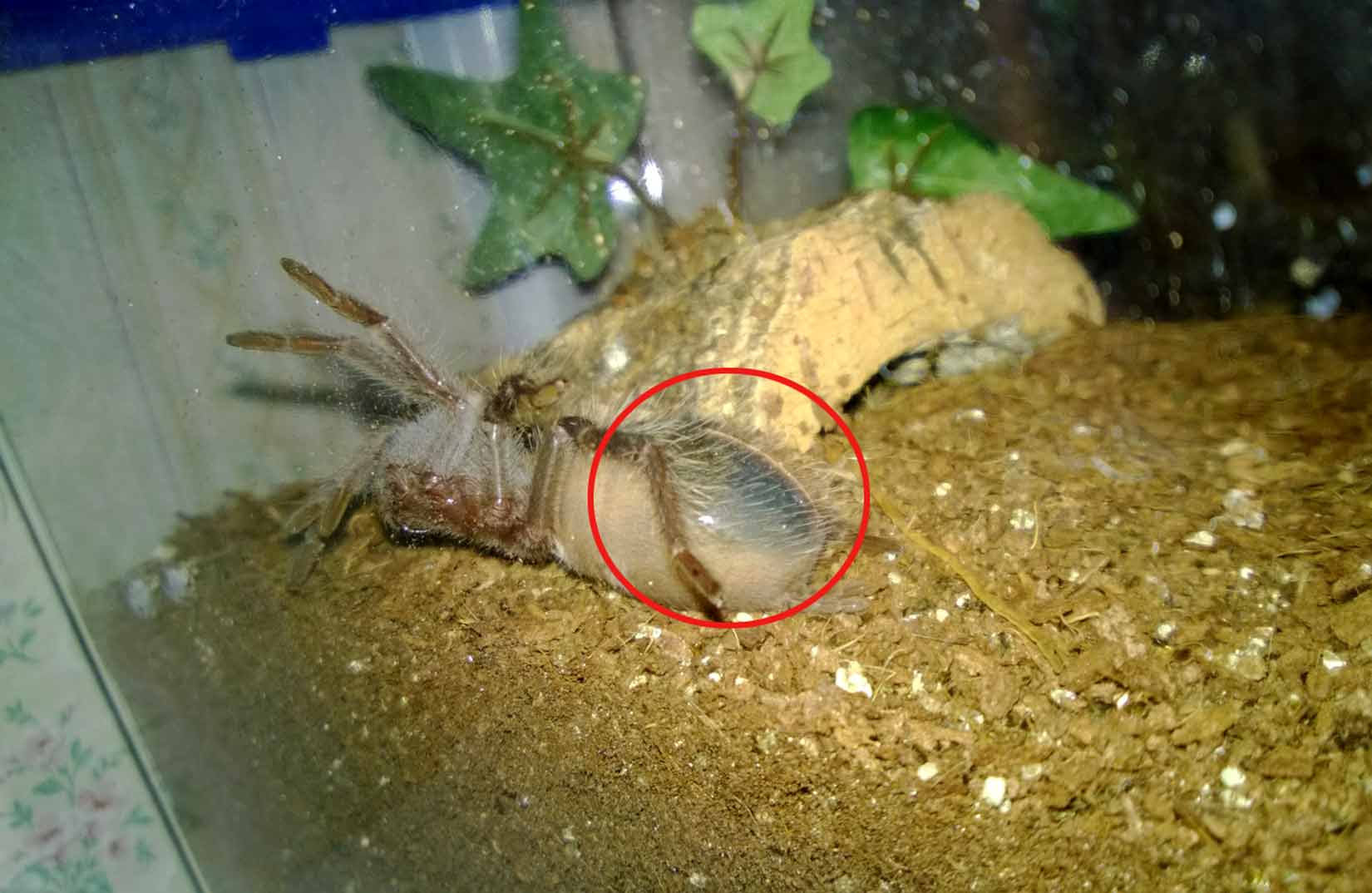
My L. itabunae in premolt. Notice the shiny abdomen and the dark patch forming .
4. The tarantula becomes slower and more lethargic.
Not all of the indicators are physical; an observant keeper should notice some behavioral changes as well. Besides not eating, most of my tarantulas that are in premolt become less active and often more secretive. Keep an eye on your tarantula, and along with the physical signs listed above, look for a change in behavior. Some of my most hyper species become noticeably sluggish when they are in premolt. For example, my GBBs tend to be fast little buggers who are constantly moving around their enclosures. However, when in premolt, they often become much more sedentary, sitting in one spot and often tucking themselves away behind their cork bark. Speaking of secretive…
5. The tarantula has buried itself in its den.
I frequent the Arachnoboards forum, and there is usually at least a post a week by a concerned keeper who wants to know if his/her buried T is okay. Heck, this is the situation that caused me alarm when my LP buried itself during a molt. Many tarantulas will retreat to their burrows and close of the entrances when entering a premolt period. My LP slings, M. balfouri juveniles, and G. pulchripes slings all bury themselves before a molt. Some things to consider if your T buries itself due to premolt.
They are not in danger.
They will not suffocate.
They have not been buried alive.
They do not need to be rescued.
The tarantula is just looking for some privacy and security during this vulnerable period. The tarantula will reopen its den once is has molted and hardened up. DO NOT freak out and try to dig the poor creature out; you only run the risk of distressing the animal and possibly interrupting its molt.
6. The tarantula has constructed a hammock-like web “mat” in its enclosure.
This web is referred to as a “molt mat”, and it is where the tarantula will flip over on its back when it molts. You may catch your premolt T laying layer after layer of web in a small area, and some of the new world species will actually kick hairs on the web as a form of protection. If you see this behavior, it means that your tarantula is about to molt very soon, usually within a day. For arboreal species, they will sometime build elevated “hammocks” off the ground for their molt mats or seal themselves in their funnel webs. This behavior serves the same purpose.

My female LP during a recent molt. Notice the molt mat on the left hand side of the photo.
One more thing to remember for those who have not witnessed a tarantula molt…
IF IT IS ON ITS BACK, IT IS NOT DEAD!
That’s right, this is normal behavior; this is the position they get in to molt.
DO NOT touch a spider in this position.
DO NOT flip over a spider in this position.
DO NOT throw away, flush, or bury a spider in this position.
DO NOT blow on it.
DO NOT spray it with water.
DO leave it alone and let it complete the exhausting task of molting in peace. Molting is a natural occurrence for a tarantula, but it is also a period where they are quite vulnerable. Any fiddling with the animal could prove deadly to the T.
Hopefully, the photos and explanations above will help other keepers recognize and enjoy their tarantulas’ premolt without worry. Keep in mind, there is no set time for how long a tarantula can be in premolt. For slings, it can take anywhere from couple weeks to a month. Adult species can often spend several months in premolt. My 3.5″ B. smithi stopped eating and secluded herself for two months before finally molting. Conversely, my 3.5″ L. parahybana female molted two weeks after her last meal. Don’t panic if your animal takes a while; it’s a very natural process, and it will molt when it is ready.
And, for anyone curious as to what a tarantula molt looks like, please check out the following video.
 Tom's Big Spiders
My chilean rose hair tarantula hasn’t eaten in over 6months and just about has herself burrowed completely in her half log. Someone help me please?
LikeLike
Hi, Zach!
How large is your Chilean Rose? How long have you had her for?
This species is NOTORIOUS for random and long fasts. I have a 5/8″ sling who has fasted twice on me; once for four months and now going on three. Many times, they will stop eating for no apparent reason for months at a time. On a recent message board thread, owners were basically having a competition for how long their G. porteris and G. roseas (Chilean Roses) had gone without eating. The “winner’s” specimen hadn’t eaten for 14 months. This is one of the reasons Rosies aren’t the best beginner T; these fasts really tend to freak out those new to this species (and annoy those who aren’t!).
If you have a moment, check out this thread on Arachnoboards; I think that you’ll find it interesting.
Is her abdomen nice and plump? Are you keeping water available? If so, she is probably okay.
Tom
LikeLike
My G. Porteri hasn’t eaten for a whopping 19 months! It can be a bit frustrating and worrying because I don’t know if there’s something wrong with her. Her abdomen has shrunken slightly during all that time, but it is still a healthy size. She drinks regularly and the last time I offered her a cricket she killed it and left it. I’ve offered her waxworms, crickets, roaches and she won’t touch any of them
LikeLiked by 1 person
Wow…now THAT’S an impressive fast! How large is she? I can only imagine how frustrating that must be; it drives me crazy when my Ts fast.
LikeLike
She’s about 4.5 in, hasn’t moulted for 2.5 years, hasn’t eaten for 19 months. To me, this is not normal yet she doesn’t show any sign of ill health, she’s drinking normally and she comes out of her hide for a wander every now and then, she seems to be happy enough, I don’t get it.
LikeLike
My Grammostola Pulchripes has stop eating so i search “SIGNS OF A TARANTULA IS IN PREMOLT” and I just saw your site and thank you it is just a process of a premolt T THANK YOU TOM I hope you got my message 😀
LikeLike
Hi, Patrick!
I’m so glad you found this helpful. Thanks so much for leaving a comment; I often wonder who is reading these things! 🙂
How old is your G. pulchripes? Just to give you a heads up, this is a species that will often fast for no apparent reason. I had two .5″ slings that stopped eating for about four months this time last year (basically stopped eating when the weather turned cold). Just something to keep in mind for the future!
Again, thanks!
Tom
LikeLike
We sadly lost a b.smithi s’ling during a molt; it did not turn onto its back and never emerged from its skin. It sounds morbid, but if they die during a molt, is it from suffocation? I can’t seem to find an answer online. Thank you 🙂
LikeLike
HI, Cassi.
First off, I’m very sorry to hear about the death of your sling. Unfortunately, the spiderling stage is a very vulnerable one for Ts, and many of them will pass without any clear causes.
The molting process is an exhaustive one, and takes a lot out of even healthy spiders. Upright molts can be particularly dangerous (and can often result in fatalities). An upright molt requires the T to expel extra energy as gravity is not able to assist them. I believe one of the main causes of death for a tarantula during molt is desiccation. T’s pump fluids between the two layers of exoskeleton to loosen it, which leaves them susceptible to dehydration. If the molt doesn’t fully come off, it dries to the T, leaving it exhausted, trapped in an old body, and dehydrated. In these cases, I believe that the tarantula just expires, not from suffocation, but from exhaustion and dehydration.
Gosh…that was long-winded. Sorry! I hope that helps!
Tom
LikeLike
I just got a new T an albo to be precise… Being one of the new world It’s I know about then hair kicking and the rest but I just have one question…. Do tarantulas her stressed out if I bring it to school while it is inside its enclosure???
LikeLike
Hi, Keandre!
Congratulations on your B. albopilosum! They are a wonderful species, and one of the most consistently docile.
What size is your T? Does it have a burrow or hide that it uses? What type of enclosure is she in? Obviously, there is potential for stress, as the T will be moved and likely jostled around a bit in transit. Also, I don’t know what the temperatures are where you live, but if they are as cold as they are here, you’ll want to be extra careful or even wait until they are warmer.
However, that being said, if you are very careful and make sure to minimize stressors (no handling, no more movement than is necessary, no extreme temps), then the T should be fine. This could be a good educational experience for others, and you could really change some attitudes about tarantulas. Albos are great ambassadors!.
I’m actually a teacher by trade, and I’ve often thought about bringing some of my Ts into school as part of a lesson. I do think, if done right, the educational benefits make it worth it. Many folks misunderstand them, and seeing one and hearing about them from someone who keeps them can definitely change some attitudes.
Hope that helps!
Tom
LikeLike
Hi y’all,
my rosea ”arachne” built a hammock web inside of her burrow,while i was searching for the remains of a superworm,i accidentaly damaged it,i had to move her in order to look inside the burrow.Also i handled her,and she flicked hairs on me,i think she was trying to leave urcticating hairs on the hammock web.Basically i made a mess,and she seems pretty upset right now,is there anything i can do for her?
LikeLike
Hello!
Sounds like you have one pretty agitated T right now! 😉
Did you have reason to believe that she was in premolt?
Also, did she eat the superworm or refuse it? Did you crush the head first? I try to avoid disturbing my T burrows at all costs. I would say that a live superworm might make me go poking around (which is why I crush the heads when I use them).
I, personally, don’t handle mine as I feel that that it stresses them out and can put me and the T in danger. I don’t know how often you handle Arachne, but she was likely upset about her burrow being disturbed, which is why you got the old hair flick. If you hold her in the future, be sure to test her temperament first, and don’t try holding her after she has been in a stressful situation.
I’m assuming that she is back in her enclosure now? If so, just let her settle back in. It may take a day or so, but she should calm down. During this time, don’t handle her or try to feed her. Let her have some time to re-acclimate and calm down. Unless you interrupted a molt, she will be fine.
Hope that helps!
Tom
LikeLike
She ate the worm without a doubt,Actually this was the first time she ate since 3 months,her substrate was kinda wet and she was pretty stressed during that time,than i dried the substrate and she did fine.When i was searching for the remains of the food,i was looking for a molt-like remaining like the ones you find in your superworm container.I learned later that tarantulas gather the remains and throw them out of their burrow.Im pretty new to the hobby,and since this is my first T im kinda worriying too much for her.I thought she was molting because of the darkening of the butt and the hammock web.Im gonna leave her alone now,thanks for helping out tom.
LikeLike
Ahh! Yes, if the substrate is too wet, it can definitely stress them out and keep them from eating. Sound like you have it figured out, which is excellent. So glad to hear that it ate.
Yes, many species are actually quite clean and will dump boluses outside of their dens (I have an OBT that will put them in the same corner of her enclosure every time!). Most will also do the same with molts, although I have some that will actually used the old exoskeletons to “decorate” their dens. They are such fascinating creatures. 🙂
And ALL keepers have been where you are and have worried about their animals. Heck, it wasn’t that long ago that I was freaking out because my LP sling buried itself. It’s just part of the hobby. As you keep more species and spend more time observing their patterns and behaviors, you’ll find it much easier to recognize what’s normal and what might be an issue.
All the best,
Tom
LikeLike
Hey pls help I got my spiderling an albo im so scared!!! I don’t know how to water them and it doesn’t eat….and can I feed the worms and cut them in half cause the worms are too big for the sling and what should be the best food for my sling??? Just worried pls help
LikeLike
Sorry for the word can I feed the worms i mean can I feed them worms
LikeLike
Hi, there!
Do you mean like earthworms, or are you talking about meal worms or super worms? All three will work if they are appropriately sized. If they are too big, you can always cut the worm up and offer a smaller piece. They will scavenge feed off of it.
I hope that helps!
Tom
LikeLike
Hi, Damian!
What size is your sling?
It sounds like you are doing the right thing by cutting up the prey into smaller pieces. Are you sure it’s not eating? When you do this, the T will “scavenge feed” meaning it will eventually find the dead item and feed off of it. Sometimes when they do this, they aren’t able to devour the entire chunk.
I use anything from meal worms, crickets, and roaches to feed my slings. If it is a really tiny sling, I will cut the item up and offer it in a manageable piece.
What are you keeping it on for substrate? To water it, dribble a bit of water in the corner of the enclosures. You can also add a bit of sphagnum moss in the enclosure and moisten that once a week. Or, if it’s .75″ or so, you can offer a small water bottle cap full of water as a water bowl.
Please, feel free to ask if you have any other questions!
Tom
LikeLike
What are the signs that she is in pre molt?
LikeLike
Hi, Damian!
Well, I list quite a few of them above, but to give you a few things to look for:
1. It has a large, fat, shiny abdomen.
2. It’s abdomen darkens
3. It stops eating
4. It hides more (some will burrow)
5. It’s activity level slows down
LikeLike
good day hope all is well i have a red rump that finished the molting process but then found him to me it looked like he was eating the old skin is this normal
LikeLike
Hi, Gary.
It actually doesn’t happen often, but it’s “normal”. Some Ts will actually “eat” their old molts as a way to draw moisture out of them. A lot of fluids are lost during the process, and some Ts will try recover some of the moisture from the old molt.
Others will roll up the old molt in the way they might roll a prey item into a bolus in order to get rid of it.
So, no worries … this isn’t totally out of the ordinary and doesn’t mean that anything is wrong with your T. Just make sure that water is available as it may look for a drink.
Hope that helps!
Tom
LikeLike
Hi, i bought a red rump tarantula but it looks like it hasnt been fed in a long time its a sling and im worried about it what should i do to let him gain weight or just get more energy?
LikeLike
Hi, Henco.
I have a few questions for you.
What size is the sling? Do you have a photo of your sling? If so, could you email me at tomsbigspiders@outlook.com ?
If not, no big deal. Is the sling acting slow or lethargic? How fat is its abdomen? Also, have you tried feeding it yet?
If you can get me a bit more information, I would be happy to try to help!
Tom
LikeLike
I had a question i have a sling albo about 1/5″
What should i do to keep her safe.I haven’t even gave him food since she is in pre-molt i just gave her water,M observation is she’s slow, have a black abdomen and a shiny thing on her leg and on his head
and about the temperature approx. how much(btw im from the philippines) how much weeks or months does she in premolt??
LikeLike
Hi, Christian!
She is 1/5″ of an inch? Am I reading that correctly?
Also, is it a Brachypelma albopilosum sling?
If your sling is in premolt (fat, shiny abdomen, refusing food) they all you need to do is keep fresh water available. Because you are in the Philippines, and your humidity is likely very high, I wouldn’t bother spraying it down. If it is a B. albo, they like it fairly dry.
The time a tarantula is in premolt can vary. My smaller slings usually molt every two months or so.
If you’re not sure if it’s in premolt, try offering a small prey item. If it doesn’t eat it, take it back out.
I hope that helps!
Tom
LikeLike
Thank you for the reply Tom big help just like what you said I gave her food then she did ate the whole thing i fed him a small lat but im still confuse if shes in premolt why did she ate her food should i mind making a den for her??
LikeLike
Hi, Christian!
If she ate, then she is probably NOT in premolt. There are some species that will continue to eat right until the molt, Pamphobeteus species comes to mind, but it isn’t common. I would wait a few days and try her again with another prey item. When she finally refuses the prey, she will probably be in premolt.
What does her enclosure look like? Does she have something to hide under? My B. albo dug its own burrow.
Thanks!
Tom
LikeLike
Hey Tom! ‘Just wanted to say, thanks for all the information. I don’t have any questions, not anymore anyway… your replies to the others who’ve needed help are so informative and very friendly and we’re just what I needed. My rosie named Ruby was just doin’ a thing and I wondered, what’s up with that? Haha. She’ll be fine. Anyway, thanks!
LikeLike
Hi, Meghan! Thank YOU so much for the kind words. I’m just glad that folks like yourself are finding this information useful. Makes it all worth while! 🙂
All the best!
Tom
LikeLike
Hello ive got a female lasiodora parahybana juvenile approx 8cm it hasn’t eaten in almost 4 months since ive got it end of December2014 its abdomen was slightly bold still is bold im getting worried ?
LikeLike
Hello, Bilal!
Is that 8 cm body length or DLS (diagonal leg span)?
Also, what are the temperatures in your home?
If she is 8 cm body length, then she’s a big girl, and bigger spiders generally take longer in premolt.
If temps are colder, her metabolism might have slowed down a bit, and she will likely eat again when it warms up.
I have three L. parahybanas, and the only time they refuse food is when they are in premolt. Does her abdomen look nice and fat? If you shine light on it, does it look dark beneath the hair? If so, she might be in premolt. And, if she’s plump, she’s likely healthy and she will eat when she is ready.
Can you get a photo of her?
Hope that helps!
Tom
LikeLike
Hello tom
No not body length leg span 8cm small girl the temperature is quite cold in my house as i live in Lincolnshire but i provide it with nice substrate and a heat mat. It has slightly little 3mm dark patch where i noticed it only today it doesn’t come out of its hide plus she blocks the entrance with substrate i have to remove it to see whats happening. She will never come out of her hide i have to force her so she can explore her home when she is out she will never move just stays in the same spot and ive never seen her go near her dish.. reallt worried. . Sure i can taka a photo no probz where do i post/send it
LikeLike
Hi, Bilal.
Thanks so much for the extra information. The dark patch is normal; they should all have that dark patch. When they are in premolt, you won’t see it as predominantly because the entire abdomen will darken.
You have to try to refrain from digging her up or in any way messing with her den. When tarantulas bury themselves, it’s for a reason. My first L. parahybana sling spent the first eight months of its life deep in a burrow. Often, she would seal it up (I assumed during her premolt period). NEVER force her out or try to make her explore, as this will only serve to stress her and make her even less likely to eat. If she buries herself, just let her be. You have to remember that they are VERY vulnerable in the wild as slings and juveniles, and by staying hidden in burrow, they keep themselves safe from predators. This is natural and normal behavior. Also, even if you supply heat, they often recognize when the seasons have changed, bringing cooler weather. This could also lead to a fast.
She may be hidden now, but if you let her become secure in her own surroundings, she will eat, grow, and soon have no issue being out and about. My sling is now a bold sub-adult who has no problem sitting right out in the open.
What are the temps, if you don’t mind me asking? Be very careful with heat mats, as they can create hot spots that can cause the T to become dehydrated.
Can you send a photo to tomsbigspiders@outlook.com ?
Thanks!
Tom
LikeLike
Hello
Ive had a female L.parahybana from young age she molt a thew time she was brilliant sat out in the open i could tell when she was in premolt from her behaviour but this one strange. I know it will cause strees and discomfort she will be in there for days weeks, i guess this is natural what she will do in reality. What other kind a heat sorce can i use im using a exo terra terrarium which has a thick glass my heat mat is outside by the glass. Honestly i do not have a temperature but it can be quite cold during this season my terrarium is near a radiator so yeah..just sending you the pictures now.
Thanks..
LikeLike
Hi, Bilal!
I have a lot of burrowing species, so I’ve learned to leave them alone when they disappear for a while. I know how difficult it can be, as you are left to wonder sometimes if the spider is okay. You just have to try to keep in mind that the T generally knows best, and this is a very natural occurrence.
Is the heat mat on the side of the terrarium? Is the tarantula able to get away from it if needed? I’m fortunate in that I have all of my Ts in one room, so I can heat the room up as apposed to trying to heat the individual enclosures.
If possible, I would try to get read on the temperature in the terrarium to see if extra heat is needed (or, if the heat mat is throwing too much heat). I know some folks use the heat mats with Ts, but I still find them to be very risky.
Tom
LikeLike
This T has burrowed before i got worried so i ran out of patients but now i know.. yes thw heat mat is on the side as you can see from the second email i sent you.. this heat mat dont release alot of heat very minimal and im pretty sure the T can get away from it.. Just got into the room the T has blocked the entrance up cant believe this what do i do tom
Thanks
LikeLike
If it has blocked its entrance, just leave it be. This is TOTALLY natural behavior that it will outgrow as it gets older and larger. I’ve had three LPs, and two burrowed until they were juveniles. If you dig them up, the only thing you’ll accomplish is disturbing and distressing your pet.
At the moment, I currently have seven Ts who have sealed off their burrows. I learned to recognize that this will happen and requires no action on my end. They will come out when they are ready.
I think that one reason why many of us end up keeping so many tarantulas is because that when one buries itself or stop eating, you just concentrate on the others for a while. It helps keep you from fixating!
Tom
LikeLike
My rose hair has not eaten in two and a half weeks……which you would think its normal…..but the abdomen has shrunk about half the size and is shriveling up. I thought maybe it was dehydrated. So I put her in a smaller very very moist enclosure. She actually got worse. I really want to take her in to make sure everything is normal but don’t ever have time. There is however a bald spot on the very top of the abdomen, but the hair came off a month ago when I decided to pet her. I am very concerned. I also pick her up daily and not just once. I let her roam the carpet in my supervision. I NEED an explanation asap. Please try and give any thoughts on what may be happening. Thank you
LikeLike
Hi, Katie.
Yikes. Could you answer a couple questions for me?
First off, what size is the T?
Second, how long have you had her for?
Has water been available the entire time?
Is there an external heat source?
Usually, an abdomen only shrivels if the T is severely dehydrated or has an injury and is leaking fluid. I’m assuming that there is no sign of injury> She hasn’t fallen, perhaps?
If you could get pics of the T and the enclosure, that would be VERY helpful.
A could things to think about. First off, G. porteri/roseas abhor moist conditions, and a moist enclosure could actually kill one. I know there is a lot of talk about putting sick Ts in a damp “ICU”, but this theory is rapidly falling out of favor with hobbyists. Not only does relocating the T cause extra stress, but humid conditions are actually horrible for species that need an arid environment.
Also, I won’t comment on the petting, but Ts and carpet are NOT a good mix. Their feet can become entangled in the fiber, leading to injury.
If you can answer some of these questions, and get a couple pics, I can probably tell you more.
All the best,
Tom
LikeLike
Thank you so much Tom. One, she is about three to four inches long. Second, I have had her for almost two months. Third, a shallow water dish has always been available. And bout heat I don’t have a heat lamp but read that they could be left at room temperature. She has fallen quite a bit……..from a 3 foot dresser but not recently and she does not land on her back but I think that may be the main reason her adbomin has shrunk due to multiple accidents. Maybe five times it has happened. When I first got her I didn’t know she would climb out also the lid that came with the cage cracked where it locks onto the bottom part so I did leave it open for a couple hours. This is my first tarantula. I feel so clumbsy about it but thought that after she fell she was perfectly fine. Assuming she was acting normal until the past two weeks. I don’t know how to post a picture of her on here so if you could think of other alternatives that would be great. Thank you so much Tom.
LikeLike
Hi, Katie.
Thanks so much for answering my questions. The only reason I asked about heat is that supplementary heat, like heat bulbs, mats, and rocks, can quickly dehydrate a tarantula. You’ve done right be not using one of these.
Oh, dear…that is a VERY high fall for a terrestrial tarantula. In fact, a fall from more than a few INCHES can prove deadly to one, as their abdomens are very fragile and easy to rupture. It’s quite possible that your T injured herself during one of these falls. I’m honestly amazed that she is still alive, as five is just so many times for her to fall…
If she makes it, please keep her inside her enclosure and make sure that her enclosure is secure. Although the temptation is going to be there to handle your pet, you have to keep in mind that they are not “cuddly” creatures that enjoy handling. Many of those in the hobby treat them the same way as you would a goldfish; look, but don’t touch. If you continue to hold and take her out, make sure she is safe.
Don’t be too hard on yourself, as you’re obviously new to the hobby and all of us have made mistakes.
Could you email photos to tomsbigspiders@outlook.com ?
I’ll keep an eye on my email…
All the best!
Tom
LikeLike
Hi there! I was wondering if my G. Rosea is in premolt. I noticed she closed off her entry way and she made a flat circular web that she sits on and she refuses to eat. Also is it ok to feed her water gel??
LikeLike
Hi, Anna!
How large is your G. rosea? Did her abdomen look very plump before she closed off her den?
G. roseas are infamous for fasting, so just because she’s not eating doesn’t necessarily mean that she’s in pre-molt. They will also lay down a web mat for feeding, so that could be what you are seeing, If it is a molting mat, she should molt within 24 hours or so.
I would not use water gels for her; they can drink fine from a water dish. I use fresh water for all of my Ts. If they add chemicals to your tap, you can always use bottled. I honestly don’t even use water gels any more for my feeder insects; fresh fruits and vegetables (potatoes and carrots are particularly good for crickets) work wonderfully.
I hope that helps. Do you have a photo of her? 🙂
Tom
LikeLike
She’s has a very plump behind! I’d like to say she has a Kim Kardashian booty, if you will hahaha. I dropped her a juicy cricket yesterday but she didn’t eat it within the 24 hours so I removed it. However, she did eat the water gel. An employee at Petco told me water gel was the best but I’d rather take advice from you, being as you seem more educated on this topic. She hasn’t ate for about 3 months.
LikeLike
Hahahaha! I have an Aphonopelma schmidti that I call “Nicki” (after Nicki Minaj) because of her huge booty. I love it!
Has she eaten at all since you acquired her? If she’s plump and has closed off her den, then she certainly could be in premolt. Are you positive she’s a female? At 6″ she should be full grown and would be a very old specimen. I have a 6″ G. porteri/rosea who is in her 20s. Just something to think about.
Unfortunately, if you purchased her from Petco, she is probably a wild caught specimen and there is no way to determine her age. They have also been selling other species as “rosies” lately, so they have not been incredibly reliable in what species they are selling.
Could you email some photos to tomsbigspiders@outlook.com ? I would love to check her out!
Be VERY careful of advice you get from Petco (or any local pet store for that matter). Although many folks mean well, they often give inaccurate information about the species they sell and their care. There are tons of horror stories on tarantula keeper message boards about pet stores and their T care and advice. I actually have a care sheet somewhere that I got from a Petco that says to keep G. roseas on damp substrate and to mist them daily. They HATE moisture, and these conditions would cause them great stress and could even kill them. They also tend to try to sell extra stuff you don’t need, like heat lamps, heat rocks, and gels.
If you’re online reading about your species, you’re doing it right. Read up on the folks that keep them for the best information! 🙂
Hope that helps!
Tom
LikeLike
I do have many photos of her, just not sure how to upload it haha
LikeLike
Sorry I’m all over the place but she’s is about 6 inches legs and all
LikeLike
I sent you 3 pictures of her from
My yahoo and my bad I did a re measure and she’s about 3 1/2-4 inches legs and all!
LikeLike
Hi, Anna!
I received them…she’s a beauty! Her abdomen looks quite plump in the photos, and in the last one, it also looks quite dark. It’s quite possible that she is in premolt. If she is, it could be a while before she is ready to actually molt. Just give her some privacy (it’s obvious that you love her, so this will be difficult. :)) and keep fresh water available.
If she’s 3 1/2-4 and a female, you will likely have her for decades. I acquired mine at about 4.5″ in the mid ’90s, and she’s still going strong!
Also, I don’t know if you saw this page, but I did a feature on the G. porteri/rosea that you might be interested in. There is also a link at the bottom of the article to the site of a tarantula expert on them.
https://tomsbigspiders.wordpress.com/2014/07/20/grammastola-porteri-the-rosie-care/
Hope this helps!
Tom
LikeLike
She has not ate since I’ve had her.
LikeLike
Just came home from work and noticed she’s closing her entry way with her web………..
LikeLike
Definitely sounds like premolt behavior. You might get to witness a molt soon! 🙂
LikeLike
That’s exciting if she is in pre molt but then scary haha because then I think “OMG what if her molt isn’t successful and she dies” OMG I’d be so devastated. I haven’t bothered her but I did change the water gel out with some bottled water, just enough to cover the bottom of her bowl. That feature was rather helpful and you have been extremely helpful! Put my anxiety at ease for the most part haha. This is my first time having a tarantula as a pet so I have all these burning questions haha. I have a big ole juicy house spider as a pet but she is way too easy to care for and doesn’t have me raising an eyebrow haha
LikeLike
The good news is, I don’t think it’s common for G. roseas/ G. poteris to have bad molts. Generally, if she made it to that size, she should probably be okay. Although I can certainly understand the worrying (I’d be lying if I said I didn’t STILL worry sometimes when a T is molting), try to remember that it’s a very natural occurrence for them.
If you have any other questions, please don’t hesitate to ask! It wasn’t that long ago that I was in your very position with my G. rosea, so I definitely get it!
All the best!
Tom
LikeLike
I have a B. Vagans. I was very shocked when I looked at the tank and found it empty but holes. Then I realized its in the hole, I don’t know if its alive or what but it didn’t closed its hole, are this a sign of premolt? I’m a beginner though, its my first t. Thank you 🙂
LikeLike
Hello, Lee!
What size is your B. vagans? Has it been eating? When did you acquire it?
I’m sure your guy/gal is just fine. If it’s a sling, they often bury themselves to feel more secure. If it didn’t close the mouth of its den, it might still be eating. If it’s in premolt, it will likely refuse the next prey item you drop in with it. If this is the case, take the feeder out and try again in a week or so.
Before it disappeared into the den, was its abdomen plump and shiny?
Tom
LikeLike
My B. Vagans is 2 inch, and I acquire it just last week. And it buried itself as soon as I put it on its tank. 😦 now I can’t see it
LikeLike
If it buried itself right after you got it, then it might just be making a home for itself. They often hide as slings, and this is its way of making this strange new environment feel more safe and secure.
Have you tried feeding it yet? If you offer it something, and it doesn’t eat, that would be a better indicator.
Learning the rope with your first T can be VERY stressful. However, B. vagans are resilient little guys, so I’m sure your new little one is fine!
Tom
LikeLike
Its abdomen is now shiny but not darker than before? Is it a sign of premolt?
LikeLike
My rose hair named Pretty has webed the entire bottom of her enclosure. She is not showing any signs of a “balding” abdominal area or any swelling in the area. She has not eaten in 4 weeks and is not active at all at this point. I have only had her about a year and I’m still fairly new at the “spider mom” thing. Actually I totally missed her first molt due to being on vacation so I’m a little concerned…could this be pre molt or is could something else be wrong with Pretty?
LikeLike
Hi there, Jessi!
I love the name “Pretty!”
Was she eating well up until this point? What size is she? How long ago did she molt?
She is likely just fine. Rose hairs are notorious for fasting for no apparent reason, and these fasts can last quite some time.
Do you have a photo of her and the webbing?
Tom
LikeLike
Tom
I woke up this morning to find Pretty about half way through shedding her old skin, so I’m less concerned. Its weird though she didn’t show the normal signs of a molt. I didn’t take any pictures of her prior to the molting process but if you like once she is finished I will be happy to share one or two of her.
LikeLike
Hi, Jessi.
That’s fantastic news! Sounds like all that webbing was a molting mat. Sometimes these guys will surprise you with a molt; at least you got to catch some of the process.
I would love to see pics when she’s done. 🙂
Congrats!
Tom
LikeLike
Hey Tom!
My rose hair’s abdomen has grown quite a bit in the last couple of weeks, and is also starting to show a large shiny dark spot on it, which it would seem to indicate she’s in pre-molt. The thing that puzzles me however is that she still eats a ton! I’ll throw a few crickets in there and she’ll eat them all in a couple of hours. Do you think she’s in pre-molt and if so should I not feed her as much?
Also, I’ve only had her about 2 months, and she’s extremely defensive and will posture up if I put my hand near her. Is this also an indication of pre-molt or do I just have an aggressive T?
Thanks!
Matt
LikeLike
Hi, Matt!
What size is your G. rosea?
Do you have a photo of her? Where did you acquire her from?
I only ask, because some folks have been sold defensive “rose hairs” only to later discover that they were instead sold a different species. Just wanted to be sure.
Although G. porteri/roseas (the species referred to as “rose hairs”) have a reputation for being tame and tractable, temperament varies between specimens. Many folks report having “psycho rosies”, or rose hairs that are quite defensive. It’s possible that yours is just a bit more high-strung.
If your spider is still eating, then she is probably NOT in premolt yet. Generally speaking, the majority of species will stop eating while in premolt (I have had members of the Phormictopus and Pamphobeteus genera eat right up to their molts, though). Rose hairs usually stop eating, however.
If you can get me a bit more info, the would be great!
All the best!
Tom
LikeLike
Hey Tom!
The Rosie I have is She’s 3.5 inches diameter. I got her from Twin Cities Reptiles.I have some pictures of her, but not sure where I should send/post them.
Thanks again!
Matt
LikeLike
Hi, Matt!
If you’d like, you can send them to tomsbigspiders@outlook.com .
If she was purchased from a reptile specialty store, she should be the correct species. There have just been several instances of P. cancerides (Haitian Brown) tarantulas being sold as rose hairs. People then get them home and wonder why there new spider is so feisty!
As long as your T has an appetite, you can keep feeding her. She will likely stop eating when she gets ready for premolt.
Hope that helps!
Tom
LikeLike
i don’t know if you remember me!? We talked back in April! My Chilean has finally begin the molting process!!! I found her in her “hammock” on her back earlier!!! I’m excited!!! 😜
LikeLike
Hello, Anna!
Yes, I remember…great to hear from you!
That’s fantastic news. Hopefully, you get to watch the molting process (although, it can be quite lengthy for a T that size). It really is amazing to watch.
Please let me know how it goes!
Tom
LikeLike
It’s been about 7 hours since I found out and she’s about to emerge!!! The only part that’s left in her old molt is her abdomen!! She’s about there! 20 more minutes I’d say, give or take, and she’ll be out. This was most definitely an exhilarating experience to say the least! I am a very happy girl to witness the beauty of a tarantula molting!
LikeLike
That’s just awesome! I’ve seen a few of mine got through the process, and it’s always AMAZING and never loses it’s novelty. Congrats on getting to witness it! You’ll even get a souvenir with the molted exoskeleton. 🙂
LikeLike
I forgot to update you! After I commented last, it took about 40 more minutes to get her old molt off! It was successful! Although after it came off she laid on her back for about 20 minutes and her legs were curling in and I thought it was the infamous “death curl” she would wiggle her little legs here and there, but I was kind of in a hysteria haha but than I looked back up at her and she had already flipped over! I’m soooo happy and happy that it’s over though. Is there anything I can or should do for her after the molt, or just leave her alone?
LikeLike
Oh, boy…I should have warned you about that. Right after molting, they literally go into the “death curl” position. That is totally natural and due to exhaustive molting process.
At this point, just make sure that she has fresh water and let her be. You’ll have fun watching all of the strange poses she’ll strike as her new exoskeleton hardens up. 🙂
Congrats!
Tom
LikeLike
I had just gootten my tarantula about a week and a half ago, I’ve fed him like I should and gave him the enclosure he likes but he won’t lay silk anywear or eat anything. Idk if I’m making him feel uncomfortable or if he doesn’t like his enclosure’s set up. Please tell me if this is him getting ready to molt or if I’m doing something wrong. Oh, and he has a dark spot on the upper part of the abdomen, close to the thorax, idk if that means anything.
LikeLike
Hi, Steven!
What species of tarantula is it? And what size?
Can you get a picture of the T and the setup? If so, you can email me at tomsbigspiders@outlook.com .
All the best!
Tom
LikeLike
I am extremely new to “T keeping” I just got my first specimen 2 days ago, on Friday and its now Sunday. Aphonopelma seemanni. Also known as the Costa Rican Stripe Knee. I did some research on it before getting it, as I do with any new animal I don’t have experience with. But there have been very conflicting caresheets on these spiders. One care sheet said they require high humidity, while another said they prefer dry. There were extreme variations in temp as well. She’s in a 20 gallon terrarrium, with about 4 inches of eco-eartj substrate. I bought heat lamps for the tank, a 75w day light and a 60w red light for night time. I’ve heard then described as obligate burrowers, and she hasn’t even attempted. When I first put her in she “basked” so to speak on top of a log under the day light for a good 3 hours, which struck me as odd because I didn’t read anything about that in any of the guides, and she also hasn’t done it since. She seems to prefer the corners of the tank, in what I feel is a tight position, with part of her body tucked under her front legs. I looked a bit ago and saw her on the wall just above the substrate, but even though she had plenty of space she was still scrunched up tight, minus one of her back legs which was stretched out to the ground. I figured she might be too hot, and so I immediately replaced the 75 and 60 watt bulbs with 40s. The temp dropped from 86f to 81f in about 20 minutes, but she still is not moving much. This caused me to turn the lights completely off. Now the temp has dropped to 78f but she’s still just laying there. This got me really worried. I tickled her with a drumstick (gently of course) and she moved just enough for me to see she wasn’t dead. I don’t know what possessed me to drop her a cricket at that moment, but I did, and surprisingly she took it almost immediately. She does have a flat water dish which I keep full. I’m just confused. You seem to know your stuff so rather than referring to Google care sheets I’ll just ask you
1) most importantly, is my T OK at this moment in time
2) exactly what temperature and humidity is needed for her? Keep in mind I got the lights primarily so I could see her not for excess heat
3) I’ve heard they are obligate burrowers, so why has she not, especially if she is too hot as I suspect. I have a half log in there which other than sunbathing on it that first morning she hasn’t even acknowledged its presence
4) most reptiles won’t eat at all if they are stressed. I’m hoping that’s a sure fire way for me to know everything is fine? She did take the cricket as I mentioned. Is it possible she could still be stressed even though she ate?
5) lastly, I’ve read they are avid escape artists, one gentlemen even put it so eloquently as to say they have Houdini genese. Well, not only has she not escaped, she hasn’t even tried. Aside from that one moment I saw her on the wall with her leg extended, she’s spent a good amount of her time on the ground, in the far back corner between the glass and water dish. I’ve hard too large an enclosure can be stressful on the T, so I put her in the 20 because it was the smallest tank I had. I want to be able to display her, even if she burrows I would still be able to at least point out her entry point. I don’t just want to stick her in a closet. I can email you pictures if that would be helpful
I apologize for the extensive length of my comment but I’m just so freaking worried and I don’t want to kill my T
Sincerely, an extremely concerned T keeper
LikeLike
Hello there!
First off, congrats on your new acquisition. An A. seemanni was the second tarantula I ever kept; it’s a wonderful species. I just love those stripes.
First off, and this is very important: get rid of the lights immediately. Heat lamps or even light bulbs that give off heat are extremely dangerous for tarantulas. Heating lamps cause rapid dehydration and death in tarantulas. Unlike reptiles or snakes, which will bask under the lamp only until it gets too warm (then they move), Ts will often sit beneath them until it’s too late. I actually just read a post on a forum where someone accidentally baked her new G. rosea after leaving under a 45 watt bulb for only a few hours.
There is a very good chance that her basking in the heat of those lamps almost caused her death. Although slings are more at risk from dehydration, adults can quickly become dehydrated from external heat sources (heat mats, rocks, lamps). You showed very good instincts in recognizing that she was likely stressed due to the heat lamps; great call. Too much longer in those high 80s temps with no way to get away from the heat could have been very bad. If you really want a light so you can see her (and keep in mind that most Ts are nocturnal and dislike bright light) try to find something like an LCD that won’t give off heat.
The 20 gallon tank is a bit large for a species this size, so it could take her a bit more time to settle in. Although giving them extra room is by no means wrong, once most Ts settle in, they don’t move around much and the extra space isn’t utilized.
She will climb the glass, and terrestrials are not particularly good at climbing, so she will likely fall. You want to make sure to fill the tank up with enough substrate so that a fall from the top doesn’t lead to an injury. For a 4-5″ spider, you don’t want more than about 6″ or so from the substrate to the top of the container. You also want to make sure that any hard, sharp objects (hides, water dishes, decorations, etc.) are not in the corners or sides of the enclosure where she could fall on them.
In the photo you sent, it looks like she has a hid. If you want to encourage her to take it up, try angling it so that the back is partially buried and the front leaves a little cave-like opening. You can even dig out beneath it to create a bit of a starter den for her. If she wants to burrow, she will likely use this.
Although A. seemanni are recognized as obligate burrowers, many report that that start staying out in the open more as adults. I know that mine was always out and about, and only seemed to retreat to its burrow when startled.
Okay, on to the questions!
1) If you’ve removed the lamps and she has eaten, she is probably okay now. Just make sure that her water bowl stays full and maybe overflow it a bit to give her a damp spot to sit over in the corner. Although it sounds like it could have been a close call, she should be fine.
2) If you try to hit exact temperatures, you’ll only drive yourself crazy and possibly do more harm than good with the spider. The problem with “ideal” temperatures is that we honestly don’t know what temperatures they prefer. When folks put on care sheets that temps run between 66-88 degrees where the Ts come from, that’s a bit misleading. First off, just because they are able to tolerate temps that low or high, doesn’t mean that they are comfortable in them. Also, burrowing species will dig down to where the temps are often much cooler than they are outside the den.
What are the temps in your house right now? A species like A. seemanni will do well in temps between 70 and 80. Right now, I have about 40 different species, and they’re experiencing temps of about 78-80 degrees during the day, and 73-75 during the night. Everyone is eating and molting like crazy. In the winter, they’ll get 74-76 during the day and 70 at night. their eating and growth will slow down a bit, but they all stay healthy.
Unless your house is really hot or really cold right now, room temperature with a little dip at night is likely fine. If you’re interested, I explained this much more in depth here: https://tomsbigspiders.wordpress.com/2015/01/19/humidity-temperature-and-tarantulas/ It addresses much of what you’re experiencing right now.
What is the humidity where you are? The A. seemanni does appreciate a bit more moisture than some other Ts in the genus Aphonopelma, however, it definitely shouldn’t be a major concern. Personally, I would just wet down a third or so of the substrate (this will be easier due to the size of the tank) and let it dry out in between. I don’t spray mine, but instead us a bottle with holes in the cap to simulate rain. I then just moisten down the sub at one end, and let it dry out for several days. You can also use some sphagnum moss around the enclosure and moisten that. The sphagnum will help to hold some moisture in. If you keep a water bowl in the enclosure, and if the humidity where you are is 65% or so, I really wouldn’t worry about it.
In the winter when the furnaces are running (if you are in a region with cold winters) the humidity can drop a great deal. You’ll want to be a bit more careful then to make sure that the water bowl stays full and that there isn’t so much ventilation that inside of the tank dries out as badly as the air outside of the tank. If the top of the tank is a screen, you’ll want to think about blocking some of the ventilation off to keep the humidity up inside the enclosure.
Also, when she inevitably stops eating and goes into premolt, you’ll want to keep thing a bit more moist in there for her to ensure that she has a good molt.
3) I keep several obligate burrowers, and they all take a different amount of time to start digging. I’ve had species dig out elaborate burrows over night, and others who sit on top in full view for weeks before finally getting down to business. Sometimes, it just takes them some time to get settled in their new surroundings and to find the spot that they want to dig in.
That being said, your A. seemanni might decide to stay out in the open, as many older specimens seem to give up the burrowing behavior. If you end up tilting that log and giving her a starter burrow, that may encourage the behavior.
4) Having kept snakes before, I can say that Ts seem to experience “stress” differently than the reptiles. With snakes, I found that if they were stressed, especially after first being rehoused, they often wouldn’t eat. With my Ts, the majority of them will eat immediately after being rehoused (and often after being jostled around in the mail!). I would say that the T eating is still a very good sign, but it could still be “stressed” until it becomes acclimated to it’s new enclosure. When they pull their legs up over their heads, that is one indication that they are not yet secure. I would give her a bit more time to get used to that tank and to act more normally.
5) All tarantulas are fantastic escape artists, and most will come out at night and seemingly search every corner of their enclosure for a way out. They are also much stronger than they appear and can squeeze out of holes that look impossibly small. What do you have for a top for that tank? The wire mesh tops they sell for most aquariums can be problematic as their feet can become caught in the mesh. This can lead to the T dangling or losing a leg.
I think that this about covers it. If you have any other questions, please don’t hesitate to ask.
All the best,
Tom
LikeLike
Man am I glad I found your site! I’ve enjoyed reading all the posts and responses!
So my bf found a T at work – I don’t even know what kind. (Desert area in So Cal). We’ve kept Ranch for over two months now and he’s been a cool pet. He’s burrowes himself for his molt a couple weeks ago. We were worried, thinking it would happen sooner, but after reading your info here, I decided to take him off the kitchen table and put him in the closet until he emerges.
If this was already asked, I apologize for not getting robot yet, but my question tho is, if the wire mesh isn’t ideal (Poor Ranvh has fallen a few times) what kind of top should we use?
Thanks!
LikeLike
Hi, Patty!
I’m so glad that you’re finding some of this stuff useful!
If he found the spider in So Cal, then it’s from the genus Aphonopelma. Is it dark in coloration? Check out pics of Aphonopelma reversum (San Diego Bronze) and Aphonoplema eutylenum (California Ebony). You should find a match for your little guy there.
When he burrowed, did he close off the entrance? Did it stop eating.
Are you keeping him in a glass aquarium/terrarium? A lot of pet stores will sell these with the screen tops to house tarantulas, and in other instances, people just have these on hand and figure they’ll make good T homes. When I first got into the hobby, I kept one of mine in a glass tank with a wire mesh top, and we used to get a good giggle when the spider would climb up and start dangling. We had no idea how dangerous this could be to the spider. It’s honestly not something you think about until you read about some of the mishaps other keepers have experienced.
Unfortunately, glass tanks with wire mesh tops just aren’t ideal for tarantulas, and they currently don’t make tops that would be more appropriate for Ts. Those in the hobby who do use glass tanks usually replace the wire mesh with a sheet of 1/8-3/16″ thick plexiglass, which they modify by drilling dozens of small holes in it. I’ve done this before, and it works quite well. However, you’ll need the tools to cut it to size and drill it, and it can be quite a pain drilling that many holes in plexiglass.
If you go this route, you will also have to find some way to keep this new top on (tarantulas are escape artists, and if it’s not secured, the T could push out of it). If you cut it to fit flush in the top of the tank, you’ll either have to install hinges and something to lock it with, or put something heavy on it to keep it down. Anther possibility would be to use the existing frame of the mesh top you are using, and glue the plexiglass inside of it.
I know…none of these alternatives probably sound like fun!
What size is Ranch at the moment? If she/he is larger, it may just be worth it to pick up a large/x-large critter keeper. Then, just fill it with enough substrate to allow for burrowing and to protect it from a fall. This would eliminate the mesh top and still give you something attractive and transparent to display it in.
Or, another alternative would be to modify a Sterilite plastic container. I use a lot of these, and although they may not be as “professional” looking as a tank, they can still look nice and work very well. For my larger Ts, I use a 27-quart Sterilite container that I get from Target for about $6. It is completely clear, including the top, lockable (with purple clamps!) and very easy to modify. Just drill or melt some holes in the sides and you’re good to go. It’s also deep enough that you could fill it with enough substrate to allow Ranch to burrow.
Again, just a thought.
Wow…this is long-winded! Anyhow, the short answer to your question is keepers that use glass tanks will replace the mesh with plexiglass. Personally, I found it easier just to switch to using other types of enclosures to house mine as it was just easier.
I hope this helps! If you need any other information, or want some links that might be helpful, just say the word. 🙂
Tom
LikeLike
Man am I glad I found your site! I’ve enjoyed reading all the posts and responses!
So my bf found a T at work – I don’t even know what kinD, but after seeing your FB page, it looks EXACTLY like your profile picture) We’ve kept “Ranch” for over two months now and he’s been a cool pet. He’s burrowed himself for his molt a couple weeks ago. We’ve been worried, as we thought it would’ve happened sooner, but after reading your info here, I decided to take him off the kitchen table and put him in the closet until he emerges.
I apologize if this was asked already, I haven’t read ALL the questions yet…but if the wire mesh isn’t ideal (Poor Ranch has fallen a few times) what kind of top should we use?
Thanks!
LikeLike
Hi, Patty!
First off, a hug apology for the delay! I was positive I responded to this post the next day, but as I was scrolling through the comments, I see that there is nothing following it! Ugh!
Could you possibly email me a photo of it at tomsbigspiders@outlook.com ? I would love to see what the species is. How large is the tarantula?
Unfortunately, their little feet can get caught in the screen tops, which is why they are not ideal. The pet stores LOVE to sell this type of enclosure for tarantulas, and it’s just not safe. Or, in some situations folks have these tanks sitting around for other pets, and figured, “hey, this will work great for my T!” I did this years ago myself.
Is he currently in a glass terrarium I’m assuming? I’ve fixed the screen tops by removing the screen and gluing plexiglass in after drilling numerous holes in it. To be honest, though, this was a bit of a pain in the butt, and I don’t think that I’d do it again.
Your best bet might be to look for an inexpensive, but more suitable replacement enclosure for it. There are some Sterilite containers that can be easily altered to make nice homes, or you can look at an acrylic cage (although, they are much more pricey).
Would you be open to switching?
Again SO SORRY for the delay!
Tom
LikeLike
Ha! And now my first post just showed up and I look like I’m crazily answering questions from months ago. Yikes!
LikeLike
Hi, Tom
Recently over the past week my farther has reported to me that my chillie rose trantula (grammostola rosea) has buried its self in its hide as you said in this handy guide to leave it be but unfortunately my farther dug him/her out (i have yet to figure
Out its sex as im waiting for it to molt)
Should i leave it alone now to cause less stress or try to carfully cover its hide back up with the soil its binded
Reply soon anythings helpful
LikeLike
Hi, Jacob.
Whoops. Well, I’m sure your father meant well. He’s certainly not the first person to dig up a buried T.
At this point, it would be best to just leave it alone. If it wants to bury itself again, it likely will. If you mess with it any more at this point, it will only cause it needless stress.
Tom
LikeLike
Hi, tom
4 weeks now since I disturbed the little guy and its since hid it self again. 4 weeks so far is there anything I should look out for during this time
LikeLike
Hi, Jacob.
How large was your G. rosea? Some species take longer than others to molt, so it could be a several weeks before they stop eating and when they finally shed. I have a T. stirmi that spent about three months in premolt recently, just to give you an idea.
Has it sealed off its den? Does it have water available?
Unfortunately, there’s not much to do at this point except wait if it’s in premolt. If it’s just fasting (and G. roseas are NOTORIOUS for this), then you could try offering a cricket and see if it goes for it.
When was the last time it ate?
Tom
.
LikeLike
I came to your site before i got an adult B. Boehmei. I don’t think it is going to molt since it doesn’t have a big, fat, shiny and dark booty nor hiding/burrow :/. I didn’t do anything to it in 20 days until I gave food (any insects) to my boehmei, but it refuses all the food i gave it and it has a water bowl. All what I see my boehmei only dehydrates and often stops moving. Is it nervous, stressed or is just going to molt, even if it doesnt look it is going to molt? I’m just worried about it ) :
LikeLike
Hi, Meepling!
Do you know if your B. boehmei is male or female? Adult male tarantulas are at the end of their life cycles and, after their final molt, they often stop eating as they look for a female to breed with. I don’t know what your boehmei was sold to you as, but this is something to consider.
Have you had him/her for only 20 days? It’s possible that it is not settled in yet. How are you currently keeping it? Do you have any photos? If I could get a look at it and its enclosure, I may be able to help more. If you want, you can send them to me at tomsbigspiders@outlook.com.
What have you been offering it for food? How often have you been offering prey?
If you can answer these questions, I should be able to help more.
All the best,
Tom
LikeLike
1. I don’t know which gender it is, but I think it’s a male.
2. I have it in a month now. I only said “20 days” cause when I got my boehmei and just didn’t do anything in 20 days. I hope you understand it…
3. Crickets, mealworms, grasshoppers, etc.
3.2. I’m feeding it every 3 days, but it’s still refusing its prey.
+ 2 days ago I handled it just a little, putted it down on my bed and when I wanted it back to its enclosure, It ran away and fell about 2 inches from my bed
LikeLike
Thanks for the pics! Your setup looks appropriate, and the spider doesn’t look in bad shape. Unfortunately, the little guy/gal is all tucked up in the photo, so I can’t tell if it’s a male or female or how large its rump is. I will tell you that with that bald spot being nice and pale, he/she is likely not in premolt yet. Once it gets into premolt, you’ll see that spot start to turn darker and darker.
If it IS a male, then there is a possibility that it won’t eat again. Do you have the contact information of the person/vendor you purchased it from? Unfortunately, some folks will try to offload mature males on unsuspecting hobbyists by labeling them as “unsexed.” Hopefully, this isn’t the case.
You’ll want to look at the pedipalps, or the shorter set of appendages inside the first set of walking legs, and see if they have a rounded, clubbed appearance. Basically, they will be shorter and not have the “foot” segment on the end. Some describe them as looking like little boxing gloves. If so, then you likely have a mature male.
A mature male B. boehmei will also have tibial hooks, You would find these on the tibia of the first set of walking legs. If you Google “tarantula tibial hooks”, you will get a good idea of what to look for.
Now, if it’s NOT a male, it’s quite possible that it’s fasting. If this is the case, i would lay off the handling/taking it out of its enclosure for a while and start offering it food once a week. If it doesn’t eat the offered insect within 24 hours, take the bug out, and try again in another week. I wouldn’t handle, move it, or cause it any other stress until it starts eating again.
How are the temps and humidity where you are at? I’ve had some tarantulas key into different environmental cues that tell them that it’s a time to stop eating. If this is a wild-caught specimen, they can be particularly sensitive to these cues.
Is he/she moving around the enclosure at all?
Sorry for more questions, but I’m trying to narrow down the possible causes!
Tom
LikeLike
owh it’s already eating… Just learned something new today. Well… I misunderstood, but thanks…
LikeLike
So glad to hear it’s now eating! Please let me know if you have any other questions. 🙂
LikeLike
Hello, my girls tarantula molted and THEN stopped eating and is now dead. What happened? It was a pink toe. We had cricket in with it and it refused to eat. Help me so this doesn’t happen again!!
LikeLike
Hi there, Bud.
About what size was the pink toe and how long did you have it for? What type of enclosure did you keep it in? Was it kept moist or dry?
Sorry for all of the questions, but if I can get some details, I might be able to help.
Unfortunately, keepers often report their pink toes (Avicularia) dying seemingly without warning or cause. They even coined the term SADS or “Sudden Avic Death Syndrome” as sort of a name for this phenomena. This species seems to be a bit more sensitive to environmental factors than other Ts.
Tom
LikeLike
Hi, I just got my tarantula. I believe it is a juvenile. I am wondering. When should I start to handle it – if ever?
LikeLike
Hi, there!
Congratulations on your acquisition!
What is the length of the T? What species is it?
As for IF you should handle, you might want to check out this article if you haven’t already:
https://tomsbigspiders.wordpress.com/2014/11/26/handling-tarantulas-some-things-to-consider/
It basically covers the the two trains of thought on it.
Let me know the species when you can and we can go from there!
Tom
LikeLike
I have a Brachypelma Smithi, which I know to be a very docile species. I’d also guess it’s length to be legspan 5cm I think…
LikeLike
LOVE the B. smithi … I have a 4.5-5″ female (10.5 cm), and she’s just beautiful.
If you’re going to hold yours, you’ll want to test its temperament first. Mine was VERY skittish when she was smaller, and she wouldn’t tolerate handling. If you try to hold her and she isn’t in the mood or doesn’t seem to cotton to it, she will likely mellow out as she goes through a few molts. Personally, if she seems nervous and bolts around, I would wait to try again.
Let me know how it goes!
Tom
LikeLike
Thank you so much for your advice, I’ll let you know!
LikeLike
Hello,
Amazing job with the blog sir! thank you.
As am I very new to T’s keeping, unfortunately I am also very inpatient, constantly wondering “what is my little b. smithi up to today”. I know I did wrong, poking her with a small paintbrush from time to time especially when I know for sure she is in pre-molt. I was also handling her which again I know is a very stressful thing for them, but they are so damn adorable, couldn’t help it.
Just today she got WAY darker and I know is a process of molting. Anyway for the exact reasons you mentioned in the tutorial above (getting concerned, being new to this) I read and understood that an ICU would help them during molting. I took a small plastic plastic container with holes, put in a paper towel which I did wet, drop a tint of water in a corner so she can have a drink if needed, and placed her there.
Now my question to which I think I know the answer… “Did I overreacted?”. Ofcourse after reading this page now I know I did.
Also the most important question now.
Should I just leave her there and not stress her out further or move her back in her normal container?
I have a small plastic container with a bit of plantation soil from those “exo-terra” guys.
Thank you!
LikeLike
I realized I didn’t mention, she has around 1,5~ cmd legspan
LikeLike
Hi, again!
Okay, that actually helps. For a sling that size, you could always dampen down part of the substrate using an eye dropper.
Tom
LikeLike
Thanks so much for the kind words.
Unfortunately, tarantula keeping is a hobby that requires a lot of patience. I think that one of the reasons many of us amass large collections is so that there is always enough going on that we don’t have to fixate on things like premolt periods and fasts.
I would definitely get her out of the ICU and get her back into her enclosure. If you have a water dish in with her, even just a bottle cap would do, that would be great. If you want to spike the humidity a bit for the molt process, dampen the substrate in one corner leaving the rest dry. The B. smithi does fine in drier conditions, so an ICU could do more harm than good.
What is the humidity where you are at? Has she been kept on dry or moist substrate? How large is she?
Hope that helps!
Tom
LikeLike
Thank you.
I did put her back and used a bottlecap as a hideout for her.
Damped the soil a bit more in a corner also. As far as the drinking water… isn’t she too small? even for a bottlecap?
I’ll figure something out.
Thanks
LikeLike
Hi, Alex.
My apologies; I didn’t see the size of the sling until after I wrote the first post. You can add a little sphagnum moss to a corner and keep that wet. Or, I will sometimes add a plastic leaf from an artificial plant and spray that. The T can then easily drink from that. I usually offer a bottle cap water bowl when they hit about 2 cm.
Hope that helps!
Tom
LikeLike
She molted successfully last night 🙂 big shiny beauty, and very active 😀 im glad that after all the awful stress I put her through everything went well.
Thanks for your advice sir!
LikeLike
So glad that it went well! 🙂 They’re resilient little creatures!
All the best,
Tom
LikeLike
Hi,
I have a question, I have a Chaco golden knee and a Mexican red knee tarantula, one is a sling the other one a juveline.
My is question is: should I use a heat mat, or a heating cable.
I live in the Netherlands so it’s not really hot over here.
Thanks in advance
LikeLike
Hi, there!
What are your average temps there right now? These are two species that do fine in lower temps (19 C or so). Although some folks use heat mats to heat enclosures when the temps are just too low, it can be VERY tricky using them with slings.
Let me know what temps your dealing with, and we can take it from there.
All the best!
Tom
LikeLike
Hi,
Thanks for the quick response.
Daytime temperature is between 14 to 20 degrees Celsius.
Nighttime temperature is between 9 to 13 degrees Celsius
Greetings,
Richard
LikeLike
Hi, Richard.
No problem!
Yikes…are those the temps inside your home or outside? If those are inside temps, you’ll definitely want to think about some type of extra heating.
Some folk use heat mats, but they put them on one side of the enclosure instead of the bottom (to give the T a warm and cool side and to let it escape the heat).
How large are the enclosures for your two Ts? If they are quite small. you would want to consider getting a larger terrarium (like a 5 or 10 gallon glass tank) and mount the mat on one side. Use a thermometer inside the tank to measure a comfortable temperature zone, then put the other enclosures inside this one. You can move the two smaller enclosures to a spot where they wont be too warm. If you go this route, you will also want to get a rheostat (they make several for reptiles) to keep the temps optimal.
Hope this helps!
Tom
LikeLike
Also, it might just be easier to buy a space heater. That’s what I use for mine. There are some nice ones out there that have built in rheostats that allow you to maintain a certain temperature. Just a thought.
LikeLike
Hi,
The sling still has a small one, the juveline quit a big one.
I actually started using a heat cable, grabbed some styrofoam and cut “trails” inside it for the cable, so there is some space left between the heating gable and the enclosure.
The cable gets a maximum of 24 degrees Celsius so I think this should be ok. I usually unplug the cable when the temps go up.
I do have another question about my Chaco, it seems like he likes to be handled, whenever I put my hand inside the enclosure he walks towards it (even when he’s on the other end) and just sits on it. Is this normal for Chaco’s?
Kind regards,
Richard
LikeLike
Hello, Richard.
If you’ve been using the heat cables without incident, then you would probably do best to continue using them. As long as the heat inside the enclosure doesn’t get up too high (and you continue to unplug it on warmer days) it sounds like you’ll be fine.
As for your G. pulchripes (Chaco golden knee), they are considered to be one of the more tractable species. I’m not sure I’ll every be able to fully say that a tarantula “enjoys” handling, as it’s just not really in their nature, but I’ve seen evidence that some are quite inquisitive and tolerant of it. Just be careful to monitor its attitude after molts, as many specimens can change temperaments after a shed. Just something to keep in mind.
Hope that helps!
Tom
LikeLike
I have a juvenile B. smithie for my first Tarantula. This morning I found her having barricaded herself inside her hideout (which I thankfully can see into, since she dug it against the glass of the terrarium). But since her abdomen hasn’t darken (she has had a plate since I got her two weeks ago) and she had eaten just two days ago I wanted to ask whether all the signs of premolt have to manifest themselves or if some can be missing?
(Sry for my english, not my native language 🙂 )
LikeLike
Actually, her abdomen now has turned nice and dark, so lil’ madame should be in premolt 😀
LikeLike
Ahhh, yes…sounds likes she’s getting ready! Glad you were able to spot that!
LikeLike
Hello there.
Your English is fine! 🙂
Sounds like she is probably in premolt. Sometimes, they seal themselves off before you are able to notice physical signs of an upcoming molt. For example, you might not notice the abdomen darkening, but your T could still be preparing to molt.
I really wouldn’t worry!
Hope that helps,
Tom
LikeLike
Little update:
She is starting to put down her mat, so she should be ready any time now. Is there anything I could do to help her (of course, without disturbing her)?
LikeLike
If she’s putting down a molting mat, she should be shedding in less than 24 hours. Nothing to do at this point but to enjoy the show. 🙂
Let me know how it goes!
Tom
LikeLike
Hi, as you seem to know what you’re talking about. Could I please as your advice.
I’m really worried about my tarantula.
I got it almost a month ago and it still hasn’t eaten. Is that worrying? What can I do?
It is also hiding a lot and not coming out of it’s hide. This is normal right? And I should just leave it.
A bit of background info:
Species: B. smithi
Leg length: One leg approx. 1-1.5cm. (So it is a baby)
Hasn’t molted with me yet.
Any help would be much appreciated.
Thanks!
LikeLike
Hi, there.
First off, thanks so much for the background info; that’s very helpful.
I currently have a B. smithi sling and a B. auratum sling, and both are the same size as yours. Neither has eaten in about 2 months. Unfortunately, Brachypelmas are slow-growing species that are known to fast on occasion, so that behavior isn’t particularly abnormal. I’ve had the B. auratum for about 9 months, and it has molted twice in that time and eats on occasion.
What are the temperatures in your home? Is it cooler?
Unfortunately, there isn’t much you can do except make sure there is a damp corner of substrate in case it wants a drink.
Are you feeding live prey? If so, you may want to try killing a cricket or offering a piece of meal worm to see if it will scavenge feed. A lot of slings that size will be easily startled by live food, and this trick can help get them to eat.
Let me know, and I’ll try to help further!
Tom
LikeLike
Thank you so much! I will try to kill the meal worms or fly larvae that I have and see if it will eat it, as I did notice it seemed to move away from the food. You asked about temperature, and well I live in Scotland so from 8-14 degrees Celsius (outside) in September. is that too cold? For a T this size do I not use a small lid for water then? (Do I just use a damp corner instead?)
Thanks again
LikeLike
No problem! I feed most of my tiny slings this way, as I’ve seen too many of them get spooked by the prey insects. This way, they can come and feed as much as they want (and many will get quite a big meal in one sitting). I just leave the item in overnight, and look to see if it was moved or eaten in the morning.
If the temperature inside your home is 18 C or lower where its enclosure is, your T may think that it’s the colder winter months and fast. This T is fine in lower temps, but I’ve noticed that will really slow down their eating.
You could use a very small lid for a bowl if you want (like the ones on water bottles); just don’t fill it all the way up. Or, you can just moisten the substrate or put some moist sphagnum moss in a corner.
LikeLike
I’m not sure if my tarantula is dead or is just molting. How do I tell?
LikeLike
Hi, there!
Is it on it’s back or standing up? If it’s standing up, are it’s legs curled beneath it?
Tom
LikeLike
Hello!
I have had my tarantula (Avic. Avic) for about 3 months. S/he eats regularily (1-2 large crickets a week) and lives in an 8 x 8 x 12 Nano Tall Exo Terra Tank. I use eco earth as substrate, and have fresh water available at all times in a dish. I have fake flowers/branches in as welI. I do not use any overhead lighting or any heat mats. It is always around the low to mid 70s. I do not mist the tank. I think I am doing everything right. S/he has not molted while I have owned her. S/he is about 3 inches long (including legs).
My only concern is that s/he has not made any kind of webbing… ever. All day just sits on the side of the terrarium. If I open it to see her, s/he is very shy and tends to just pull all of her legs in to try to appear small and unnoticed. If I do try to hold her she gets very frightened and jumps away. I was thinking that it was unusual for her/him to not make a web for privacy, especially to avoid ME (haha) being as s/he does not like to be handled. Should I be worried? Will s/he ever make a web?
Any advice would be appreciated! Thank you in advance!!!
LikeLike
Hello there!
First off, thanks so much for your detailed description of your set up! My first question is usually, “what is your set up like?” 🙂
Personally, it sounds to me like you’ve done everything right. It is a larger specimen, and it has only been three months, so there will likely be some webbing in the future.I found that as Avics grow larger, they tend to web less. My Avicularia metallica has been in her enclosure for close to two years, and there isn’t really an abundance of webbing.
Do you have any cork bark in the enclosure with the plants? For my arboreals, I’ll take a cork bark flat and lean it at an angle against the side of the enclosure, I then put the plants/vines around it.It usually gives them a nice, private corner to hide in if they are so inclined.
I would refrain from the handling for a bit until you’re certain that it is settled in, especially if it seems a bit skittish. It’s possible that the disruptions are causing it to feel insecure in its surroundings.It can take a T several months to truly adapt to and settle down in its new enclosure. Just a thought.
Also, although this species is usually described as docile and open to handling, keep in mind that the attitudes of individual specimens may vary. Some of these guys just won’t tolerate it. However, they sometimes mellow as they mature, so it may calm down as it get older.
As long as she is eating, that’s great; I really wouldn’t worry at all. I would try to stay hands-off for a bit and see if she webs. If not, she may just not be a heavy webber.
Hope that helps!
Tom
LikeLike
Thanks so much it has web little piece on top and stays in corner ,just bought my rose hair ,is she molting
LikeLike
Hi, Simona.
She could just be settling in and getting used to her enclosure. Can you answer a few questions for me?
When did you get her? Does the webbing look like a hammock? Is her abdomen fat? Has she eaten for you yet?
Tom
LikeLike
My juvenile red knee that i got on oct 16th had a meal on the 16th and on the 17th has hidden away and burrowed itself in its hide. It’s been 15 days and counting so far. Slightly concerned but being patient is the best way forward with this right?
LikeLike
Hi, Ashley.
The short answer to your question is a big YES. 🙂 Patience is always the key with tarantulas. When one buries itself, it’s usually due to an impending molt and it’s the spider’s way of putting up the “do not disturb” sign. In the wild, they would be protecting themselves during this vulnerable time.
What size is she? Did she look nice and plump before she secreted herself away? Has she refused food?
If she buried herself for pre-molt/molt, she could be in her den for several weeks. Generally speaking, the larger the specimen, the longer the pre-molt period. Just be sure to provide fresh water and, if you’re worried that she might be hungry, you could drop a cricket in overnight and remove it in the morning if it’s not gone.
Hope that helps,
Tom
LikeLike
Hey there! I noticed my fellow T-owners are asking you very interesting questions, and I thought I’d join!
My lovely GBB lady is refusing food (flag one of premolt), doesn’t come out of her burrow (flag two) and has put a very thick, white web over the entrance (flag 3).
Now, all would be good and well but she appears to be very active inside her cocoon, ie walking around all the time.
Ia this normal?
Thanks in advance, great article, by the way!
LikeLike
Hello, Alex!
Welcome to the discussion! 🙂 What size is your your lady?
It definitely sounds to me like premolt behavior, even with the activity inside the burrow. They are normally a more active species, so they can be a bit antsy right up until the molt. This was one species I always had trouble immediately recognizing premolt as they don’t always slow down like other species (now if I pay attention, I can usually recognize their slightly more sedentary behavior).
Generally speaking, if a GBB refuses food, it’s in premolt. These guys are voracious feeders!
Hope this helps!
Tom
LikeLike
Tom, thank you for the very quick reply! I’d say she’s in her sub-adult stage, the adult colours are there, but she’s not reached her full size yet. And like you said, eventhough she seems to be quite active, she’s not her usual hothead self running around everywhere.
Yes, tell me about it, they eat and eat and eat! Those guys are even more enthousiastic feeders than my mantids!
Thank you, once again, great blog!
LikeLike
Ha! Yup, that sounds like them. 🙂 Usually their premolt “sluggishness” is subtle.
You’re most welcome…and thanks so much!
Tom
LikeLike
Hi all, im new ay spiders, I just want to know why you must remove food thatss left from sling
LikeLike
Hi, there!
If you leave a cricket/insect in with a tarantula that’s molting, the cricket can harm or kill the tarantula while it’s in this vulnerable state. I was JUST reading about a keeper who accidentally left a cricket in with sling that was molting, and he found the sling half eaten the next day. Even if the tarantula isn’t molting yet, the prey items can become an annoyance. So, the best thing to do is remove any prey items after day if the T doesn’t eat them.
Hope that helps!
Tom
LikeLike
hi why my sling (T’s Fireleg pre-molt) have sweat afterthe 2nd day buried itself ?
LikeLike
Hello, Sir Kim!
I think something got lost in translation! What did you mean by “sweat”?
It’s very normal for tarantulas to bury themselves during premolt, so I wouldn’t worry.
If I didn’t answer the question correctly, please let me know!
Tom
LikeLike
Hello Tom, my T collection has increased and your jornal has ben of extreme importance to us!
Excellent job done here, very useful information as Always! evey time i have a doubt i came to here.
Tks, best wishes!
LikeLike
Rafael!
Great to hear from you! What tarantulas have you added to your collection? How many do you have now?
Again, thanks so much!
Tom
LikeLike
My rose hair tarantula is moving her legs like crazy help
LikeLike
Hi, Rebekah.
Oh, dear…is it moving like the tarantula in the video below?
Tom
LikeLike
Hey I have a little baby Brazilian black who just disappeared on me. She had a couple tunnels but sealed them off after a day of being down there. I think I disturbed it slightly this morning but have left it alone since, how long should I expect it to be under there before I worry. Also, do I continue misting the substrate while its down there? I would imagine so. I’ve never cared for one this small and it’s quite worrisome.
LikeLike
What size is the sling? Has it been eating okay? When they bury themselves, it’s usually a sign of premolt (or, in some instances, a fast). Both would be completely normal behavior. I wouldn’t mist, but I would pour a little water in one side to give it a moist spot.
Smaller slings usually molt more frequently, although the G. pulchra is a slow-growing species. It should reappear in a couple weeks or so.
LikeLike
I also just realized another thing deeply concerning me. I put a TINY little cricket in there to feed and shortly after the burrow was closed off and I couldn’t find the damn cricket. Is my spiderling going to be ok?? I don’t want to dig for the cricket for the risk of stressing the little thing but I don’t want it to be harmed.
LikeLike
Yes, definitely avoid digging for the cricket. If it got in the hole, the spider either ate it or killed it.Your T should be fine. 🙂
LikeLike
Hello! I’m a novice keeper from the Philippines! I got my B. Boehmei as a birthday gift, it is 2.5″ and the previous owner said that it is on pre molt because it has stopped eating for a month or 2 now. And it’s my first time to handle a situation tho I have an H. Formosus about an inch now and it has molted several times and they were all successful 🙂 but I’m new to keeping a big one (her closure is a deliware with a size of 7×5 and substrate of 1″) Any tips? Do’s and don’ts? Thank you so much! I find your page very helpful and I want to have a piece of advice from you. Hope you’ll reply! 🙂
LikeLiked by 1 person
Hi, there! First off, congratulations on your new B. boehmei; they are a gorgeous species, and very slow growing, so you will have it for a long time! Do you have a water dish in with it? If it’s in premolt, it may appreciate a bit more humidity. Of course, if you are in the Philippines, chances are your local humidity will be high enough. I have a 4.5″ B. Boehmei female, and she does well on mostly dry substrate with a water dish and hide (which she sometimes uses). I’ll overflow the water dish during the winter to give her a moist corner only because when the heat goes on during the winter, the air gets very dry. The size enclosure you’re using and the depth of substrate sounds fine; I would just make sure she has a hide. She may want to use it when she molts. I hope that helps! Let me know if you have any other questions! – Tom
LikeLike
Thank you for the respose! Yes I placed a water dish in the corner. OMG I’m really not sure if she’s on pre molt, mind if I send you a photo of her? Maybe you want to take a look and examine her body. Thanks!
LikeLike
You’re most welcome! Of course…please, send me a photo. Do you have my email address?
LikeLike
Hi Tom,
I added a B. Emilia sling (1.5″) to my collection a couple of weeks ago now and it hasn’t eaten since I have housed it. It is constantly sitting on the walls/near the roof of the square deli container it is in.
I use peat moss, coco fibre and vervumilite substrate mix for its housing. The temperature between 21-26C and humidity between 50-60%.
I have only seen similar behavior once when I first got a G porteri and I puther in her housing before peat moss had dried out fully. Even then the G. porteri was always moving and new little one is sitting still up high in the corners of enclosure.
I’m a bit baffled and thought I’d ask you.
Any help would be greatly appreciated.
Thanks.
Scott
LikeLike
Hi, Scott.
My first question was going to be “how moist is the substrate?” 🙂 Like you observed with your G. porteri (I did the same thing with mine many years ago), some tarantulas will hang up top if the substrate is too moist. In this instance, I would moisten a corner of the enclosure for it, give it a small bottle cap water dish, and leave the rest a bit dry. That way, it will have a choice. A 1.5″ sling would be less prone to dehydrating, and this species does live on savannas and in scrubland, so you don’t want to keep it too moist.
That said, I’ve had MANY species of Ts spend their first couple weeks in a corner, even if the substrate and setup were fine. It can take spiders a little while to acclimate to their new surroundings, and many will act uncharacteristically until they settle in. I actually just bought two P. muticus (King Baboon) juveniles, which is a burrowing species. Although one quickly burrowed down to the bottom, the other hung up in the corner of the enclosure for a couple weeks. So, that’s something to keep in mind as well.
I would start with giving it a dry spot and perhaps a hide if it doesn’t have one. If the sub is only partially dry, it might just take a little more to get it to settle in.
Keep me updated!
Tom
LikeLiked by 1 person
Thanks for quick reply!
I checked the substrate earlier and was dry 😊
I live in Scotland and winters here are very cold. I keep my T’s in small a room in my apartment and keep the tempratures stable for most of my Ts by using 2 moonlight bulbs. I only use them at during winter. I only use them to keep the room at 21-24c them far away from the enclosures as to not ruin humidity levels and make my Ts bask for too long and dehydrate.
I put the little Brachy on a lower shelf in a colder part of the room and it came down from the top corner of the tub after a while and had a roam about. Seems like it might have been uncomfortable with the heat? I didnt think that would be an issue because when it was hanging from roof she was in an area that was at 21.8 and I thought that was the low end for a Brachy already.
The hide is a great idea! With the others I didnt bother until they we quite a bit bigger. I will make it a new hide tomorrow as i haven’t made one yet. Hopefully once thats done and I’ve put it in, the lil guy will get burrowing and make a home of it and get some food eaten. 😁😁😁
Thanks again!
LikeLike
You’re most welcome! Okay, sorry about that; I wasn’t sure if the sub was dry or not. I think I know what the issue is. Were the moonlight bulbs ABOVE the tank? Tarantulas can sense heat sources pretty well, and it was quite possible that your little one was moving to a spot that put it as close to the bulbs as possible. Like you said, they’ll try to bask when the opportunity presents itself, so that COULD be what’s going on. Of course, if the light wasn’t in that direction, I could be completely wrong. 🙂
I tend to give everything a hide now. Some use it; some don’t. Still, you never can tell, so I just err on the side of caution!
All the best!
Tom
LikeLike
I meant to add. I do use cosmetic spray bottle to gentle mist one corner of the deli tub so only one corner is damp. I do this with all my slings and then as the grow I move them on to bottle lids then water dishes.
Scott
LikeLike
I do pretty much the same thing! 🙂
LikeLike
Hi I have a metallica spiderling that has just stopped feeding and it hasn’t moved for 5/6 days now it has gone black on the head part and it’s black on the abdomen with a white mark I’m a novice at this due too it’s my first spider ohh and it’s legs are stretched out and it’s upright can u give me any info on what is happening plz tia
LikeLike
Can you please send me a photo at tomsbigspiders@outlook.com ? Has it moved at all in the last six days?
A picture would help immensely!
LikeLike
Hey Tom, it’s me again! So my GBB hasn’t been eating for over a month now after her molt. She just sits around in her burrow and doesn’t react to prey at all. Simply walks past them. Having the same problem with my p. metallica aswell. Very weird since they usually are like that ghost from Ghostbusters that would eat anything and everything.
What do you think?
GBB is mature
Gooty is like 1 molt away from being an adult
LikeLike
I’ve just discovered that my A. Genic hates the substrate when he’s in pre-moult. When I first got him he was in pre-moult and I couldn’t understand why he spent the first 2 months stuck to the side of the enclosure, I tried dampening the substrate, drying it out, I even changed it completely but he wouldn’t go anywhere near it. Then he moulted and everything was ok after that, he seemed quite happy to sit on the substrate all the time. Now I’ve noticed the last few weeks he’s stuck on the side of the enclosure again and avoiding the substrate completely. Perhaps their body becomes really sensitive and the substrate is too rough? I dunno.
LikeLike
What do you have him on for substrate? That is some truly odd yet interesting behavior! Usually once they settle in, they have no problem sitting on the sub.
LikeLike
He’s on coco fibre and vermiculite. It is odd behaviour and I’ve never read elsewhere that this is a sign of pre-moult, but it definitely is because he’s refusing food as well now and normally he would all eat day every day if I let him. He’s got a damp end and a dry end and two pieces of bark, but he’ll only sit on the side of the glass or on the bark, he won’t go anywhere near the substrate, yet he’s been quite happy to sit on it for the last 6 months since his last moult.
LikeLike