H. villosella Death – Tarantula Impaction?

Not the way I wanted to begin my Friday evening.

For the past several weeks, I have been keeping an eye on my Heterothele villosella (Tanzanian Chestnut Baboon) sling, as its behavior after a recent molt had become abnormal. I had received this wonderful little tarantula as a freebie several months back, and it immediately impressed me with its vicious appetite and beautiful webbing. Like many of my Ts, this one would only refuse food while in premolt.

My H. villosella, alive and well, after a recent molt. Despite only eating twice, its abdomen was still remarkably plump.

My H. villosella, alive and well, after a recent molt. Despite only eating twice, its abdomen was still remarkably plump.

Well, after this specimen refused a meal about two months ago, I assumed it was in premolt. Sure enough, it emerged after a week of hiding a little bit larger and sporting fresh colors. As this particular sling was usually ravenous after a molt, I offered it a small cricket, which it took no problem. Another cricket was offered a few days later with similar results. She was back to eating well.

I dropped the third cricket in about two weeks after she emerged from her last molt, and I was surprised to find the cricket alive and kicking the next morning.

Hmmm…

I waited a few more days before offering another cricket. This, too, was rejected. Now, I’ve had many tarantulas change their eating habits after a recent molt, so I wasn’t particularly concerned yet. I made sure to wet down part of the substrate in the enclosure to keep the humidity up, and waited another week to try again. Again, no dice. Despite being a great eater in the past, this T had inexplicably stopped eating, and during the warm months of summer when even my most picky specimens were ravenous.

More odd behavior.

About three weeks ago, my H. villosella started spending a lot of time out in the open. For the first six months I had this spider, I rarely saw it out of its heavily-webbed den, and when I did, it was usually in the early morning after I turned the lights on.  The slightest bump would send it scurrying back inside its burrow.

However, this T was now out all the time and wouldn’t flee even when I picked up its enclosure. In many ways, I found this new behavior more alarming than its lack of appetite. I was pleased, however, to see that despite having only eaten twice, its abdomen was actually fairly plump.

I also noticed this T dragging its abdomen on the ground and on the side of the enclosure. I first thought that it was just webbing, but there didn’t seem to be any webbing coming out of it. The H. villosella was also using its back legs to rub its rear, something that didn’t seem particularly worrisome by itself, but proved concerning when added to the other odd behaviors.

With little I could do, I kept sprinkled water on the side of the enclosure daily to give it something to drink and kept it under close observation. It continued to hang out in the open, and this once speedy little spider was much more sluggish and calm.

Unfortunately, it wasn’t able to recover.

When I arrived home from work yesterday, I was saddened to find the little guy in a partial death curl. As a precaution (it is sometimes difficult to determine if they are truly dead), I put it into an ICU to see if it might be “revived”. While moving the T, I noticed something I hadn’t seen before. The area around its anus was caked with bit of white stool. Also, there was a white “plug” partially protruding from it.

My H. villosella sling in an ICU. Unfortunately, it did not make it.

My H. villosella sling in an ICU. Unfortunately, it did not make it.

Suddenly, it seemed more clear as to what probably happened to this unfortunate T. I had read about other keepers losing tarantulas to fecal impactions, but I had never experienced it myself. An impaction occurs when the Ts anus becomes blocked, prohibiting it from evacuating its waste.

In some of these instances, the T will essentially eat itself to death as the waste compounds inside it until it dies. In some instances, the animal stops eating after a molt, yet it’s abdomen remains large and bloated. In this instance, it’s suspected that a complication with the molt causes the issue. Other symptoms reported are sluggishness and unusual grooming of its backside, especially around the anus.

When a tarantula is showing signs of a fecal impaction, there is little a keeper can do. Some recommend using a paper towel or cotton swab moistened with warm water to try to wipe away and loosen up any feces that may be blocking the anus. In my case, I don’t know if this would have worked due to the very small size of the specimen.

I checked on the T this morning to see if its condition had improved over night, but it was in the same position it had been in the night before. Unfortunately, it had passed. Can I be positive that it was a fecal impaction that killed it. No. However, I have made no changes in husbandry in the last six months, and it had been healthy and seemingly thriving until its last molt, so I’m convinced it wasn’t something I did. It also displayed many of the common symptoms of an impaction, which lend more credence to the theory.

A dead H. villosella sling. Notice the white around the anus, and the yellowish spot that formed beneath the corpse (likely feces loosened by the moist towel.

A dead H. villosella sling. Notice the white around the anus, and the yellowish spot that formed beneath the corpse (likely feces loosened by the moist towel).

For those who may fear that they have a tarantula suffering from this malady, I will list the symptoms my T exhibit in hopes that it helps in identification.

Symptoms that indicated fecal compaction:

  • Diminished appetite (food refusal)
  • Plump, hard abdomen (even after not eating much)
  • Dragging abdomen and rubbing it on substrate without laying web
  • Excessive grooming of anus area with back legs
  • Sluggishness and decreased activity
  • White “plug” protruding from anus
  • White stool around anus


NE Herp – A Review

NE Herp

Although my T. stirmi enclosure has been holding at proper humidity with no pest or mold issues, I’ve been planning on adding isopods or springtails to help clean up any waste and to keep the tank mold free. While searching the net for dealers who carry these amazing insects, I stumbled upon NE Herp. Although I visited the site with the sole intention of procuring maintenance insects, I discovered that they carried so much more.

An amazing one-stop shop for all of your vivarium needs.

I first thought that NE Herp only carried invertebrates like D. Hydei fruit fly cultures, Springtails, and Dwarf Isopods, and it was quite by accident that I navigated to a page that presented the store’s ridiculously diverse selection of vivarium products. Water dishes, cork bark, bamboo, moss, hides, lights, enclosures, substrates…I could go on for pages. Keepers of frogs, lizards, snakes, tarantulas, or other invertebrates would be wise to check out the site.

I was elated to discover that they carry bamboo and cork bark at ridiculously low prices. Since entering the hobby, I’ve always been floored by the high cost of cork bark, and I’m constantly on the lookout for someone who sells this material for a reasonable price. NE Herp not only offers larger pieces for great prices, but they also sell a gallon-sized grab bag filled with medium to small pieces. At $7.99 (on sale for $5.99), this is an absolute STEAL.

Great packing and fast shipping!

My order was packed and shipped very quickly via Fed Ex, and it arrived on my doorstep a day later (NE Herp is just across the state from me, so the shipping time was extra fast). My order was very well packed, and NE Herp even included a cold pack to keep my springtails from baking in the hot temps. All of my items were heavily padded with packing paper and arrived in pristine condition.

The bag of cork bark proved an amazing value. I was elated to find that I contained curved and flat pieces ranging from 3 to 7″. As I like to include corkbark hides in most of my enclosures, the accumulated cost of buying this material can become costly. However, for about $6, I now have enough for at least a dozen cages.

My box from NE Herp.

My box from NE Herp.

The well-packed contents of my package.

The well-packed contents of my package.

My new cork bark, bamboo, plastic plants, and springtails from NE Herp.

My new cork bark, bamboo, plastic plants, and springtails from NE Herp.

I highly recommend NE Herp to any hobbyist.

I have already spent several hours on this site window shopping and putting together my wishlist for my next order. The amount of products they carry is staggering, and I’m still finding new things to add to my list. I will definitely be placing a second order soon. NE Herp carries an amazing selection of vivarium supplies, and their quick and reasonable shipping make ordering from them a very satisfying experience. I highly recommend them to any tarantula, snake, reptile, or frog keepers who are looking for reasonably-priced supplies for their enclosures.


Phlogius crassipes (Australian Barking Spider)

 A tarantula from down under!

My 2.5" P. crassipes sling.

My 2.5″ P. crassipes sling.

Anyone who grew up watching Steve Irwin, AKA ‘The Crocodile Hunter”, knows that Australia is home to some of the most stunning and awe-inspiring wildlife on the planet. Heck, I still own the carpet python I bought after seeing him handle (and get bit!) by one. When I stumbled across my first photo of a species of tarantula from Phlogius genus, and discovered that it was from Australia, I knew that I would eventually keep one.

With a common name of “Eastern Tarantula”  or the more colorful variations of “Queensland Whistling Spider” or “Australian Barking Spider”, this thick-legged Old World species can reach lengths of 8 inches. It earned the name “whistling” or “barking” spider because this species stridulates, or uses hairs on its body to produce a loud “hissing” sound when it’s agitated. And for those who don’t heed this warning, its large fangs can deliver a potent bite.

Deep, moist substrate = happy spider!

I purchased a 1.5″ sling from Anastasia at Net-Bug back in April of this year, and it has quickly become one of my favorite species. So far, my P. crassipes has been a fast-growing species, molting twice in my care and putting on about an inch in size. As a sling, it started off as a chocolate brown color, although as an adult it will be mature into a smoky dark brown/black coloration.

In Australia, this species lives in deep, moist burrows and enjoys a higher-humidity environment. Keeping that in mind, I gave my sling an enclosure with four inches of moist substrate so that it could create its own burrow. I set the enclosure up in much the same way I do with all of my moisture-dependent species. After laying a half inch of wet vermiculite on the bottom, I then packed down a mixture of peat moss and coco fiber with some vermiculite added for water retention and percolation. I don’t add too much vermiculite as it can make the soil difficult to pack for the burrowing species.

The soil should be moist, but not wet. A good test is to squeeze your mixture in your hand. If you can squeeze water out of it, it’s too moist. However, if it sticks together and holds its shape without water dripping from it, it’s just right.

The enclosure itself is a modified plastic Sterilite storage container. I keep a water bowl in the enclosure at all times, and I will re-moisten the substrate once a week. I do not spray, but rather use a clean water bottle with holes melted in the top to “make it rain”, so to speak. I also allow water to dribble down into the burrow. This keeps the lower levels of his den moist, and keeps the humidity in the enclosure up as it slowly evaporates.

The custom enclosure for my P. crassipes sling.

The custom enclosure for my P. crassipes sling.

For temperatures, my P. crassipes is kept between 72 and 78º. Although I’ve read reports of people keeping them at higher temperatures (mid-80s is mentioned quite a bit), I’ve found that mine has been thriving with more moderate highs and lows.

A lightning-fast eating machine!

Within a day, my P. crassipes had dug a burrow all the way down to the bottom of the enclosure with two different entrances. It then created a “volcano” shaped structure over the top of the substrate and webbed around this. He likes to sit at the top of this construct with his legs just poking out as he waits for prey. As soon as a prey item hits the substrate, he tenses up and prepares to hunt.

This species has proven to be a fantastic eater. It receives 2-3 medium crickets a week, and so far it has yet to refuse a meal.  When I once dropped in a large cricket, this amazing little predator had no problem snatching it up. Speaking of snatching up prey…

These guys are FAST.

Besides more specific moisture requirements and an Old World bite potency, keepers need to be aware of this species’ speed. I’ve been dazzled on a couple occasions by just how fast my little guy can move. I once watched him bolt out of his “volcano”, snatch up a cricket, and retreat back into his den in a blink of an eye.

The footage below was meant to be a feeding video, but he unfortunately didn’t snag the cricket here. Still, it serves as a wonderful example of just how quickly they can move. So far, my sling is more skittish than defensive, although this could change at any time. With his speed, this T could easily bolt out of his enclosure if I’m not careful.

A fantastic tarantula for those who like thick, sleek, fast species.

The P. crassipes’ potent bite, skittish and sometimes defensive nature, and tremendous speed mean that this guy probably isn’t for the novice keeper. Those use to keeping slower, more docile species might find the crassipes a bit overwhelming. However, any keeper experienced with faster Old World Ts would likely find the P. crassipes to be an amazing and rewarding animal to keep.

T. Stirmi Custom Enclosure (In Progress)

The magic of trial an error.

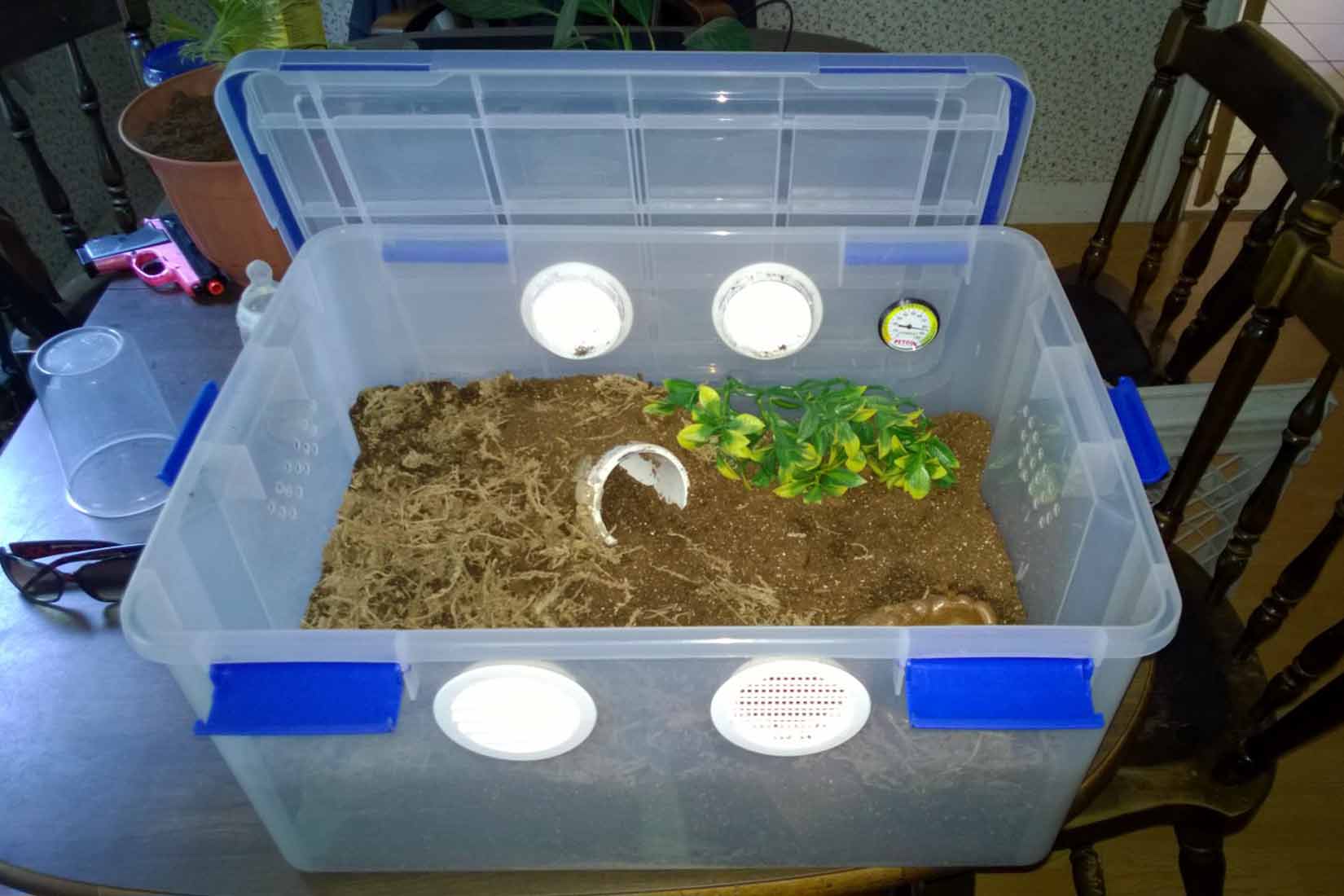
With a 4-5″ Theraposa strimi (Burgundy Bird Eater) on the way, I needed to create a custom cage that would allow me to maintain proper conditions for this animal, namely the higher humidity requirements. I’ve experimented with many smaller setups, and have had good luck maintaining the right balance of airflow circulation and humidity for my moisture-loving species.

However, this enclosure would need to be a much larger. Plus, as Theraphosa require moist soil and consistently higher humidity levels, I needed to make sure that whatever I came up with was working out before my new T arrived.

It’s been about a week since I put it together and, with some experimentation and “revisions”, it is now working great. Waiting to have the T ship until I finished proved to be an incredibly prudent move, as this cage soon became a work in progress. For those interested, here is what I did:

The Materials

I started with a Ziploc 60-Quart Large Watertight Storage Box, which I purchased at Walmart for about $17. This container is quite spacious (23″L x 17″ W x 11″ T) and has six locking clasps around the edges. Nothing will be able to squeeze under the lid of this one. The lid also has a foam gasket in it to prevent precious moisture from escaping. This will make an excellent home until my T gains some more size.

Ziploc 60-qt Storage Bin Modified.

Ziploc 60-qt Storage Bin Modified.

For the initial venting, I used four 3″ white circular plastic vents that I had purchased from roundvents.com for $1.32 each. Using a 3″ hole saw and my power drill, I cut two holes on each of the long sides of the container  (Note: if you don’t have a hole saw, you can trace the vents, then use a regular bit to drill a series of holes all round the edge. Then, using a sharp utility knife, just make cuts and connect the holes).  I then glued the vents in place using Aquarium Silicone. To promote cross-ventilation, I positioned the vents on opposite sides of the enclosure.

Ziploc 60-Quart plastic storage bin with two 3" plastic vents installed on each side.

Ziploc 60-Quart plastic storage bin with two 3″ plastic vents installed on each side.

As the T. blondi will need to kept in moist soil, and I will have to add water from time to time to keep the humidity up, I experimented with soils a bit before coming up with the formula I used. I combined Scotts organic topsoil ($2.10) with organic peat moss ($9.99) mixed at about a 60/40 ratio. To this mixture, I then added several cups of vermiculite ($3.99) to help with water retention and percolation. (Note: As the topsoil comes in .75 cubic feet bags, and the peat moss comes in a huge 3 cubic foot bag, there is plenty of substrate left over for other enclosures).

I added water to this mixture until it was damp enough that it would hold its shape when squeezed, but not so wet that water would run out of it. After adding about 1/2″ of moist vermiculite on the bottom of the enclosure to hold moisture, I packed down about 5-6″ of my substrate mixture on top of it.

For a hide, I purchased a 3″ PVC elbow from Lowes for about $2.76. I wanted something that wouldn’t decompose or mold in the moist soil, hence why I didn’t use cork bark. I turned the elbow on its side, angling one end up for the entrance and pointing the other end toward the substrate. I then buried this, making sure that there was a bit of a hide, but leaving some dirt in it for the T to clear. The T. stirmi can now continue to enlarge his burrow by digging through the submerged end.

3" diameter white PVC elbow hide.

3″ diameter white PVC elbow hide.

Finally, I added a large plastic water dish which I had  on hand, as well as some long-fiber organic sphagnum moss to help with moisture retention. I also mounted a humidity gauge on the side of the enclosure to give me a rough estimate of what the humidity was inside.

With all of this done, I closed up the new enclosure and set it on the shelf for two days to see if it would maintain the correct level of humidity without spawning mold. I was looking to maintain a humidty level between 70 and 80% at about a 75º temperature.

Back to the drawing board.

During this trial run, the humidity in my home was around 75%, and the humidity inside the enclosure was steady at about 88%. When I opened it up after about two days, I immediately detected the slightest smell of mold or mildew. A closer inspection revealed that there was some light molding around the long-grain sphagnum moss. I removed the moss and left the cover off of the enclosure for a day to let some excess moisture evaporate. I later added a much thinner coat of moistened moss.

Obviously, the four vents I had installed wouldn’t be enough to allow for proper ventilation. Time for adjustments…

Using a 5/16″ drill bit, I drilled about 10 holes in the ends opposite where I installed the vents. I was hoping these would supply much needed cross-ventilation and prevent the humidity from remaining so high that mold and mildew occurred.

With these changes made, I closed up the enclosure and left it to sit another day.

Revision three

After about 24 hours, I took the cage out again. During this period, the humidity inside the cage was lower but still in the mid 80s. This wasn’t bad, but if the humidity in my home went up, so would the humidity in the enclosure, leading to levels that would promote mold growth.

This time I added about 15 more holes on each side and sealed it up again to see if this would lower the humidity even further. So far, so good! The humidity is holding right around 78% (the humidity in my home is around 64%)

Holes drilled for extra ventilation during the humid summer months.

Holes drilled for extra ventilation during the humid summer months.

As the humidity levels here can hit 80%, I may drill a few more holes in preparation for those really humid days. In the winter, our furnace dries out the air causing the humidity to plummet to the high teens. When this happens, I will use plastic and tape to cover up some of the holes to restrict some of the airflow and to prevent the cage from drying out.

Preparation and planning was key.

Had I tried to put this cage together without allowing myself time to experiment, this could have been a nightmare. I can’t even imagine trying to clean out the cage and make alterations while a 5″ T. stirmi was lurking inside. As humidity levels can vary depending on time of year and location, I would advise anyone setting up an enclosure for one of the moisture-dependent species to allow themselves some time to monitor levels and to make adjustments as needed. I have two more days before this beauty arrives, so I will continue to keep an eye on the humidity and make more changes as needed.

To be continued…


Chromatopelma cyaneopubescens (GBB) Care

This can’t be a real tarantula…

When I first began researching what type of tarantulas I might get to start my collection, I encountered a photo of a spider so colorful and beautiful, that I was at first convinced that it was a clever Photoshop creation. With its shimmering blue legs, metallic aqua carapace, and stunningly vibrant orange abdomen, this animal looked too striking to be real. A quick search revealed this amazing specimen to be the Chromatopelma cyaneopubscens, common name Greenbottle Blue or GBB for short.

C. cyaneopubscens

Immediately interested, I began researching the GBB to learn care requirements, temperament, and cost. Surely this unique tarantula commanded high prices like the equally beautiful P. metallica? Or, being new to the hobby, would I be overwhelmed by this spider’s temperament or husbandry requirements? I was delighted to learn that, despite being a bit skittish and faster than many recommended “beginner species”, the GBB’s heartiness and ease of care made it approachable for someone relatively new to the hobby. And with .75″ slings costing around $35-$40, they were definitely affordable.

Home Sweet Home

GBBs originate from an arid, tropical desert region in Venezuela, where they live in heavily-webbed burrows under local foliage. When researching, I discovered many older accounts by keepers who said that GBBs were a fragile species that was difficult to keep alive in captivity. For years, many kept this spider in moist enclosures with damp substrate and constant misting. As GBBs hail from an arid region, these wet, stuffy enclosures often proved fatal. GBBs should be kept on dry substrate in well-ventilated enclosures. As slings are more vulnerable to dehydration, you can moisten the edge of the enclosure and a corner of the substrate once a week (Do not spray; several drops from an eyedropper will suffice). For juveniles an adults, a water dish will provide any water they may need. You can also dribble water on the webbing at night before bed so that the spider can come out and have a drink.

Although slings may dig a bit, most GBBs will construct elaborately-webbed dens using any supplied cork bark hides or furnishings for anchors. Although this species has been referred to as a semi-arboreal, this not true— this is a terrestrial species. However, if provided with an enclosure with some height and taller furnishings (cork bark, vines, plants, etc), many GBBs will web up these and choose to perch themselves above the ground. The two juveniles I keep are often in their webs just an inch or two above the substrate.

My young adult female's enclosure. Notice the copious amounts of webbing.

My young adult female’s enclosure. Notice the copious amounts of webbing.

Some keepers see this behavior as a sign that this is an arboreal species, when instead it’s likely an animal making the best of the surroundings it has been provided.  As a terrestrial species, a fall from too high up could injure this T, and care has to be taken to insure that distance between the substrate and the top of the enclosure is not too high. This species should not be set up as an arboreal due to their skittishness and increased chance of injury from a fall. That said, giving them a bit of extra height above the substrate will allow the spider to web up a bit.

My two juvenile GBBs are kept on dry coco fiber substrate with cork bark slabs and water dishes provided. They do not use the cork bark as hides, but instead as anchors for their copious webbing. Even as slings, these two liked to fill their enclosures with thick layers of web. Despite the webbing, both usually sit right out in the open, remaining highly visible and making for fantastic display animals.

Like most of my Ts, my GBB is kept at normal room temperatures. During the summer months, temps range from the low 70s at night to low 80s during the day. In winter, it’s low 70s at night, mid 70s during the day. They seem to eat well all year round, unlike other species I keep that slow down during the winter.

My 2.75

My 2.75″ GBB

Beautiful and deadly…to crickets.

Part of a GBB’s hardiness comes from its excellent prey response and appetite. My two GBBs are, by far, two of my most vicious hunters. Because of the extensive webbing, they generally feel the vibration of the cricket or roach the moment it is dropped into the enclosure. I’ve had several instances when a cricket was snatched up the second it hit the substrate. They are fast and deadly, tackling and subduing prey items ferociously and efficiently. Out of all the species I keep, the GBB is in my top three of Ts I most enjoy watching hunt.

When slings, I would feed my specimens one small cricket every three or four days. As juveniles, I offered one medium/large cricket twice a week. The only time either has ever refused a meal is when in pre-molt. Their growth rate was medium to fast, with frequent molts bringing moderate changes in size. During its first year with me, my oldest GBB molted six times and in that time it went from .75″ to 2.75″. Molts usually came about every two months during this period.

As young adults, their molt schedules slowed down to about once every four months or so. Behaviorally, the young adults are a bit more skittish and prone to kicking hair at the slightest disturbance. Now that they are both around 4″, I feed them two large crickets once a week.

GBB-full-new

Young adult female C. cyaneopubscens (GBB)

A good “beginner species”?

The GBB’s hardiness, ease of care, and affordability might make one think that it’s a great starter species, and in some respect that is true.  However, this is a tarantula with some speed that also has a reputation for being skittish. I have never seen a threat posture or any type of defensive display from my specimens, and they have never been aggressive. As adults, however, they do like to kick hairs and will eventually bolt if disturbed. A keeper used to slower, calmer species may not be ready for a spider that may be out of its cage in the time it takes them to blink. Rehousings can be particularly fun, as the GBB is prone to bolting unpredictably in any direction BUT the one you want it to go in. That being said, a keeper new to the hobby who practices caution and care should have little problem with this beautiful species.

Poecilotheria Regalis (Indian Ornamental)

The Poecilotheria regalis originates from India, hence its common name of “Indian Ornamental”, and it is probably the most commonly kept of the Poecilotheria genus of tarantulas. This is an arboreal species that, in its natural habitat, lives in tall trees where it catches flying insects as its prey. In captivity, they are a hearty and gorgeous display tarantula for any keeper experienced with fast arboreal species.

My 3" juvenile P. regalis male.

My 3″ juvenile P. regalis male.

A word of caution…

Although the regalis is recognized as being one of the “calmer” members of this genus, it is still blindingly fast and possesses “medically significant” venom. This is not an animal to be trifled with or underestimated. I have seen my juveniles run several laps around their enclosures in blink of an eye. This is definitely an animal that can move faster than human reflexes can react.

In the case of  the P. regalis, when disturbed it would much rather hide  or escape than attack. Their fractile-like patterns serve as amazingly-effective camouflage, so standing still can likely help them to avoid detection in the wild. When approaching any of my Poecilotheria for feeding or maintenance , I tap the enclosures a couple times until I see them either hunker down or scramble to a hiding spot. This hopefully prevents me from spooking or surprising the Ts, which could cause them to bolt frantically around the cage (or, even worse, onto me).

Keeping my guy comfy (while keeping my fingers safe).

To reduce the risk of bite, I keep my P. regalis juvenile in a Sterilite Large Nesting Showoff plastic storage bin modified with cross-ventilation holes for airflow. The container is a bit larger than what I would normally use for a specimen this size, but I like to give myself plenty of room to work when feeding or performing maintenance on my large, fast arboreals.

The enclosure is deep as well as long, as this species requires more height than floor space. I provide it with a cork bark slab, which is put at about a 45 degree angle, as well as some plastic plants and rocks for hiding places. A water bowl is also supplied.

With a max diagonal leg span of 7″, the P. regalis is a good-sized T. This guy will likely end up in a 5-10 gallon-sized enclosure as an adult. Again, I will use something that gives me plenty of room to work for when it comes time for cleaning or maintenance.

Custom enclosure set up for my 3" P. regalis juvenile male.

Custom enclosure set up for my 3″ P. regalis juvenile male.

For substrate, my P. regalis is kept on a coco fiber/peat moss combination with moist sphagnum moss placed around the base of the cork bark to provide extra moisture.  I also moisten the substrate a couple times a week; this coupled with the water dish keeps the humidity inside the enclosure at an sufficient level. I do not obsess over exact humidity levels, and so far my Ts have been doing just fine. This species does, however, benefit from higher humidity. For temperatures, my P. regalis is kept at low 70s to mid 80s.

A fast-growing arboreal with a great feeding response.

My P. regalis has demonstrated a fast growth rate. They are good eaters, and it’s quite amazing to watch them hunt a prey item. I give my 3″ juvenile two medium/large crickets a week. This species seems to have little trouble taking down larger prey items. I procured this particular tarantula in February, and at that time it was about 2″ long. It has molted twice since then, and it’s now 3.25″ long.  I also have smaller P. regalis that I purchased as a 1.25″ sling in January. After three molts, it is now 2.5″.

This is the modified Ziploc plastic container I use to house my 2.5" P. regalis juvenile. He will likely get rehoused after his next molt.

This is the modified Ziploc plastic container I use to house my 2.5″ P. regalis juvenile. He will likely get rehoused after his next molt.

With its beautiful coloration and patterns, impressive size, and slender and athletic build, the P. regalis makes a stunning addition to any tarantula collection. As they are very prevalent in the hobby, the slings are quite inexpensive, running anywhere from $20 to $30, and a juvenile female can usually be purchased for under $100. That being said, this is a large, fast tarantula with very potent venom and not generally a species recommended for inexperienced keepers.

For more information on this wonderful species, visit arachnoboards and search key words P. regalis!

Grammastola porteri (The “Rosie”) Care

The “vanilla” of the tarantula hobby.

Anyone who has read my bio or some of my posts knows that the first tarantula I ever acquired was my female Grammastola porteri (Common name, “Chilean Rose” or “Rosie”). Back in 1996, my future wife and I had just moved into our first apartment together, and I was was assembling a menagerie of pets I wasn’t allowed to have when I lived at home. After purchasing several snakes and a ferret, I decided it was time to fulfill a life-long dream and finally get a tarantula. Unfortunately, it was illegal for pet stores to sell tarantulas, so I took to the local classifieds to find a T. Little did I know that I was about to buy what would eventually become my longest-living pet.

My G. porteri (Chilean Rose) about a year ago.

My G. porteri (Chilean Rose) about a year ago.

18 years later, and “The Queen”, as we affectionately refer to her, is still going strong. When I acquired her, she was close to adult size at about 4.5″ or so, and she has molted four times while  in my care. As Grammastolas are notoriously slow growers, and my female was a wild-caught specimen, we estimate that she was anywhere from 5 to 10 years old when I acquired her, meaning she is now in her 20s. Her last molt was back in 2008, and she is now a full 6″ DLS (diagonal leg span). Experts on this species estimate that, with the correct care, females could be expected to live 30+ years.

Two color forms…or two species?

For years, G. porteri and G. rosea have been staples in the tarantula hobby due to their ease of care, availability, and reputation for being particularly docile. Although this is still subject of debate, the tarantula referred to as the “Chilean Rose” is actually listed as two different species by The World Spider Catalog. For years, they have been labeled as different color forms of the same species, with G. porteri usually being referred to as NCF (normal color form) and G. rosea being called RCF (red color form). The G. porteri, the species I keep, is more of gray brown coloration with a pinkish/maroon sheen on its carapace, and the rosea is known for it more red/pink tones.  However, color may not be the best way to tell these species apart, and suspected cross-breeding has likely rendered differentiation an even more muddled affair.

Just add water…and crickets!

Care for this species is very simple, and they prove to be quite hardy in captivity. I keep mine in a 5-gallon acrylic enclosure on bone dry coco fiber substrate. I supply a cork bark hide and a water bowl; this is one of the few Ts that I keep I have actually witnessed drinking. My G. porteri is a wonderful hunter, and has a great food response. I feed her 3-5 large crickets a month, easing off a bit during the winter months. Although this doesn’t sound like much, she has a plump abdomen and is in wonderful shape.

There are no special temperature requirements, as this species will do well at room temperature. Basic rule of thumb; if you’re comfortable, then your G. porteri will be fine. Temps in my tarantula room are high 60s to mid 70s in the winter, and mid 70s to low 80s in the summer. This is a species from an arid environment, so there is no need to mist or moisten the substrate. A water bowl will provide all of the moisture it will need.

Sorry, but I’m just not hungry this year.

“Rosies” are notorious for fasting. Doing a quick search on the arachnoboards forum will yield dozens of threads about G. roseas and G. porteris NOT eating for long periods of time. This is normal behavior and nothing to be concerned about. I’m very fortunate in that my G. porteri has never fasted. I do, however, have a G. rosea sling, who stopped eating for most of the winter, a period of about four months. Some report their G. porteris/roseas have fasted for over a year.

Watch those fingers…

These two species have a reputation for being very docile and handle-able, and they are therefore recommended as “beginner Ts” to those entering the hobby. Although I agree that they are great beginner tarantulas due to their ease of husbandry, this species’ temperament can be VERY unpredictable. Stories of “Psycho Rosies” can be found on any tarantula message board, and more than one keeper has been bit trying to hold his “docile” pet rock.

As with any species, temperment varies from animal to animal, and care should always be exercised when performing cage maintenance or rehousings. Although my G. porteri appears very laid back, she has a great feeding response and will charge at any disturbance in her enclosure.

Pet rock? Maybe. Beautiful T? Yes.

As more colorful and active species have been introduced into the hobby, the “Rosie” has developed a negative reputation for being a blah “pet rock.” The life of a G. porteri is mostly a sedentary one, and mine will often spend days in the same exact spot. Even when I relocated her enclosure to get a good photo, she didn’t move. They also get a bad rap for basically being the quintessential “big brown hairy spider” that everyone usually pictures when one says “tarantula.”

However, most owners of these species enjoy that their T is always visible, making it great for display, and appreciate its more easy-going temperament. Also, although I find that mine will spend long periods just sitting, it’s an event when she does get the urge to moving around and explore. Despite only being gray/brown in basic coloration, she is still a handsome tarantula and more than just a giant brown spider. Leg striping and a gorgeous pink/maroon sheen on her carapace add a touch of beauty to this species.

Notice the coloration on the carapace.

Notice the coloration on the carapace.

Although I’ve gotten into much faster and aggressive old world tarantulas, and I enjoy some of the large and feisty South American species, I will always love the G. porteri/rosea species. The ease of care, availability, and generally docile temperaments make it a wonderful beginner tarantula as long as the new owner is patient with long fasts. Even for experienced keepers, the “Chilean Rose” makes a wonderful addition to the collection.

For an amazingly comprehensive article and care sheet for this species from an expert in tarantula care, Stan Schwartz, CLICK HERE.

Monocentropus balfouri Husbandry

A cream and blue beauty!

When folks try to tell me that there there is no such thing as a “beautiful tarantula”, I have a few go-to species that I will immediately Google. Besides the P. metallica and C. cyaneopubescens, I also pull up photos of the tarantula featured in this blog, the M. balfouri. These gorgeous spiders sport creamy tan bodies, metallic blue/silver carapaces, and blue legs, and are a stunning representation of just how striking blue coloration on a T can be.

My female M. balfouri, now a young adult.

My female M. balfouri, now a young adult.

This gorgeous spider comes from a group of islands off the coast of Africa of which Socotra is the largest, hence its common name of Socotra Island Blue Baboon. Although they’ve become much more established in the hobby, they are still in demand, commanding premium prices. I got my juveniles for $60 each as part of a newsletter promotion. Expect to pay up to $100 for the same size elsewhere. I’ve seen females of this species selling for $300, so this can be a pricey pet.

This 2" juvenile is starting to show some of its blue coloration. I'm hoping to see more blue on the legs after its next molt.

This 2″ juvenile is starting to show some of its blue coloration. I’m hoping to see more blue on the legs after its next molt.

M. balfouri care

I housed my three 1,75″ juveniles in medium (5″ x 6″h x 8″l) critter keepers with about four inches of bone dry cocofiber substrate. I provided all three with small water bowls, which they usually fill up with dirt or web over. This species will burrow, creating a maze of underground tunnels with several entrances. They are also prolific webbers, and all three of mine have laid down a thick, silky carpet over much the substrate. As  this species comes from a semi-desert environment, I do not mist the enclosure or moisten the substrate; the water bowl is sufficient.

Now that my female is about 3.75″ DLS, she will be getting a rehousing very soon. The next transfer will likely be the final one, and she will be getting a 3-4 gallon Sterilite enclosure with about 6″ of substrate (60/40 mix of dry top soil and peat).

A top down view of an M. balfouri's enclosure. Notice the thick webbing.

A top down view of an M. balfouri’s enclosure. Notice the thick webbing.

The growth rate for my M. balfouris has been medium, with all three molting five times in my care over a 19-month period. Between molts, they picked up around .25 – .5″ of size or so. During their first two winters, when temps in my tarantula room were mid 70s during the day and dropped to low 70s at night, they mostly stayed in their tunnels as they fasted for a few months. During these periods, I rarely saw any of them, and I would drop a small cricket in once every two weeks and remove it if it wasn’t eaten by the next morning.

When the temps warm up (low 80s during the day, high 70s at night), and their metabolisms are more active and they eat great. I have noticed that they seem to prefer smaller prey, and I was feeding two small crickets or meal worms twice a week when they were juveniles. Now that they are sub-adults, they get two medium crickets a week. They refuse food when they are in premolt or during the slightly colder and drier winter months. During this time, they retreat to their tunnels and surface when the molt process has been completed or when the weather has warmed up.

Too much reading? Check out my husbandry video below!

This species is generally recognized for having a calmer, less defensive temperament, which could make it a good starter Old World species. Although they are more shy and reclusive than many their baboon cousins, they can still, in theory, deliver quite a bite.  Mine generally bolt into one of their many tunnel entrances at the slightest disturbance, and not one has shown any defensiveness. However, that can always change with age, and temperament differs from specimen to specimen. Always use care when working with old world species.

Although I’ve read of instances where this species can become a “pet hole”, spending the majority of its time in its den, mine are are actually visible quite often. Usually late afternoon, I can look forward to my three juveniles creeping out of their dens to sit on the surface for a while. They only seem to stay submerged when in promolt or during the colder winter months.

This juvenile is showing some of the gorgeous blue on its legs after a recent molt.

This juvenile is showing some of the gorgeous blue on its legs after a recent molt.

Although I’ve yet to try to breed any of my tarantulas, the M. balfouri is high on my list when I do. Unlike most other Ts, M. balfouri mothers will actually nurture their spiderlings, killing prey and dragging it into the den to feed them. A search of balfouri breeding and parenting will bring up some fascinating stories about M. balfouri mothering, and most breeders have more success when they leave the sacs in with the mother. It doesn’t get much cooler than that.

Those looking for a gorgeous old world tarantula with beautiful coloration and relatively simple husbandry requirements should look no further than the M. balfouri. Their calmer temperaments also make them a good, if pricey, introduction species for those new to old worlds.